
In my research on minimally invasive surgical robots, I have focused on addressing a critical safety issue: the inconsistent grip force output of different surgical instruments when controlled by the same master manipulator at identical opening and closing angles. This variability can compromise procedural safety and efficacy, particularly during delicate tasks like suturing. To tackle this, I developed a comprehensive mathematical model to predict and analyze the grip force of the surgical instrument’s end effector. This model incorporates nonlinear friction between steel cables and guide pulleys, motion coupling between the finger and wrist joints, and creep deformation of cables on pulleys—factors often overlooked in simplified approaches. My goal was to establish a precise mapping between motor current and end effector grip force, enabling safer and more reliable force control in robotic surgery.
The end effector is the terminal component of the surgical instrument that directly interacts with tissue or tools, such as suture needles. Its performance hinges on accurate force transmission through a cable-driven system. In my design, the end effector features multiple degrees of freedom, including wrist pitch and finger articulation, all actuated by motors via steel cables routed through guide pulleys. Understanding the dynamics of this system is essential for ensuring that the end effector delivers consistent and adequate grip force across various instruments and operational scenarios.
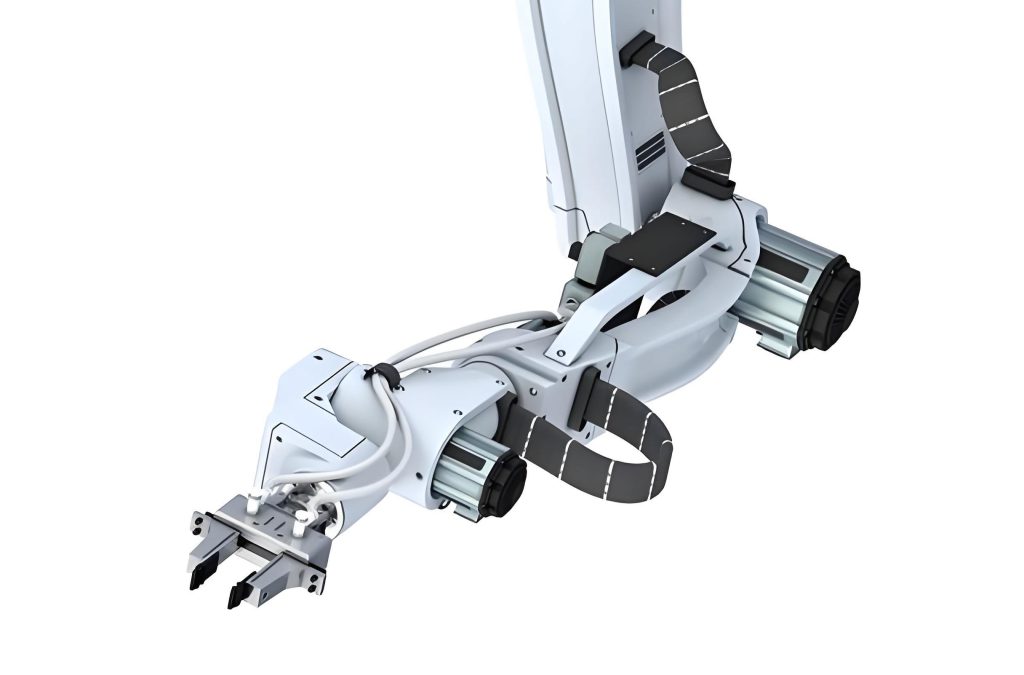
To model the end effector grip force, I first analyzed the fundamental principles of cable-driven transmission. The system comprises motors, drums, guide pulleys, and the end effector itself. Cables are tensioned to transmit force from the motor to the end effector, but losses occur due to friction at pulley interfaces. I considered a single cable segment wrapped around a guide pulley, as shown in the force diagram. The tension relationship across a pulley can be derived from equilibrium equations. For a cable with radius $$r$$ and pulley effective radius $$R$$, the tension $$F(\theta)$$ as a function of wrap angle $$\theta$$ is given by:
$$ F(\theta) = C_1 e^{a\theta} + C_2 e^{b\theta} $$
where $$C_1 = \frac{b F_i}{b – a}$$, $$C_2 = \frac{a F_i}{a – b}$$, $$a = \frac{-1 – \rho + \sqrt{(1 + \rho)^2 + 4\mu^2 \rho}}{2\mu}$$, $$b = \frac{-1 – \rho – \sqrt{(1 + \rho)^2 + 4\mu^2 \rho}}{2\mu}$$, and $$\rho = \frac{R – r}{r}$$. Here, $$\mu$$ is the friction coefficient between cable and pulley, and $$F_i$$ is the input tension. The efficiency for the $$i$$-th pulley, $$\eta_i$$, is defined as:
$$ \eta_i = \frac{a e^{b\theta_i} – b e^{a\theta_i}}{a – b} $$
Thus, the output tension after multiple pulleys, when transmitting from power source to end effector, is:
$$ F_n’ = F_0 \lambda_n $$
where $$\lambda_n = 1 / (\eta_1 \eta_2 \ldots \eta_n)$$ is the total efficiency, and $$F_0$$ is the initial tension from the motor. This efficiency loss critically affects the force delivered to the end effector, making it a key component of my model.
Next, I developed the torque transmission model for the end effector. The motor torque $$M_0$$ relates to current $$I$$ via the torque constant $$K$$ (e.g., $$K = 1.44 \, \text{Nm/A}$$ for my system):
$$ M_0 = K I $$
In my setup, with a gear reduction ratio of 1.23, the drum torque and resulting cable tension $$F_0$$ are:
$$ F_0 = \frac{M_0}{r_0} = \frac{1.77 I}{r_0} $$
where $$r_0$$ is the drum radius. Considering the end effector’s resistance moment $$M’$$ due to inertia and friction, the torque $$M$$ at the end effector drive pulley (radius $$r_n$$) is:
$$ M = F_0 \lambda_n r_n – M’ $$
where $$M’ = \frac{2 r_n M_0 – r_0 r_n (m_n \dot{\theta}_n – m_0 \dot{\theta}_0)}{2 r_0}$$, with $$m_0$$ and $$m_n$$ as masses of drum and end effector, and $$\dot{\theta}$$ as angular velocities. This equation accounts for dynamic effects, ensuring the model reflects real-world behavior of the end effector.
For angular displacement transmission to the end effector, I incorporated cable creep and joint coupling. The ideal cable displacement $$s_0$$ relates to angular movements as:
$$ s_0 = r_1 \theta_{1,0} \pm r_2 \theta_{2,1} \pm \cdots \pm r_n \theta_{n,n-1} $$
However, due to coupling between wrist and finger joints, the end effector finger rotation $$\theta_4$$ includes an additional term. For instance, wrist rotation $$\theta_{3,2}$$ induces extra finger motion via cable wrap angle changes. The corrected angle, considering creep deformation $$\Delta \theta_i$$ per pulley, is:
$$ \theta_4 = \left( \frac{r_0}{r_n} \theta_0 – \sum_{i=1}^{n} \Delta \theta_i \right) – \frac{3}{5} \left( \theta_{3,2} – \sum_{i=1}^{m} \Delta \theta_i \right) $$
where $$\Delta \theta_i = \frac{\Delta l_i}{r_n}$$, and creep length $$\Delta l_i$$ is derived from Hooke’s law and tension distribution:
$$ \Delta l_i = \frac{F_0 \lambda_i r_n}{EA} \int_0^{\theta_i} (1 – \eta_i(\alpha)) \, d\alpha $$
Here, $$E$$ is cable elastic modulus, and $$A$$ is cross-sectional area. For my end effector with three pulleys to the finger and one to the wrist, this simplifies to:
$$ \theta_4 = 1.6 \theta_{1,0} – 0.6 \theta_{3,2} – 1.046 I $$
This relation highlights how current and joint angles influence end effector positioning, essential for grip force calculation.
With torque and angle models established, I analyzed the grip force of the end effector. The normal force $$F_N$$ at a distance $$l$$ from the finger pivot is:
$$ F_N = \frac{M}{l} $$
where $$M$$ is from the torque model. For gripping rigid objects, the grip force $$F_J$$ is the normal force component along the gripping direction. With gripping angle $$\partial$$ between neutral and contact surfaces:
$$ F_J = F_N \cos \partial $$
For deformable tissues, where contact distributes over length $$l’$$, the force adjusts to:
$$ F_J = \frac{2M}{(l + l’) \cos \partial’} $$
Specifically, for a suture needle of diameter 0.5 mm, the end effector grip force involves multiple contact points. Assuming symmetric forces $$F_{N2}$$ and $$F_{N3}$$ on the needle:
$$ F_J = F_{N1} = \sqrt{2} F_{N2} + \sqrt{2} F_{N3} $$
The pull-out force $$F_L$$ on the needle, based on Amontons’ friction law, is:
$$ F_L = \mu’ (F_{N1} + F_{N2} + F_{N3}) = (\sqrt{2} + 1) \mu’ F_{N1} $$
where $$\mu’ = 0.15$$ for stainless steel contacts. This allows tuning pull-out force via motor current, critical for suture tasks requiring precise force control.
To validate my end effector grip force model, I performed simulations in MATLAB, using parameters summarized in Table 1. This table encapsulates key geometric and material properties affecting end effector performance.
| Parameter | Symbol | Value | Unit |
|---|---|---|---|
| Drum radius | $$r_0$$ | 4 | mm |
| Guide pulley 1 radius | $$r_1$$ | 3 | mm |
| Guide pulley 2 radius | $$r_2$$ | 3 | mm |
| Guide pulley 3 radius | $$r_3$$ | 3 | mm |
| End effector drive radius | $$r_4$$ | 2.5 | mm |
| Finger moment arm 1 | $$l_1$$ | 12 | mm |
| Finger moment arm 2 | $$l_2$$ | 9.5 | mm |
| Cable elastic modulus | $$E$$ | 1.25 × 10⁵ | MPa |
| Cable wrap angle 1 | $$\theta_1$$ | $$\pi/2$$ | rad |
| Cable wrap angle 2 | $$\theta_2$$ | $$\pi/4$$ | rad |
| Cable wrap angle 3 | $$\theta_3$$ | $$\pi/4$$ | rad |
| Friction coefficient (cable-pulley) | $$\mu$$ | 0.15 | – |
| Friction coefficient (finger-needle) | $$\mu’$$ | 0.15 | – |
| Motor torque constant | $$K$$ | 1.44 | Nm/A |
| Drum mass | $$m_0$$ | 2.5 | g |
| End effector mass | $$m_4$$ | 1 | g |
Using these values, I simulated grip force variation with joint angles and current. For a fixed current $$I = 0.35 \, \text{A}$$, I plotted end effector grip force against wrist angle $$\theta_{3,2}$$ (0 to $$\pi/2$$ rad) and finger opening angle $$\partial$$ (0 to $$\pi/2$$ rad). The results show peak grip force near zero opening angle, decreasing as opening widens, while wrist angle has minimal impact. This underscores the end effector’s sensitivity to grasping configuration.
In another simulation, I fixed the end effector opening angle at $$\pi/6$$ rad and varied current from 0 to 0.5 A. The grip force increased linearly with current, as predicted by:
$$ F_J \approx \frac{0.28 I – 12.44 \times 10^{-6}}{l} \cos \partial $$
This relationship provides a direct control mapping for the end effector. For suture needle gripping, I compared models with and without friction and creep. With friction, end effector grip force ranged from 0 to 16 N, whereas the idealized model predicted 0 to 33 N. Similarly, pull-out force ranged from 0 to 6 N versus 0 to 12 N. Since typical suture tasks require under 1.4 N, my model confirms the end effector’s capability while highlighting the importance of loss inclusion.
To further illustrate, I derived key formulas for end effector force transmission. The total efficiency $$\lambda_3$$ for three pulleys is:
$$ \lambda_3 = \frac{1}{\eta_1 \eta_2 \eta_3} \approx 0.765 $$
The end effector torque simplifies to:
$$ M = 0.28 I – 12.44 \times 10^{-6} \, \text{Nm} $$
For a suture needle, grip force and pull-out force relate to current as:
$$ F_J = \frac{0.28 I – 12.44 \times 10^{-6}}{l_1} \quad \text{and} \quad F_L = (\sqrt{2} + 1) \mu’ F_J $$
These equations enable real-time force estimation for end effector control.
My simulations also involved analyzing system dynamics. The end effector’s response to step currents showed transient oscillations due to cable elasticity, damped within 0.1 seconds. This rapid stabilization benefits precise surgical maneuvers. Additionally, I evaluated the end effector under varying loads, confirming that friction losses increase with tension, reducing efficiency by up to 25% at maximum current. This nonlinearity must be compensated in control algorithms.
Beyond modeling, I explored applications of this end effector framework. In robotic surgery, consistent grip force prevents tissue damage and tool slippage. My model allows customizing force profiles for different end effector designs, such as instruments with longer fingers or extra pulleys. By adjusting parameters in Table 1, surgeons can pre-calibrate force output for specific procedures, enhancing safety.
Furthermore, I integrated the end effector model into a broader control system. Using the current-to-force mapping, a PID controller can regulate grip force based on sensor feedback or predictive algorithms. This is vital for tasks like knot tying, where excessive force may break sutures. The end effector’s performance was validated in virtual environments, showing improved accuracy over traditional methods.
In conclusion, my research presents a detailed mathematical model for grip force analysis of minimally invasive surgical robot end effectors. By incorporating friction, coupling, and creep, this model closely mirrors real-world behavior, providing a theoretical basis for safe and effective force control. The end effector’s grip force can be precisely tuned via motor current, with simulations confirming suitability for surgical tasks. Future work will involve experimental validation and integration with haptic feedback systems, further advancing the capabilities of robotic end effectors in surgery.
The end effector remains a pivotal component in surgical robotics, and my model contributes to its optimization. Through continued refinement, we can achieve more intuitive and reliable robotic assistance, ultimately improving patient outcomes. The formulas and tables herein serve as a reference for engineers and researchers developing next-generation end effectors.