
In modern agriculture, robotic harvesting systems are increasingly vital for addressing labor shortages and improving efficiency. Among various crops, dragon fruit presents unique challenges due to its complex growth environment, diverse postures, high stem shear strength, and susceptibility to peel damage near the fruit pedicle. As an autonomous systems researcher, I have focused on developing a specialized end effector to enable无损采摘 of dragon fruit across varying生长姿态. This article details the design, mechanical analysis, experimental validation, and performance evaluation of a novel shear-based end effector incorporating elliptical grippers. The end effector aims to overcome existing limitations in precision requirements and adaptability, thereby enhancing the feasibility of dragon fruit harvesting robots.
The core innovation lies in the integration of elliptical claws with V-shaped grooves and a scissor-type cutting mechanism. This design allows for effective separation of the fruit from branches, protection of fruit integrity, and adaptation to different fruit inclinations. By employing a “cut-then-pull” harvesting method, the end effector minimizes mechanical stress on the fruit. Throughout this work, the term “end effector” is emphasized as the critical interface between the robotic arm and the fruit, underscoring its role in precise manipulation and harvesting. Below, I present a comprehensive exploration of the end effector’s design principles, mathematical models, and empirical results.
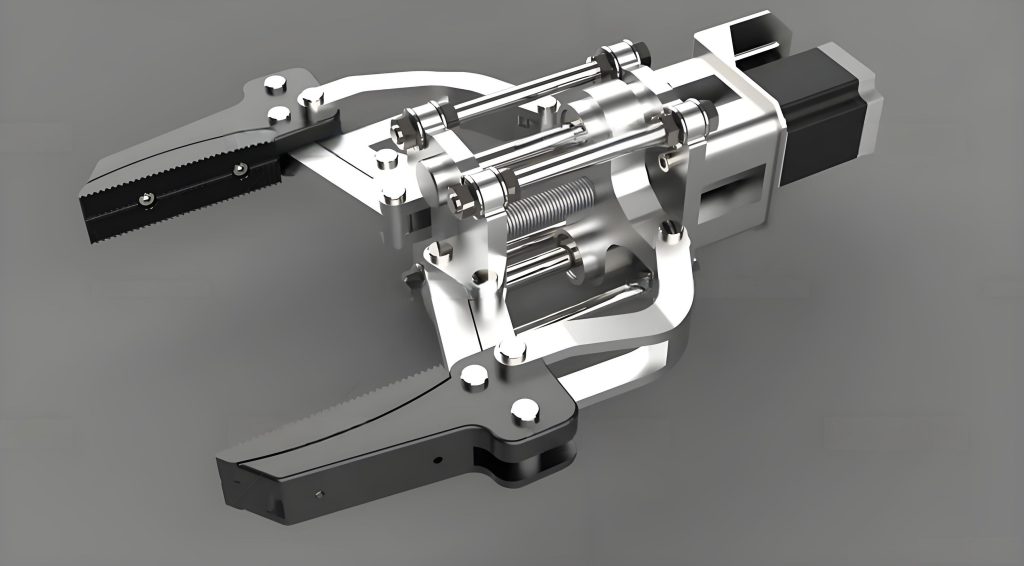
The overall architecture of the end effector consists of three main subsystems: the gripping mechanism, the driving mechanism, and the剪切机构. The gripping mechanism uses 3D-printed elliptical claws that conform to the fruit’s oval shape, increasing contact area and reducing pressure points. V-shaped grooves machined into the claws accommodate the triangular branches of dragon fruit, preventing interference during gripping. The driving mechanism employs servo motors to actuate齿轮啮合 for both gripping and cutting actions. The cutting mechanism features a scissor assembly connected to a rhomboid four-bar linkage, enabling simultaneous extension and shearing motion. This integrated design ensures that the end effector can handle fruits with inclinations ranging from 50° to 90°, which is crucial given the natural variability in dragon fruit growth.
To quantify the mechanical requirements, I conducted thorough力学分析 of both gripping and cutting operations. For the gripping mechanism, the force equilibrium during stable holding is analyzed. Let $F_1$ and $F_2$ represent the normal forces from the upper and lower claws, respectively, $f_1$ and $f_2$ denote frictional forces, $G$ is the fruit’s weight, and $\epsilon$ is the angle between the gripping force and vertical axis. The equilibrium equations are:
$$ \vec{F_2} + \vec{F_1} + \vec{f_1} + \vec{f_2} + \vec{G} = 0 $$
Projecting onto horizontal and vertical axes yields:
$$ F_1 \cos(\epsilon) + f_1 \sin(\epsilon) – F_2 \cos(\epsilon) – f_2 \sin(\epsilon) + mg = 0 $$
$$ F_1 \sin(\epsilon) + F_2 \sin(\epsilon) = f_1 \cos(\epsilon) + f_2 \cos(\epsilon) $$
The gripping torque $M$ is given by $M = (F_1 + F_2) l_1$, where $l_1$ is the force arm. For polished claws, friction is negligible, and $\epsilon \approx 0$. With a maximum fruit mass of 0.674 kg and $l_1 = 96.8$ mm, the minimum required torque is approximately 652.7 N·mm. This informed the selection of an MG-996R servo motor with a rated torque of 1300 N·mm for the gripping action, ensuring reliable performance for this end effector.
For the cutting mechanism, a rhomboid four-bar linkage translates rotational motion into linear shear action. The力学分析 involves the forces at the scissor joints. Let $F_3$ and $F_4$ be the symmetric shear forces, $F_5$ the force at the linkage joint, $l_5$, $l_6$, and $l_7$ as linkage and moment arms, and $\alpha$ and $\beta$ as angles of the scissor and linkage relative to horizontal. The torque $M_2$ from the servo relates to the shear force via:
$$ M_2 = 2 F_5 l_5 $$
$$ F_5 l_6 \cos(\alpha + \beta) = F_3 l_7 $$
Combining these, the shear torque is:
$$ M_2 = \frac{2 F_3 l_7 l_5}{l_6 \cos(\alpha + \beta)} $$
The kinematic analysis of the linkage determines the scissor’s motion profile. The vector loop equation is:
$$ \vec{X_A} = \vec{l_6} + \vec{l_5} + \vec{R} $$
With projections:
$$ X_A = l_6 \cos(\alpha) + l_5 \cos(\beta) $$
$$ l_6 \sin(\alpha) + l_5 \sin(\beta) + R = 0 $$
Differentiating with respect to time gives velocity and acceleration relations, ensuring smooth operation without abrupt impacts. Assuming initial angles $\beta = 85^\circ$ and $\alpha = 57^\circ$, and a servo speed $\omega_2 = 1.5$ rad/s, the horizontal velocity $v_A$ and angular velocity $\omega_1$ of the scissor are derived. The motion remains stable throughout the cutting cycle, which is critical for this end effector’s precision.
To determine the cutting force requirements, I performed shear tests on dragon fruit stems using a texture analyzer. The stems, with diameters between 4.05 mm and 5.47 mm, were sheared at different speeds. The results are summarized in Table 1, showing that the maximum shear force decreases with increasing speed. Since the end effector uses a scissor action, the required force is approximately half of the single-blade shear force, yielding a minimum of 33.5 N. This data guided the choice of a DS3230 servo motor with a torque of 3000 N·mm for the cutting mechanism.
| Test Number | Stem Diameter (mm) | Loading Speed (mm/min) | Maximum Shear Force (N) |
|---|---|---|---|
| 1 | 4.24 | 10 | 35.64 |
| 2 | 5.24 | 10 | 46.67 |
| 3 | 5.47 | 10 | 44.89 |
| 4 | 4.56 | 10 | 67.10 |
| 5 | 4.05 | 10 | 38.03 |
| 6 | 4.50 | 10 | 34.56 |
| 7 | 4.05 | 20 | 38.17 |
| 8 | 5.23 | 20 | 63.82 |
| 9 | 5.10 | 20 | 46.38 |
| 10 | 4.65 | 20 | 47.12 |
| 11 | 4.70 | 20 | 51.89 |
| 12 | 4.53 | 20 | 44.23 |
| 13 | 4.10 | 50 | 32.06 |
| 14 | 4.93 | 50 | 61.29 |
| 15 | 5.04 | 50 | 45.78 |
| 16 | 4.91 | 50 | 43.84 |
| 17 | 4.83 | 50 | 39.37 |
| 18 | 4.48 | 50 | 48.46 |
| 19 | 4.11 | 80 | 35.04 |
| 20 | 4.90 | 80 | 46.97 |
| 21 | 4.95 | 80 | 43.54 |
| 22 | 5.10 | 80 | 41.60 |
| 23 | 4.63 | 80 | 44.44 |
| 24 | 4.20 | 80 | 48.46 |
The harvesting method involves cutting the internal stem followed by pulling to detach the fruit. To validate this approach, I developed a finite element model of the fruit and branch after剪切. The model includes the椭圆火龙果, branch tissue, and internal stem, with material properties derived from experimental measurements: fruit elastic modulus 0.76 MPa, Poisson’s ratio 0.35; branch tissue modulus 1.22 MPa, Poisson’s ratio 0.35; stem modulus 4.78 MPa, Poisson’s ratio 0.40. Densities are 108 kg/m³ for fruit, 854.70 kg/m³ for tissue, and 933.30 kg/m³ for stem. A tensile force is applied along the fruit axis after simulating a剪切 with a 3 mm cut depth and 50 mm length. The analysis reveals stress concentration at the cut ends and branch-fruit junctions, with maximum tensile stress of 1.21 MPa and strain of 0.752 mm at 5 N拉力. The fruit experiences minimal stress, confirming that the pull force does not cause damage. This model underpins the feasibility of the cut-then-pull strategy for this end effector.
Field experiments were conducted to measure the actual pull forces required after manual stem cutting. Twenty dragon fruits of varying sizes were tested using a force gauge. The results, shown in Table 2, indicate an average pull force of 20 N, with a range of 16 N to 25.5 N. The average detached tissue length was 46.5 mm. These values align with the finite element predictions, demonstrating that the end effector can complete harvesting without fruit injury. The consistency between simulation and experiment reinforces the reliability of the design parameters for this end effector.
| Fruit Number | Fruit Size (mm) | Cut Length (mm) | Pull Force (N) | Detached Tissue Length (mm) |
|---|---|---|---|---|
| 1 | 63.7 × 81.0 | 43.3 | 16.0 | 58.4 |
| 2 | 67.3 × 76.3 | 45.4 | 25.5 | 40.7 |
| 3 | 61.0 × 73.6 | 49.0 | 25.5 | 40.8 |
| 4 | 73.4 × 90.3 | 54.2 | 22.0 | 54.1 |
| 5 | 66.2 × 93.1 | 47.2 | 18.0 | 33.1 |
| 6 | 70.8 × 81.1 | 50.1 | 22.5 | 58.9 |
| 7 | 62.0 × 78.4 | 46.8 | 18.0 | 41.6 |
| 8 | 64.5 × 77.0 | 54.2 | 17.0 | 38.3 |
| 9 | 61.0 × 71.1 | 46.5 | 20.0 | 45.4 |
| 10 | 71.5 × 79.8 | 58.0 | 23.0 | 63.7 |
| 11 | 83.0 × 100.5 | 47.4 | 21.0 | 43.1 |
| 12 | 86.0 × 104.0 | 51.3 | 19.0 | 53.6 |
| 13 | 87.0 × 105.1 | 55.2 | 23.5 | 59.4 |
| 14 | 89.0 × 107.3 | 48.1 | 22.0 | 55.3 |
| 15 | 78.3 × 99.4 | 45.3 | 16.5 | 32.5 |
| 16 | 75.8 × 94.2 | 40.6 | 20.5 | 41.7 |
| 17 | 70.0 × 90.0 | 52.1 | 17.5 | 53.7 |
| 18 | 73.0 × 92.0 | 46.2 | 15.5 | 32.1 |
| 19 | 67.0 × 88.1 | 44.3 | 17.0 | 47.6 |
| 20 | 64.5 × 84.3 | 43.5 | 19.5 | 46.3 |
The harvesting range of the end effector is a critical performance metric, as it affects compatibility with vision systems and overall成功率. I conducted gripping tests on three fruit size categories: small (90 mm × 68 mm), medium (98 mm × 78 mm), and large (110 mm × 90 mm). The allowable offsets in the x, y, and z directions relative to the claw center were measured. Table 3 summarizes the results, showing that smaller fruits permit larger offsets, expanding the operational envelope. For instance, small fruits allow x-offsets from 19.0 mm to 33.0 mm, y-offsets from 0 to 22.0 mm, and z-offsets from -26.2 mm to 49.8 mm. These ranges significantly exceed typical定位误差 of 2-3 mm from stereo vision systems, meaning the end effector can tolerate substantial positioning inaccuracies. This robustness is a key advantage for field deployment, where environmental factors may degrade sensing accuracy. The V-groove design effectively accommodates branch interference, though protruding leaf scales can occasionally hinder claw closure, a point for future refinement of this end effector.
| Fruit Size Category | Sample Count | Allowable X-Offset (mm) | Allowable Y-Offset (mm) | Allowable Z-Offset (mm) |
|---|---|---|---|---|
| Small (90 mm × 68 mm) | 5 | [19.0, 33.0] | [0, 22.0] | [-26.2, 49.8] |
| Medium (98 mm × 78 mm) | 5 | [15.0, 31.5] | [0, 17.0] | [-18.0, 44.2] |
| Large (110 mm × 90 mm) | 5 | [9.0, 20.5] | [0, 15.0] | [-8.4, 38.8] |
Field harvesting trials were performed with the physical prototype to evaluate overall performance. Twenty-five dragon fruits with inclinations between 50° and 90° were randomly selected. The end effector achieved a success rate of 92% (23 successful picks out of 25), with an average harvesting time of 3.1 seconds per fruit. The average length of cut branch tissue was 55.3 mm, slightly longer than manual harvesting norms but acceptable for initial implementation. Failures were attributed to residual木质化 stems from previous harvests obstructing scissor closure, highlighting an area for improvement. The end effector consistently handled various inclinations, with an average fruit inclination of 75° during tests. These results validate the practicality of the design for real-world applications, though further optimization could reduce tissue damage and enhance reliability.
In discussion, the elliptical claw shear end effector demonstrates significant advancements over prior designs. The integration of V-grooves and a rhomboid linkage allows for adaptive gripping and efficient cutting, reducing fruit damage and放宽 precision requirements. The mechanical models provide a foundation for scaling and optimization. For example, the gripping force equation can be extended to account for dynamic loads, and the cutting linkage kinematics can be refined for faster cycles. Compared to existing end effectors for火龙果, this design offers a larger harvesting range and better倾角 tolerance, which are crucial for economical robotic harvesting. However, the剪下 tissue length remains longer than ideal, suggesting opportunities for scissor geometry tweaks or alternative cutting mechanisms. Future work could explore adaptive control algorithms to adjust gripping force based on fruit size, or incorporate sensors for real-time feedback, further enhancing the versatility of this end effector.
The end effector’s compatibility with robotic arms and vision systems is another strength. By decoupling precise fruit localization from the harvesting action, it reduces the computational burden on perception algorithms. This is particularly beneficial in cluttered orchard environments where occlusions and lighting variations are common. The modular design also facilitates maintenance and customization for different fruit varieties, underscoring the end effector’s potential as a platform technology.
In conclusion, I have presented a comprehensive design and analysis of an elliptical claw shear end effector for dragon fruit harvesting. The end effector addresses key challenges through innovative mechanical features, validated by rigorous力学分析 and field experiments. With a 92% success rate, adaptable harvesting range, and non-destructive operation, it represents a significant step toward viable robotic harvesting for火龙果. The insights gained from this work can inform future developments in agricultural robotics, particularly for crops with similar morphological characteristics. As research progresses, continuous refinement of the end effector will undoubtedly enhance its efficiency and adoption in commercial settings.