
In my research on automated aircraft assembly, I focused on the hole-making end effector, a critical component in robotic drilling systems. The quality of drilling and countersinking directly impacts aircraft fatigue life and stealth performance, making precision essential. Traditional manual methods are inefficient, and while large CNC drilling equipment exists, it is costly and restricted for military use. Therefore, I turned to robotic-based end effectors, which offer flexibility and cost-effectiveness. This article details my work on optimizing the presser foot structure of the hole-making end effector to minimize mechanical errors, using ANSYS for finite element analysis and implementing lightweight design principles. The goal is to reduce deformations perpendicular to the spindle feed direction to under 0.05 mm, ensuring high accuracy in drilling operations.
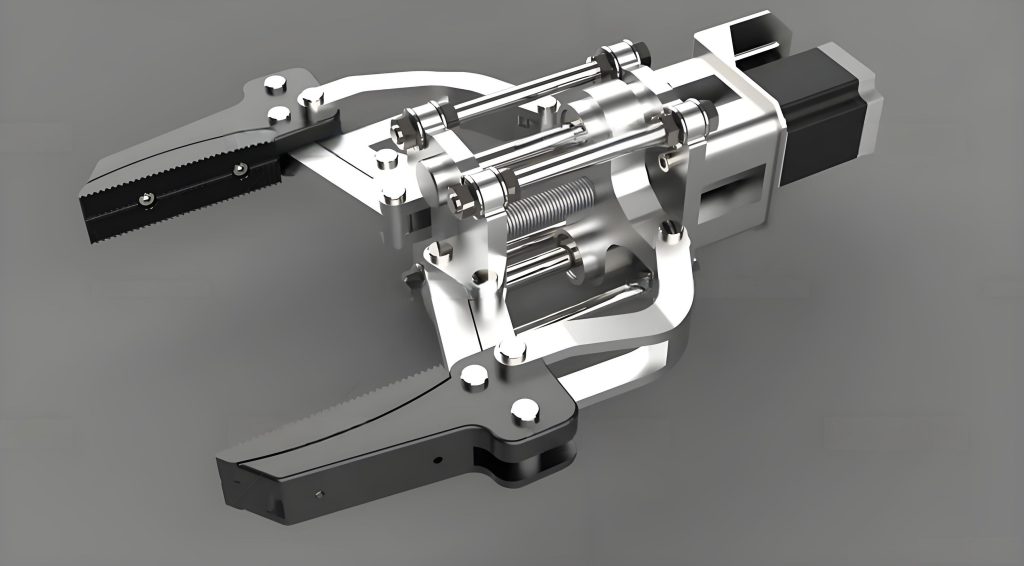
The hole-making end effector I designed consists of several key units: a spindle feed unit (including an electric spindle, cylinder, and sleeve), a pressing unit (the presser foot head and support frame), a detection unit (laser displacement sensors), an auxiliary support unit (rear cover, lower plate, and adjustment blocks), and a chip removal and cooling unit. During operation, the end effector is mounted on a robotic arm. The process begins with the robot positioning the end effector over the workpiece. The laser sensors then measure and correct normal errors relative to the workpiece surface. Once aligned, the presser foot presses against the workpiece, with a spring mechanism allowing compensation in the spindle feed direction (X-direction) to maintain contact. The spindle then advances to drill and countersink in one step, controlled by a depth adjustment mechanism. After reaching the desired depth, the spindle and presser foot retract, completing the hole. The accuracy of this end effector hinges on two factors: countersink depth error (must be less than 0.05 mm) and drilling normal error (must be within ±0.5°). To achieve this, the presser foot’s mechanical precision is paramount, as it houses the laser sensors and depth control structure. Any deformation in the presser foot can lead to measurement inaccuracies and poor depth control.
The presser foot is the component that directly contacts the workpiece, applying pressure to eliminate gaps between layers, smooth burrs, and reduce vibrations. Its structure includes a presser foot head connected to a support frame, which slides via four sliders along guide rails. Mechanical errors in the presser foot arise from two sources: rigid deformation due to clearances between guide rails and sliders, and elastic deformation from structural loads under operating forces. In my analysis, I treated these separately to develop optimization strategies. For rigid deformation, I assumed the presser foot as a rigid body, where gaps cause tilting. For elastic deformation, I used finite element analysis to model stress and strain. The combined deformation perpendicular to the spindle feed (Y-direction) must be minimized to meet the 0.05 mm threshold.
I first examined rigid deformation caused by guideway clearance. The presser foot acts like a lever, where small gaps at the sliders are amplified at the presser foot head. The geometry involves distances: let \( x \) be the distance from the presser foot head to the first slider, \( a \) be the distance between two sliders, and \( b \) be the maximum clearance between the guide rail and slider. When force is applied, the clearance allows rotation, causing displacement \( y \) at the presser foot head in the Y-direction. Using similar triangles, the relationship is derived as:
$$ \frac{y}{x} = \frac{b}{a} $$
This simplifies to:
$$ y = \frac{x}{a} \cdot b $$
From this equation, I deduced that to minimize \( y \), the ratio \( \frac{x}{a} \) should be less than 1, as this reduces the amplification effect. If \( \frac{x}{a} > 1 \), displacement is amplified; if \( \frac{x}{a} < 1 \), it is reduced. Therefore, the necessary condition for small rigid deformation is \( \frac{x}{a} < 1 \). In my design, I optimized the slider positions: I set \( x_{\text{min}} = 260 \, \text{mm} \) and \( a_{\text{max}} = 300 \, \text{mm} \), giving \( \frac{x}{a} = \frac{260}{300} \approx 0.867 \). Using GRV03 guide rails with a maximum clearance \( b = 0.02 \, \text{mm} \), I calculated the rigid deformation:
$$ y = \frac{260}{300} \times 0.02 = 0.0173 \, \text{mm} \approx 0.017 \, \text{mm} $$
This value represents the rigid component of error. Note that deformation in the X-direction is compensated by the spring in the presser foot head, so only Y-direction deformation is critical. To summarize the parameters and results, I created Table 1.
| Parameter | Symbol | Value | Description |
|---|---|---|---|
| Distance to first slider | \( x \) | 260 mm | Minimum distance from presser foot head to slider 1 |
| Slider spacing | \( a \) | 300 mm | Maximum distance between sliders |
| Guideway clearance | \( b \) | 0.02 mm | Maximum clearance in rail-slider interface |
| Rigid deformation | \( y \) | 0.017 mm | Calculated Y-direction displacement at presser foot head |
| Ratio \( x/a \) | \( \frac{x}{a} \) | 0.867 | Less than 1, indicating reduced amplification |
Next, I addressed elastic deformation using finite element analysis (FEA) with ANSYS software. I modeled the presser foot structure in CATIA, simplified minor features like fillets and screw holes, and imported it into ANSYS. The material is Q235 structural steel with properties: yield strength \( \sigma_y = 235 \, \text{MPa} \), density \( \rho = 7.85 \times 10^3 \, \text{kg/m}^3 \), and elastic modulus \( E = 210 \, \text{GPa} \). The mesh consisted of 40,223 elements and 148,362 nodes, with hex-dominant elements for the support frame and tet-dominant for the presser foot head, ensuring good orthogonality (quality score 0.83). The total mass was 20.24 kg. For boundary conditions, I applied forces simulating operational loads: a reaction force \( F = 1000 \, \text{N} \) on the presser foot head face in the X-direction, a tensile force of 500 N on the support frame from the weight of components like the spindle and base, an axial drilling force of 1000 N, and a torque of 3.21 N·m from drilling. The sliders were fixed to represent connection to the guide rails. I solved for deformations, focusing on Y-direction and Z-direction displacements, as X-direction deformation is compensated.
The FEA results showed that elastic deformation in the Y-direction was dominant. The maximum Y-direction deformation was 0.047 mm at the presser foot head, while Z-direction deformation was negligible (0.005 mm at the head). Thus, the elastic deformation perpendicular to the spindle feed is effectively \( y_{\text{ela}} = 0.047 \, \text{mm} \). The total deformation \( d \) in the Y-direction is the sum of rigid and elastic components:
$$ d = y_{\text{rig}} + y_{\text{ela}} $$
Substituting values:
$$ d = 0.017 + 0.047 = 0.064 \, \text{mm} $$
This exceeds the target of 0.05 mm, indicating a need for optimization to reduce elastic deformation. The stress distribution had a maximum of 20.258 MPa, well below the yield strength, confirming structural safety. To identify critical areas, I examined the maximum principal strain cloud plot, which revealed high strain at the presser foot head and the roots of the front two sliders. This guided my optimization efforts. I compiled key FEA results in Table 2.
| Metric | Value | Location | Comment |
|---|---|---|---|
| Y-direction elastic deformation | 0.047 mm | Presser foot head | Primary source of error |
| Z-direction elastic deformation | 0.005 mm | Presser foot head | Negligible |
| Maximum stress | 20.258 MPa | Presser foot head and slider roots | Safe (<235 MPa) |
| Total mass | 20.24 kg | Entire structure | Baseline for lightweight design |
| Total Y-direction deformation (d) | 0.064 mm | Presser foot head | Exceeds 0.05 mm target |
To reduce elastic deformation, I optimized the presser foot structure by reinforcing high-strain areas. I increased the thickness of the support frame from 10 mm to 20 mm and the presser foot head from 5 mm to 10 mm, and extended the rear edge of the support frame to increase its area. This enhanced stiffness, reducing Y-direction deformation. After re-running the FEA, the Y-direction deformation dropped to 0.012 mm, meeting the requirement of being below 0.033 mm (since \( 0.017 + 0.012 = 0.029 \, \text{mm} < 0.05 \, \text{mm} \)). However, these changes added mass, so I proceeded with lightweight design. Using ANSYS topology optimization, I identified non-critical regions for material removal, such as areas with low stress. I added weight-reduction holes in these zones, achieving a final mass of 15.28 kg—a 24.5% reduction. The optimized structure was re-analyzed, showing a Y-direction deformation of 0.013 mm and maximum stress of 22 MPa, both within limits. The optimization process is summarized in Table 3.
| Aspect | Before Optimization | After Reinforcement | After Lightweight Design | Improvement |
|---|---|---|---|---|
| Y-direction elastic deformation (mm) | 0.047 | 0.012 | 0.013 | Reduced by 72.3% |
| Total Y-direction deformation (mm) | 0.064 | 0.029 | 0.030 | Below 0.05 mm target |
| Maximum stress (MPa) | 20.258 | ~20 (estimated) | 22 | Safe (<235 MPa) |
| Mass (kg) | 20.24 | Increased (approx. 22) | 15.28 | Reduced by 24.5% from original |
| Key changes | Baseline design | Thicker support frame and head | Added weight-reduction holes | Balanced stiffness and weight |
The effectiveness of this end effector optimization relies on precise control of both rigid and elastic deformations. For rigid deformation, the condition \( \frac{x}{a} < 1 \) is crucial. In general, for any lever-like structure in an end effector, minimizing the ratio of lever arm to support span can reduce error amplification. This principle can be expressed as a design rule: for a given clearance \( b \), the displacement \( y \) is proportional to \( \frac{x}{a} \), so designers should maximize \( a \) and minimize \( x \). I derived a general formula for total deformation \( d_{\text{total}} \) in such systems:
$$ d_{\text{total}} = \frac{x}{a} \cdot b + y_{\text{ela}} $$
Where \( y_{\text{ela}} \) depends on material and geometry. To meet a tolerance \( T \), we need \( d_{\text{total}} \leq T \). Substituting from FEA, \( y_{\text{ela}} \) can be modeled as a function of load \( F \) and stiffness \( k \). For the presser foot, stiffness is enhanced by increasing cross-sectional area. I formulated an optimization objective to minimize mass while constraining deformation. Let \( m \) be mass, \( A \) be cross-sectional area, and \( \delta \) be deformation. Using a simple beam model for the support frame, elastic deformation can be approximated as:
$$ y_{\text{ela}} \approx \frac{F L^3}{3 E I} $$
Where \( L \) is length, \( E \) is elastic modulus, and \( I \) is moment of inertia. For a rectangular section, \( I = \frac{w t^3}{12} \), with width \( w \) and thickness \( t \). Mass is proportional to volume \( m \propto w t L \). To reduce \( y_{\text{ela}} \), increase \( t \) or \( w \), but this increases mass. My approach balanced these by targeting high-strain areas. In ANSYS, I used sensitivity analysis to find optimal thicknesses. For instance, doubling thickness reduced deformation by over 70%, as shown in the FEA. This highlights the importance of iterative design in end effector development.
Regarding the end effector’s overall performance, the presser foot optimization contributes significantly to drilling accuracy. The end effector must maintain precise contact with the workpiece, and any deviation can cause hole misalignment or poor countersink depth. My design ensures that the presser foot head remains stable under load, with minimal perpendicular deformation. This is vital for the laser displacement sensors, which rely on a fixed reference point. If the presser foot deforms, sensor readings may be inaccurate, leading to normal errors beyond ±0.5°. By keeping total Y-direction deformation at 0.030 mm, I estimated the angular error contribution. Assuming a sensor baseline distance, the error angle \( \theta \) can be approximated as \( \theta \approx \arctan(\frac{d}{L_s}) \), where \( L_s \) is sensor spacing. For small deformations, this is negligible, confirming that the end effector meets requirements.
In conclusion, my work on the hole-making end effector demonstrates a comprehensive approach to structural optimization. I analyzed mechanical errors from both rigid and elastic perspectives, derived design criteria to minimize rigid deformation, and used ANSYS FEA to reduce elastic deformation by 72.3%. The lightweight design further reduced mass by 24.5% without compromising performance. This end effector design achieves a total perpendicular deformation of 0.030 mm, below the 0.05 mm target, ensuring high precision in aircraft assembly. The methods I developed—leveraging formulas like \( y = \frac{x}{a} \cdot b \) and FEA-based topology optimization—can be applied to other end effector components, such as robotic grippers or welding tools, to enhance accuracy and efficiency. Future work could explore dynamic effects during drilling or advanced materials for further weight reduction. Overall, this optimized end effector contributes to reliable automated drilling, supporting advancements in manufacturing technology.