
The increasing complexity of on-orbit servicing, assembly, and maintenance tasks has driven the demand for highly reliable and precise mechanisms in spacecraft design. Among these, the robotic manipulator, particularly its end effector, is a critical component for interaction with the external environment. The end effector must perform capture, docking, and locking operations with high precision and repeatability over an extended mission life. Within such mechanisms, linear guide rails are fundamental elements that provide smooth, accurate, and constrained linear motion. While ball linear guide rails are mature technology in terrestrial applications like precision machinery and CNC machine tools, their direct adoption for space mechanisms is precluded by the harsh orbital environment. This article, from a first-person engineering perspective, details the design, adaptation, and comprehensive verification process for solid-lubricated ball linear guide rails developed for a space station robotic arm’s end effector. The focus is on overcoming the challenges posed by vacuum, thermal extremes, and radiation to ensure long-life performance.
The space environment presents a unique set of constraints that fundamentally alter the design paradigm for mechanical components. Components like those in the end effector are exposed to high vacuum, atomic oxygen, electron and proton irradiation, ultraviolet radiation, and severe temperature cycling between approximately -150°C and +120°C. Traditional lubrication strategies fail in this setting; hydrocarbon-based greases and oils rapidly volatilize in vacuum, leading to loss of lubrication and potential contamination of sensitive surfaces like optical lenses or thermal control coatings. Consequently, space mechanisms must employ solid lubrication. Furthermore, material selection must account for outgassing, thermal expansion mismatches, and resistance to atomic oxygen erosion. These factors necessitate a complete re-evaluation and adaptation of commercial-off-the-shelf (COTS) guide rail components, followed by rigorous ground testing that simulates the on-orbit life cycle.
The primary function of the space station robotic arm’s end effector is to securely capture and dock with a target adapter, forming a rigid mechanical and electrical connection. This operation is critical for relocating modules, handling cargo, and assisting astronauts. The specific end effector discussed here utilizes a cable-driven capture system for initial, tolerant engagement, followed by a two-stage coarse/fine alignment process. Final rigidization and electrical connection are achieved by four independent, symmetrically distributed locking mechanisms. A clear understanding of this function is essential for designing its subsystems.
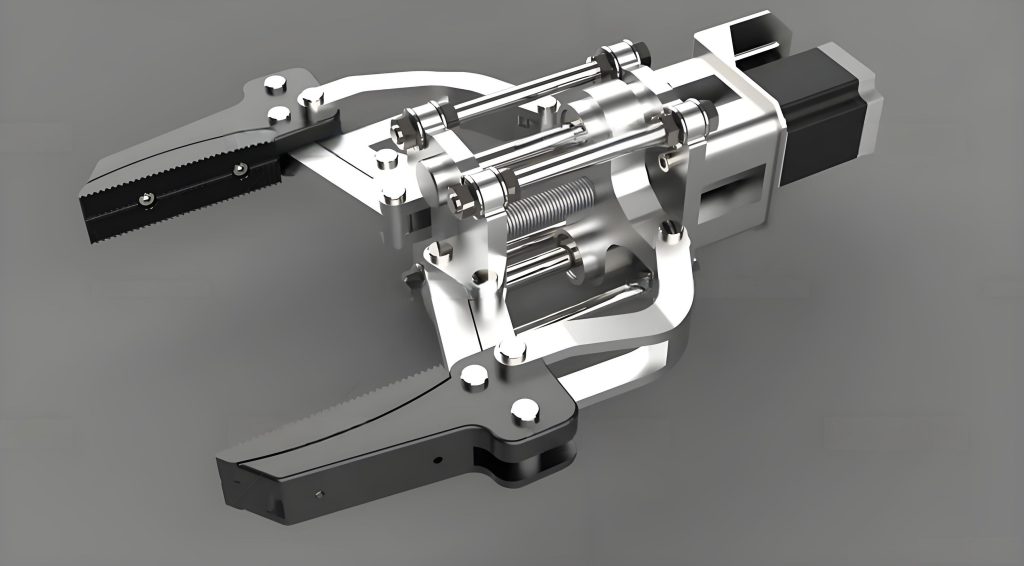
Each locking mechanism within the end effector is a complex assembly. Its core function is to translate rotary input from a central drive into a controlled linear clamping motion. This assembly includes a ball screw, disc spring stack, fixed bracket, moving components, linkages, a locking support bracket, and the critical linear guide rail pair. The guide rail’s role is to precisely constrain the motion of the locking support bracket, ensuring it moves along a defined straight path without binding or tilting. This precision is paramount for the successful mating of electrical connectors mounted on the bracket with their counterparts on the target adapter. Any deviation or excessive friction could prevent proper electrical connection or induce undesired sideloads, jeopardizing the mission.
Load Analysis for the End Effector Guide Rail
The design process begins with a thorough understanding of the loads the guide rail must withstand during the locking cycle. The loads are derived from the preload of the disc springs, inertial forces, and most importantly, misalignment forces between the end effector and the target adapter. A dynamic simulation model of the locking mechanism was constructed using multibody dynamics software. Two primary operational scenarios were analyzed: a nominal, perfectly aligned docking and a worst-case docking with a defined positional misalignment (e.g., 0.1 mm offset).
The simulation outputs the forces ($F_x$, $F_z$) and moments ($T_x$, $T_y$, $T_z$) acting on the guide rail adapter block. For guide rail selection, the bending moments ($T_x$ and $T_z$) are the most critical as they induce uneven loading on the ball rows, accelerating fatigue. The torque about the axis of motion ($T_y$) is less critical for fatigue life. Results from a representative simulation are summarized below:
| Condition | Fx (N) | Tz (N·m) | Remarks |
|---|---|---|---|
| Nominal Alignment | -2.4 | 0.138 | Minor forces and moments. |
| With 0.1 mm Misalignment | -26.8 | 1.546 | Significant moment induced. |
The worst-case moment $T_z = 1.546\, \text{N·m}$ is used for sizing. Assuming this moment is shared unequally between two parallel guide rails (with an uneven load factor of 0.6) and applying a safety factor of 2.0, the required design load per rail is calculated:
$$ M_{\text{design}} = \frac{M_{\text{max}} \times \text{Safety Factor}}{n \times k} = \frac{1.546 \times 2}{2 \times 0.6} \approx 2.58\, \text{N·m} $$
Therefore, a design value of $3.0\, \text{N·m}$ was selected for the guide rail’s moment rating.
Adaptive Design of the Space-Qualified Guide Rail
Based on the load requirement, interface space, and stroke, a miniature ball linear guide model (analogous to GGC9BA-type) was selected as the baseline. This rail features a two-row, Gothic arc raceway design with a 45° contact angle, providing equal load capacity in all four radial directions. Its catalog rated moment capacity ($M_A$, $M_B$) is $6.58\, \text{N·m}$, which offers a margin over the $3.0\, \text{N·m}$ design load. The catalog life under load $F$ is estimated by the standard bearing life formula:
$$ L = \left( \frac{C}{F} \right)^3 \times 50 $$
where $L$ is the rated travel life in km, $C$ is the dynamic load rating, and $F$ is the working load. Under nominal conditions, this predicts a life far exceeding the application’s travel distance.
However, this catalog data is invalid for space applications because it assumes oil or grease lubrication. Three major adaptations were made:
1. Solid Lubrication Scheme: The choice of solid lubricant is critical. After evaluating common space-qualified coatings, MoS2-based composite film applied by magnetron sputtering was selected for the balls. This coating provides excellent adhesion, very low friction in vacuum, and generates minimal debris, making it suitable for the precise, small-clearance environment of a guide rail. The lubricant film thickness is controlled between 1-2 μm.
| Lubricant Type | Key Advantages | Key Disadvantages for this Application |
|---|---|---|
| Sputtered MoS2 Composite Film | Very low vacuum friction, strong adhesion, long wear life, minimal debris. | Performance degrades in humid air (not an issue in space). |
| Reactively Sputtered W-C:H Film | Good synergy with lubricants in vacuum, high load capacity. | Higher friction in pure vacuum without companion lubricant. |
| PECVD a-C:H Film (DLC) | High hardness, low friction in air, good corrosion resistance. | High friction in vacuum. |
2. Material Selection: All metallic components (rail, slider block, balls, and the critical end-cap/ball return unit) were manufactured from G95Cr18 martensitic stainless steel. This material offers good corrosion resistance for ground handling, high hardness for wear resistance, and low magnetic permeability. Replacing standard polymer ball return units with metal was essential for preventing degradation under UV/particle radiation and ensuring dimensional stability across the operational temperature range.
3. Precision Assembly and Clearance Control: The ball return unit must be aligned with extreme precision to the slider’s raceways to ensure smooth ball recirculation. Misalignment causes increased resistance, ball skidding, and accelerated wear. Therefore, the return units were individually matched and pinned to each slider. Furthermore, unlike terrestrial applications where preload (negative clearance) is often used to increase stiffness, a deliberate running clearance was specified. This accounts for the finite wear life of the solid lubricant; debris from coating wear can accumulate in the raceways. A small clearance (initially targeted at 0.04-0.05 mm) helps prevent binding caused by this debris, thereby extending the operational life of the end effector mechanism.
Experimental Verification: A Necessity for Space Mechanisms
Theoretical analysis and catalog specifications are insufficient to guarantee performance in space. The transition from fluid to solid lubrication drastically alters the wear mechanics, load distribution, and ultimate life of the guide rail. Consequently, a dedicated test campaign is mandatory to validate the design for the end effector. The guiding standard for spacecraft mechanism testing specifies that the total ground test cycles must be a multiple of the expected life cycles (both ground and on-orbit). For an end effector requiring 100 ground tests and 2,000 on-orbit operations, the test factor method prescribed a minimum of 6,460 test cycles. A test goal of 7,000 cycles was established to provide margin.
A specialized test setup was developed to simulate the locking action. It consisted of a motor-driven ball screw to move the guide rail’s slider back and forth over its full stroke. A moment-loading fixture, applying a constant $3.0\, \text{N·m}$ bending moment via dead weights, was attached to the slider. This accurately replicated the worst-case operational load. The test protocol involved monitoring the drive motor current (proxy for friction force) and periodically measuring the no-load running resistance of the guide rail. A significant increase in resistance or the appearance of audible irregularities would signal failure.
To determine the optimal configuration, four distinct guide rail states were fabricated and tested sequentially:
| State ID | Lubrication | Clearance | Pre-test Run-in | Objective |
|---|---|---|---|---|
| State 1 | MoS2 on balls | 0.04-0.05 mm | None | Baseline configuration. |
| State 2 | MoS2 on balls | 0.04-0.05 mm | Loaded run-in (700 cycles) | Assess impact of run-in on life. |
| State 3 | MoS2 on balls | -0.01 to 0 mm (Preload) | None | Assess feasibility of preload. |
| State 4 | None (Ceramic Balls) | 0.04-0.05 mm | None | Assess necessity of lubrication. |
Analysis of Test Results and Critical Findings
The test outcomes provided decisive data for finalizing the end effector guide rail design:
State 1 (Baseline): Three identical units (1-a, 1-b, 1-c) all successfully completed the full 7,000-cycle test. The no-load running resistance remained below 0.1 N throughout. Post-test inspection showed intact lubricant film on the majority of balls and minimal wear on raceways. This confirmed that the chosen design—solid lubrication with a controlled clearance and no post-lubrication run-in—was viable for the required life.
State 2 (With Loaded Run-in): This unit failed at 6,713 cycles. Analysis revealed significant wear: the MoS2 coating was largely worn off many balls, and the raceways, particularly at the ball entry/exit points of the slider, showed visible scoring. The loaded run-in consumed a substantial portion of the lubricant’s useful life before the official test even began, leading to premature failure. This is a critical lesson: for solid-lubricated components intended for finite life, post-lubrication run-in under load should be avoided or strictly minimized.
State 3 (Preloaded/Zero Clearance): This configuration failed catastrophically at only 3,465 cycles. The initial preload, combined with debris from lubricant wear having nowhere to go, caused a rapid increase in friction, binding, and severe damage. This proves that a small positive clearance is essential for solid-lubricated guide rails to accommodate wear debris and prevent seizure.
State 4 (Unlubricated): As expected, this configuration failed almost immediately (after 416 cycles), demonstrating unequivocally that effective lubrication is non-negotiable for the reliable function of a guide rail in the end effector, even with hard materials like ceramic.
The performance contrast between the lubricated and un-lubricated states, and between the different clearance states, can be conceptualized in terms of a modified life equation. The standard life equation $L \propto (C/F)^3$ assumes a constant wear rate governed by subsurface fatigue. For solid lubrication, life is often governed by coating wear-out. A more relevant metric might be a wear-life model dependent on the lubricant film thickness $h$, hardness $H$, and load $P$:
$$ N_{\text{max}} \propto \frac{h \cdot H}{k \cdot P \cdot s} $$
where $N_{\text{max}}$ is the maximum cycles before lubricant failure, $k$ is a wear coefficient, and $s$ is the stroke length. The test showed that configurations consuming $h$ faster (State 2: run-in, State 3: high contact stress) directly reduced $N_{\text{max}}$.
Conclusions and Design Recommendations for Space Mechanisms
The successful development and on-orbit validation of the robotic arm’s end effector guide rail yielded several fundamental conclusions for the design of space mechanisms:
1. Mandatory Performance Derating and Testing: The load capacity and travel life of a solid-lubricated ball linear guide rail are significantly lower than its grease-lubricated commercial counterpart. Catalog ratings cannot be used. A dedicated life test under the actual operating load profile is absolutely essential to verify that the assembly can meet the mission’s cycle requirements.
2. Strategic Lubrication and Run-in Practice: The finite wear life of solid lubricant films must be conserved. Components should be precision-machined to minimize initial run-in needs. If run-in is necessary, it should be performed before applying the final lubricant coating, or conducted unloaded afterwards. Loaded run-in after lubrication directly subtracts from the in-orbit service life of the end effector.
3. Clearance over Preload: For solid-lubricated linear motion pairs, a controlled running clearance is strongly preferred over a preload. This clearance provides a vital tolerance for the accumulation of lubricant wear debris, preventing the dramatic increase in friction and risk of seizure observed in the test. The optimal clearance (0.04-0.05 mm in this case) must be determined empirically.
4. Holistic Design Approach: The guide rail cannot be designed in isolation. Its material, lubrication, clearance, and interface design are dictated by the system-level requirements of the end effector, including launch loads, thermal environments, vacuum exposure, and required positional accuracy. The integration with the ball screw, support structures, and feedback sensors must be carefully analyzed.
In summary, the adaptation of terrestrial mechanical components like linear guide rails for use in a robotic end effector in space is a non-trivial engineering challenge. It requires a disciplined systems-engineering approach that starts with a clear understanding of the operational environment and mission life, proceeds through careful adaptive design focusing on materials and solid lubrication, and culminates in rigorous, application-specific life testing. The process validated here ensures that the delicate and precise mechanisms within the end effector can perform their critical capture and docking functions reliably for thousands of cycles in the unforgiving environment of space.