
In modern agriculture, the automation of fruit and vegetable harvesting is a critical step toward improving efficiency and reducing labor costs. Among various crops, tomatoes present unique challenges due to their clustered growth patterns and delicate nature. Traditional harvesting methods often rely on manual labor, which is time-consuming and prone to inconsistencies. As a result, the development of robotic systems, particularly the end effector—the component directly interacting with the produce—has become a focal point of research. In this study, I address the limitations of existing end effector designs by proposing a novel wrapping strategy that enables selective harvesting of tomatoes from clusters with minimal interference from non-target fruits. This approach not only enhances the success rate but also reduces damage to both the target and surrounding crops. The end effector is designed to adapt to the tomato’s surface, leveraging underactuated mechanisms and sensor-based control to ensure precise and gentle handling. Through rigorous testing and analysis, I demonstrate the feasibility of this design, providing a foundation for future advancements in agricultural robotics. The integration of this end effector into robotic systems could revolutionize tomato harvesting, making it more sustainable and cost-effective.
The importance of the end effector in harvesting robots cannot be overstated. It serves as the interface between the robot and the crop, directly influencing the success of picking operations. For tomatoes, which are often grown in clusters, the end effector must navigate complex environments to isolate and harvest individual fruits without causing damage. Existing end effectors fall into several categories, such as gripping types, suction types, combination types, and stem-fixing types. However, these designs frequently struggle with non-target interference, leading to lower success rates. For instance, gripping end effectors may inadvertently capture multiple tomatoes, while suction-based ones can be hindered by nearby fruits. In contrast, my proposed end effector employs a wrapping strategy, where the fingers envelop the target tomato from below, gradually conforming to its shape and isolating it from neighbors. This method mitigates the common pitfalls associated with clustered growth, offering a more robust solution. The development of such an end effector is driven by the need for higher automation in agriculture, especially as global demand for tomatoes continues to rise. By focusing on the end effector’s design and performance, this study aims to contribute valuable insights to the field, paving the way for more efficient and reliable harvesting robots.
To understand the design requirements for the end effector, it is essential to analyze the mechanical and physical properties of tomatoes. Tomatoes are soft, spherical to oval fruits with variable sizes, typically ranging in diameter from 65 mm to 95 mm. Their susceptibility to damage necessitates careful handling, as excessive force can cause bruising or cracking. In my experiments, I measured key parameters to inform the end effector design. These include the transverse diameter $h_t$, vertical diameter $h_v$, mass $m$, static friction coefficient $\mu$, maximum gripping force $F_d$, and stem breaking force $F_s$. The static friction coefficient was determined using a tensile testing machine, with the formula:
$$ \mu = \frac{\sum_{i=1}^{10} f_i}{\sum_{i=1}^{10} m_i g} $$
where $f_i$ is the maximum pulling force, $m_i$ is the mass of each tomato, and $g = 9.8 \, \text{m/s}^2$ is the gravitational acceleration. The results showed a static friction coefficient of approximately 1.34, indicating the need for sufficient gripping force in the end effector to prevent slippage. Additionally, the maximum gripping force $F_d$ was found to be 17.07 N, beyond which damage occurs, and the stem breaking force $F_s$ was 8.62 N when the tomato is rotated 540° before pulling. These values are critical for setting thresholds in the end effector’s control system to ensure safe harvesting. The table below summarizes the physical characteristics of the tomatoes used in this study:
| Parameter | Unit | Value |
|---|---|---|
| Transverse Diameter $h_t$ | mm | 65.2–94.3 |
| Vertical Diameter $h_v$ | mm | 54.7–78.3 |
| Mass $m$ | g | 122.3–409.3 |
| Static Friction Coefficient $\mu$ | — | 1.34 |
| Maximum Gripping Force $F_d$ | N | 17.07 |
| Stem Breaking Force $F_s$ | N | 8.62 |
These properties guided the design of the end effector, particularly in terms of dimensions, force application, and material selection. For example, the end effector’s fingers were coated with a 3 mm thick silicone pad to increase the contact area and reduce pressure points, thereby minimizing damage. The wrapping strategy relies on the end effector’s ability to conform to the tomato’s surface, which is achieved through an underactuated mechanism with torsion springs. This design allows the end effector to adapt to variations in tomato size and shape without requiring complex control algorithms. The end effector’s key parameters, such as the initial opening diameter $d_i$, maximum opening diameter $d_o$, and minimum opening diameter $d_c$, were derived from these physical characteristics to optimize performance. The next section delves into the detailed structure and kinematics of the end effector.
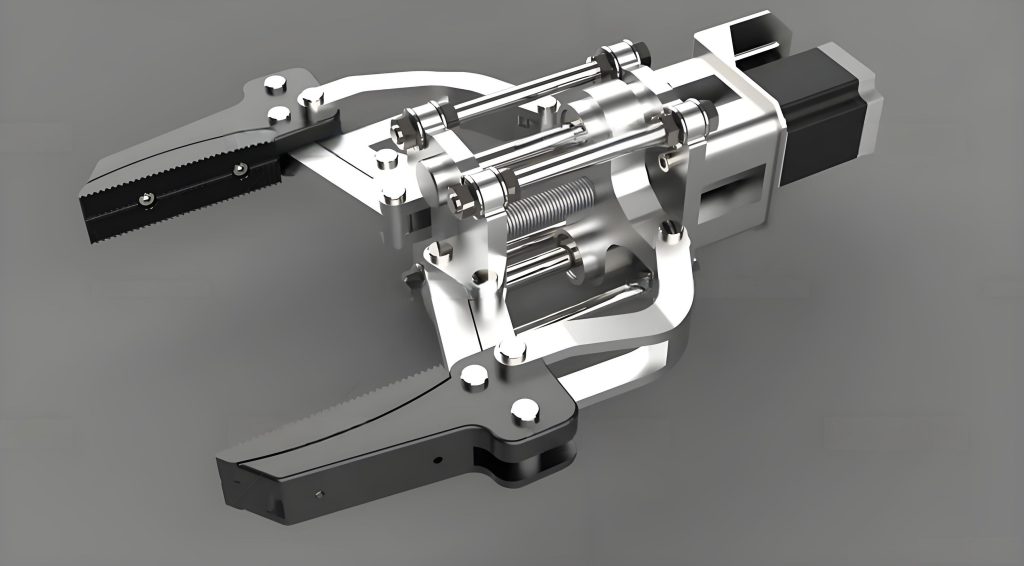
The end effector proposed in this study features a three-finger design, each finger consisting of a fingertip, finger pad, and finger root. The fingertip is equipped with a roller that rolls along the tomato’s surface during the wrapping process, reducing friction and preventing damage. The finger pad is covered with a silicone pad to enhance grip, while the finger root is driven by a stepper motor to open and close the end effector. Torsion springs are installed between the finger pad and root to enable adaptive motion, allowing the fingers to wrap around the tomato smoothly. A central silicone pad acts as a palm to support the tomato and increase contact area. The end effector operates through a sequence of steps: first, it moves to a pre-picking position below the target tomato; then, the rollers contact the tomato and the fingers wrap around it until fully enclosed; next, the motor closes the end effector to apply a clamping force; after that, the end effector rotates the tomato 540° around its axis; and finally, it pulls downward to detach the tomato from the stem. This process ensures that the end effector isolates the target tomato from non-target ones, leveraging the wrapping strategy to overcome interference.
The kinematics of the end effector are crucial for its performance. Each finger can be modeled in a Cartesian coordinate system, with key points representing joints and contact areas. For instance, point A represents the slider, points B, C, and D are hinges, and points E and F denote the silicone pad center and roller center, respectively. The motion is governed by the relationship between the opening diameter $d$ and the slider position $l_0$. When the end effector is fully open, $d = d_o = 95 \, \text{mm}$, and when fully closed, $d = d_c = 0 \, \text{mm}$. The initial opening diameter is set to $d_i = 80 \, \text{mm}$, based on the average tomato size. The kinematic equations ensure that the fingers can wrap around tomatoes within the size range without collision. The force analysis during clamping involves balancing the normal force $F_N$, friction force $f$, and stem breaking force $F_s$. The condition for successful picking is given by:
$$ 3 \times (F_N \cos \theta + f \sin \theta) + mg > F_s $$
$$ F_N < F_d $$
where $\theta$ is the inclination angle of the silicone pad, $f = \mu F_N$, and $g = 9.8 \, \text{N/kg}$. The minimum tomato mass $m_{\text{min}} = 122.3 \, \text{g}$ is used to ensure robustness. The clamping force threshold $F_0$ is set to $2.52 \, \text{N}$ to prevent damage, derived from the maximum gripping force $F_d$. The torsion spring force $F_s$ is calculated using the formula:
$$ F_s = \frac{E \phi d_s^4}{3670 n_s D_s l_s} $$
where $E$ is the spring modulus, $\phi$ is the twist angle, $d_s$ is the wire diameter, $n_s$ is the effective number of coils, $D_s$ is the mean diameter, and $l_s$ is the arm length. For this end effector, values such as $d_s = 1.5 \, \text{mm}$ and $\phi = 30^\circ$ were selected to meet the torque requirements for stable gripping. The control system of the end effector integrates pressure sensors and a photoelectric sensor to monitor clamping force and position. The pressure sensors, embedded in the silicone pads, detect the force applied by each finger, while the photoelectric sensor determines the opening limit by tracking the slider position. An Arduino microcontroller coordinates these sensors with the stepper motor, ensuring precise operation. This closed-loop control allows the end effector to adjust in real-time, enhancing reliability during harvesting.
To evaluate the performance of the end effector, I conducted a series of picking experiments in a laboratory setting. The end effector was mounted on a robotic arm, and tomato clusters were suspended from a支架 to simulate natural growth conditions. The tomatoes were classified into four groups based on the number of non-target tomatoes in contact with the target tomato: 0, 1, 2, or 3 contacts. Each group included 10 tomatoes, and the picking process was repeated for each. The metrics used to assess performance included the picking success rate $S_t$, mild damage rate $S_{md}$, severe damage rate $S_{sd}$, plant damage rate $S_p$, non-target fruit damage rate $S_f$, and non-damage picking success rate $S$. These are defined as:
$$ S_t = \frac{n_t}{N} \times 100\% $$
$$ S_{md} = \frac{n_{md}}{N} \times 100\% $$
$$ S_{sd} = \frac{n_{sd}}{N} \times 100\% $$
$$ S_p = \frac{n_p}{N} \times 100\% $$
$$ S_f = \frac{n_f}{N} \times 100\% $$
$$ S = \frac{n}{N} \times 100\% $$
where $n_t$ is the number of successfully picked tomatoes, $n_{md}$ is the number with mild damage (e.g., no visible cracks but potential storage issues), $n_{sd}$ is the number with severe damage (visible cracks), $n_p$ is the number of times plants were damaged, $n_f$ is the number of non-target tomatoes damaged, $n$ is the number of picks with no damage to target, plants, or non-target fruits, and $N = 40$ is the total number of picks. The results are summarized in the table below:
| Metric | Group A (3 contacts) | Group B (2 contacts) | Group C (1 contact) | Group D (0 contacts) | Overall |
|---|---|---|---|---|---|
| Picking Success Rate $S_t$ | 90% | 90% | 90% | 100% | 92.5% |
| Mild Damage Rate $S_{md}$ | 0% | 0% | 0% | 10% | 2.5% |
| Severe Damage Rate $S_{sd}$ | 0% | 0% | 0% | 0% | 0% |
| Plant Damage Rate $S_p$ | 0% | 0% | 10% | 0% | 2.5% |
| Non-target Damage Rate $S_f$ | 10% | 10% | 0% | 0% | 5% |
| Non-damage Success Rate $S$ | 80% | 80% | 90% | 90% | 85% |
The overall picking success rate of 92.5% demonstrates the effectiveness of the wrapping strategy in the end effector. Notably, the non-damage success rate of 85% indicates that most tomatoes were harvested without any harm to the target, plants, or surrounding fruits. The mild damage rate was only 2.5%, occurring in Group D where no non-target tomatoes were present; this suggests that individual variations in tomato firmness may play a role, as some tomatoes are more prone to damage even under gentle handling. The severe damage rate was 0%, highlighting the end effector’s ability to avoid cracking or bruising. Plant damage occurred in 2.5% of cases, primarily when leaves were entangled with the fingers during picking; this issue could be mitigated through better crop management or sensor improvements. Non-target tomato damage was 5%, mostly due to mature fruits detaching easily upon contact. Importantly, the number of non-target contacts had little impact on success rates, as Groups A, B, and C all achieved 90% success, proving that the end effector can effectively isolate target tomatoes in clustered environments. These results validate the design principles and control strategies employed in the end effector.
The success of this end effector can be attributed to several key features. First, the wrapping strategy allows the fingers to enclose the tomato gradually, minimizing the risk of non-target interference. Unlike traditional gripping end effectors that require a large opening diameter, this design starts with a smaller diameter and expands through adaptive motion, ensuring that only the target tomato is captured. Second, the use of rollers and silicone pads reduces friction and pressure, preventing surface damage. The rollers enable smooth rolling along the tomato’s contour, while the silicone pads distribute force evenly. Third, the underactuated mechanism with torsion springs provides passive adaptation to varying tomato sizes and shapes, eliminating the need for complex sensing or control for each finger individually. Fourth, the integrated sensor system allows for real-time force feedback, enabling the end effector to adjust clamping force to a safe threshold. Compared to existing end effectors, such as suction-based or stem-fixing types, this design offers a higher success rate in clustered settings. For instance, suction end effectors often struggle with multiple fruits, while stem-fixing types may not be suitable for tomatoes due to size constraints. The wrapping strategy addresses these limitations, making the end effector more versatile and reliable.
Further analysis of the end effector’s performance involves mathematical modeling of its dynamics. The motion of each finger can be described using kinematic equations that relate the slider position to the opening diameter. Let $x_F$ and $y_F$ be the coordinates of the roller center, and $x_D$ and $y_D$ be the coordinates of the hinge at the finger root. Based on the geometry, when points C, D, and F are collinear, the relationship is given by:
$$ \frac{x_D – x_F}{l_{DF}} = \frac{x_C – x_D}{l_{CD}} $$
where $l_{DF}$ and $l_{CD}$ are the lengths between points. The slider limits $l_{0}^{\text{up}}$ and $l_{0}^{\text{down}}$ correspond to the fully closed and fully open states, respectively, calculated as:
$$ l_{0}^{\text{up}} = y_C = -\sqrt{l_{CD}^2 – (x_C – x_D)^2} $$
$$ l_{0}^{\text{down}} = y_C – \sqrt{l_{BC}^2 – (x_C – x_B)^2} $$
For this end effector, with $l_{CD} = 40 \, \text{mm}$ and $l_{BC} = 40 \, \text{mm}$, the values are $l_{0}^{\text{up}} = -34.6 \, \text{mm}$ and $l_{0}^{\text{down}} = -76.39 \, \text{mm}$. These parameters ensure that the end effector can achieve the required opening range for tomatoes of all sizes. Additionally, the force balance during clamping involves the torsion spring torque and the applied force. The torque equilibrium around point D is expressed as:
$$ \frac{1}{2} F_0 l_{DE} \sin \theta = \frac{1}{2} F_s l_{DE} \leq \frac{1}{2} F_{s,\text{max}} l_{DE} $$
where $F_0$ is the clamping force threshold, $l_{DE} = 60 \, \text{mm}$ is the length from the hinge to the pad center, and $F_{s,\text{max}}$ is the maximum spring force. This equation ensures that the spring provides sufficient torque to maintain grip without exceeding the damage threshold. The end effector’s control system uses these principles to regulate force and position, with the Arduino processing sensor data to command the stepper motor. The pressure sensors measure the force on each finger, and if the total force approaches $F_d$, the motor stops to prevent damage. The photoelectric sensor detects the slider position, ensuring the end effector opens fully before each pick. This combination of mechanical design and electronic control makes the end effector highly responsive and safe for delicate tomatoes.
In terms of broader implications, this end effector represents a significant step forward in agricultural robotics. The wrapping strategy could be adapted for other fruits and vegetables that grow in clusters, such as grapes, cherries, or peppers, with modifications to size and force parameters. The use of underactuation and sensor feedback reduces complexity and cost, making the end effector more accessible for commercial applications. Future work could focus on integrating machine vision systems to automate target detection and positioning, further enhancing the end effector’s autonomy. Additionally, material improvements, such as using softer or more durable coatings, could reduce damage rates even further. The end effector’s design also aligns with sustainable farming practices by minimizing crop waste and labor requirements. As robotics technology advances, end effectors like this one will play a crucial role in meeting the growing demand for automated harvesting solutions.
To conclude, I have designed and tested a novel end effector for tomato picking that employs a wrapping strategy to overcome the challenges of clustered growth. The end effector features a three-finger underactuated design with rollers and silicone pads for gentle handling, supported by a sensor-based control system. Experimental results show a high picking success rate of 92.5% and a non-damage success rate of 85%, with minimal harm to tomatoes and surrounding plants. The end effector’s performance is largely unaffected by the number of non-target contacts, demonstrating its robustness in complex environments. This study provides a valuable reference for future research on end effectors in agricultural robotics, highlighting the importance of adaptive strategies and integrated control. By continuing to refine such designs, we can move closer to fully automated harvesting systems that are efficient, reliable, and gentle on crops. The end effector is not just a tool but a key component in the evolution of smart agriculture, offering promise for increased productivity and sustainability in tomato farming and beyond.