
In the context of transitioning from traditional to modern agriculture, the mechanization and intelligentization of tea production have become pivotal. As a major tea-producing country, China faces significant labor costs in tea harvesting, which can account for up to 50% of farmers’ income. Existing tea harvesters primarily focus on bulk tea collection using a non-selective “one-cut” mode, which is unsuitable for premium tea shoots that require selective picking. Therefore, developing an intelligent harvesting machine capable of selective picking is essential. The core of such a machine lies in the design of the harvesting end effector, which directly interacts with tea shoots. This study focuses on designing and optimizing a clamping-type end effector for selective tea shoot harvesting based on the physical and mechanical properties of tea shoots. We employ MATLAB’s GUI module and SolidWorks for structural parameter optimization and kinematics simulation, followed by field trials in tea gardens to validate performance.
The selective harvesting of tea shoots presents a significant challenge due to the need to distinguish between tender shoots and old leaves based on their mechanical properties. Traditional harvesters often damage shoots or fail to pick them entirely. Our approach involves designing an end effector that applies a controlled clamping force to detach shoots without harming the plant. The end effector is a critical component of a larger robotic system envisioned for automated tea harvesting. In this system, multiple end effectors are mounted on manipulators, guided by machine vision and processing modules to identify and locate tea shoots along tea ridges.
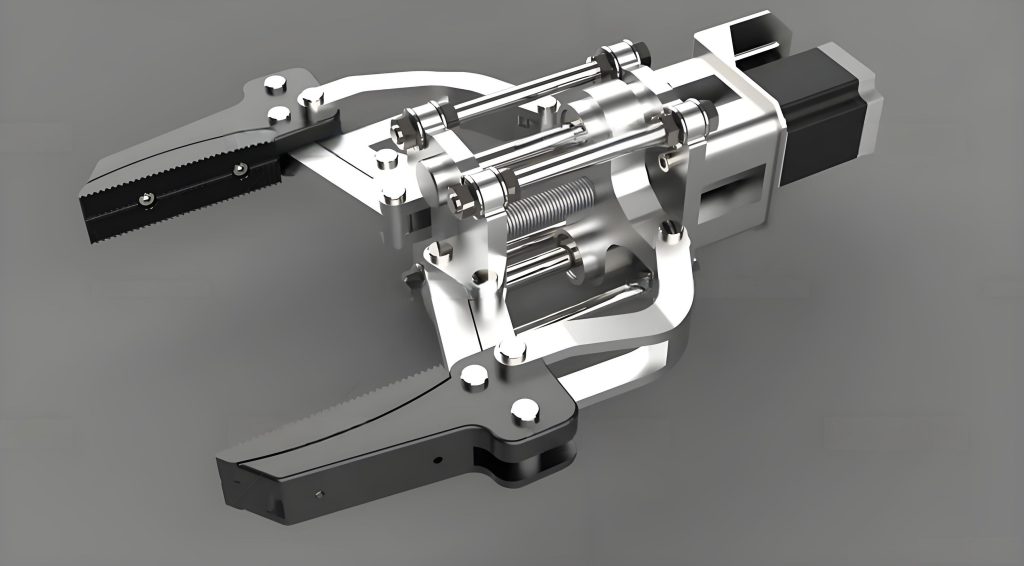
The design of the end effector is grounded in the physical characteristics of tea shoots, specifically their tensile failure force. For the tea variety studied (Mingshan 131), experimental data show that the average tensile force to break the petiole of one-bud-one-leaf shoots is 3.08 N, with an upper limit of 3.51 N, while for one-bud-two-leaves shoots, it is 5.51 N on average with an upper limit of 7.40 N. Old leaves have a tensile force lower limit exceeding 10 N. These values inform the required clamping force of the end effector. To ensure selective picking, the end effector must apply a force sufficient to detach tender shoots but below the threshold for old leaves. We set a target clamping force upper limit of 8 N at the contact point of the end effector, providing a safety margin based on a safety factor of 0.64 derived from prior regression analysis.
The end effector adopts a clamping-type mechanism utilizing a symmetrical four-bar linkage system. This design enables a smooth, arc-like motion trajectory for the clamping jaws, minimizing damage to adjacent shoots and ensuring stable harvesting. The end effector consists of several key components: a pair of clamping jaws made from waterproof and oxidation-resistant aluminum alloy, a driving servo motor, transmission shafts, main and driven gears, rocker arms (both driving and driven), and a housing. The servo motor actuates the four-bar linkage via gear transmission, causing the jaws to open and close. The four-bar linkage parameters—lengths of the driving rocker, connecting rod, driven rocker, and the fixed link—are crucial for achieving the desired clamping force and motion characteristics.
To determine the optimal dimensions of the clamping jaws, we considered the contact area required to apply the necessary force without causing damage. Using regression analysis from previous experiments, the relationship between the jaw contact width (x) and the actual clamping force (y) is given by:
$$ y = 0.64 \times (1.555x + 2.5238) $$
Solving for x with an average required clamping force of 5.51 N yields x = 4 mm. Thus, the clamping jaws are designed with dimensions 176 mm × 56 mm × 90 mm, providing a contact area of 176 mm × 4 mm. This ensures effective force distribution during clamping.
The transmission system parameters, including gear radius and four-bar linkage dimensions, were selected to minimize size and weight while meeting force requirements. Gears with a radius of 20 mm were chosen. The housing dimensions are 150 mm in length and 70 mm in width. The four-bar linkage parameters (denoted as l1, l2, l3, l4 for the fixed link, driving rocker, connecting rod, and driven rocker, respectively) were optimized using a multi-objective approach to maximize transmission efficiency, ensure a near-horizontal arc trajectory, and achieve the target clamping force.
We developed a mathematical model of the four-bar linkage to analyze displacement, velocity, acceleration, and force transmission. The coordinate system is established with point B as the origin, as shown in the kinematic diagram. The position of point C (which corresponds to the clamping point E on the jaw) is given by:
$$ x_C = l_4 \times \cos(\gamma – \beta) $$
$$ y_C = -l_4 \times \sin(\gamma – \beta) $$
where γ is the angle between BD and BC, and β is the angle between BD and the positive X-axis. The velocity and acceleration components at point C are derived from kinematic relations, considering the motions of points B and D. The transmission angle α1, defined as the angle between the driving rocker and the connecting rod, influences the efficiency of force transmission. It is calculated as:
$$ \alpha_1 = \arccos\left( \frac{l_2^2 + l_3^2 – l_{AC}^2}{2 \times l_2 \times l_3} \right) $$
where l_AC is the distance between points A and C. A larger transmission angle indicates higher efficiency. The clamping force F’ at point C, generated by the servo motor torque M, is related to the force at the jaw contact point F1 by:
$$ F’ = \frac{F_1}{2 \cos \theta_3} $$
where θ3 is the angle between the connecting rod and the horizontal axis. The servo motor torque required to produce the clamping force is:
$$ M = F_1 \times d_3 $$
$$ d_3 = l_2 \sin \alpha_1 $$
with F1 set to 8 N as the target upper limit.
To optimize the four-bar linkage parameters, we employed MATLAB’s GUI to create an interactive simulation environment. The optimization goals were to maximize the transmission angle, ensure a smooth arc trajectory, and achieve a clamping force close to 8 N at the harvesting point. Constraints included the Grashof condition for linkage mobility (l1 + l2 ≤ l3 + l4, with l1 as the shortest and l2 as the longest link) and a maximum rotation angle of 30° for the driving rocker to avoid over-clamping. Through iterative simulations, the optimal parameter set was determined as: l1 = 35 mm, l2 = 60 mm, l3 = 35 mm, and l4 = 50 mm.
The table below summarizes the key design parameters of the end effector:
| Component | Parameter | Value | Unit |
|---|---|---|---|
| Clamping Jaw | Dimensions | 176 × 56 × 90 | mm |
| Clamping Jaw | Contact Width | 4 | mm |
| Gear | Radius | 20 | mm |
| Housing | Length × Width | 150 × 70 | mm |
| Four-Bar Linkage | Fixed Link (l1) | 35 | mm |
| Four-Bar Linkage | Driving Rocker (l2) | 60 | mm |
| Four-Bar Linkage | Connecting Rod (l3) | 35 | mm |
| Four-Bar Linkage | Driven Rocker (l4) | 50 | mm |
| Servo Motor | Angular Velocity | 8.055 | rad/s |
| Rotation Angle | Maximum | 30 | degrees |
With these parameters, the kinematic behavior of the end effector was analyzed. The motion trajectory of point C forms a near-horizontal arc, which is ideal for gentle harvesting. The velocity, acceleration, and clamping force variations with horizontal displacement Xc were plotted. At Xc = 16 mm, corresponding to the lowest point of the trajectory where clamping occurs, the acceleration is minimized (indicating stable motion), the velocity is maximized, and the clamping force F’ reaches its peak magnitude of approximately -3.5 N (negative indicating direction). Using the transmission angle at this point, the required servo motor torque is calculated as 840 N·mm.
To validate the design, we performed a kinematics simulation using SolidWorks Motion. A virtual prototype of the end effector was assembled, and a servo motor with an angular velocity of 8.055 rad/s was applied. A reverse pressure of 8 N was exerted at the clamping point to simulate resistance during harvesting. The simulation results over one operational cycle (closing and opening) show that the servo motor torque peaks at around 845 N·mm at 0.13 seconds, closely matching the theoretical value of 840 N·mm. The slight difference is attributed to the neglect of component weight and inertia in theoretical calculations. The acceleration at point C reaches a minimum of 6,738 mm/s² at the clamping instant, confirming stable operation. These results verify the feasibility of the end effector design.
The performance of the end effector was further evaluated through field trials in a tea garden. A physical model was constructed using a DS32250 metal servo motor. Tests were conducted in March (spring tea season) and August (late season) on Mingshan 131 tea plants. For each test, 72 samples of one-bud-one-leaf shoots, one-bud-two-leaves shoots, and old leaves were harvested. Key performance metrics included the actual clamping force F, missed picking rate R, and harvesting integrity rate R1, defined as:
$$ R = \frac{m_2}{m + m_2} \times 100\% $$
$$ R_1 = \frac{m_1}{m} \times 100\% $$
where m is the number of harvested shoots, m1 is the number of undamaged harvested shoots, and m2 is the number of missed shoots. The results are summarized in the following table:
| Tea Shoot Type | Min Clamping Force F (N) | Max Clamping Force F (N) | Avg Missed Picking Rate (%) | Avg Integrity Rate (%) |
|---|---|---|---|---|
| One-Bud-One-Leaf | 2.76 | 3.51 | 2.8 | 91 |
| One-Bud-Two-Leaves | 4.51 | 7.80 | 3.0 | 94 |
| Old Leaf | 13.70 | 27.20 | 11.0 | 83 |
The trials demonstrated that the end effector successfully selects tender shoots while largely avoiding old leaves. For one-bud-one-leaf shoots, the missed picking rate is below 2.8% with an integrity rate of 91%. For one-bud-two-leaves, the missed picking rate is below 3% with an integrity rate of 94%. The performance was better in March compared to August due to more uniform shoot growth and distribution in the spring season. The end effector’s clamping force range ensures that when F is between 2.76 N and 4.51 N, only one-bud-one-leaf shoots are harvested; between 7.80 N and 13.70 N, tender shoots are harvested with some quality reduction but old leaves remain unpicked; above 27.20 N, all leaves are harvested, potentially causing damage. Thus, the design meets the selective harvesting requirement.
The design of this clamping-type end effector addresses several challenges in automated tea harvesting. By leveraging the mechanical properties of tea shoots, we optimized the structure to apply precise forces. The four-bar linkage mechanism provides a robust and efficient transmission system. However, there are limitations. The current design assumes idealized conditions; factors like friction, material wear, and environmental variations (e.g., moisture affecting shoot properties) were not fully accounted for. Future work should incorporate these aspects into the model. Additionally, integrating the end effector with machine vision for real-time shoot detection and adaptive control could enhance performance. The end effector’s compatibility with different tea varieties also needs exploration, as mechanical properties may vary.
In conclusion, we have designed and optimized a clamping-type end effector for selective tea shoot harvesting. The end effector’s parameters were derived from physical characteristics of tea shoots and optimized using computational tools. Kinematics simulation confirmed the design’s validity, and field trials demonstrated effective selective picking with low missed rates and high integrity. This end effector provides a foundational component for developing fully automated tea harvesting robots. Future research will focus on refining the control algorithms, enhancing durability, and scaling the system for commercial use. The iterative design process underscores the importance of multidisciplinary approaches in agricultural robotics, combining mechanical engineering, material science, and computer simulation to solve practical problems in tea cultivation.
The development of such an end effector is a step toward reducing labor dependency and increasing efficiency in tea production. As automation advances, tailored solutions for specific crops will become increasingly vital. This study contributes to that growing body of knowledge, emphasizing the role of precise mechanical design in agricultural robotics. The end effector’s performance highlights the potential for selective harvesting in other high-value crops where manual picking remains prevalent. By continuing to refine these systems, we can move closer to sustainable and intelligent agricultural practices that benefit farmers and consumers alike.