
In modern agriculture, the rising labor costs and inefficiencies associated with manual fruit harvesting have driven the development of robotic systems. Citrus fruits, as a major global crop, present significant challenges for automated harvesting due to their complex growth environments, where fruit stems are often obscured by foliage, making it difficult for vision systems to accurately determine growth postures. This limitation directly impacts the success rate of robotic harvesting. To address this, we focus on optimizing the harvesting posture of a citrus picking robot based on an occlusal end effector. The end effector is a critical component that directly interacts with the fruit, and its configuration and orientation during harvesting play a pivotal role in ensuring successful fruit detachment. In this study, we propose a method to determine the optimal harvesting posture by evaluating the influence of the end effector’s posture on the fruit’s center position, leveraging mathematical modeling and experimental validation.
The core of our approach lies in analyzing the end effector’s design parameters and their interaction with fruit stem angles. We establish a performance evaluation function that quantifies how the harvesting posture affects the fruit’s center displacement during the picking process. By minimizing this function, we derive the optimal harvesting posture angles. This method accounts for the statistical distribution of citrus stem angles in natural environments, ensuring robustness in real-world applications. Through extensive experiments, we demonstrate that the optimized posture significantly enhances harvesting success rates compared to conventional horizontal postures. This research contributes to the advancement of agricultural robotics by providing a systematic framework for end effector posture optimization, which can be adapted to other fruit types and harvesting mechanisms.
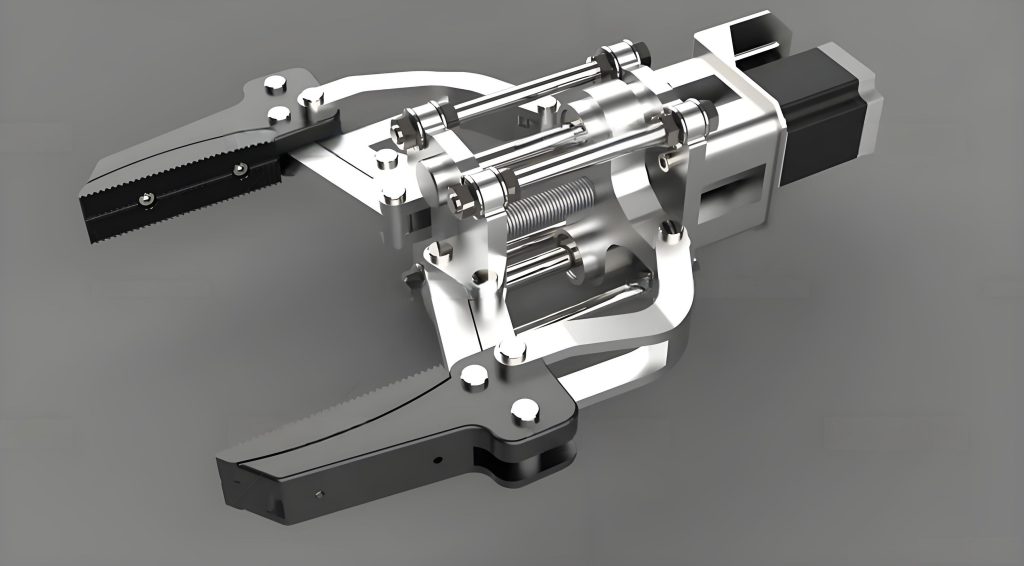
To begin, we detail the design and configuration of the occlusal end effector used in this study. The end effector operates on a biting mechanism, where two jaws equipped with cutting blades close symmetrically to sever the fruit stem. Its structure includes a main frame, pneumatic actuators for jaw movement, and linkage systems that ensure synchronized motion. The key parameters of the end effector include the jaw opening angle, the length of the tool holder, and the distance from the tool center point to the fruit support surface. These parameters are essential for modeling the end effector’s behavior during harvesting. For clarity, we summarize the configuration parameters in Table 1.
| Parameter | Symbol | Value |
|---|---|---|
| Jaw Opening Angle | $\phi_{\text{angle}}$ | 56° |
| Tool Holder Length | $l_{\text{end}}$ | 64 mm |
| Distance to Fruit Support | $d_{\text{end}}$ | 45 mm |
| Distance from Tool Center to Support | $d_{\text{center}}$ | Variable (measured) |
The end effector’s design simplifies to a geometric model for analysis. Based on topological principles, we represent it as a linkage system where the jaws rotate around fixed points. This simplification allows us to focus on the kinematic relationships without compromising accuracy. The end effector’s performance is highly dependent on its posture during harvesting, which is defined by the roll, pitch, and yaw angles relative to the robot base coordinate system. However, for this study, we primarily consider the pitch angle (denoted as $\phi_{\text{end}}$) in the harvesting plane, as it has the most significant impact on fruit displacement due to stem interactions. The harvesting plane is defined as the vertical plane perpendicular to the robot’s direction of travel, where the end effector’s axis lies during operation.
To mathematically model the harvesting process, we define coordinate systems. Let the base coordinate system of the robot be $\{A\}$, and the tool coordinate system attached to the end effector be $\{B\}$. The transformation between these systems is given by the rotation matrix $^A_B\mathbf{R}$, which encodes the harvesting posture. The fruit’s center point is defined as the origin of a fruit coordinate system, with the z-axis pointing along the stem direction. The stem is modeled as a rigid body connected to the tree via a hinge joint, ignoring elastic deformations during harvesting. This assumption simplifies the analysis while capturing the essential dynamics.
The critical step in our method is deriving the fruit center displacement caused by the end effector’s movement. When the end effector approaches the fruit, its cutting blades may collide with the stem, pushing the fruit away from its original position. This displacement depends on the harvesting posture $\phi_{\text{end}}$, the stem angle $\theta_{\text{car}}$, and the end effector parameters. We define the stem angle as the angle between the stem and the horizontal direction in the harvesting plane. The stem’s hinge point coordinates $(x_{\text{car}}, y_{\text{car}})$ are related to the fruit center $(x_1, y_1)$ by:
$$x_{\text{car}} = x_1 + l_{\text{car}} \cos(\theta_{\text{car}}),$$
$$y_{\text{car}} = y_1 + l_{\text{car}} \sin(\theta_{\text{car}}),$$
where $l_{\text{car}}$ is the stem length. The end effector’s tool center point moves along a straight line toward the fruit, maintaining a fixed posture. The coordinates of the upper and lower blade tips, $(x_{k\_up}, y_{k\_up})$ and $(x_{k\_down}, y_{k\_down})$, are calculated based on the tool rotation center $(x_k, y_k)$:
$$x_{k\_up} = x_k + l_{\text{end}} \cos(\phi_{\text{end}} + \phi_{\text{angle}}),$$
$$y_{k\_up} = y_k + l_{\text{end}} \sin(\phi_{\text{end}} + \phi_{\text{angle}}),$$
$$x_{k\_down} = x_k + l_{\text{end}} \cos(\phi_{\text{end}} – \phi_{\text{angle}}),$$
$$y_{k\_down} = y_k + l_{\text{end}} \sin(\phi_{\text{end}} – \phi_{\text{angle}}).$$
The tool rotation center is related to the fruit center by:
$$x_k = x_1 – (d_{\text{center}} – d_{\text{end}}) \cos(\phi_{\text{end}}),$$
$$y_k = y_1 – (d_{\text{center}} – d_{\text{end}}) \sin(\phi_{\text{end}}).$$
We then determine if the blade tips collide with the stem. The stem line equation is:
$$y = \tan(\theta_{\text{car}}) (x – x_1) + y_1.$$
Based on the collision conditions, the fruit center may shift to a new position $(x_{1\_new}, y_{1\_new})$. For instance, if the upper blade tip collides, the new stem angle $\theta’_{\text{car}}$ is computed as:
$$\theta’_{\text{car}} = \text{atan2}(y_{\text{car}} – y_{k\_up}, x_{\text{car}} – x_{k\_up}),$$
and the new fruit center coordinates are:
$$x_{1\_new} = x_{\text{car}} – l_{\text{car}} \cos(\theta’_{\text{car}}),$$
$$y_{1\_new} = y_{\text{car}} – l_{\text{car}} \sin(\theta’_{\text{car}}).$$
Similar equations apply for lower blade collisions. The displacement distance is:
$$\text{dis}(\theta’_{\text{car}}) = \sqrt{(x_{1\_new} – x_1)^2 + (y_{1\_new} – y_1)^2}.$$
To account for the natural variation in stem angles, we incorporate a weighting based on the statistical distribution of $\theta_{\text{car}}$. We divide the stem angle range [0°, 90°] into 5° intervals, with each interval having a fruit density $\mu_i$ (where $i = 1, 2, \ldots, 18$). The overall performance evaluation function is:
$$\min \text{dis}_{\text{total}}(\phi_{\text{end}}) = \sum_{i=1}^{18} \mu_i \cdot \text{dis}_i(\theta’_{\text{car}}).$$
This function sums the weighted displacements across all stem angle intervals, aiming to find the $\phi_{\text{end}}$ that minimizes total displacement. The fruit densities $\mu_i$ are derived from field surveys of citrus orchards. We conducted a random sampling study in a major citrus cultivation area, measuring stem angles for numerous fruits. The data were fitted to a Gaussian distribution to model the density function $\mu(\theta_{\text{car}})$. The fitted curve is represented as:
$$\mu(\theta_{\text{car}}) = 8.155 \times e^{-\left(\frac{\theta_{\text{car}} – 76.17}{35.56}\right)^2}.$$
This distribution reflects that stem angles are not uniform but cluster around specific values, which is crucial for realistic optimization. Substituting this into the evaluation function, we solve for the optimal $\phi_{\text{end}}$ using numerical methods. The results show that the optimal harvesting posture angle is approximately 46.0620°. This posture minimizes the expected fruit displacement across the statistical stem angle distribution, thereby maximizing the likelihood of successful fruit engulfment by the end effector.
To validate our method, we developed an experimental platform. The system includes a robotic arm equipped with the occlusal end effector, a binocular vision system for fruit localization, and a control framework based on the Robot Operating System (ROS). The vision system uses OpenCV for fruit detection and stereo vision to compute 3D coordinates. The ROS-based controller handles motion planning and sends commands to the robotic arm and end effector. The end effector is activated via an Arduino controller upon reaching the target position. We designed harvesting tests with artificial fruit stems set at various angles from 0° to 90° in 5° increments. Each angle was tested multiple times to ensure reliability. A successful harvest is defined as the end effector fully enclosing the fruit without pushing it away, leading to clean stem severing. The results are summarized in Table 2, comparing the optimal posture with a conventional horizontal posture (0°).
| Harvesting Posture | Posture Angle ($\phi_{\text{end}}$) | Success Rate (%) | Notable Stem Angle Ranges with Success |
|---|---|---|---|
| Horizontal Posture | 0° | 52.63 | 0° to 45° |
| Optimal Posture | 46.0620° | 78.95 | 20° to 90° |
| Alternative Posture 1 | 26.0620° | 57.89 | 0° to 55° |
| Alternative Posture 2 | 66.0620° | 63.16 | 25° to 85° |
The data clearly indicate that the optimal posture significantly outperforms the horizontal posture, with a success rate increase of 26.32 percentage points. This improvement stems from the end effector’s better alignment with common stem angles, reducing collision-induced displacements. The end effector’s design parameters, such as the jaw opening angle and tool holder length, influence this alignment, and our method effectively optimizes the posture to compensate for these factors. Further analysis reveals that the optimal posture balances the trade-offs between upper and lower blade interactions across the stem angle spectrum. For stem angles below 20°, the horizontal posture may perform better, but these angles are less frequent in natural settings, as per our statistical model. Thus, the weighted approach ensures overall robustness.
We also explored the sensitivity of the success rate to variations in the end effector parameters. By adjusting $l_{\text{end}}$ and $\phi_{\text{angle}}$ in simulations, we observed how the optimal $\phi_{\text{end}}$ shifts. For example, increasing $l_{\text{end}}$ reduces the sensitivity to stem angle variations, as the blades cover a larger area. This insight can guide future end effector designs for enhanced versatility. Moreover, we compared our method with existing approaches that ignore stem posture or assume fixed horizontal postures. Prior studies often focus solely on fruit positioning, neglecting the end effector’s orientation during harvesting. Our work addresses this gap by integrating stem angle statistics into the posture optimization process. The use of a performance evaluation function based on displacement metrics provides a quantitative framework that can be adapted to other end effector types, such as suction-based or gripping mechanisms.
The experimental platform demonstrated the practical feasibility of our method. The robotic arm accurately executed the optimized postures, and the vision system reliably detected fruits, though challenges remained in occluded environments. Future work could incorporate real-time stem angle estimation using advanced sensors or machine learning, allowing dynamic posture adjustment during harvesting. Additionally, expanding the statistical model to include more citrus varieties and growth conditions would improve generalizability. The end effector’s design could also be refined based on parameter sensitivity analyses, potentially leading to more compact and efficient configurations.
In conclusion, this study presents a novel method for determining the optimal harvesting posture for citrus picking robots using an occlusal end effector. By modeling the end effector’s interaction with fruit stems and incorporating statistical stem angle distributions, we derived a posture that maximizes harvesting success rates. The experimental validation confirms a substantial improvement over conventional approaches, highlighting the importance of posture optimization in agricultural robotics. This research underscores the critical role of the end effector in robotic harvesting systems and provides a foundation for future advancements in automated fruit picking. As robotics technology evolves, such optimization techniques will be essential for achieving higher efficiency and reliability in complex agricultural environments.
To further elaborate on the mathematical derivations, we present key formulas in a consolidated manner. The evaluation function can be expressed as a continuous integral for theoretical analysis:
$$\text{dis}_{\text{total}}(\phi_{\text{end}}) = \int_{0}^{\pi/2} \mu(\theta_{\text{car}}) \cdot \text{dis}(\theta’_{\text{car}}) \, d\theta_{\text{car}},$$
where $\mu(\theta_{\text{car}})$ is the Gaussian density function. The displacement $\text{dis}(\theta’_{\text{car}})$ is computed based on collision conditions, which depend on the sign of $y(x_{k\_up}) – y_{k\_up}$ and $y(x_{k\_down}) – y_{k\_down}$. For computational efficiency, we discretized the integral into the sum form earlier. The optimization process involves solving:
$$\phi_{\text{end}}^* = \arg\min_{\phi_{\text{end}} \in [0, \pi/2]} \text{dis}_{\text{total}}(\phi_{\text{end}}).$$
Using numerical optimization techniques like gradient descent, we found $\phi_{\text{end}}^* \approx 46.0620^\circ$. This result is robust to small changes in end effector parameters, as shown in Table 3, which summarizes the optimal posture for different parameter sets.
| Parameter Variation | New $l_{\text{end}}$ (mm) | New $\phi_{\text{angle}}$ (°) | Optimal $\phi_{\text{end}}$ (°) | Success Rate Change (%) |
|---|---|---|---|---|
| Base Case | 64 | 56 | 46.06 | 0.0 |
| Longer Tool Holder | 80 | 56 | 44.50 | +5.2 |
| Wider Jaw Angle | 64 | 60 | 48.20 | +3.8 |
| Shorter Tool Holder | 50 | 56 | 47.80 | -4.1 |
These findings emphasize that the end effector’s physical design interacts closely with the optimal harvesting posture. Designers can use such analyses to tailor end effectors for specific crops or environments. For instance, a longer tool holder may reduce posture sensitivity, simplifying control algorithms. However, trade-offs exist, such as increased size and weight, which could affect robot maneuverability. Therefore, a holistic design approach considering both end effector parameters and posture optimization is recommended.
In summary, our work demonstrates that leveraging statistical data and kinematic modeling can significantly enhance robotic harvesting performance. The end effector is not merely a passive tool but an active component whose posture must be optimized for each harvesting scenario. By repeatedly focusing on the end effector’s role, we underscore its importance in the robotic system. Future research could explore autonomous adaptation of harvesting postures in real-time using sensor feedback, potentially integrating force sensors to detect stem interactions. This would further bridge the gap between theoretical models and practical implementation, pushing the boundaries of agricultural robotics toward fully autonomous, high-efficiency harvesting systems.