
The advancement of automated transplanting technology is crucial for enhancing agricultural productivity and reducing labor intensity. A core component of an automatic transplanter is the end-effector, responsible for the precise and gentle extraction of seedlings from their nursery trays. This paper focuses on the design and virtual analysis of a novel multi-link mechanism-based end-effector specifically for cabbage plug seedlings. The primary objective is to develop an end effector that achieves both insertion and clamping motions with a single actuator, thereby improving operational consistency and reliability in field conditions.
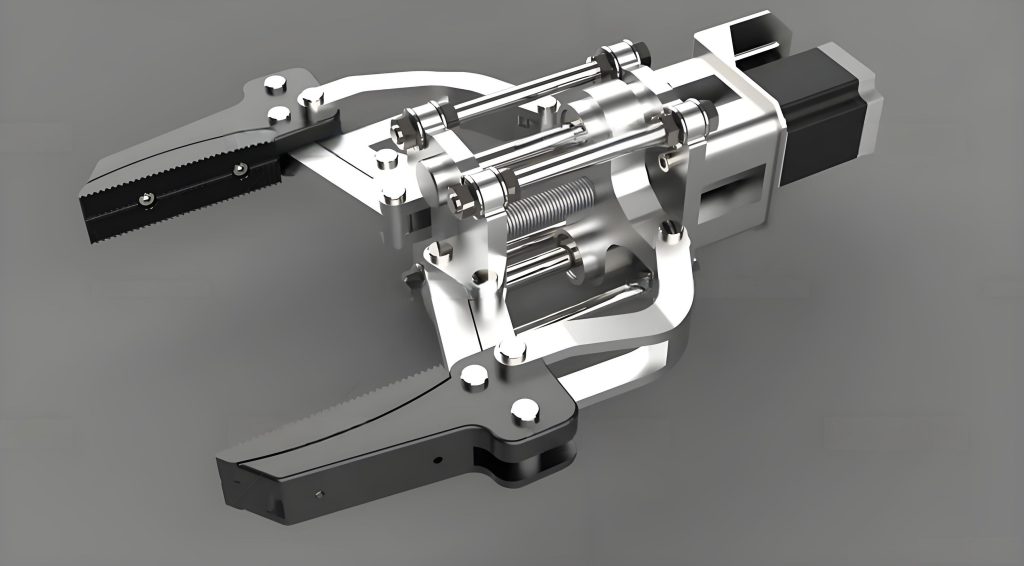
The designed end-effector is a two-finger, four-needle mechanism. Its core innovation lies in a multi-linkage system that translates the linear motion of a single motor-driven lead screw into a complex, predetermined path for the seedling needles. This path involves simultaneous vertical insertion into the substrate and a subsequent inward clamping motion to securely grip the plug. The structural composition primarily includes a motor mounted on a trapezoidal fixed frame, a lead screw-nut assembly, connecting rods, two rocker arms, a needle fixation block, and the seedling needles themselves. The working cycle consists of four phases: the needles insert into the substrate at an initial angle, the angle increases as they penetrate deeper while simultaneously moving inward to clamp, the assembly pauses to ensure a firm grip, and finally, the entire end-effector retracts vertically to extract the seedling from the cell.
Kinematic Design and Parameter Determination
The kinematic design ensures the seedling needles follow a trajectory that minimizes damage to the root system while providing sufficient gripping force. The substrate extraction force FT required to overcome adhesion to the tray cell walls is derived from a force balance on the gripped plug. The force provided by the end-effector needles depends on the normal force, friction, and the needle clamping angle α.
$$F_T = 2F_f \cos\alpha + 2F_N \sin\alpha$$
Where \(F_f = \mu F_N\) is the frictional force and \(F_N = \sigma A_N\) is the normal force. The compressive stress \(\sigma\) is related to the substrate’s mechanical properties. For a 72-cell cabbage plug, empirical data relates the compressive force \(F\) to the deformation \(x\) (in mm):
$$F = 0.0251x^3 – 0.2453x^2 + 1.3541x + 0.227$$
Combining these equations, the required deformation \(x\) for a given pull-out force can be solved. For target parameters (clamping angle \(\alpha = 15^\circ\), insertion depth = 39 mm, needle diameter = 2.5 mm, friction coefficient \(\mu = 0.52\)), the calculation yields a required substrate deformation of \(x \approx 8.43\) mm to generate adequate pull-out force.
The motion path of the needle tip is defined using vector loop equations for the multi-link mechanism. The mechanism is decomposed into left and right linkage groups and a slider-crank group. Defining the needle tip point as \(E(x_E, y_E)\), the geometric constraints for the left linkage group are given by:
$$x_A + a\cos\theta_{1i} + e\cos(\gamma + \theta_{2i}) = x_{Ei}$$
$$y_A + a\sin\theta_{1i} + e\sin(\gamma + \theta_{2i}) = y_{Ei}$$
Where \(a\) is the length of rocker AB, \(e\) is the distance from point B to E, and \(\theta_{1i}, \theta_{2i}\) are corresponding link angles. After elimination, the relationship is expressed as:
$$(x_{Ei} – x_A)^2 + (y_{Ei} – y_A)^2 + e^2 – a^2 – 2e[(x_{Ei} – x_A)\cos\gamma + (y_{Ei} – y_A)\sin\gamma]\cos\theta_{2i} + 2e[(x_{Ei} – x_A)\sin\gamma – (y_{Ei} – y_A)\cos\gamma]\sin\theta_{2i} = 0$$
A similar equation is derived for the right linkage group. Three precision points were selected along the desired needle path to avoid dense root zones: the initial point \(E_1(45, 14)\), an intermediate point \(E_2(25, 9.5)\), and the final insertion point \(E_3(3, 5)\) (coordinates in mm). Solving the system of equations with constraints on angular displacement yields the optimal link dimensions. The parameters for the slider-crank mechanism are determined similarly to convert the linear nut motion into the rocker swing. The final designed structural parameters are summarized below.
| Parameter Group | Symbol | Value (mm or °) |
|---|---|---|
| Left Linkage Group | Rocker AB Length (a) | 62.6 |
| Link BC Length (b) | 37.3 | |
| Distance BE (e) | 138.6 | |
| Angle γ | 180° | |
| Rocker DC Length (c) | 50.7 | |
| Right Linkage Group | Distance CE (k) | 175.9 |
| Angle ζ | 180° | |
| Needle Length | 110.0 | |
| Slider-Crank Group | Rocker DF Length (f) | 28.0 |
| Connecting Rod GF Length (g) | 110.0 | |
| Vertical Stroke (i) | 24.0 | |
| Final Nut Position (y_H’) | 90.0 |
Motion Simulation via ADAMS
A virtual prototype of the end-effector was constructed in ADAMS to verify its kinematic performance. The simulation confirmed that the single motor drive successfully produced the compound insertion-clamping motion. The needle tip trajectory showed a vertical insertion depth of 43 mm and a horizontal clamping displacement of 9.3 mm. The distance between the two needle tips decreased from an initial 30 mm to a final 11.66 mm, ensuring a firm grip. The needle angle relative to the vertical axis started at 11.8°, briefly decreased, and then increased to a final clamping angle of 14.9° during the insertion phase, which was maintained during extraction. This validated that the designed multi-link end-effector could follow the intended path and achieve the necessary geometry for seedling grasping.
Discrete Element Modeling and Coupled EDEM-ADAMS Analysis
To analyze the interaction between the end-effector and the seedling substrate—a complex porous medium—a coupled EDEM-ADAMS simulation was employed. The substrate was modeled as spherical particles with properties representative of a peat-based mix. The Hysteretic Spring Contact Model, often effective for simulating moist, compressible materials like potting soil, was applied to define particle-particle interactions. The critical material and interaction parameters are listed below.
| Category | Parameter | Value |
|---|---|---|
| Particle (Substrate) | Poisson’s Ratio | 0.246 |
| Density (kg/m³) | 794 | |
| Shear Modulus (Pa) | 1.597e6 | |
| Tray Cell (PP) | Poisson’s Ratio | 0.35 |
| Density (kg/m³) | 1050 | |
| Shear Modulus (Pa) | 1.25e9 | |
| Particle-Particle Contact | Restitution Coefficient | 0.2 |
| Static Friction Coefficient | 0.65 | |
| Rolling Friction Coefficient | 0.345 | |
| Particle-Needle Contact | Restitution Coefficient | 0.6 |
| Static Friction Coefficient | 0.397 | |
| Rolling Friction Coefficient | 0.261 |
The coupled simulation visualized the entire pickup process. The force analysis revealed that the pull-out force provided by the end-effector needles peaked at approximately 6.38 N at the end of the insertion-clamping phase, which is sufficient to overcome substrate-tray adhesion and the plug’s weight. The contact force between the needles and substrate particles increased during insertion, peaked at around 0.60 N, and then decreased once the upward extraction began. The distribution of compressive forces within the substrate showed higher stress concentrations adjacent to the needles, particularly near the tips, which is critical for assessing potential root damage.
Virtual Experiment: Effect of Clamping Parameters
A two-factor, three-level virtual experiment was conducted using the validated coupled model to investigate the influence of operational parameters on substrate integrity. The factors were the final clamping angle \(\alpha\) (12.9°, 14.9°, 16.9°) and the total clamping time \(t\) (0.1 s, 0.3 s, 0.5 s). The response variables were the maximum contact force and the maximum deformation experienced by the substrate particles during the gripping process. The simulation results are presented below.
| Run | Clamping Angle α (°) | Clamping Time t (s) | Max. Contact Force (N) | Max. Deformation (mm) |
|---|---|---|---|---|
| 1 | 12.9 | 0.1 | 1.714 | 0.484 |
| 2 | 12.9 | 0.3 | 1.506 | 0.386 |
| 3 | 12.9 | 0.5 | 1.422 | 0.410 |
| 4 | 14.9 | 0.1 | 1.706 | 0.490 |
| 5 | 14.9 | 0.3 | 1.568 | 0.459 |
| 6 | 14.9 | 0.5 | 1.363 | 0.447 |
| 7 | 16.9 | 0.1 | 3.352 | 0.542 |
| 8 | 16.9 | 0.3 | 2.569 | 0.520 |
| 9 | 16.9 | 0.5 | 2.610 | 0.530 |
Two-way analysis of variance (ANOVA) was performed on the data. The results indicated that the clamping angle \(\alpha\) had a statistically significant effect (p < 0.05) on both the maximum contact force and the maximum deformation. In contrast, the clamping time \(t\) did not show a significant effect (p > 0.05) on either response variable within the tested range. This is a valuable finding for the operational design of this end-effector, as it suggests that the pickup cycle time can be reduced to increase transplanting speed without adversely affecting substrate damage, provided the clamping angle is appropriately set. The optimal performance, characterized by the lowest force and deformation values, was observed at a clamping angle of 14.9°, which aligns closely with the initial design target and the natural inclination angle of the tray cell walls.
Conclusion
This study successfully designed and analyzed a novel multi-link end-effector for automatic transplanting of cabbage plug seedlings. The kinematic model and parameter optimization ensured the seedling needles follow a path that minimizes root zone interference while achieving the necessary insertion depth and clamping action through a single actuator. The ADAMS motion simulation validated the functional feasibility of the mechanism. The coupled EDEM-ADAMS analysis provided deep insight into the mechanical interaction between the end-effector and the substrate, allowing for the assessment of gripping forces and substrate strain. The virtual experiment further demonstrated that the final clamping angle is a critical parameter influencing substrate integrity, whereas the clamping speed has negligible impact within practical limits. The optimal configuration was identified at a clamping angle of 14.9°. This integrated design and simulation methodology provides a robust foundation for developing efficient, low-damage end-effectors, contributing significantly to the advancement of high-performance automatic vegetable transplanters. The modular and single-driver design of this end-effector offers promising potential for enhancing the stability and consistency of automated seedling pickup systems.