
In the realm of industrial robotics, the rotary vector reducer stands as a pivotal component, enabling precise motion control with compact design and high torque transmission. As an integral part of the rotary vector reducer, the main bearings, typically angular contact ball bearings, directly dictate the system’s load capacity, rigidity, and operational longevity. In this comprehensive discussion, we explore the design principles and practical applications of these main bearings, emphasizing force analysis, structural optimization, precision manufacturing, and installation techniques for rotary vector reducers.
The rotary vector reducer is a two-stage closed transmission mechanism built upon a cycloidal planetary gear system, renowned for its small axial dimensions, flexible speed ratios, and extended service life. Within this system, main bearings are positioned between the housing and the planet carrier, subjected to complex loads including axial forces, radial forces, and overturning moments.
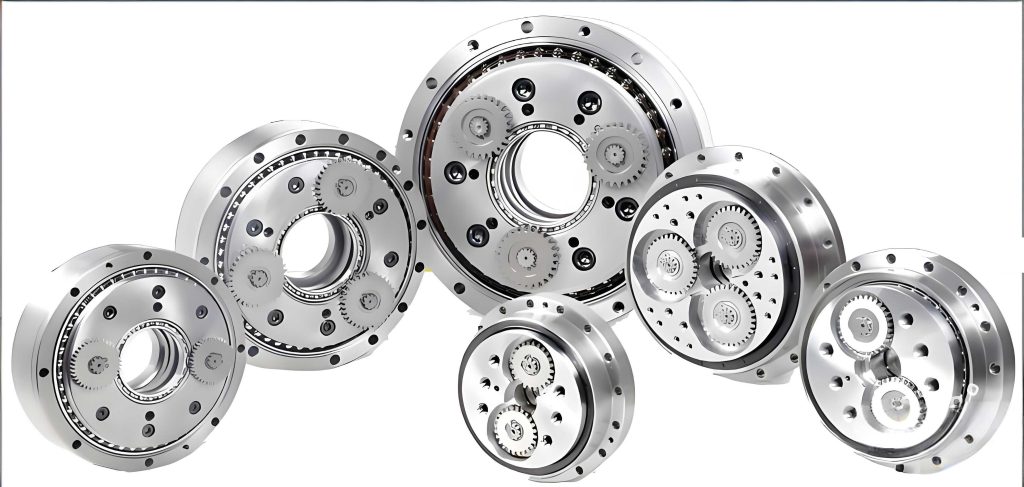
This image depicts a typical rotary vector reducer assembly, highlighting the placement of main bearings in a back-to-back configuration. Understanding the forces acting on these bearings is crucial for optimizing the rotary vector reducer’s performance across various robotic applications.
To ensure reliable operation under diverse loading conditions, we first analyze the force model of main bearings in a rotary vector reducer. Consider external loads applied to the reducer, which generate an overturning moment. Let $F_1$ and $F_2$ represent external forces acting at distances $c$ and $e$ from the bearing center, respectively. The external overturning moment $M_1$ is given by:
$$M_1 = c F_1 + e F_2$$
Inside the rotary vector reducer, this moment must be balanced by the radial forces on the main bearings. For two bearings arranged back-to-back, labeled A and B, with radial forces $F_{rA}$ and $F_{rB}$, and distances $a$ and $b$ from the force application points, the internal moment $M_2$ is:
$$M_2 = a F_{rA} + b F_{rB} = M_1$$
This equation reveals that the anti-overturning moment capability of the rotary vector reducer depends not only on the radial load capacity of the bearings but also on the contact angle, which influences the effective moment arm $L_{mn}$ between bearing force points. To quantify this, we examine a specific bearing example, such as the H76/182 used in some rotary vector reducers. Its structural parameters are summarized in Table 1.
| Parameter | Value |
|---|---|
| Inner diameter $d$ (mm) | 182 |
| Outer diameter $D$ (mm) | 214 |
| Ball diameter $D_w$ (mm) | 10.319 |
| Inner groove curvature radius $R_i$ (mm) | 5.366 |
| Outer groove curvature radius $R_e$ (mm) | 5.366 |
| Contact angle $\alpha$ | 30° / 40° |
| Number of balls $Z$ | 51 |
Using simulation tools like RomaxDesigner, we model the bearing system with a center distance $L = 100$ mm and an external overturning moment $M_1 = 1000$ N·m. The results for different contact angles are presented in Table 2, demonstrating how contact angle affects performance in a rotary vector reducer.
| Parameter | Contact Angle 30° | Contact Angle 40° |
|---|---|---|
| Dynamic load rating $C_r$ (kN) | 49.0 | 43.4 |
| Static load rating $C_{0r}$ (kN) | 73.4 | 64.5 |
| Force action point distance $L_{mn}$ (mm) | 214 | 266 |
| Radial deformation (μm) | 27.43 | 23.75 |
| Axial stiffness $K_a$ (kN/mm) | 830 | 1117 |
From Table 2, we infer that increasing the contact angle from 30° to 40° reduces the dynamic and static load ratings but enlarges the moment arm $L_{mn}$, thereby decreasing radial deformation from 27.43 μm to 23.75 μm. This enhances the anti-overturning moment capacity of the rotary vector reducer. Additionally, axial stiffness rises from 830 kN/mm to 1117 kN/mm, making larger contact angles beneficial for applications with high axial loads, such as in wrist joints of industrial robots. Thus, for rotary vector reducers, a contact angle range of 30° to 50° is recommended to balance radial, axial, and moment load capabilities.
Expanding on this analysis, we derive the axial stiffness $K_a$ using Hertzian contact theory. For an angular contact ball bearing, the axial deformation $\delta_a$ relates to the axial force $F_a$ and ball load $Q$ as:
$$F_a = Z Q \sin \alpha$$
where $Z$ is the number of balls and $\alpha$ is the contact angle. The stiffness can be expressed as:
$$K_a = \frac{dF_a}{d\delta_a} = Z \frac{dQ}{d\delta_a} \cos \alpha$$
Approximating the ball load-deformation relationship as $Q = k \delta^{3/2}$ based on Hertz contact, we get:
$$K_a \propto Z k \delta^{1/2} \cos \alpha$$
This formula underscores why increasing contact angle boosts axial stiffness in rotary vector reducer main bearings, albeit at the cost of reduced radial load capacity. To optimize for specific applications, we perform parametric studies, as shown in Table 3 for various contact angles.
| Contact Angle | Radial Load Capacity | Axial Load Capacity | Anti-Overturning Moment | Axial Stiffness | Suitable Rotary Vector Reducer Position |
|---|---|---|---|---|---|
| 30° | High | Moderate | Moderate | Moderate | Base, Shoulder |
| 40° | Moderate | High | High | High | Elbow, Wrist |
| 50° | Lower | Very High | Very High | Very High | Wrist (High Load) |
In designing main bearings for rotary vector reducers, structural parameters extend beyond contact angle. The outer ring width often differs from the inner ring to achieve lightweight design, but the critical dimension is the groove position rather than overall width. Thus, during precision manufacturing, we focus on controlling groove diameter and position, along with mating surface flatness. Tolerances for outer ring width deviation and parallelism can be relaxed, reducing cost without compromising the rotary vector reducer’s functionality. Similarly, the rib height on the outer ring base side serves dual purposes: preventing contact ellipse overflow and limiting axial displacement of internal components like pin gears. Therefore, its height is determined based on the specific layout of the rotary vector reducer.
For the inner ring, groove parameters and base flatness are tightly controlled, while rib height only ensures contact ellipse containment. Notably, the inner ring width typically exceeds the outer ring width, resulting in positive protrusion after preload. This design helps restrict axial movement of cycloidal gears, avoiding interference within the rotary vector reducer. The protrusion quantity, critical in standard bearing pairing, has minimal impact here; a tolerance of 0.1 mm suffices as it primarily affects cycloidal gear displacement.
Assembly height, however, is paramount for preload control in rotary vector reducers. Preload influences bearing stiffness, accuracy, and lifespan, so we严格控制 assembly height dispersion during production. Instead of targeting an absolute value, we manage batch-to-batch variation, allowing preload adjustment via shim selection during assembly. The relationship between preload force $P$ and axial displacement $\delta$ can be modeled experimentally or via simulation. For the H76/182 bearing, a typical curve follows:
$$\delta = \beta P^{2/3}$$
where $\beta$ is a geometry-dependent constant. This nonlinear relationship emphasizes the need for precise preload setting in rotary vector reducers to avoid excessive friction or inadequate rigidity.
In application, main bearings are installed back-to-back in the rotary vector reducer using定位预紧 (position preload). The assembly dimension chain involves bearing assembly heights $T_A$ and $T_B$, housing shoulder width $L_1$, theoretical shim thickness $L_3$, and planet carrier shoulder distance $L$. The chain equation is:
$$L = T_A + L_1 + T_B + L_3$$
To achieve desired preload, we adjust $L_3$ based on measured $T_A$ and $T_B$. Since assembly height dispersion is controlled, shim thickness variation remains manageable, simplifying installation. The actual shim thickness $L’_3$ includes axial deformation due to preload:
$$L’_3 = L_3 + \delta_A + \delta_B$$
where $\delta_A$ and $\delta_B$ are axial deformations of bearings A and B, respectively. By selecting shims accordingly, we ensure the rotary vector reducer operates with optimal stiffness and minimal play.
To further enhance design robustness, we consider fatigue life calculations using the ISO 281 standard. For angular contact ball bearings in rotary vector reducers, the equivalent dynamic load $P$ is:
$$P = X F_r + Y F_a$$
where $X$ and $Y$ are factors depending on contact angle, and $F_r$ and $F_a$ are radial and axial loads. The rated life in millions of revolutions $L_{10}$ is:
$$L_{10} = \left( \frac{C}{P} \right)^3$$
with $C$ as the dynamic load rating. For rotary vector reducers in robotics, we aim for $L_{10}$ values exceeding 10,000 hours under typical cyclic loads, ensuring durability across millions of operating cycles.
Material selection also plays a vital role in rotary vector reducer main bearings. We often employ high-carbon chromium steel (e.g., AISI 52100) or hybrid ceramics (silicon nitride balls) to reduce weight, increase speed capability, and enhance corrosion resistance. Heat treatment processes like carburizing or through-hardening are tailored to achieve desired hardness and toughness, critical for withstanding shock loads in robotic applications.
Lubrication and sealing are additional considerations for rotary vector reducers. Grease lubrication is common due to its simplicity and long maintenance intervals. We select greases with high viscosity index and anti-wear additives to minimize friction and prevent wear in main bearings. Seals must exclude contaminants while retaining lubricant, often using non-contact labyrinth seals or rubber contact seals depending on the rotary vector reducer’s environment.
In summary, the design and application of main bearings for rotary vector reducers demand a holistic approach, integrating force analysis, structural optimization, precision manufacturing, and careful installation. By focusing on key parameters like contact angle, groove position, and assembly height, while relaxing less critical tolerances, we achieve cost-effective production without sacrificing performance. Proper preload via shim adjustment ensures optimal stiffness and longevity, enhancing the reliability of rotary vector reducers in robotics. As technology advances, ongoing research into materials, lubrication, and simulation will further refine these bearings, enabling more compact, efficient, and durable rotary vector reducers for future robotic systems.