
In the field of industrial robotics, the reliability of core components is paramount to ensuring operational efficiency and minimizing downtime. Among these components, the rotary vector reducer, often abbreviated as RV reducer, serves as a critical transmission element in six-axis industrial robots. Its performance directly influences the robot’s precision, load capacity, and overall reliability. However, predicting the failure rate of a rotary vector reducer has been a persistent challenge due to the complexity of its structure, varying manufacturing conditions, and the lack of comprehensive failure data for domestic products. In this study, I address this issue by proposing a novel methodology that integrates fuzzy mathematics, expert evaluation, and multi-level analysis to estimate the failure rate and assess the reliability of rotary vector reducers. This approach quantifies engineering insights under practical production constraints, providing a theoretical foundation for spare parts management and reliability growth strategies for manufacturers utilizing rotary vector reducers.
The rotary vector reducer is a precision reduction device commonly used in industrial robots, accounting for approximately 30–40% of overall robot failures. Its high failure rate stems from factors such as rapid temperature rise, significant wear, limited lifespan, and manufacturing inconsistencies. While advancements in materials, processing techniques, heat treatment, and accuracy have been made, domestic rotary vector reducers still lag behind international standards in reliability metrics. Traditional reliability prediction methods, such as those relying on foreign handbooks like NPRD (Non-electronic Parts Reliability Data), often fail to align with the actual conditions of locally produced reducers. Therefore, developing a tailored approach for failure rate prediction is essential. In this work, I combine expert scoring with a multi-level analytic hierarchy process (AHP) to allocate weights to key components, leveraging NPRD data for non-critical parts to achieve a more accurate estimation. The methodology not only quantifies subjective engineering judgments but also offers a scalable framework for reliability assessment in complex mechanical systems.
To understand the failure mechanisms of a rotary vector reducer, it is crucial to first examine its structure and transmission principles. A typical rotary vector reducer, such as the RV-20E model, consists of a two-stage reduction system. The first stage is a planetary gear system, while the second stage is a cycloidal pin-wheel system. This design enables high reduction ratios, compact size, and high torque capacity, making it ideal for industrial robot joints. The primary components include an input gear, planetary gears, crank shafts, cycloidal gears, pins, a pin housing, and various bearings (e.g., roller bearings, needle bearings). These components work in tandem to transmit motion from the input shaft to the output shaft, with the cycloidal motion providing the secondary reduction. Understanding these interactions is vital for identifying failure-prone parts and allocating reliability resources effectively.
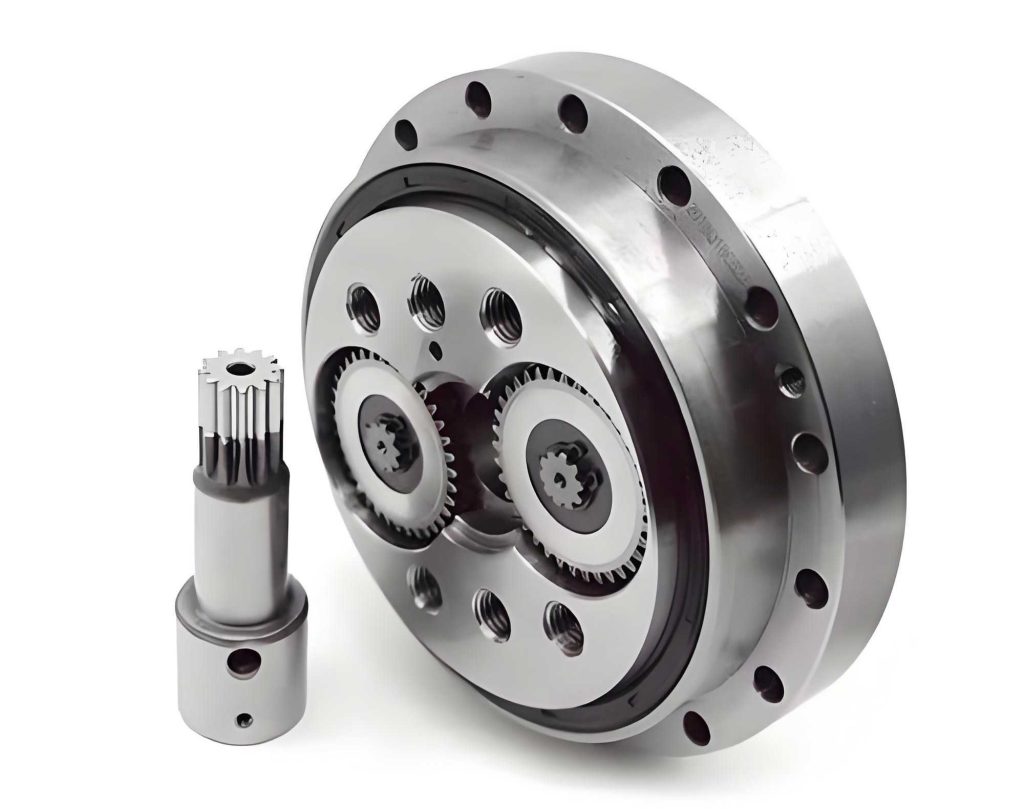
The transmission principle of a rotary vector reducer involves coordinated movement between its stages. When the input gear rotates, it drives the planetary gears, which in turn rotate and revolve around the central axis. The planetary gears are connected to crank shafts, causing eccentric motion in the cycloidal gears. These cycloidal gears then engage with pins in the pin housing, converting eccentric rotation into output rotation through the output plate. This multi-stage process subjects components to complex stresses, including friction, impact, and cyclic loading, leading to potential failures such as wear, fracture, or fatigue. By analyzing this mechanism, I can identify critical failure modes and prioritize components in the reliability prediction model. The rotary vector reducer’s efficiency and durability hinge on the precision and robustness of these interconnected parts.
To tackle the failure rate prediction problem, I employ a multi-level analytic hierarchy process combined with expert evaluation. This approach is grounded in fuzzy mathematics, which handles uncertainties and subjective judgments inherent in engineering assessments. The rotary vector reducer is decomposed into subsystems and components, creating a hierarchical structure for analysis. Specifically, I categorize the main parts into three subsystems: the planetary gear system (U1), the crank shaft and bearing system (U2), and the cycloidal gear and pin system (U3). Each subsystem is further divided into individual components, such as planetary gears, input gears, roller bearings, elastic retaining rings, crank shafts, needle bearings, support bearings, cycloidal gears, pins, and the pin housing. This multi-level breakdown simplifies the analysis and enhances accuracy by reducing the dimensionality of comparison matrices.
The hierarchical model for the rotary vector reducer is structured with four criteria influencing failure rate: complexity, technical difficulty, operational load, and component quality. These criteria are used to evaluate both the subsystems and their constituent parts. For the subsystem level, the goal is to determine the relative importance of each subsystem concerning the overall failure rate. Similarly, for the component level within each subsystem, the goal is to assess the weight of each part relative to its subsystem. This two-tiered analysis ensures a comprehensive consideration of factors affecting the rotary vector reducer’s reliability. I construct judgment matrices based on expert evaluations, where experts compare elements pairwise using a scale from 1 (equally important) to 9 (absolutely more important). The consistency of these matrices is verified using consistency ratios, ensuring reliable weight allocations.
Mathematically, let the judgment matrix for the criteria layer be denoted as \( A = (a_{ij})_{4 \times 4} \), where \( a_{ij} \) represents the relative importance of criterion \( i \) over criterion \( j \). This matrix is positive reciprocal, satisfying \( a_{ii} = 1 \) and \( a_{ij} = 1/a_{ji} \). The priority vector \( \mathbf{a} \) is obtained by solving the eigenvalue problem \( A\mathbf{w} = \lambda_{\text{max}}\mathbf{w} \), where \( \lambda_{\text{max}} \) is the maximum eigenvalue and \( \mathbf{w} \) is the corresponding eigenvector. After normalization, \( \mathbf{a} \) gives the weights of the criteria:
$$ \mathbf{a} = (a_1, a_2, a_3, a_4)^T $$
The consistency index \( CI \) is calculated as:
$$ CI = \frac{\lambda_{\text{max}} – n}{n – 1} $$
where \( n \) is the order of the matrix. The consistency ratio \( CR \) is then:
$$ CR = \frac{CI}{RI} $$
with \( RI \) being the random consistency index from standard tables. If \( CR < 0.1 \), the matrix is considered consistent. Similarly, judgment matrices are constructed for subsystems and components, yielding weight vectors \( \mathbf{w}_i \) for each subsystem \( i \) and \( \mathbf{p}_{ij} \) for each component \( j \) in subsystem \( i \). The overall weight of each component in the rotary vector reducer is computed through hierarchical total ordering, combining criteria and subsystem weights. For instance, the weight of subsystem \( U_i \) is:
$$ v_i = \sum_{k=1}^{4} a_k \cdot w_{ik} $$
where \( w_{ik} \) is the weight of subsystem \( i \) under criterion \( k \). The component weights \( P_{2ij} \) are then:
$$ P_{2ij} = v_i \cdot p_{ij} $$
This process is repeated for all components, ensuring a robust weight distribution that reflects their contribution to the overall failure rate of the rotary vector reducer.
To illustrate the expert evaluation process, consider the criteria comparison matrix based on expert inputs. For example, a matrix might be:
$$ A = \begin{bmatrix} 1 & 1/4 & 1/2 & 1/7 \\ 4 & 1 & 2 & 1/3 \\ 2 & 1/2 & 1 & 1/3 \\ 7 & 3 & 3 & 1 \end{bmatrix} $$
Solving this yields \( \lambda_{\text{max}} \approx 4.05 \), \( CI \approx 0.0167 \), and with \( RI = 0.90 \) for \( n=4 \), \( CR \approx 0.0186 < 0.1 \), indicating acceptable consistency. The normalized eigenvector gives the criteria weights: \( \mathbf{a} = (0.07, 0.247, 0.1465, 0.5364)^T \). This shows that component quality is the most influential criterion, followed by technical difficulty, operational load, and complexity. Such insights guide the focus of reliability improvements for the rotary vector reducer.
Once the weights are determined, the failure rate calculation proceeds by referencing failure data from NPRD for non-key components. I select a standard component with high consistency and minimal influence from manufacturing variations, such as an elastic retaining ring, as a baseline. Its failure rate \( \lambda_{\text{baseline}} \) is obtained from NPRD (e.g., \( 1.052 \times 10^{-6} \, \text{h}^{-1} \)). The failure rate of other components \( \lambda_{ij} \) is estimated proportionally based on their weights:
$$ \frac{P_{2ij}}{P_{\text{baseline}}} = \frac{\lambda_{ij}}{\lambda_{\text{baseline}}} $$
where \( P_{\text{baseline}} \) is the weight of the baseline component. The overall failure rate of the rotary vector reducer \( \lambda_s \) is the sum of the component failure rates, assuming a series system:
$$ \lambda_s = \sum_{i=1}^{3} \sum_{j} \lambda_{ij} $$
This approach leverages objective data while incorporating subjective weightings, enhancing the accuracy of failure rate predictions for domestically produced rotary vector reducers.
Reliability assessment involves deriving reliability functions and metrics such as Mean Time Between Failures (MTBF). Assuming constant failure rates for components and independence between them, the reliability of a component \( R_{ij}(t) \) at time \( t \) is:
$$ R_{ij}(t) = e^{-\lambda_{ij} t} $$
For the entire rotary vector reducer system, the system reliability \( R_s(t) \) is the product of component reliabilities:
$$ R_s(t) = \prod_{i=1}^{3} \prod_{j} R_{ij}(t) = e^{-\lambda_s t} $$
The MTBF is then calculated as:
$$ \text{MTBF} = \int_0^\infty R_s(t) \, dt = \frac{1}{\lambda_s} $$
These formulas provide a quantitative basis for evaluating the longevity and performance of the rotary vector reducer. By plotting \( R_s(t) \) over time, I can visualize reliability degradation and identify critical periods for maintenance or replacement.
To demonstrate the methodology, I apply it to a specific rotary vector reducer model, RV-20E. The hierarchical structure includes three subsystems and ten main components. Expert evaluations yield the following weight distributions after consistency checks. The criteria weights are as derived earlier: \( \mathbf{a} = (0.07, 0.247, 0.1465, 0.5364)^T \). Subsystem weights are computed from judgment matrices for each criterion. For example, the subsystem weight matrix \( W \) might be:
$$ W = \begin{bmatrix} 0.0844 & 0.0616 & 0.0654 & 0.1226 \\ 0.5605 & 0.3545 & 0.3412 & 0.5571 \\ 0.3551 & 0.5839 & 0.5934 & 0.3202 \end{bmatrix} $$
Multiplying \( \mathbf{a} \) by \( W^T \) gives the subsystem weights: \( \mathbf{v} = (0.096, 0.4756, 0.4278)^T \). Component weights within each subsystem are similarly obtained. For instance, in the planetary gear system (U1), the component weights \( \mathbf{p}_{11} \) might be \( (0.152, 0.257, 0.543, 0.048)^T \) for planetary gear, input gear, roller bearing, and elastic retaining ring, respectively. The overall component weights \( P_{2ij} \) are calculated as \( v_i \cdot p_{ij} \), resulting in values such as 0.0146 for the planetary gear. These weights are summarized in the table below, along with failure rates derived from the baseline elastic retaining ring failure rate of \( 1.052 \times 10^{-6} \, \text{h}^{-1} \).
| Component | Weight | Failure Rate (10⁻⁶ h⁻¹) |
|---|---|---|
| Planetary Gear | 0.0146 | 3.1345 |
| Input Gear | 0.0247 | 5.3029 |
| Roller Bearing | 0.0522 | 1.1207 |
| Elastic Retaining Ring | 0.0049 | 1.0520 |
| Crank Shaft | 0.0648 | 13.9120 |
| Needle Bearing | 0.2788 | 59.8570 |
| Support Bearing | 0.1318 | 28.2970 |
| Cycloidal Gear | 0.1026 | 22.0280 |
| Pin | 0.2729 | 58.5900 |
| Pin Housing | 0.0565 | 12.1300 |
| Rotary Vector Reducer (System) | 1.0000 | 214.6900 |
From the table, it is evident that needle bearings and pins have the highest failure rates (approximately \( 59.857 \times 10^{-6} \, \text{h}^{-1} \) and \( 58.590 \times 10^{-6} \, \text{h}^{-1} \), respectively), aligning with practical observations from manufacturer feedback. This highlights areas for reliability improvement, such as enhancing manufacturing precision or material quality for these components. The overall system failure rate is \( 214.69 \times 10^{-6} \, \text{h}^{-1} \), leading to an MTBF of approximately 4658 hours. The reliability function \( R_s(t) = e^{-214.69 \times 10^{-6} t} \) can be plotted to show degradation over time. For example, at 4000 hours, reliability drops to about 0.4237, and at 5000 hours, to 0.3418. This quantitative assessment aids in planning maintenance schedules and spare parts inventory for industrial robots using rotary vector reducers.
The proposed methodology offers several advantages for reliability engineering of rotary vector reducers. First, by integrating expert evaluation with multi-level AHP, it quantifies subjective engineering knowledge, making it applicable to domestic production contexts where handbook data may be inadequate. The use of fuzzy mathematics handles uncertainties in judgments, improving robustness. Second, the hierarchical decomposition simplifies complex systems, reducing computational burden and enhancing accuracy through localized comparisons. The consistency checks ensure logical coherence in weight allocations. Third, leveraging NPRD data for baseline components bridges the gap between generic data and specific applications, providing a pragmatic failure rate estimate. This approach not only predicts failure rates but also identifies critical components, guiding targeted reliability enhancements for rotary vector reducers.
In practice, this methodology can be extended to other mechanical systems in industrial robots, such as actuators or controllers, by adapting the criteria and hierarchy. For rotary vector reducers, ongoing work could involve dynamic weight adjustments based on real-time operational data or environmental factors. Additionally, incorporating failure mode and effects analysis (FMEA) could refine the criteria weights, further aligning the model with actual failure patterns. The flexibility of this framework supports continuous improvement in reliability prediction, contributing to the advancement of domestic manufacturing capabilities for rotary vector reducers.
In conclusion, the combination of expert scoring, multi-level analysis, and fuzzy mathematics provides a effective solution for failure rate prediction and reliability assessment of rotary vector reducers in industrial robots. This approach quantifies engineering insights, accommodates manufacturing realities, and yields actionable results for spare parts management and design optimization. By focusing on critical components like needle bearings and pins, manufacturers can prioritize resources to improve the overall reliability of rotary vector reducers, ultimately enhancing the performance and longevity of industrial robots. The methodology underscores the importance of tailored reliability strategies in advancing domestic robotics technology and supporting industrial automation initiatives.