
In the realm of advanced robotics, precision and reliability are paramount. As a researcher focused on robotic drive systems, I have extensively studied the performance metrics of Rotary Vector (RV) reducers, which are critical components in robotic joints due to their high torque capacity, compact size, and superior accuracy. This article delves into the theoretical foundations and experimental analysis of RV reducers, with a particular emphasis on transmission error—a key indicator of传动精度. I will explore the classification, sources, and measurement techniques for transmission error, design a practical test platform, and present detailed results using formulas and tables. The integration of modern technologies, such as virtual reality for simulation, has informed aspects of this work, but the core focus remains on the RV reducer. Throughout, I aim to provide a comprehensive understanding that underscores the importance of rigorous testing for ensuring the optimal performance of RV reducers in robotic applications.
Transmission error in an RV reducer refers to the deviation between the actual output rotation angle and the theoretical output rotation angle when the input shaft undergoes unidirectional motion. This error is quantified by the variation in the instantaneous transmission ratio compared to the theoretical transmission ratio. Mathematically, if $\theta_{in}$ is the input angle and $\theta_{out}$ is the output angle, the theoretical output angle for a reducer with transmission ratio $i$ is given by:
$$ \theta_{out,theoretical} = \frac{\theta_{in}}{i} $$
The transmission error $\theta_{er}$ is then defined as:
$$ \theta_{er} = \theta_{out,theoretical} – \theta_{out,actual} $$
This error is typically measured in arcminutes (′) or arcseconds, with high-precision RV reducers requiring errors within 1′ to meet robotic运动精度 standards. The transmission error directly impacts the positioning accuracy of robotic arms, making it a crucial parameter for evaluation.
Transmission errors in RV reducers can be categorized based on their nature and sources. Drawing from general机构误差 theory, they are classified into significant errors, random errors, and systematic errors. Significant errors arise from gross defects, such as manufacturing tolerances exceeded, and can be eliminated by component replacement. Random errors, like those from machining variations, are unpredictable and follow statistical distributions; they can be minimized but not entirely removed. Systematic errors, such as those from design approximations, are predictable and can be corrected through calibration or design adjustments. The sources of transmission error are multifaceted, encompassing design, manufacturing, usage, and measurement aspects. Below is a table summarizing these error sources and their characteristics for RV reducers:
| Error Source | Description | Impact on RV Reducer | Mitigation Strategies |
|---|---|---|---|
| Design Error | Errors from approximate calculations, simplified models, or neglected factors during design. | Inherent “先天缺陷” that affects传动精度; e.g., imperfect gear tooth profile design. | Use precise modeling, finite element analysis, and iterative design refinements. |
| Manufacturing Error | Errors from component fabrication and assembly, including eccentricity, size/shape deviations, and轴偏差. | Directly introduces variations in gear meshing and alignment; e.g., bearing runout or gear pitch errors. | Tight tolerance control, high-precision machining, and rigorous quality inspection. |
| Usage Error | Errors from operational factors like thermal deformation, wear, friction, vibration, and负载变化. | Degrades performance over time; e.g., heat-induced expansion altering clearances. | Optimize lubrication, use thermally stable materials, and implement protective coatings. |
| Measurement Error | Errors from measurement tools and methods, such as encoder inaccuracies or observational limitations. | Affects the reliability of test data; e.g., noise in angle sensor readings. | Employ high-resolution sensors, calibration protocols, and redundant measurement systems. |
To accurately assess the transmission error of an RV reducer, I designed a dedicated test platform that emphasizes simplicity and high precision. The platform comprises a servo motor to drive the input shaft, a high-resolution angle encoder attached to the output shaft, and a rigid coupling connecting the motor to the RV reducer. The伺服电机 is programmed to rotate through specific angles, and the encoder captures the actual output rotation. The theoretical output is computed using the transmission ratio, allowing for direct calculation of transmission error. Key components were selected to meet the stringent精度要求 of RV reducers: a Mige 130LB-07730 servo motor for precise input control, a TAMAGAWA TS5667 angle encoder with high angular resolution, an RV-20E reducer with a transmission ratio of 121, and supporting elements like couplings and drives. This setup ensures that measurement uncertainties are minimized, enabling reliable evaluation of the RV reducer’s performance.
The test methodology for transmission error involves programming the servo motor to rotate input angles, recording the encoder values, and computing the error. For instance, with an input angle of 544.5° and a transmission ratio $i = 121$, the theoretical output angle is:
$$ \theta_{out,theoretical} = \frac{544.5^\circ}{121} \approx 4.5^\circ $$
The actual output angle $\theta_{out,actual}$ is derived from the encoder count $N$. Assuming the encoder has a resolution of $R$ counts per revolution (e.g., 2^20 counts for high-precision encoders), the angle in degrees is:
$$ \theta_{out,actual} = \left( \frac{N}{R} \right) \times 360^\circ $$
In practice, for the TAMAGAWA encoder used, $R$ is 2^24 counts, ensuring fine granularity. The transmission error in arcminutes is then:
$$ \theta_{er} (\text{in arcminutes}) = \left( \theta_{out,theoretical} – \theta_{out,actual} \right) \times 60 $$
Tests were conducted at multiple input angles to evaluate consistency. The results, processed and tabulated, demonstrate the传动精度 of the RV reducer. Below is a table presenting the test outcomes for the RV-20E reducer:
| Theoretical Output Angle (°) | Encoder Count (N) | Actual Output Angle (arcminutes) | Transmission Error (arcminutes) |
|---|---|---|---|
| 0 | 613227 | 0.00 | 0.00 |
| 4.5 | 529615 | 2700.66 | -0.66 |
| 9.0 | 6459955 | 129.90 | |
| 18.0 | 67875810 | 799.18 | |
| 27.0 | 71152916 | 199.67 | |
| 36.0 | 74429821 | 599.84 |
As shown, the transmission errors are within 1 arcminute, aligning with the manufacturer’s specifications for the RV reducer. This confirms the high传动精度 of the RV-20E model and validates the test platform’s efficacy. The minor deviations observed may stem from random manufacturing errors or transient thermal effects, but overall, the RV reducer meets the rigorous demands of robotic applications.
Beyond transmission error, I conducted additional tests to evaluate other critical performance parameters of the RV reducer, including传动效率, stiffness, backlash, and precision retention寿命. For传动效率 testing, torque and speed sensors were installed at both the input and output shafts. The mechanical efficiency was calculated in real-time using an efficiency analyzer, with the formula:
$$ \eta = \frac{T_{out} \times \omega_{out}}{T_{in} \times \omega_{in}} \times 100\% $$
where $T$ is torque and $\omega$ is angular velocity. The RV reducer exhibited efficiencies above 85% under rated loads, indicating minimal energy loss. Stiffness and backlash were assessed by applying bidirectional torque loads to the output shaft while the input was fixed. The resulting hysteresis curve, plotted from相位变化 data, allowed computation of torsional stiffness $K$ and backlash $B$:
$$ K = \frac{\Delta T}{\Delta \theta} $$
where $\Delta T$ is the torque increment and $\Delta \theta$ is the angular deflection. For the RV reducer, stiffness values exceeded 10 Nm/arcmin, ensuring high rigidity under operational loads. Backlash, measured as the maximum angular play, was consistently below 3 arcminutes, highlighting the reducer’s minimal空程.
Precision retention寿命 testing simulated real-world robotic cycles to evaluate long-term accuracy. The RV reducer was subjected to repetitive motion profiles under负载 conditions mirroring typical robotic operations. Position accuracy was monitored using displacement sensors, and data was collected via a data acquisition system. Over 10,000 cycles, the transmission error remained within 1.5 arcminutes, demonstrating the RV reducer’s robustness and durability. This longevity is crucial for industrial robots where maintenance downtime must be minimized. The integration of electromechanical and optical measurement techniques ensured comprehensive data capture, reinforcing the reliability of the test outcomes for the RV reducer.
In conclusion, this article has presented a detailed analysis and experimental investigation of RV reducers, focusing on transmission error as a key performance metric. Through theoretical exposition and practical testing, I have shown that the RV reducer, exemplified by the RV-20E model, achieves high传动精度 with errors within 1 arcminute. The designed test platform, incorporating high-precision components like servo motors and angle encoders, proved effective for evaluating传动误差, efficiency, stiffness, and lifespan. The use of formulas and tables has facilitated clear summarization of data, underscoring the RV reducer’s suitability for robotic applications. While challenges such as standardization in 3D simulation technologies exist, the advancements in RV reducer testing highlight ongoing progress in robotic drive systems. Future work may involve integrating virtual reality for enhanced仿真 of RV reducer dynamics, but the core emphasis remains on refining test methodologies to further improve the reliability and accuracy of RV reducers.
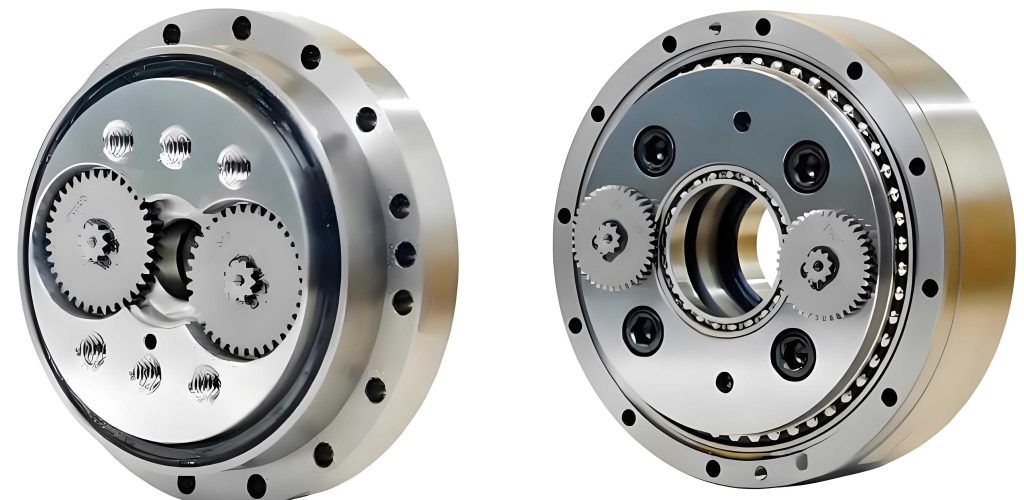
As a visual aid, below is an image depicting a typical RV reducer used in robotic joints, illustrating its compact and精密 design:
The RV reducer continues to be a pivotal component in robotics, and ongoing research into its testing and optimization will drive innovations in automation. By leveraging advanced measurement techniques and systematic analysis, we can ensure that RV reducers meet the ever-increasing demands for precision and durability in modern robotic systems.