
As a precision engineer specializing in robotic drive systems, I have dedicated significant effort to understanding the factors that influence the exceptional performance of Rotary Vector (RV) reducers. These compact, high-ratio speed reducers are the cornerstone of modern industrial robot joints, prized for their high torque capacity, compactness, and, most critically, their exceptional positional accuracy. The allowable transmission angular error for a typical industrial-grade RV reducer is often specified to be no greater than 1 arc-minute (1′). Achieving and maintaining this level of precision is a formidable challenge, as it is profoundly sensitive to minute deviations introduced during the manufacturing and assembly of its components. While the complete RV reducer consists of a first-stage planetary gear train and a second-stage cycloidal drive, it is widely acknowledged that the second reduction stage contributes more significantly to the overall transmission error. Within this critical stage, the interaction between the crankshafts, the cycloid gears, and the output mechanism (often a planet carrier) is paramount. This article, from my analytical perspective, focuses on modeling and analyzing the primary errors associated with these three key components. By representing their kinematic relationship through an equivalent four-bar linkage model, we can directly establish the input-output relationship for the second stage and rigorously quantify how individual and combined manufacturing tolerances propagate to affect the final output rotational accuracy of the RV reducer.
The core of the second stage in an RV reducer is the cycloidal disc principle. An input rotation, typically from the first-stage planetary carrier, drives two or more eccentric crankshafts. These crankshafts, in turn, cause the cycloid gears to undergo a compound epicycloidal motion relative to a stationary ring of needle rollers (the pinwheel). This motion is then converted into a slow rotation of the output flange through a set of pins or rollers housed in the output mechanism. The kinematic integrity of this process hinges on the precise geometry and alignment of the crankshaft eccentric journals, the bores in the cycloid gears that fit over these journals (via bearings), and the corresponding bores in the output mechanism. Any deviation from the ideal dimensions or positions of these features constitutes a primary error that directly degrades transmission precision.
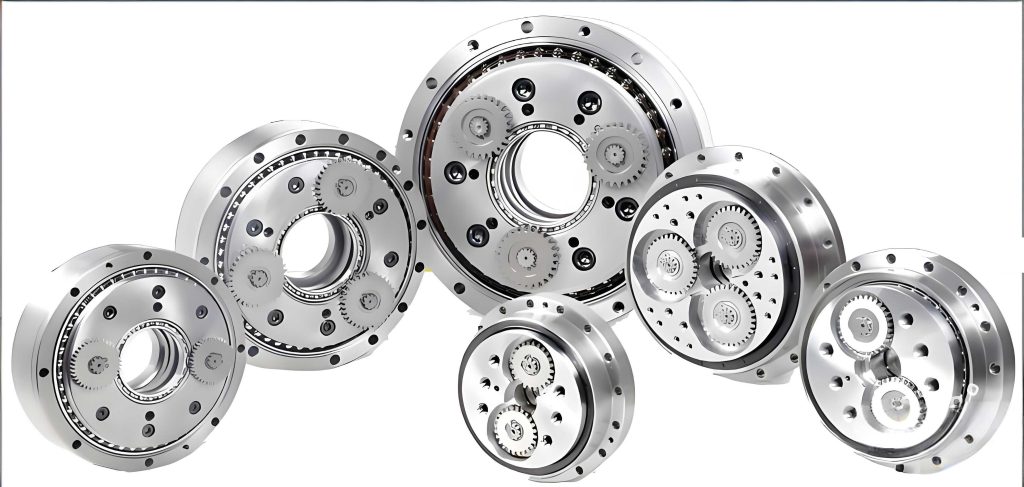
Before delving into error analysis, it is essential to establish the baseline parameters of a common RV reducer model, such as the RV-40E, which serves as our reference. These parameters define the ideal geometry against which errors are measured.
| Parameter Name | Symbol | Value |
|---|---|---|
| Pin Center Circle Diameter | $d_p$ | 128 mm |
| Pin Diameter | $D_{rp}$ | 6 mm |
| Number of Cycloid Gear Teeth | $z_c$ | 39 |
| Number of Sun Gear Teeth (Stage 1) | $z_1$ | 10 |
| Number of Planetary Gear Teeth (Stage 1) | $z_2$ | 26 |
| Number of Pinwheel Teeth | $z_p$ | 40 |
| Crankshaft Eccentricity | $e$ | 1.3 mm |
| Typical Input Speed | $n$ | 525 rpm |
Establishing the Equivalent Four-Bar Linkage Model
The kinematic chain formed by two opposing crankshafts, the cycloid gear, and the output mechanism can be abstracted into a planar four-bar linkage. This elegant simplification is powerful for error analysis. In the ideal, error-free state of the RV reducer:
- The eccentricity of the two crankshafts ($e$) acts as two equal cranks, $l_1$ and $l_3$.
- The center distance between the two crankshaft bearing bores in the cycloid gear acts as the coupler link, $l_2$.
- The center distance between the two corresponding crankshaft bearing bores in the output mechanism acts as the ground link, $l_4$.
With perfect synchronization of the crankshafts, $l_2 \parallel l_4$ and $l_1 \parallel l_3$, forming a perfect parallelogram $O_1 P_i P_j O_2$. The input angle is the rotation of the cranks $l_1, l_3$, and the output angle is related to the motion of the ground link $l_4$ (which is fixed in orientation but its effective points move with the output mechanism). When primary errors are introduced—such as deviations in crankshaft eccentricity, cycloid gear bore positions, or output mechanism bore positions—the lengths ($l_i$) and orientations ($\beta_i$) of these links deviate from their nominal values, breaking the perfect parallelogram as shown in the generalized error schematic $O_1 P’_i P’_j O’_2$.
The fundamental kinematic closure equation for the four-bar mechanism, considering deviations, is given by the vector sum:
$$ \vec{l’}_1 + \vec{l’}_2 – \vec{l’}_3 = \vec{l’}_4 $$
where $l’_i = l_i + \Delta l_i$ and $\beta’_i = \beta_i + \Delta \beta_i$ represent the actual (deviated) link lengths and angles, respectively. Projecting this vector equation onto the x and y axes yields:
$$ (l_1 + \Delta l_1) \cos \beta’_1 + (l_2 + \Delta l_2) \cos \beta’_2 = (l_3 + \Delta l_3) \cos \beta’_3 + (l_4 + \Delta l_4) \cos \beta’_4 $$
$$ (l_1 + \Delta l_1) \sin \beta’_1 + (l_2 + \Delta l_2) \sin \beta’_2 = (l_3 + \Delta l_3) \sin \beta’_3 + (l_4 + \Delta l_4) \sin \beta’_4 $$
Furthermore, bearing clearances at the joints (between crankshaft journals and the cycloid gear bores, and between crankshafts and output mechanism bores) introduce additional small displacement vectors $\Delta \vec{p}$. For a joint with radial clearance $\Delta p$, the displacement of the effective center point can be modeled as:
$$ \Delta \vec{p} = P_i P’_i = \Delta p \cdot \vec{f}_p $$
where $\vec{f}_p$ is a unit vector in the direction from one link’s center to the other at the joint.
For analytical simplification, we often analyze the case where the output mechanism’s positional error is initially neglected ($\Delta \beta_4 \approx 0$). Assuming small angular errors for the coupler link ($\beta’_2$ is small), we can use the approximations $\sin \beta’_2 \approx \beta’_2$ and $\cos \beta’_2 \approx 1 – (\beta’_2)^2/2$. Substituting and manipulating the projected equations leads to a quadratic equation in $\beta’_2$:
$$ a (\beta’_2)^2 + b \beta’_2 + c = 0 $$
where the coefficients $a$, $b$, and $c$ are functions of the deviated link parameters:
$$ a = l’_2 l’_4 – l’_1 l’_2 \cos \beta’_1 $$
$$ b = 2 l’_1 l’_2 \sin \beta’_1 $$
$$ c = (l’_1)^2 + (l’_2)^2 + (l’_4)^2 – (l’_3)^2 – 2l’_1 l’_4 \cos \beta’_1 + 2l’_1 l’_2 \cos \beta’_1 – 2l’_2 l’_4 $$
Solving this quadratic allows us to compute the actual coupler angle $\beta’_2$ for a given input angle $\beta’_1$ and set of errors, from which the resulting output rotation error of the RV reducer can be derived.
Analysis of Individual Primary Error Sources
The impact of each primary error source is investigated by considering it in isolation, first under “rigid” conditions (unloaded, geometric error only) and then under “elastic” conditions (loaded, considering contact deformations at bearings and teeth).
Crankshaft Eccentricity Error
This error, denoted $\Delta e$, directly alters the lengths of cranks $l_1$ and $l_3$. Under rigid conditions, bearing clearances allow the cycloid gear to shift, changing the effective positions of $P_i$ and $P_j$, while $l_2$ and $l_4$ remain nominally unchanged in length. The mechanism deforms from $O_1 P_i P_j O_2$ to $O_1 P’_i P’_j O_2$.
Under load, the force transmission through the RV reducer induces elastic deflections at the bearing contacts. The cycloid gear experiences both tangential ($F_t$) and radial ($F_r$) forces from the crankshafts. These forces, calculated from the gear meshing dynamics, cause small elastic displacements $l_{11}$ and $l_{33}$ at the joints. The effective loaded cranks become $l”_1$ and $l”_3$, found using the law of cosines in triangles $\triangle O_1 P’_i P”_i$ and $\triangle O_1 P’_j P”_j$:
$$ l”_1 = \sqrt{ (l’_1)^2 + (l_{11})^2 – 2 (l’_1 \cdot l_{11}) \cos \theta_1 } $$
$$ l”_3 = \sqrt{ (l’_3)^2 + (l_{33})^2 – 2 (l’_3 \cdot l_{33}) \cos \theta_3 } $$
Here, $\theta_1$ and $\theta_3$ are the angles between the rigid-error crank vectors and the elastic displacement vectors, determined by the force directions. Analysis shows that the maximum rigid geometric error often occurs when the input angle $\beta’_1 = 90^\circ$.
My parametric studies reveal a clear trend: as the crankshaft eccentricity error $\Delta e$ varies within a range of ±0.1 mm, the output angular error changes. The rigid error ranges from approximately 0.0333° to 0.0389°, while the elastic error is slightly larger, ranging from 0.0335° to 0.0390%. Crucially, the error is minimized when $\Delta e$ is negative (i.e., the actual eccentricity is less than the nominal value). Therefore, for higher precision, manufacturing should aim for the crankshaft eccentricity to be at the lower limit of its tolerance band.
Cycloid Gear Crankshaft Bore Eccentricity Error
This error, $\Delta c_{cyc}$, affects the position of the cycloid gear’s bore centers, primarily altering the length and orientation of the coupler link $l_2$. Under rigid conditions, $l_1$ and $l_3$ maintain their nominal lengths but change orientation, $l_2$ changes in both length and orientation, and $l_4$ is unaffected. The analysis proceeds similarly, incorporating bearing clearance and later elastic deflections $l_{11}$ and $l_{33}$ under load.
The results are intriguing. The rigid output error for a ±0.1 mm bore error variation ranges from 0.036058° to 0.036111°, and the elastic error from 0.03618° to 0.03624°. Unlike the crankshaft error, the transmission error shows a slight decrease (improved accuracy) for both positive and negative deviations of the bore position from nominal. This suggests that a small, controlled error in the cycloid gear bore position can partially compensate for other inherent errors in the system, effectively “tuning” the linkage. Thus, the manufacturing tolerance for this feature can be relatively more relaxed within a specific symmetric band without degrading, and potentially even slightly improving, the RV reducer‘s precision.
Output Mechanism Crankshaft Bore Eccentricity Error
This error, $\Delta c_{out}$, directly changes the length of the ground link $l_4$. In the rigid model, $l_1$, $l_2$, and $l_3$ keep their nominal lengths but may change orientation, while $l_4$ changes length. Elastic deflections are again superposed under load.
The sensitivity analysis shows a distinct asymmetry. For a ±0.1 mm error in the output bore position, the rigid error varies between 0.036008° and 0.036123°, and the elastic error between 0.038588° and 0.038706%. The output error increases significantly when $\Delta c_{out}$ is negative (bore centers closer together than nominal) and decreases notably when $\Delta c_{out}$ is positive (bore centers farther apart). Therefore, to enhance the accuracy of the RV reducer, the bores in the output mechanism should be manufactured toward the upper limit of their tolerance band, creating a slightly larger center distance.
| Error Source | Rigid Error Range | Elastic Error Range | Recommended Tolerance Bias |
|---|---|---|---|
| Crankshaft Eccentricity ($\Delta e$) | 0.0333° – 0.0389° | 0.0335° – 0.0390° | Toward Lower Limit (Negative Bias) |
| Cycloid Gear Bore ($\Delta c_{cyc}$) | 0.036058° – 0.036111° | 0.03618° – 0.03624° | Symmetric (Can be relaxed) |
| Output Mechanism Bore ($\Delta c_{out}$) | 0.036008° – 0.036123° | 0.038588° – 0.038706° | Toward Upper Limit (Positive Bias) |
Analysis of Combined Error Effects
In a real RV reducer, all primary errors exist simultaneously. Their combined effect is not merely additive; they interact in a coupled manner within the four-bar linkage kinematics. Studying these interactions is key to establishing a comprehensive tolerance design strategy.
Combination: Crankshaft Eccentricity and Cycloid Gear Bore Errors
When these two errors are varied together, the resulting output error landscape forms a convex, stepped surface. The minimum error region confirms the individual findings: lowest errors occur when the crankshaft error is negative and the cycloid gear bore error is within its central, symmetric range. The combined rigid error for variations within ±0.1 mm for both parameters ranges from 0.0347° to 0.0375°, with elastic errors between 0.0355° and 0.0383°.
Combination: Crankshaft Eccentricity and Output Mechanism Bore Errors
This combination also yields a convex error surface. The most favorable region for minimizing the RV reducer‘s error is where the crankshaft error is negative and the output mechanism bore error is positive. The combined rigid error varies from 0.0346° to 0.0375°, and the elastic error from 0.0354° to 0.0383°.
Combination: Cycloid Gear Bore and Output Mechanism Bore Errors
The interaction between these two “link length” errors produces a more complex, saddle-shaped error surface. The global minimum error occurs not when both are zero, but when the errors are antagonistic: a positive maximum cycloid gear bore error combined with a negative maximum output mechanism bore error, or vice-versa. However, given the previous recommendation to bias the output bore error positively for independent benefit, the logical complementary choice is to bias the cycloid gear bore error negatively. This combination provides a near-optimal compensation. The rigid error for this combined variation spans 0.0358° to 0.0362°, with elastic errors between 0.0384° and 0.0387°.
| Error Combination | Rigid Error Range | Elastic Error Range | Optimal Error Sign Combination |
|---|---|---|---|
| $\Delta e$ & $\Delta c_{cyc}$ | 0.0347° – 0.0375° | 0.0355° – 0.0383° | $\Delta e$ (-), $\Delta c_{cyc}$ (~0) |
| $\Delta e$ & $\Delta c_{out}$ | 0.0346° – 0.0375° | 0.0354° – 0.0383° | $\Delta e$ (-), $\Delta c_{out}$ (+) |
| $\Delta c_{cyc}$ & $\Delta c_{out}$ | 0.0358° – 0.0362° | 0.0384° – 0.0387° | $\Delta c_{cyc}$ (-), $\Delta c_{out}$ (+) |
Error Control Strategies and Manufacturing Implications
The analytical results lead to concrete, actionable strategies for designing and manufacturing high-precision RV reducers.
- Tolerance Allocation with Intentional Bias: Instead of aiming for the nominal value at the center of a tolerance band, critical dimensions should be biased.
- Crankshaft Eccentricity ($e$): Target the lower specification limit (LSL).
- Output Mechanism Bore Center Distance ($c_{out}$): Target the upper specification limit (USL).
- Cycloid Gear Bore Center Distance ($c_{cyc}$): Can be held to a symmetric tolerance, but if paired with a positive $c_{out}$ bias, a slight bias toward the LSL is beneficial.
- Bearing Clearance Management: The analysis inherently includes bearing radial clearance as a joint displacement error. Excessive clearance amplifies the effect of all geometric errors. Therefore, specifying and controlling high-precision, low-clearance bearings (e.g., C2 or P4 class) is crucial for minimizing the “play” that allows the four-bar linkage to deviate from its ideal constrained path.
- Elastic Deformation Consideration: The consistent increase in error from the rigid to the elastic model underscores the importance of stiffness. Design choices that increase the structural rigidity of the crankshafts, cycloid gear, and output mechanism, as well as using stiffer bearing types, will reduce the load-induced error component.
- Selective Assembly: For ultra-high-precision applications, the concept of selective assembly can be employed. By measuring the actual errors of individual components (crankshaft eccentricity, bore distances), they can be selectively matched into sets that minimize the predicted combined output error based on the four-bar model, optimizing the performance of each assembled RV reducer unit.
Dynamic Considerations and Extended Error Sources
While this analysis focuses on primary geometric errors under static or quasi-static conditions, the complete picture of RV reducer accuracy involves additional dynamic factors:
- Cycloid-Pinwheel Mesh Error: The form error and spacing error of the cycloid gear teeth and the needle rollers constitute another major error source that directly modulates the output angle. This is often analyzed separately but ultimately combines with the four-bar linkage error.
- Thermal Effects: Differential thermal expansion of the components under operating temperatures can effectively alter the link lengths ($l_1, l_2, l_3, l_4$) in the model, introducing a thermally-induced error drift.
- Torsional Deflection: The torsional wind-up of the crankshafts under load adds a phase lag between the input and the effective motion of the crank pins, which can be modeled as an additional angular error on $\beta_1$.
- Lubrication Film: The thickness of the elastohydrodynamic lubrication film in the gear meshes and bearings slightly increases effective clearances, similar to enlarging the $\Delta p$ values in the model.
A comprehensive error budget for an RV reducer would integrate the four-bar linkage error model developed here with statistical models for the cycloid mesh error, thermal models, and torsional stiffness data.
Conclusion
Through the establishment and analysis of an equivalent four-bar linkage model, this study has systematically dissected the influence of primary geometric errors in the second reduction stage of an RV reducer. The model provides a direct and insightful method to relate input rotation to output rotation in the presence of component deviations. The key findings are that errors are not equally detrimental and that their effects can be compensatory. Specifically, for the RV reducer to achieve its required sub-arc-minute precision, a strategic approach to manufacturing tolerances is essential: crankshaft eccentricities should be biased low, output mechanism bore distances biased high, and cycloid gear bore distances can be held to a more relaxed, symmetric tolerance. Furthermore, the analysis confirms that elastic deformations under load consistently degrade precision compared to the purely geometric case, highlighting the importance of system stiffness and controlled bearing clearance. This work provides a foundational theoretical framework that can guide the design, manufacturing, and selective assembly processes for high-performance RV reducers, ultimately contributing to the advancement of precision robotics and motion control systems.