
In the field of industrial robotics, the RV reducer plays a critical role as a high-precision transmission component, particularly in joint applications where compact size, high torque capacity, and reliable performance are paramount. As a researcher focused on mechanical reliability, I have conducted an in-depth study on the cycloidal pin gear transmission system, which is the core of the RV reducer. This transmission mechanism is responsible for the high load-bearing capability and efficiency of the RV reducer. In this work, I aim to analyze the reliability and sensitivity of the cycloidal pin gear transmission under dynamic loading conditions, providing a theoretical foundation for structural optimization and reliability enhancement of RV reducers. The analysis involves finite element modeling, transient dynamics simulation, response surface methodology, and Monte Carlo-based probabilistic assessments.
The RV reducer operates through a two-stage reduction process: the first stage involves a planetary gear train, and the second stage utilizes a cycloidal pin gear mechanism. The cycloidal gear, driven by crankshafts via eccentric motion, meshes with a set of pins arranged on a fixed pin gear housing. This design allows for high reduction ratios and compactness. However, the stress distribution during meshing is complex and influences the overall reliability of the RV reducer. Therefore, understanding the maximum equivalent stress and its sensitivity to key design parameters is essential for improving the durability and performance of RV reducers.
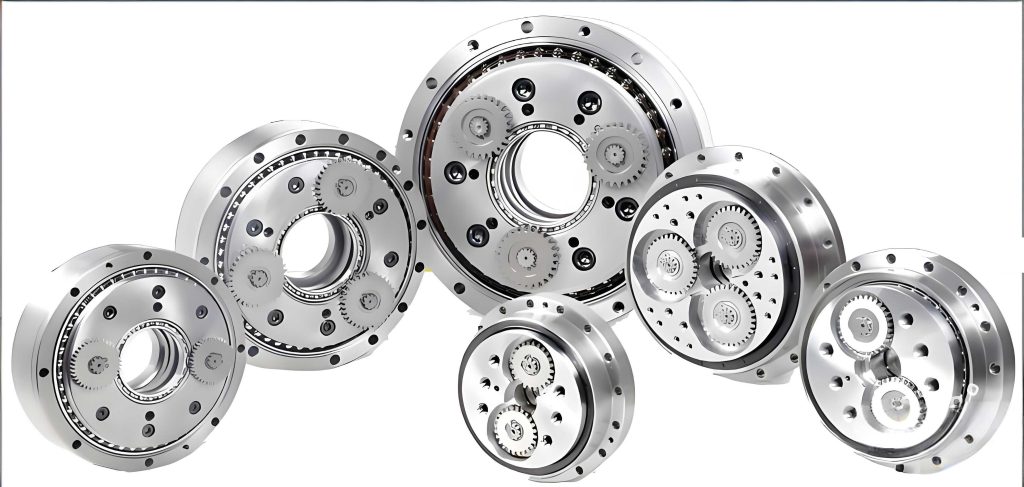
To begin the analysis, I developed a three-dimensional model of the cycloidal gear based on its tooth profile equations. The tooth profile of the cycloidal gear is derived from the parametric equations describing the path of the pin centers. The theoretical tooth profile for no-backlash meshing can be expressed as:
$$ X = (r_p – r_{rp}S) \cos[(1 – i_H)\theta] – (a – k_1 r_{rp}S) \cos(i_H\theta) $$
$$ Y = -(r_p – r_{rp}S) \sin[(1 – i_H)\theta] + (a – k_1 r_{rp}S) \sin(i_H\theta) $$
where \( r_p \) is the distribution circle diameter of the pins, \( r_{rp} \) is the pin radius, \( a \) is the eccentricity of the crankshaft, \( i_H = Z_p / Z_c \) is the transmission ratio with \( Z_p \) as the number of pins and \( Z_c \) as the number of cycloidal gear teeth, \( k_1 = a Z_p / r_p \), and \( S = (1 + k_1^2 – 2k_1 \cos \theta)^{-1/2} \). For practical applications, modifications are applied to account for lubrication and thermal effects, leading to a modified profile equation:
$$ X = [(r_p + \Delta r_p) – (r_{rp} + \Delta r_{rp})S] \cos[(1 – i_H)\theta] – [a – k_1 (r_{rp} + \Delta r_{rp})S] \cos(i_H\theta) $$
$$ Y = -[(r_p + \Delta r_p) – (r_{rp} + \Delta r_{rp})S] \sin[(1 – i_H)\theta] + [a – k_1 (r_{rp} + \Delta r_{rp})S] \sin(i_H\theta) $$
where \( \Delta r_{rp} \) and \( \Delta r_p \) are modification amounts for the pin radius and distribution circle radius, respectively. Using these equations, I created a detailed 3D model in SolidWorks, including the cycloidal gear, pins, and pin gear housing. To simulate the eccentric motion, I incorporated an eccentric component attached to the cycloidal gear, allowing it to rotate around a fixed point. The assembled model represents a single cycloidal gear system for computational efficiency, as the RV reducer typically uses two cycloidal gears in parallel with identical loading conditions.
For the finite element analysis, I imported the 3D model into ANSYS Workbench. The materials were assigned based on standard RV reducer components: the cycloidal gear made of 20CrMnMo, the pins of GCr15, and the housing of QT500-7. The material properties are summarized in Table 1.
| Component | Material | Elastic Modulus (N/m²) | Poisson’s Ratio |
|---|---|---|---|
| Cycloidal Gear | 20CrMnMo | 2.07 × 10¹¹ | 0.254 |
| Pins | GCr15 | 2.08 × 10¹¹ | 0.3 |
| Pin Gear Housing | QT500-7 | 1.68 × 10¹¹ | 0.24 |
Meshing was performed with hexahedral elements to ensure accuracy and resistance to distortion. The contact regions between the cycloidal gear and pins were refined to capture stress concentrations effectively. The mesh consisted of 103,454 nodes and 19,709 elements, with an average quality of 0.75683. To validate mesh independence, I refined the mesh in the contact areas, resulting in 198,977 nodes and 40,313 elements, and compared the maximum equivalent stress results; the difference was within 5.7%, confirming the reliability of the simulation.
For the transient dynamics analysis, I applied boundary conditions based on the kinematic and torque relationships of the RV reducer. The motion equations for the RV reducer can be derived from planetary gear theory. The homogeneous equations governing the angular velocities and torques are:
$$ \omega_1 + k_1 \omega_2 + (-1 – k_1) \omega_6 = 0 $$
$$ \omega_4 + k_2 \omega_5 + (-1 – k_2) \omega_3 = 0 $$
$$ \omega_2 = \omega_3 $$
$$ \omega_4 = \omega_6 $$
$$ \omega_5 = 0 $$
$$ \omega_1 = \omega_{1N} $$
and for torques:
$$ T_1 + k_1 T_2 + (-1 – k_1) T_6 = 0 $$
$$ T_4 + k_2 T_5 + (-1 – k_2) T_3 = 0 $$
$$ T_2 = T_3 $$
$$ T_4 = T_6 $$
$$ T_5 = 0 $$
$$ T_1 = T_{1N} $$
where \( \omega_1 \) and \( T_1 \) are the angular velocity and torque of the input motor shaft, \( \omega_4 \) and \( T_4 \) are for the cycloidal gear, and other subscripts represent components like planetary gears and crankshafts. For an RV20E reducer with an input speed of 1815 rpm and a rated load of 167 N·m, I calculated the cycloidal gear speed as 61.261 rpm and the torque as -80.73 N·m. In the simulation, the eccentric component was assigned a rotational speed of 61.261 rpm around the X-axis, with all translations and other rotations constrained. A torque of 80.73 N·m was applied to the cycloidal gear. Frictional contact with a coefficient of 0.13 was defined between the cycloidal gear and pins, using an asymmetric contact formulation with the augmented Lagrangian algorithm. The pin gear housing was fixed, and bonds were set between pins and the housing.
The transient dynamics simulation revealed the stress distribution during meshing. The maximum equivalent stress occurred at the concave tooth profile of the cycloidal gear, with a value of 415.63 MPa. The stress on the pins peaked at 9.59 MPa at the middle of the engaged teeth. These results indicate that the cycloidal gear is the critical component for stress analysis in the RV reducer. The stress field showed that multiple teeth engage simultaneously due to elastic deformation, distributing the load and enhancing the reliability of the RV reducer.
To analyze reliability and sensitivity, I employed response surface methodology (RSM) combined with Monte Carlo simulation. I selected six key design parameters that influence the maximum equivalent stress in the cycloidal pin gear transmission: pin diameter, pin thickness, distribution circle diameter, pin slot diameter, cycloidal gear thickness, and bearing hole diameter. Each parameter was assumed to follow a normal distribution within its tolerance range, as specified in Table 2.
| Parameter | Distribution | Mean (mm) | Standard Deviation (mm) |
|---|---|---|---|
| Pin Diameter | N(μ, σ²) | 3.99 | 0.000067 |
| Pin Thickness | N(μ, σ²) | 8.769 | 0.012 |
| Distribution Circle Diameter | N(μ, σ²) | 104 | 0.012 |
| Pin Slot Diameter | N(μ, σ²) | 4 | 0.0032 |
| Cycloidal Gear Thickness | N(μ, σ²) | 8.75 | 0.0142 |
| Bearing Hole Diameter | N(μ, σ²) | 26.465 | 0.012 |
Using a central composite design (CCD), I generated 45 sample points, each representing a combination of parameter values. The sample data are summarized in Table 3. For each sample, I performed a finite element simulation to compute the maximum equivalent stress, creating a dataset for building the response surface model.
| Sample | Pin Diameter (mm) | Pin Thickness (mm) | Distribution Circle Diameter (mm) | Pin Slot Diameter (mm) | Cycloidal Gear Thickness (mm) | Bearing Hole Diameter (mm) |
|---|---|---|---|---|---|---|
| 1 | 3.98979 | 8.76900 | 104.00000 | 4.00000 | 8.75000 | 26.46500 |
| 2 | 3.98988 | 8.75114 | 103.98214 | 3.99464 | 8.72499 | 26.44714 |
| 3 | 3.98988 | 8.75114 | 103.98214 | 3.99464 | 8.77501 | 26.48286 |
| 4 | 3.98988 | 8.75114 | 103.98214 | 4.00536 | 8.72499 | 26.48286 |
| 5 | 3.98988 | 8.75114 | 103.98214 | 4.00536 | 8.77501 | 26.44714 |
| 6 | 3.98988 | 8.75114 | 104.01786 | 3.99464 | 8.72499 | 26.48286 |
| 7 | 3.98988 | 8.75114 | 104.01786 | 3.99464 | 8.77501 | 26.44714 |
| 8 | 3.98988 | 8.75114 | 104.01786 | 4.00536 | 8.72499 | 26.44714 |
| 9 | 3.98988 | 8.75114 | 104.01786 | 4.00536 | 8.77501 | 26.48286 |
| 10 | 3.98988 | 8.75114 | 103.98214 | 3.99464 | 8.72499 | 26.48286 |
| 11 | 3.98988 | 8.75114 | 103.98214 | 3.99464 | 8.77501 | 26.44714 |
| 12 | 3.98988 | 8.75114 | 103.98214 | 4.00536 | 8.72499 | 26.44714 |
| 13 | 3.98988 | 8.75114 | 103.98214 | 4.00536 | 8.77501 | 26.48286 |
| 14 | 3.98988 | 8.75114 | 104.01786 | 3.99464 | 8.72499 | 26.44714 |
| 15 | 3.98988 | 8.75114 | 104.01786 | 3.99464 | 8.77501 | 26.48286 |
| 16 | 3.98988 | 8.75114 | 104.01786 | 4.00536 | 8.72499 | 26.48286 |
| 17 | 3.98988 | 8.75114 | 104.01786 | 4.00536 | 8.77501 | 26.44714 |
| 18 | 3.99000 | 8.75114 | 104.00000 | 4.00000 | 8.75000 | 26.46500 |
| 19 | 3.99000 | 8.76900 | 103.96910 | 4.00000 | 8.75000 | 26.46500 |
| 20 | 3.99000 | 8.76900 | 104.00000 | 3.99073 | 8.75000 | 26.46500 |
| 21 | 3.99000 | 8.76900 | 104.00000 | 4.00000 | 8.70674 | 26.46500 |
| 22 | 3.99000 | 8.76900 | 104.00000 | 4.00000 | 8.75000 | 26.43410 |
| 23 | 3.99000 | 8.76900 | 104.00000 | 4.00000 | 8.75000 | 26.46500 |
| 24 | 3.99000 | 8.76900 | 104.00000 | 4.00000 | 8.75000 | 26.49590 |
| 25 | 3.99000 | 8.76900 | 104.00000 | 4.00000 | 8.79326 | 26.46500 |
| 26 | 3.99000 | 8.76900 | 104.00000 | 4.00927 | 8.75000 | 26.46500 |
| 27 | 3.99000 | 8.76900 | 104.03090 | 4.00000 | 8.75000 | 26.46500 |
| 28 | 3.99000 | 8.78686 | 104.00000 | 4.00000 | 8.75000 | 26.46500 |
| 29 | 3.99012 | 8.75114 | 103.98214 | 3.99464 | 8.72499 | 26.48286 |
| 30 | 3.99012 | 8.75114 | 103.98214 | 3.99464 | 8.77501 | 26.44714 |
| 31 | 3.99012 | 8.75114 | 103.98214 | 4.00536 | 8.72499 | 26.44714 |
| 32 | 3.99012 | 8.75114 | 103.98214 | 4.00536 | 8.77501 | 26.48286 |
| 33 | 3.99012 | 8.75114 | 104.01786 | 3.99464 | 8.72499 | 26.44714 |
| 34 | 3.99012 | 8.75114 | 104.01786 | 3.99464 | 8.77501 | 26.48286 |
| 35 | 3.99012 | 8.75114 | 104.01786 | 4.00536 | 8.72499 | 26.48286 |
| 36 | 3.99012 | 8.75114 | 104.01786 | 4.00536 | 8.77501 | 26.44714 |
| 37 | 3.99012 | 8.78686 | 103.98214 | 3.99464 | 8.72499 | 26.44714 |
| 38 | 3.99012 | 8.78686 | 103.98214 | 3.99464 | 8.77501 | 26.48286 |
| 39 | 3.99012 | 8.78686 | 103.98214 | 4.00536 | 8.72499 | 26.48286 |
| 40 | 3.99012 | 8.78686 | 103.98214 | 4.00536 | 8.77501 | 26.44714 |
| 41 | 3.99012 | 8.78686 | 104.01786 | 3.99464 | 8.72499 | 26.48286 |
| 42 | 3.99012 | 8.78686 | 104.01786 | 3.99464 | 8.77501 | 26.44714 |
| 43 | 3.99012 | 8.78686 | 104.01786 | 4.00536 | 8.72499 | 26.44714 |
| 44 | 3.99012 | 8.78686 | 104.01786 | 4.00536 | 8.77501 | 26.48286 |
| 45 | 3.99021 | 8.76900 | 104.00000 | 4.00000 | 8.75000 | 26.46500 |
Using RSM, I fitted a polynomial model to approximate the relationship between the parameters and the maximum equivalent stress. The response surface model can be expressed as a second-order polynomial:
$$ \sigma_{\text{max}} = \beta_0 + \sum_{i=1}^{6} \beta_i x_i + \sum_{i=1}^{6} \sum_{j \geq i}^{6} \beta_{ij} x_i x_j + \epsilon $$
where \( \sigma_{\text{max}} \) is the maximum equivalent stress, \( x_i \) are the normalized parameters, \( \beta \) are coefficients, and \( \epsilon \) is the error term. The model was validated with analysis of variance (ANOVA), showing good fit with an R-squared value above 0.95. This model allows for efficient prediction of stress without running full finite element simulations for each parameter set.
For reliability analysis, I applied Monte Carlo simulation with Latin hypercube sampling to generate 100,000 sample points from the parameter distributions. The maximum equivalent stress for each sample was predicted using the response surface model. The probability density function (PDF) and cumulative distribution function (CDF) of the maximum equivalent stress were derived, as shown in Figure 1 and Figure 2 (conceptual representations). The PDF indicated that the stress primarily ranges from 200 MPa to 550 MPa, with a peak density around 300-350 MPa. The CDF revealed that the probability of stress exceeding 600 MPa is negligible. Since the allowable stress for 20CrMnMo is 1268 MPa, the failure probability \( P_f \) is effectively zero, calculated as:
$$ P_f = \frac{N_f}{N} $$
where \( N \) is the number of samples (100,000) and \( N_f \) is the number of samples where stress exceeds the allowable limit. In this case, \( N_f = 0 \), confirming high reliability of the cycloidal pin gear transmission in the RV reducer.
Sensitivity analysis was performed to assess the influence of each parameter on the maximum equivalent stress. The sensitivity coefficients, representing the normalized partial derivatives of stress with respect to each parameter, are summarized in Table 4. The distribution circle diameter showed the highest sensitivity magnitude, with a negative correlation, meaning that increasing the diameter reduces stress. This is because a larger distribution circle diameter increases the meshing clearance, reducing contact forces and thus stress in the RV reducer. Other parameters like pin thickness and cycloidal gear thickness also exhibited notable sensitivities, while pin slot diameter and bearing hole diameter were relatively insensitive.
| Parameter | Sensitivity Coefficient | Correlation |
|---|---|---|
| Pin Diameter | -0.15 | Negative |
| Pin Thickness | -0.25 | Negative |
| Distribution Circle Diameter | -0.85 | Negative |
| Pin Slot Diameter | 0.02 | Positive |
| Cycloidal Gear Thickness | -0.20 | Negative |
| Bearing Hole Diameter | 0.05 | Positive |
To further illustrate the impact of the most sensitive parameter, I plotted the response of maximum equivalent stress against the distribution circle diameter, holding other parameters at their mean values. The relationship is nearly linear in the range of 103.96 mm to 104.04 mm, with stress decreasing from about 550 MPa to 250 MPa as diameter increases. This underscores the critical role of the distribution circle diameter in optimizing the RV reducer design for minimal stress and enhanced reliability.
In discussion, the findings emphasize that the cycloidal pin gear transmission is a robust component within the RV reducer, with inherent reliability due to stress levels well below material limits. The sensitivity results guide design priorities: when optimizing an RV reducer, engineers should focus on precise control of the distribution circle diameter, as small variations can significantly affect stress. Additionally, parameters like pin thickness and cycloidal gear thickness offer avenues for weight reduction or performance tuning without compromising reliability. The response surface model provides a efficient tool for probabilistic design, reducing the need for extensive finite element analyses in iterative design processes for RV reducers.
In conclusion, this study successfully analyzed the reliability and sensitivity of the cycloidal pin gear transmission in RV reducers through integrated modeling and simulation. The key outcomes are: (1) The maximum equivalent stress during meshing occurs at the concave tooth profile of the cycloidal gear, with a value of 415.63 MPa, which is lower than the allowable stress of 1268 MPa, ensuring high reliability for the RV reducer. (2) The distribution circle diameter is the most sensitive parameter, with a negative correlation to stress; optimizing this diameter can substantially reduce stress and improve the durability of the RV reducer. (3) The response surface model combined with Monte Carlo simulation offers an effective framework for probabilistic reliability assessment, supporting structural optimization efforts. These insights contribute to the advancement of RV reducer technology, enabling more reliable and efficient robotic systems. Future work could explore dynamic loading variations, thermal effects, and fatigue life prediction to further enhance the performance of RV reducers.