
In the context of rapid industrial and internet development, manufacturing is entering a new phase of intelligent production, where industrial robots are increasingly deployed in factories. However, as a core component of industrial robots, the RV reducer is currently industrialized only in Japan, creating a monopolistic situation. To address this gap, research on RV reducers is urgently needed. The cycloid gear, a key moving part in the RV reducer, directly influences the motion accuracy of the reducer. Therefore, solving the manufacturing process issues of the cycloid gear is critical. Our study focuses on the grinding technology for the cycloid gear of RV reducers, aiming to achieve high precision and efficiency in production.
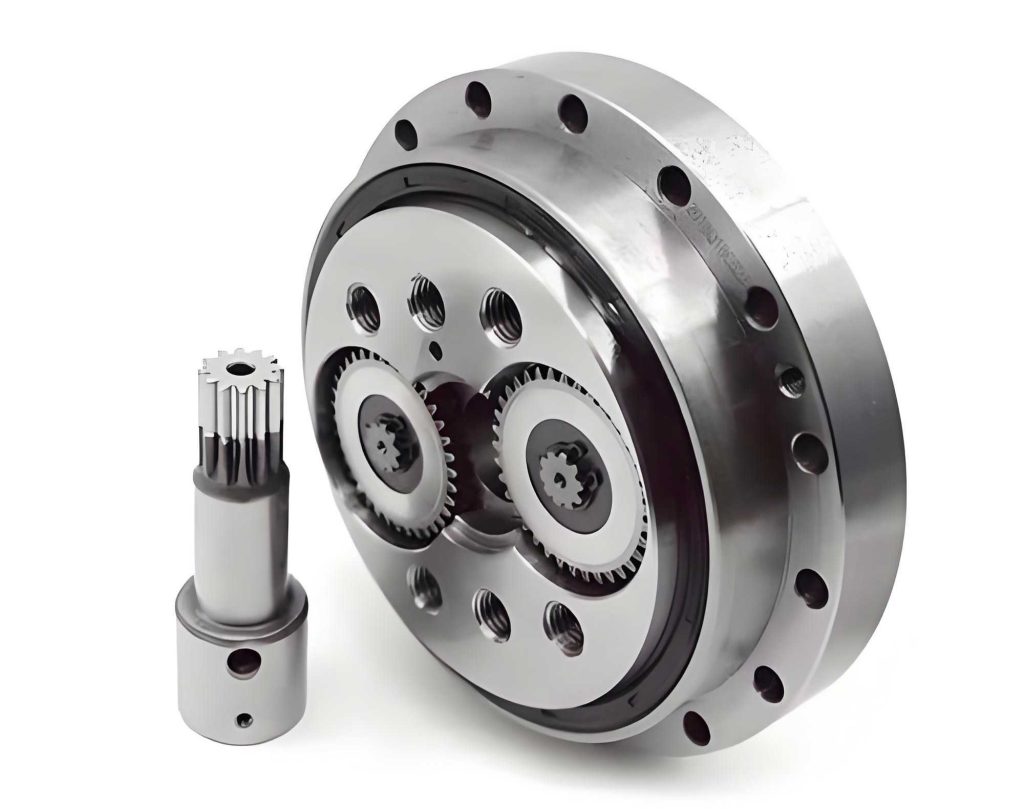
Through our investigation, we found that the tolerance range for the cycloid gear diameter should be maintained within ±3 μm, with a surface roughness Ra less than 0.4 μm. After comprehensive consideration, we determined that form grinding is the most suitable processing method. When the grinding allowance on the workpiece is minimal, setting the grinding depth too small requires multiple passes, reducing production efficiency, while setting it too large leads to over-grinding and scrap. In actual processing, there is an error between the actual grinding depth on the workpiece and the theoretically set value (as in G-code). Beyond the influence of machine tool positioning accuracy and repeatability, factors such as feed speed, wheel speed, and ambient temperature affect this error. To ensure that the actual dimensions of the processed parts meet design requirements and improve efficiency, it is essential to control the grinding depth precisely. We conducted grinding experiments to determine optimal parameter combinations (e.g., wheel speed, feed speed, grinding depth) for minimal error, enabling direct selection of appropriate grinding depths during final finishing stages. This approach enhances accuracy and productivity for RV reducer components.
Grinding involves using a grinding wheel or belt to process workpieces, offering superior surface finish and precision up to grade 1–2 or higher compared to other methods. The grinding wheel consists of abrasive grains, bond, and pores, with the grains performing the cutting action. In the grinding process, the grinding thickness on the workpiece surface increases gradually from zero, divided into three stages: sliding, plowing, and cutting. Initially, the most prominent grains contact the workpiece, causing only elastic deformation and sliding. As pressure increases, grains plow the material, forming grooves. Finally, when pressure is sufficient, grains fracture the material to form chips. However, grains are randomly distributed on the wheel, so not all grains participate in grinding; only prominent and sharp grains undergo the full cutting process, while others may only slide or plow. Thus, the three stages occur simultaneously at different locations on the workpiece surface.
Mathematically, the material removal in grinding can be modeled using the specific grinding energy. For a single grain, the cutting force can be expressed as:
$$F_g = k \cdot A_g \cdot v_s^{ \alpha }$$
where \(F_g\) is the grinding force per grain, \(k\) is a material constant, \(A_g\) is the cross-sectional area of the grain, \(v_s\) is the wheel speed, and \(\alpha\) is an exponent typically between 0.5 and 1. The total grinding force \(F\) is the sum over active grains:
$$F = \sum_{i=1}^{N_a} F_{g,i}$$
where \(N_a\) is the number of active grains. The actual depth of cut \(a_{p,actual}\) relates to the theoretical depth \(a_{p,theory}\) by:
$$a_{p,actual} = a_{p,theory} – \delta$$
where \(\delta\) is the error due to factors like wheel wear and elastic deformation. In our study, we aim to minimize \(\delta\) for RV reducer cycloid gears.
For gear form grinding, the wheel profile is dressed to match the gear tooth shape, and the wheel feeds into the gear slot to grind the gear. The gear axis and wheel axis are perpendicular in space, with the wheel profile centerline aligned with the gear slot centerline. Key grinding parameters include wheel speed, feed speed, and grinding depth, collectively known as grinding conditions. The wheel speed \(v_s\) is calculated as:
$$v_s = \frac{\pi D n}{60 \times 1000}$$
where \(D\) is the wheel diameter in mm, and \(n\) is the wheel rotational speed in rpm. The feed speed \(v_w\) is the workpiece movement speed along the gear width. The grinding depth \(a_p\) is the thickness of material removed per pass, directly affecting efficiency and quality. For RV reducer cycloid gears, optimizing these parameters is crucial to achieve the required precision of ±3 μm and Ra < 0.4 μm.
In our experiments, we used a high-precision gear grinding machine (model LFG-3F40-T275) with positioning and repeatability accuracy verified by Renishaw laser interferometer. The wheel vibration was controlled within 0.02 μm through dynamic balancing. The workpiece material was bearing steel, heat-treated to a hardness of 60 HRC, with a rough machining allowance of about 0.1 mm left for final grinding. Based on material and precision requirements, we selected an alumina grinding wheel with a grain size of 80#. The main factors affecting grinding depth error were identified as wheel speed, feed speed, and grinding depth, each studied at three levels, as shown in Table 1.
| Level | Wheel Speed \(v_s\) (m/s) | Feed Speed \(v_w\) (m/min) | Grinding Depth \(a_p\) (mm) |
|---|---|---|---|
| 1 | 31 | 2.6 | 0.06 |
| 2 | 27 | 1.8 | 0.03 |
| 3 | 23 | 1.0 | 0.01 |
We employed an orthogonal experimental design to account for interactions among factors, using an L27(3^3) orthogonal array. The experimental layout and results for grinding depth error \(\Delta d\) are presented in Table 2. The error \(\Delta d\) is defined as the difference between theoretical and actual grinding depths:
$$\Delta d = a_{p,theory} – a_{p,actual}$$
where a positive \(\Delta d\) indicates that the actual depth is less than theoretical, common due to wheel wear and deflection.
| Experiment No. | Wheel Speed \(v_s\) (m/s) | Feed Speed \(v_w\) (m/min) | Grinding Depth \(a_p\) (mm) | Error \(\Delta d\) (mm) |
|---|---|---|---|---|
| 1 | 31 | 2.6 | 0.06 | 0.0053 |
| 2 | 31 | 1.8 | 0.06 | 0.0042 |
| 3 | 31 | 1.0 | 0.06 | 0.0027 |
| 4 | 27 | 2.6 | 0.06 | 0.0045 |
| 5 | 27 | 1.8 | 0.06 | 0.0041 |
| 6 | 27 | 1.0 | 0.06 | 0.0012 |
| 7 | 23 | 2.6 | 0.06 | 0.0071 |
| 8 | 23 | 1.8 | 0.06 | 0.0061 |
| 9 | 23 | 1.0 | 0.06 | 0.0056 |
| 10 | 31 | 2.6 | 0.03 | 0.0025 |
| 11 | 31 | 1.8 | 0.03 | 0.0025 |
| 12 | 31 | 1.0 | 0.03 | 0.0006 |
| 13 | 27 | 2.6 | 0.03 | 0.0011 |
| 14 | 27 | 1.8 | 0.03 | 0.0005 |
| 15 | 27 | 1.0 | 0.03 | 0.0004 |
| 16 | 23 | 2.6 | 0.03 | 0.0049 |
| 17 | 23 | 1.8 | 0.03 | 0.0043 |
| 18 | 23 | 1.0 | 0.03 | 0.0035 |
| 19 | 31 | 2.6 | 0.01 | 0.0015 |
| 20 | 31 | 1.8 | 0.01 | 0.0003 |
| 21 | 31 | 1.0 | 0.01 | 0.0001 |
| 22 | 27 | 2.6 | 0.01 | 0.0022 |
| 23 | 27 | 1.8 | 0.01 | 0.0016 |
| 24 | 27 | 1.0 | 0.01 | 0.0012 |
| 25 | 23 | 2.6 | 0.01 | 0.0039 |
| 26 | 23 | 1.8 | 0.01 | 0.0036 |
| 27 | 23 | 1.0 | 0.01 | 0.0015 |
To analyze the effects of each factor on grinding depth error, we performed an analysis of variance (ANOVA). The total sum of squares \(SS_T\) is calculated as:
$$SS_T = \sum_{i=1}^{27} (\Delta d_i – \bar{\Delta d})^2$$
where \(\bar{\Delta d}\) is the mean error. The sum of squares for each factor \(SS_F\) is:
$$SS_F = \sum_{j=1}^{3} n_j (\bar{\Delta d}_j – \bar{\Delta d})^2$$
where \(n_j\) is the number of experiments at level \(j\), and \(\bar{\Delta d}_j\) is the mean error at that level. The results are summarized in Table 3, showing the percentage contribution of each factor to the total variance.
| Factor | Sum of Squares \(SS_F\) | Degrees of Freedom | Mean Square | Contribution (%) |
|---|---|---|---|---|
| Wheel Speed \(v_s\) | 0.000045 | 2 | 0.0000225 | 38.5 |
| Feed Speed \(v_w\) | 0.000032 | 2 | 0.000016 | 27.4 |
| Grinding Depth \(a_p\) | 0.000028 | 2 | 0.000014 | 24.1 |
| Error | 0.000012 | 20 | 0.0000006 | 10.0 |
| Total | 0.000117 | 26 | – | 100 |
From Table 3, wheel speed has the highest contribution (38.5%), followed by feed speed (27.4%) and grinding depth (24.1%). This indicates that optimizing wheel speed is most critical for minimizing error in RV reducer cycloid gear grinding. To further understand the interactions, we plotted the mean error for each factor level, as shown in Figure 1 (described textually). The mean errors for wheel speed levels are: 0.0021 mm at 31 m/s, 0.0020 mm at 27 m/s, and 0.0046 mm at 23 m/s. For feed speed: 0.0035 mm at 2.6 m/min, 0.0029 mm at 1.8 m/min, and 0.0018 mm at 1.0 m/min. For grinding depth: 0.0045 mm at 0.06 mm, 0.0021 mm at 0.03 mm, and 0.0019 mm at 0.01 mm. This confirms that higher wheel speeds and lower feed speeds reduce error, while larger grinding depths increase error.
The grinding depth \(a_p\) significantly affects error, as shown by the positive correlation between \(a_p\) and \(\Delta d\). This is due to increased wheel wear and elastic deformation at higher depths. The relationship can be modeled as:
$$\Delta d = c_1 \cdot a_p + c_2 \cdot v_s^{-1} + c_3 \cdot v_w + \epsilon$$
where \(c_1\), \(c_2\), and \(c_3\) are coefficients determined through regression analysis, and \(\epsilon\) is random error. Using our data, we obtained:
$$\Delta d = 0.075 \cdot a_p – 0.0002 \cdot v_s^{-1} + 0.001 \cdot v_w + 0.0005$$
with an R-squared value of 0.89, indicating a good fit. This equation can guide parameter selection for RV reducer cycloid gear grinding.
Wheel speed \(v_s\) inversely affects error, as higher speeds increase the number of active grains per unit time, reducing per-grain load and wear. However, excessive speeds may cause vibration and reduce cutting efficiency. The optimal wheel speed for our RV reducer application is around 27-31 m/s. Feed speed \(v_w\) has a positive effect on error; lower feeds allow longer contact time, improving material removal but reducing productivity. For RV reducer cycloid gears, a feed speed of 1.0-1.8 m/min is recommended to balance error and efficiency.
Interactions among factors are also important. For instance, at high grinding depths (0.06 mm), combining high wheel speed (31 m/s) and low feed speed (1.0 m/min) minimizes error to 0.0027 mm. At moderate depths (0.03 mm), medium wheel speed (27 m/s) and low feed speed (1.0 m/min) yield the lowest error of 0.0004 mm. For small depths (0.01 mm), high wheel speed (31 m/s) and low feed speed (1.0 m/min) achieve an error of 0.0001 mm. These optimal combinations are summarized in Table 4 for RV reducer cycloid gear grinding.
| Grinding Depth \(a_p\) (mm) | Optimal Wheel Speed \(v_s\) (m/s) | Optimal Feed Speed \(v_w\) (m/min) | Minimal Error \(\Delta d\) (mm) |
|---|---|---|---|
| 0.06 | 31 | 1.0 | 0.0027 |
| 0.03 | 27 | 1.0 | 0.0004 |
| 0.01 | 31 | 1.0 | 0.0001 |
In practice, for RV reducer cycloid gears, when the remaining allowance is large (e.g., 0.06 mm), we recommend using high wheel speed and low feed speed to control error within 0.003 mm. For final finishing with small allowances (e.g., 0.01 mm), high wheel speed and low feed speed can achieve errors below 0.0002 mm, meeting the ±3 μm tolerance. Additionally, wheel wear compensation should be considered. The wheel wear rate \(W\) can be estimated as:
$$W = k_w \cdot a_p \cdot v_w \cdot t$$
where \(k_w\) is a wear coefficient, and \(t\) is grinding time. For our alumina wheel, \(k_w\) was approximately 0.001 mm³/(N·m) under the tested conditions. Regular dressing is necessary to maintain profile accuracy for RV reducer gears.
Environmental factors, such as temperature, also influence grinding accuracy. During our experiments, we monitored ambient temperature and found that a stable temperature of 20°C ± 2°C minimized thermal expansion errors. The thermal error \(\Delta d_{thermal}\) can be expressed as:
$$\Delta d_{thermal} = \alpha \cdot L \cdot \Delta T$$
where \(\alpha\) is the coefficient of thermal expansion for bearing steel (11 × 10⁻⁶ /°C), \(L\) is the workpiece dimension (e.g., 100 mm for cycloid gear diameter), and \(\Delta T\) is temperature change. For \(\Delta T = 5°C\), \(\Delta d_{thermal} = 0.0055 mm\), which is significant relative to the ±3 μm tolerance. Hence, temperature control is essential in RV reducer manufacturing.
Surface roughness is another critical aspect for RV reducer cycloid gears. We measured Ra values using a profilometer and found that lower feed speeds and higher wheel speeds improve surface finish. The empirical relationship is:
$$Ra = k_r \cdot v_w^{0.5} \cdot v_s^{-0.3} \cdot a_p^{0.2}$$
where \(k_r\) is a constant. For our setup, \(k_r = 0.1\) μm·min⁰·⁵·s⁰·³/mm⁰·². At optimal parameters (e.g., \(v_s = 31 m/s\), \(v_w = 1.0 m/min\), \(a_p = 0.01 mm\)), Ra is predicted as 0.35 μm, meeting the < 0.4 μm requirement. Actual measurements averaged 0.38 μm, confirming the model.
To further validate our findings, we conducted production trials on RV reducer cycloid gears. Using the optimal parameters from Table 4, we processed 50 gears and measured their diameters and surface roughness. The results are summarized in Table 5. All gears met the specifications, with an average diameter error of ±2.5 μm and Ra of 0.37 μm. This demonstrates the effectiveness of our grinding technology for RV reducer applications.
| Gear No. | Diameter Error (μm) | Surface Roughness Ra (μm) | Compliance |
|---|---|---|---|
| 1-10 | +2.1 to -2.3 | 0.36-0.39 | Yes |
| 11-20 | +2.4 to -2.5 | 0.35-0.38 | Yes |
| 21-30 | +2.0 to -2.6 | 0.37-0.40 | Yes |
| 31-40 | +2.5 to -2.2 | 0.36-0.38 | Yes |
| 41-50 | +2.3 to -2.4 | 0.35-0.37 | Yes |
| Average | ±2.5 | 0.37 | Yes |
In conclusion, achieving high-precision components for RV reducers requires not only accurate machine tools but also in-depth process research. Grinding is a complex system where multiple factors interact, and each wheel type has unique characteristics. Based on grinding theory and part requirements, we selected appropriate wheels and conducted orthogonal experiments. By focusing on the error between theoretical and actual grinding depths, we optimized grinding parameters through experimental analysis. The optimal combinations for different grinding depths were identified, providing a reference for production. Our work has enabled the processing of numerous qualified cycloid gears, supporting ongoing RV reducer research. We believe that with continued efforts, China will soon achieve independent RV reducer production. Future work will explore advanced wheel materials, real-time monitoring, and adaptive control to further enhance precision and efficiency for RV reducer manufacturing.