
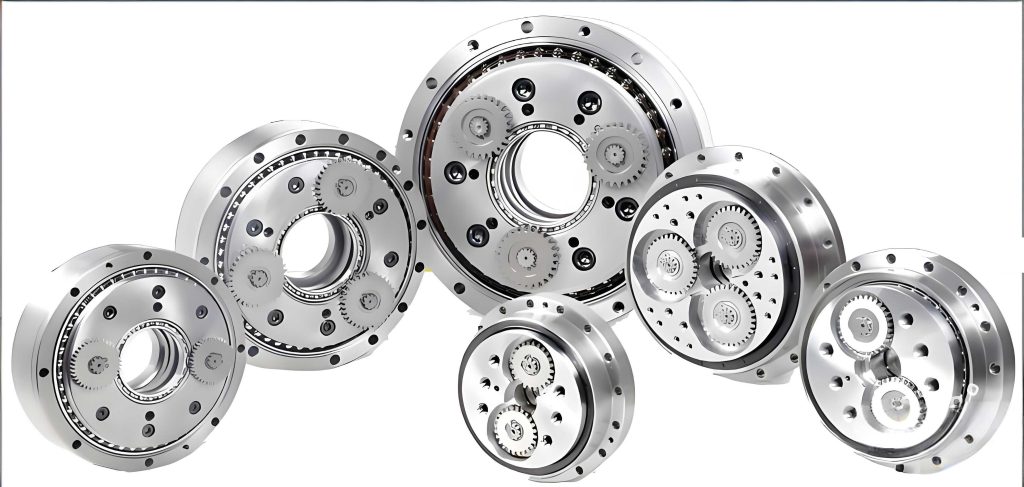
The precision and longevity of a rotary vector (RV) reducer are fundamentally governed by the tribological performance of its second-stage cycloid-pin drive. This transmission, characterized by a high reduction ratio and compact design, operates predominantly under grease-lubricated conditions. Understanding the transient elastohydrodynamic lubrication (EHL) and mixed lubrication behavior at the interface between the cycloid gear and the pin teeth is therefore critical for optimizing transmission efficiency, minimizing wear, and preventing contact fatigue. This analysis delves into the lubrication characteristics, examining the influence of design and operational parameters through numerical modeling and kinematic analysis.
Kinematics and Load Distribution in Cycloid-Pin Drives
The motion within an RV reducer is complex. The cycloid gear undergoes a combined planetary motion: revolution around the central pinwheel housing and rotation about its own axis due to meshing. While theoretical engagement is pure rolling, practical assembly and lubrication necessitate profile modifications, introducing minimal sliding. The modified tooth profile of the cycloid gear is derived from its generating principle and can be expressed as:
$$
\begin{aligned}
x &= R_p^* \cos(\theta) – e^* \cos\left(\frac{Z_p}{Z_c}\theta\right) – \left[ R_{rp}^* S^* – R_{rp}^* \right] \cos\left(\theta – \arctan\left(\frac{\sin(\theta)}{K_1^* – \cos(\theta)}\right) \right) \\
y &= R_p^* \sin(\theta) – e^* \sin\left(\frac{Z_p}{Z_c}\theta\right) + \left[ R_{rp}^* S^* – R_{rp}^* \right] \sin\left(\theta – \arctan\left(\frac{\sin(\theta)}{K_1^* – \cos(\theta)}\right) \right)
\end{aligned}
$$
where $Z_c$ and $Z_p$ are the number of teeth on the cycloid gear and pinwheel, $e^*$ and $R_p^*$ are the modified eccentricity and pin circle radius, $R_{rp}^*$ is the modified pin radius, $K_1^*$ is the modified short width coefficient, $S^* = \sqrt{1 + (K_1^*)^2 – 2K_1^* \cos(\theta)}$, and $\theta$ is the input crank angle.
The equivalent radius of curvature $R$ at the contact point, a critical parameter for EHL analysis, is given by:
$$
\frac{1}{R} = \frac{1}{R_{rp}^*} + \frac{Z_c (1 + K_1^{*2}) \cos(\theta) – K_1^*(Z_c + Z_p)}{R_p^* (1 + K_1^{*2} – 2K_1^* \cos(\theta))^{3/2}}
$$
The entraining velocity $U$, assuming near-pure rolling conditions, is a function of the kinematic conversion and contact geometry:
$$
U = \frac{\pi N_{in}}{60} \cdot \frac{Z_p}{Z_c} \cdot \frac{R_{rp}^* S^* – \sqrt{x_K^2 + y_K^2}}{R_{rp}^* S^*}
$$
Here, $N_{in}$ is the input speed (rpm), and $(x_K, y_K)$ are the coordinates of the meshing point on the cycloid profile.
Load distribution across multiple simultaneously engaged teeth is derived from a torsional stiffness model. The force $F_i$ on the i-th pin tooth is proportional to its distance from the line of action. The contact load per unit length $w_i$ is:
$$
w_i = \frac{F_i}{b} = \frac{4 T_{out} \sin(\theta_i)}{K_1 Z_c Z_p R_p^* b S^*}
$$
where $T_{out}$ is the output torque, $b$ is the effective face width, and $\theta_i$ is the angular position of the i-th pin.
The transient variation of these key parameters—load, curvature radius, and entraining velocity—over a meshing cycle is complex and non-linear, as summarized conceptually below:
| Meshing Phase | Contact Load Trend | Curvature Radius Trend | Entraining Velocity Trend |
|---|---|---|---|
| Initial Engagement | Rapidly Increasing | Larger, Decreasing | Lower, Increasing |
| Mid-Meshing | Near Maximum, Stable | Small, Stable | Higher, Stable |
| Final Disengagement | Decreasing | Small, Increasing | Highest |
Modeling Transient Mixed Elastohydrodynamic Lubrication
To analyze the lubrication state, which often falls into the mixed EHL regime due to surface roughness, a numerical model for point contact is employed. The governing Reynolds equation for transient, isothermal conditions is:
$$
\frac{\partial}{\partial x}\left(\frac{\rho h^3}{\eta} \frac{\partial p}{\partial x}\right) + \frac{\partial}{\partial y}\left(\frac{\rho h^3}{\eta} \frac{\partial p}{\partial y}\right) = 12U \frac{\partial (\rho h)}{\partial x} + 12 \frac{\partial (\rho h)}{\partial t}
$$
The film thickness $h(x,y,t)$ accounts for macro geometry, elastic deformation $\nu$, and combined surface roughness $\delta$:
$$
h(x,y,t) = h_0(t) + \frac{x^2}{2R_x(t)} + \frac{y^2}{2R_y(t)} + \nu(x,y,t) + \delta(x,y,t)
$$
The elastic deformation is computed via the Boussinesq integral:
$$
\nu(x,y,t) = \frac{2}{\pi E’} \iint_{\Omega} \frac{p(\xi,\zeta,t) \, d\xi \, d\zeta}{\sqrt{(x-\xi)^2 + (y-\zeta)^2}}
$$
where $E’$ is the effective elastic modulus.
The lubricant’s piezoviscous and density-pressure behaviors are modeled using the Roelands equation and a standard density relationship, respectively:
$$
\eta(p) = \eta_0 \exp\left\{ (\ln(\eta_0) + 9.67) \left[ -1 + (1 + 5.1 \times 10^{-9}p)^Z \right] \right\}
$$
$$
\rho(p) = \rho_0 \left( 1 + \frac{0.6 \times 10^{-9}p}{1 + 1.7 \times 10^{-9}p} \right)
$$
The model is solved using a Progressive Mesh Densification (PMD) method coupled with a finite difference scheme, ensuring efficiency and accuracy in capturing the steep pressure gradients and thin films characteristic of EHL in RV reducers.
Influence of Design Parameters on Lubrication
Equivalent Curvature Radius
The equivalent radius of curvature $R$, determined by tooth profile parameters, significantly impacts the EHL film. A larger $R$ generally results in a thinner central film thickness ($h_c$) but a more pronounced secondary pressure spike ($p_{spike}$) at the outlet. The relationship can be qualitatively summarized:
$$
h_c \propto R^{\alpha}, \quad \alpha < 0; \quad p_{spike} \propto R^{\beta}, \quad \beta > 0
$$
The negative exponent $\alpha$ indicates film thinning with increased radius, a critical consideration in the design of the RV reducer’s cycloid profile.
| Radius $R$ (mm) | Min. Film Thickness $h_{min}$ (nm) | Max. Hertzian Pressure $p_{h}$ (GPa) | Outlet Spike Pressure $p_{spike}$ (GPa) |
|---|---|---|---|
| 1.0 | 225 | 1.45 | 1.58 |
| 3.0 | 180 | 1.38 | 1.65 |
| 5.0 | 155 | 1.35 | 1.72 |
| 8.0 | 130 | 1.40 | 1.81 |
Tooth Profile Modifications
Practical cycloid gears in an RV reducer undergo two critical modifications: end-rounding and crowning (arc-top modification).
1. End-Rounding: While it does not eliminate the edge pressure concentration, it increases the local film thickness at the tooth flank edges, mitigating wear initiation. A comparison shows a 15-25% increase in end-film thickness with rounding compared to a sharp edge.
2. Crowning (Arc-Top Modification): This transforms the contact from a theoretical line to a controlled point/elliptical contact, effectively eliminating destructive edge stresses. The crown radius $R_y$ is a key design variable. A larger $R_y$ produces a wider, more favorable pressure distribution and a thicker central film.
$$
a, b \propto \left( \frac{w R_{eff}}{E’} \right)^{1/3}; \quad R_{eff} = \left( \frac{1}{R_x} + \frac{1}{R_y} \right)^{-1}
$$
where $a$ and $b$ are the semi-axes of the Hertzian contact ellipse. The optimal crown radius for an RV reducer balances contact stress and misalignment tolerance.
| Crown Radius $R_y$ (mm) | Max. Contact Pressure (GPa) | Central Film $h_c$ (nm) | Pressure Peak at Edge (% of $p_{max}$) |
|---|---|---|---|
| 800 | 1.52 | 165 | ~60% |
| 1000 | 1.48 | 172 | ~55% |
| 1200 | 1.45 | 178 | ~52% |
| 1500 | 1.42 | 185 | ~50% |
Influence of Operational Parameters on the RV Reducer
Load and Speed Effects
The unit load $w$ and entraining velocity $U$ are primary operational variables for any RV reducer. Their influence follows classical EHL scaling laws but with modifications due to the transient nature of the meshing.
Load ($w$): Increased load dramatically reduces film thickness while only marginally increasing the maximum Hertzian pressure due to the elastic deformation and piezoviscous effect.
$$
h \propto w^{-0.13}, \quad p_{max} \propto w^{0.10}
$$
Entraining Velocity ($U$): Higher speed generates a thicker lubricant film, improving the lubrication regime.
$$
h \propto U^{0.68}
$$
These relationships underscore the importance of operating the RV reducer within specified torque and speed ranges to maintain an adequate EHL film.
| Parameter Change | Effect on Min. Film $h_{min}$ | Effect on Pressure $p_{max}$ | Practical Implication for RV Reducer |
|---|---|---|---|
| Load $w$ ↑ 25% | ↓ ~4% | ↑ ~2% | Minor impact on film; stress increases slightly. |
| Speed $U$ ↑ 25% | ↑ ~17% | ↓ ~1% | Significantly improves lubrication safety margin. |
| Combined $w$↑ & $U$↑ | Net Increase | Small Increase | Higher speed can offset film thinning from load. |
Dynamic Lubrication Analysis Over the Meshing Cycle
The most critical analysis involves evaluating the transient lubrication condition at discrete points representing the entire meshing path of a single cycloid tooth. For a standard RV reducer, the main working zone corresponds to a crank angle $\theta$ range of approximately $30^\circ$ to $120^\circ$. Discretizing this into 15 points reveals significant variation in lubrication conditions.
The key parameters (load $w_i$, curvature $R_i$, speed $U_i$) at each discrete meshing point $i$ are computed from kinematic and force analysis. These time-variant parameters serve as inputs for a series of transient mixed-EHL simulations. The results highlight a non-uniform lubrication landscape:
$$
\lambda_i = \frac{h_{avg,i}}{\sigma} \quad \text{(Film thickness ratio at point i)}
$$
where $\sigma$ is the composite RMS roughness.
The analysis reveals that the first half of the engagement zone (points corresponding to $\theta < 80^\circ$) exhibits poorer lubrication: lower film thickness, higher asperity contact pressure, and a lower $\lambda$ ratio. The lubrication state transitions and stabilizes in the latter half of the meshing zone ($\theta \in [80^\circ, 120^\circ]$). This zone demonstrates superior and more consistent EHL conditions, with thicker films and a higher proportion of the load carried by the fluid film rather than asperity contacts.
| Meshing Zone (Crank Angle $\theta$) | Avg. Film Ratio $\bar{\lambda}$ | Asperity Load Ratio | Lubrication State Characterization |
|---|---|---|---|
| Initial ($27^\circ$ – $76^\circ$) | 0.65 – 0.70 | 0.30 – 0.35 | Unstable Mixed EHL, Severe Asperity Interaction |
| Optimal ($83^\circ$ – $125^\circ$) | 0.72 – 0.75 | 0.25 – 0.28 | Stable Mixed EHL, Dominant Fluid Film |
Furthermore, the maximum contact pressure $p_{max,i}$ at each point shows a characteristic three-peak distribution when surface roughness is considered, with peaks often exceeding the smooth Hertzian prediction due to micro-contact stresses. The average film thickness $h_{avg,i}$ and the deformed roughness $\sigma_{def,i}$ are also calculated, showing that high contact pressure can locally smoothen the surface ($\sigma_{def} < \sigma_{initial}$).
Conclusions and Implications for RV Reducer Design
The comprehensive lubrication analysis of the cycloid-pin drive within an RV reducer yields several critical insights for design and operation:
- Meshing Zone Optimization: The lubrication characteristics are not uniform across the tooth flank. The latter half of the engagement zone ($\theta \approx 80^\circ-120^\circ$) provides consistently better mixed-EHL conditions. Therefore, profile modification strategies for the cycloid gear should aim to confine the major load-bearing contact to this optimal zone, thereby enhancing overall transmission life and efficiency of the RV reducer.
- Importance of Crowning: Arc-top modification (crowning) is essential to transform the contact to a benign elliptical form, eliminating detrimental edge stresses. A larger crown radius, within practical limits, improves pressure distribution and increases film thickness.
- Parameter Sensitivity: Among operational parameters, the entraining speed has a more pronounced positive effect on film thickness than load has a negative one. This suggests that, where possible, operating an RV reducer at moderate to high speeds within its rating is beneficial for lubrication.
- Mixed Lubrication Reality: Under real manufacturing finishes, the interface operates in a mixed lubrication regime. The film thickness ratio $\lambda$ across the optimal zone was found to be between 0.72 and 0.75, indicating a regime where the fluid film carries most of the load but asperity contact is non-negligible, necessitating high-quality surface finishes and robust lubricants.
In summary, the performance and durability of an RV reducer are intimately linked to the elastohydrodynamic phenomena in its cycloid drive. By integrating kinematic analysis, load distribution models, and advanced transient mixed-EHL numerical solutions, designers can make informed decisions on tooth profile modification, manufacturing tolerances, and operational guidelines to ensure reliable and efficient performance of this critical power transmission component.