
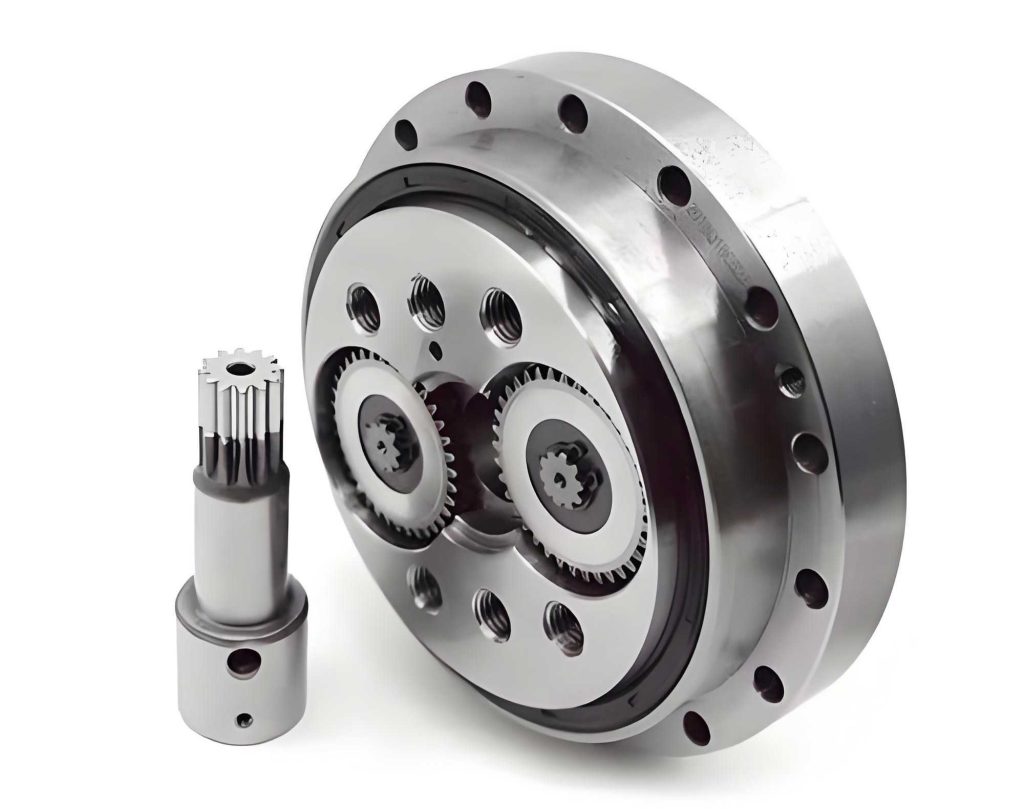
The pursuit of precision, longevity, and reliability in modern robotics, particularly for demanding applications such as aerospace, places stringent requirements on core transmission components. The RV reducer, a precision planetary gear system derived from cycloidal-pin wheel drives, is paramount in this context. Its performance and service life are critically dependent on the mechanical properties of its core element: the cycloid gear. This gear undergoes significant line-contact stresses during meshing with needle rollers, necessitating exceptional surface hardness, wear resistance, and fatigue strength. Heat treatment is the indispensable metallurgical process employed to imbue the cycloid gear material with these required properties.
Traditionally, heat treatment parameters for such gears are often derived from general practices for standard gears, lacking specific optimization for the unique geometry and service conditions of the RV reducer cycloid gear. Key parameters like heating and soaking times are typically defined by wide empirical ranges, which can lead to either suboptimal mechanical performance or wasted energy and production time. This study leverages advanced numerical simulation to analyze and optimize the heat treatment process for a cycloid gear made of alloy steel 20Cr2Ni4, aiming to define a process that guarantees required hardness, minimizes detrimental residual stresses, and enhances production efficiency for the RV reducer.
1. Material Selection and Heat Treatment Fundamentals
The choice of material is foundational. For the high-stakes environment of an aerospace robot RV reducer, the selected alloy must offer high core toughness and the capability to develop a hard, wear-resistant case. 20Cr2Ni4 alloy steel is an excellent candidate. Its chemical composition is detailed in Table 1.
| C | Si | Mn | Cr | Ni | S | P |
|---|---|---|---|---|---|---|
| 0.20 | 0.27 | 0.45 | 1.45 | 3.45 | 0.019 | 0.014 |
The synergy of Chromium (Cr) and Nickel (Ni) is crucial. Cr significantly increases hardenability by slowing the decomposition of austenite, allowing deeper and more uniform hardening. Ni is a potent austenite stabilizer; it lowers the Ac1 and Ac3 transformation points, refines the microstructure, and enhances toughness. For the RV reducer cycloid gear, a case-hardening process is ideal: enriching the surface with carbon (carburizing) followed by quenching to create a hard martensitic case while maintaining a tough, ductile core.
The standard process route considered is: Normalizing → Carburizing → Quenching → Tempering. Normalizing refines the grain structure after forging. Carburizing at high temperature (e.g., 900-950°C) diffuses carbon into the surface. Quenching rapidly cools the part to transform the high-carbon austenite at the surface into hard martensite. Finally, tempering relieves quenching stresses and improves toughness.
2. Numerical Simulation Methodology with DEFORM-HT
Heat treatment is a complex, coupled multi-physics phenomenon involving transient temperature fields, phase transformations, and the generation of thermal and transformation stresses. Physical trial-and-error is costly and time-consuming. This study employs the DEFORM-HT software module, which is specifically designed for simulating such coupled thermo-metallurgical-mechanical processes.
The software’s internal material database for the analogous grade BS 655M13 (20Cr2Ni4) was used, which includes essential data on thermal properties, phase transformation kinetics (TTT/CCT diagrams), and stress-strain behavior as a function of temperature and phase. The simulation solves the governing equations for energy, phase transformation, and stress equilibrium in a fully coupled manner. The accuracy of such simulations for predicting hardness and distortion has been validated in literature, with reported errors often below 5%, making it a reliable tool for process development for the RV reducer component.
The cycloid gear model was created based on standard design formulas. The key parameters for the RV reducer in this study were: Pin gear radius r_p = 23 mm, Pin radius r_rp = 1.5 mm, Eccentricity a = 0.5 mm, Number of pin teeth Z_p = 39, Number of cycloid gear teeth Z_c = 38, Gear thickness t = 3 mm, and Short-width coefficient k = 0.65. Due to symmetry, one-third of the full model was used for simulation to reduce computational cost, as shown in Figure 1(b).
3. Defining Process Parameters and Initial Simulation
Critical process parameters, especially time, must be determined. Soaking time is traditionally estimated from empirical formulas based on workpiece thickness (D), leading to a wide and often imprecise range. For the 3mm thick cycloid gear, common formulas suggest a heating/soaking time between 2.0 and 10.8 minutes. An initial value of 10 minutes was selected for the baseline simulation.
The carburizing case depth (δ) is another vital parameter. For the cycloid gear, it can be estimated based on an equivalent “module.” The module for a cycloid gear can be approximated as:
$$ m_c = \frac{D \cdot k \cdot \pi}{Z_p \cdot d} $$
Where D is the cycloid gear diameter and d is the initial rolling circle diameter. For our RV reducer parameters, m_c ≈ 0.93 mm. The recommended case depth for gears is (0.2~0.3)m_c, resulting in a range of 0.19–0.28 mm. Alternatively, treating it as a thin plate suggests a depth of 0.6–0.9 mm. The required carburizing time (t) to achieve a depth (δ) at temperature (T) can be estimated using a simplified diffusion-based formula like the Harris equation:
$$ t = \frac{\delta^2}{802.6} \cdot 10^{-\frac{6700}{T}} \times 60 $$
where T is in Kelvin (K), δ in mm, and t in minutes. For a target depth of ~0.7 mm at 900°C (1173 K), the calculated time is substantial (~60 minutes), highlighting the lengthy nature of carburizing.
Based on standard practices for 20Cr2Ni4, three distinct quenching variants were simulated after carburizing:
- Process 1: Carburize → Slow cool (furnace cool) to room temperature → Reheat for single quenching at 850°C → Oil quench → Low temper at 150°C.
- Process 2: Carburize → Slow cool to quenching temperature (~840°C) → Direct oil quench → Low temper at 150°C.
- Process 3: Carburize → Direct oil quench from carburizing temperature (900°C) → Low temper at 150°C.
Process 3, direct quenching, offers potential benefits of reduced processing steps, less oxidation, and potentially lower distortion. The initial simulations assumed a 10-minute soak for all heating stages (normalizing, carburizing pre-quench heats). Cooling was simulated as air cooling for normalizing (30 min) and oil quenching for hardening (20 min).
| Process Step | Temperature (°C) | Soak Time (min) | Cooling Method |
|---|---|---|---|
| Normalizing | 860 | 10 | Air Cool (30 min) |
| Carburizing | 900 | 60 | As per Process 1,2,3 |
| Quench Heating (Proc 1) | 850 | 10 | Oil Quench (20 min) |
| Direct Quench (Proc 2 & 3) | 840 / 900 | – | Oil Quench (20 min) |
| Tempering | 150 | 120 | Air Cool |
4. Simulation Results and Analysis: Hardness and Residual Stress
The simulation results for the baseline processes (10-minute soak) were analyzed by probing key points from the surface to the core and examining full-field contour plots.
4.1 Hardness Performance: All three processes successfully achieved a high surface hardness suitable for the RV reducer cycloid gear. The simulated hardness values at the surface and near-core regions converged to a very high level (approximately 54-55 HRC) due to the excellent hardenability of 20Cr2Ni4 and the thin cross-section, leading to through-hardening. The hardness evolution over time showed that for Processes 1 and 2, which involve a post-carburizing cooling and reheating cycle, the hardness drops during the reheating stage as the martensite from any prior cooling tempers back, before rising again upon the final quench. Process 3 (direct quench) showed a more monotonic path to final hardness. Crucially, the final hardness results for all three processes were virtually identical, meeting the performance requirement.
4.2 Residual Stress Analysis: While hardness was satisfactory, residual stress emerged as a critical differentiator. Residual stresses, particularly tensile stresses at the surface, are detrimental as they can promote fatigue crack initiation under the cyclic contact loading in an RV reducer.
The simulations revealed a significant finding: Processes 1 and 2, which involved slow cooling from the carburizing temperature, generated substantially higher maximum residual stresses compared to Process 3. In Process 3 (direct quench), the high-temperature austenitic state is directly quenched, leading to a more favorable compressive stress profile at the surface after tempering. For the 10-minute soak, the maximum residual stress was lower in Process 3. Furthermore, the area fraction of the gear subjected to high stress levels was also larger in Processes 1 and 2. This clearly identifies direct quenching as superior for residual stress control in this thin-section RV reducer component.
5. Optimization of Soaking Time
Given the success of Process 3 in terms of stress, the next optimization step focused on the heating/soaking time. The initial 10-minute soak was based on an empirical upper bound. The core question was: Could a shorter soak time, sufficient for complete austenitization, yield equivalent hardness while further reducing residual stress and cycle time?
To investigate this, Process 3 (Normalizing → Carburizing → Direct Quench → Temper) was simulated with varying heating stage soak times: 5 minutes, 10 minutes (baseline), and 15 minutes. The carburizing time was kept constant at 60 minutes.
| Soak Time (min) | Max. Surface Hardness (HRC) | Min. Hardness (HRC) | Max. Residual Stress (MPa) | Stress Trend vs. 5-min baseline |
|---|---|---|---|---|
| 5 | 54.9 | 53.8 | 343 | Baseline (Lowest) |
| 10 | 54.9 | 53.9 | 448 | Significantly Increased (+30%) |
| 15 | 54.9 | 54.0 | 522 | Substantially Increased (+52%) |
The results were revealing. The hardness was virtually unaffected by soak times above the minimum required for austenitization. All three soak times produced identical maximum hardness and very similar minimum hardness, confirming that for this thin-section gear, a 5-minute soak is thermodynamically sufficient.
In stark contrast, the residual stress showed a strong positive correlation with soak time. The maximum residual stress increased by approximately 30% when moving from a 5-minute to a 10-minute soak, and by over 50% for a 15-minute soak. This can be attributed to greater thermal gradients and potentially more grain growth during longer high-temperature exposure before the quench. Therefore, a longer soak time is not only unnecessary but actively harmful as it increases the level of detrimental residual stresses in the finished RV reducer cycloid gear.
6. Conclusion and Recommended Optimal Process
This comprehensive simulation study successfully analyzed and optimized the heat treatment process for a thin-section 20Cr2Ni4 cycloid gear used in a precision RV reducer. The key findings and recommendations are:
- Process Route Selection: The direct quenching process (Normalizing + Carburizing + Direct Quench + Tempering) is superior to processes involving post-carburizing slow cooling and reheating. It provides the required high hardness (54-55 HRC) while generating significantly lower levels of detrimental residual stresses, which is critical for the fatigue life of the RV reducer component.
- Soaking Time Optimization: Heating and soaking times should be minimized to the duration necessary for complete and uniform austenitization. For the 3mm thick cycloid gear, a 5-minute soak is sufficient. Extending the soak time (e.g., to 10 or 15 minutes) has no beneficial effect on final hardness but causes a substantial and undesirable increase in residual stress.
- Efficiency Gain: Adopting the optimized process with a 5-minute soak not only ensures optimal mechanical properties (high hardness, low stress) but also reduces total furnace time. This translates directly into increased production efficiency and lower energy consumption for manufacturing the RV reducer.
The final, recommended optimized heat treatment cycle derived from this simulation study is summarized in Table 4. This data-driven approach provides a reliable foundation for practical process specification, reducing reliance on broad empirical rules and ensuring high-performance, long-life cycloid gears for demanding RV reducer applications.
| Process Step | Temperature (°C) | Soak Time (min) | Cooling Method / Notes | Objective |
|---|---|---|---|---|
| 1. Normalizing | 860 – 880 | 5 | Air Cool to Room Temperature | Grain refinement, homogenization |
| 2. Carburizing | 900 – 920 | As per depth req. (e.g., 60-120) | Atmosphere controlled | Surface carbon enrichment (~0.7mm depth) |
| 3. Direct Quenching | From Carburizing Temp | N/A | Rapid Oil Quench | Form high-hardness martensitic case |
| 4. Tempering | 150 – 180 | 120 | Air Cool | Relieve quenching stresses, improve toughness |