
In recent years, the domestic robotics industry has experienced rapid development. Innovations in robotic technology and the expansion of its application fields have brought tremendous opportunities and significant challenges to the sector. With technological advancement, the application of robotics has extended from traditional areas like automotive and electronics manufacturing to diverse fields such as food, pharmaceuticals, and logistics. This expansion not only enhances production efficiency and quality but also reduces labor costs and the occurrence of workplace accidents. Within the industrial domain, industrial robots serve as the core, offering advantages such as higher efficiency, safety, intelligence, and ease of management. For an industrial robot, the reducer, as its key component, constantly influences the robot’s performance metrics. Among the common types of reducers on the market, the RV reducer stands out for its compact size, lighter weight, and higher transmission efficiency compared to traditional cycloidal pinwheel reducers. As the application areas for robots continue to broaden, the demand for higher performance and usability of these reducers is intensifying, making them a focal point of current research.
The precision of an RV reducer critically impacts the robot’s operation; higher precision leads to smaller transmission errors during operation. However, a significant challenge persists in the industry: many factories still rely on manual methods for selecting and assembling components for RV reducers. This approach, often dependent on an operator’s experience, suffers from inherent randomness and the difficulty of handling a large number and variety of parts. Consequently, it frequently fails to yield the optimal assembly combination, struggles to ensure selection accuracy, and consumes substantial time, labor, and trial-and-error costs.
Therefore, our research is dedicated to developing an intelligent algorithm-based platform for RV reducer component matching. This platform aims to significantly improve the efficiency of the component selection process, providing factories with a superior matching service. It is expected to perform component selection operations based on user requirements and conditional constraints while also featuring essential functions like user management and data storage. Compared to traditional manual methods, this platform enhances both the accuracy and speed of component matching, lowers the technical threshold for factories, and alleviates the pressure on human operators.
Analysis of RV Reducer Component Matching
Compared to harmonic drives, the RV reducer is a new type of transmission device with a more complex structure. It consists of numerous components tightly integrated into a compact and small-volume assembly. Taking the RV-20E model as an example, the primary components constituting an RV reducer can be summarized. Analyzing the matching problem for these parts requires synthesizing various factors, such as dimensional error ranges and wear levels of components, all of which ultimately affect the quality of the produced reducer.
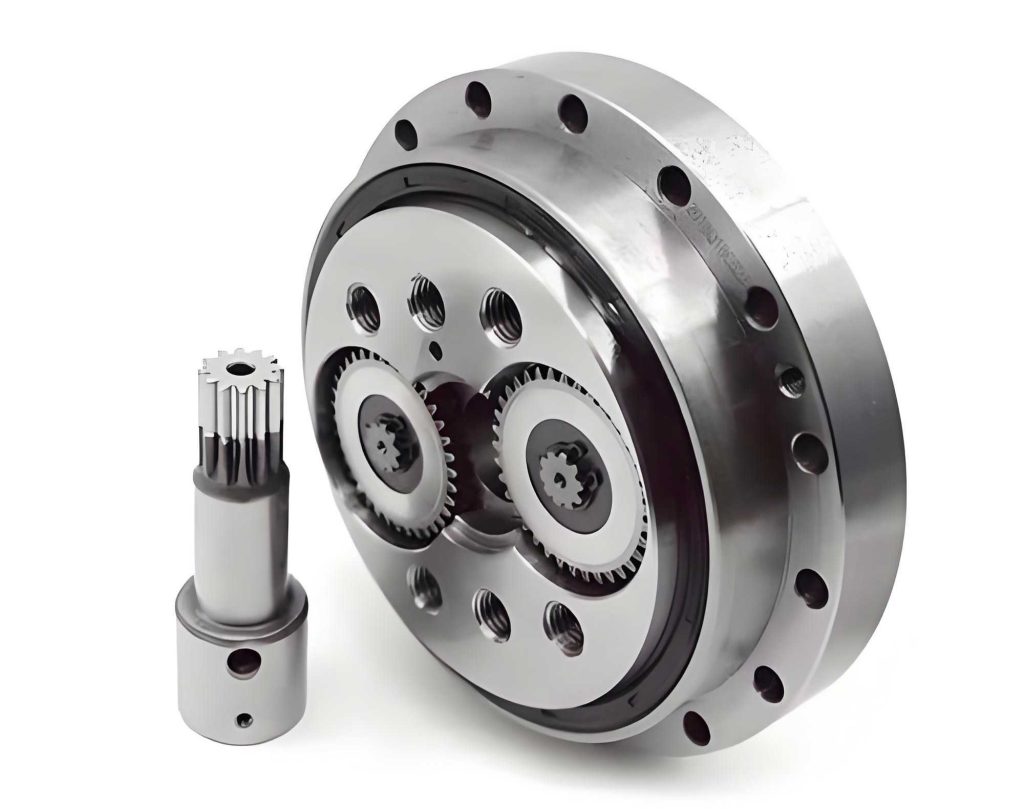
RV reducers are widely used and hold an exceptionally important position in fields requiring high-precision work, such as industrial robotics. Therefore, in the actual production of RV reducers, transmission precision is its most critical performance indicator. The selection process must begin by choosing an appropriate pin gear housing based on the reducer’s transmission error requirements. The pin gear housing is the core component, and its precision and quality directly influence the reducer’s transmission performance. Subsequently, the precision and manufacturing process of the cycloidal gears also control the transmission effect to a certain extent. The crankshafts and pin gear pins play roles in supporting and fixing other parts, and their quality and precision must also be guaranteed. In summary, a complete set of RV reducer components can be simplified to one pin gear housing, two cycloidal gears, two crankshafts, and a set of pin gear pins of the same category. By classifying and numbering different types of components and selecting them according to established matching rules, a complete RV reducer is assembled.
Clearly, relying on manual selection from a vast inventory of diverse components is inefficient and prone to error. To achieve efficient component matching, our platform employs intelligent algorithms to assist in decision-making. By analyzing the parametric characteristics of components and the matching rules, establishing a suitable mathematical model, and utilizing intelligent algorithms for optimization calculations, the platform can derive the optimal component combination scheme.
Introduction to Relevant Intelligent Algorithms
The core function of the matching platform is to select the best combination of parts from a large inventory based on user needs and constraints. Given the complexity of RV reducer part matching, our design employs population-based intelligent algorithms to seek the optimal solution. The concept of a fitness value is introduced to evaluate the quality of each part combination. The calculation of this fitness value depends on multiple factors, including part performance indicators and operational environment requirements. Through continuous iteration and updates, the platform gradually optimizes part combinations to find the optimal solution.
We focus on three primary population-based intelligent algorithms: the Genetic Algorithm (GA), the Artificial Bee Colony (ABC) algorithm, and the Particle Swarm Optimization (PSO) algorithm. The effectiveness of each algorithm in the context of RV reducer matching can be summarized by their operational characteristics.
| Algorithm | Core Inspiration | Key Operations/Mechanisms | Advantages for RV Matching | Potential Challenge |
|---|---|---|---|---|
| Genetic Algorithm (GA) | Biological Evolution | Selection, Crossover, Mutation | Strong global search, handles discrete variables (part IDs) | Premature convergence |
| Artificial Bee Colony (ABC) | Honey Bee Foraging | Employed, Onlooker, and Scout Bees phases | Good balance of exploration/exploitation, few parameters | May be slower on complex constraints |
| Particle Swarm Optimization (PSO) | Bird Flocking/Fish Schooling | Velocity & position update based on personal/global best | Fast convergence, simple implementation | Can get trapped in local optima |
Genetic Algorithm (GA)
The Genetic Algorithm is a global optimization algorithm whose basic principle simulates a biological evolutionary system. It operates on a population of candidate solutions, typically encoded as chromosomes. For RV reducer matching, where a solution is a specific combination of part IDs, integer encoding is highly suitable. Each chromosome represents a potential assembly combination. The algorithm iteratively improves the population through operations mimicking natural selection:
- Selection: Chromosomes with higher fitness (better assembly quality) are selected more often to pass their “genes” to the next generation. The selection probability for an individual i can be based on its fitness $f_i$ relative to the total population fitness: $$P_{select,i} = \frac{f_i}{\sum_{j=1}^{N} f_j}$$
- Crossover: Pairs of selected chromosomes exchange segments of their genetic material to create new offspring solutions, exploring new combinations of parts.
- Mutation: Random changes are introduced to individual genes (part IDs) with a small probability, helping to maintain genetic diversity and escape local optima.
The fitness function $f$ is crucial and is designed to quantify the quality of an RV reducer assembly. For a candidate solution $S$ representing a set of parts, the fitness might be inversely related to the predicted transmission error $E(S)$ and cost $C(S)$, with weighting factors $\alpha$ and $\beta$:
$$f(S) = \frac{1}{\alpha \cdot E(S) + \beta \cdot C(S)}$$
Higher fitness indicates a better, more precise, and cost-effective combination. To mitigate the risk of premature convergence—a common challenge in GA where the population loses diversity too quickly—strategies like adaptive mutation rates or hybrid approaches with simulated annealing can be integrated.
Artificial Bee Colony (ABC) Algorithm
The Artificial Bee Colony algorithm simulates the intelligent foraging behavior of honeybee swarms. It classifies artificial bees into three groups: employed bees, onlooker bees, and scout bees, each corresponding to a specific phase in the search process for optimal RV reducer combinations.
- Employed Bee Phase: Each employed bee is associated with a specific food source (a candidate part combination, $X_i$). It searches in the neighborhood of its current solution for a new candidate $V_i$. For example, a new solution might be generated by modifying one part ID in the combination: $$v_{i,j} = x_{i,j} + \phi_{i,j}(x_{i,j} – x_{k,j})$$ where $k$ is a randomly chosen index different from $i$, $j$ is a randomly chosen dimension (part slot), and $\phi$ is a random number in $[-1, 1]$. A greedy selection is applied between $X_i$ and $V_i$; the better one is retained.
- Onlooker Bee Phase: Onlooker bees choose food sources based on a probability proportional to their nectar amount (fitness). A food source with higher fitness $f_i$ has a higher probability $P_i$ of being chosen for further exploitation: $$P_i = \frac{f_i}{\sum_{j=1}^{SN} f_j}$$ where $SN$ is the number of food sources. This phase focuses computational resources on promising solutions.
- Scout Bee Phase: If a food source’s quality cannot be improved after a predetermined number of trials (‘limit’), it is abandoned. The employed bee associated with it becomes a scout bee and discovers a new food source randomly in the search space. This mechanism ensures exploration and helps avoid stagnation in local optima.
The ABC algorithm’s strength lies in its effective balance between exploration (via scouts and random searches) and exploitation (via employed and onlooker bees), making it robust for the complex RV reducer matching landscape.
Particle Swarm Optimization (PSO)
Particle Swarm Optimization is inspired by the social behavior of bird flocking or fish schooling. In PSO, each particle $i$ represents a candidate solution (an RV reducer part combination) and flies through the multidimensional search space. Its movement is influenced by its own experience and the experience of the entire swarm.
Each particle has a position $X_i$ and a velocity $V_i$. It remembers the best position it has personally encountered ($Pbest_i$) and knows the best position found by any particle in the swarm ($Gbest$). At each iteration $t$, the particle’s velocity and position are updated according to the following equations:
$$V_i(t+1) = \omega \cdot V_i(t) + c_1 \cdot r_1 \cdot (Pbest_i – X_i(t)) + c_2 \cdot r_2 \cdot (Gbest – X_i(t))$$
$$X_i(t+1) = X_i(t) + V_i(t+1)$$
where:
- $\omega$ is the inertia weight, controlling the influence of the previous velocity.
- $c_1$ and $c_2$ are acceleration coefficients (cognitive and social parameters).
- $r_1$ and $r_2$ are random numbers uniformly distributed in $[0,1]$.
The fitness of a particle’s position is evaluated using the same assembly quality function $f(S)$. $Pbest_i$ and $Gbest$ are updated when better positions are found. This simple yet powerful mechanism allows the swarm of particles to converge rapidly towards high-quality regions of the search space, making PSO highly efficient for finding good RV reducer matches. However, careful tuning of parameters ($\omega$, $c_1$, $c_2$) is necessary to prevent premature convergence to a local optimum.
By applying and potentially hybridizing these algorithms, our platform provides powerful methods to navigate the combinatorial complexity of RV reducer part matching, moving beyond the limitations of manual selection.
System Architecture
The RV reducer part matching platform is developed using a three-tier architecture, which effectively separates concerns and ensures maintainability, scalability, and clear data flow. The architecture comprises the Presentation Layer, the Application Layer, and the Data Layer.
| Tier | Technology / Components | Primary Responsibility |
|---|---|---|
| Presentation Layer | Vue.js Framework, Element UI Component Library | Provides the user interface (UI) for interaction. It visualizes data, allows users to input constraints, view matching results in charts/tables, and manage data. All user operations are initiated here. |
| Application Layer | Spring Boot Framework, Intelligent Algorithm Module, Business Logic Controllers | The platform’s brain. It receives requests from the UI, processes business logic (user authentication, constraint validation), invokes the intelligent algorithm engine to perform matching calculations, and formats results for the Presentation Layer. |
| Data Layer | MySQL Database, Data Access Objects (DAOs) | The system’s foundation. It persistently stores all structured data, including user credentials, detailed part parameters (dimensions, tolerances, categories), historical matching results, and algorithm configuration data. |
The communication between these layers is streamlined. The Vue.js frontend makes HTTP API calls to the Spring Boot backend. The backend controllers service these requests, interacting with the database via DAOs and performing complex computations with the algorithm module. The results are then sent back as JSON responses, which the frontend renders for the user. This separation allows for independent development and deployment of the frontend and backend components.
Functional Modules
Based on the actual needs of factory production, the RV reducer matching platform is structured into four core functional modules, each addressing a specific aspect of the system’s operation.
1. User Management Module: This module handles all security and access control aspects. It allows administrators to register new users, assign roles (e.g., Operator, Manager, Administrator), and manage permissions. Authentication ensures that only authorized personnel can access specific functions, such as modifying part databases or executing matching algorithms.
2. Part Data Management Module: This module is the repository for all information related to RV reducer components. Its functions include:
- Part Information Import/Batch Upload: Allows importing large datasets of part specifications from files (e.g., CSV, Excel) to populate the database.
- Part Type & Parameter Management: Provides a user interface to add, edit, delete, and query different part categories (Pin Gear Housings, Cycloidal Gears, Crankshafts, Pins) and their detailed parameters (nominal尺寸, tolerance ranges,批次 numbers, wear indicators).
- Data Validation: Ensures data integrity by checking for format errors and logical inconsistencies during input.
3. Intelligent Algorithm Module: This is the computational core of the platform. It encapsulates the implementations of the GA, ABC, and PSO algorithms (and potentially their hybrids). The module is designed to be configurable, allowing users or administrators to select an algorithm, set its parameters (population size, iteration count, crossover rate, etc.), and define the objective function (fitness function) based on current production priorities (e.g., maximize precision, minimize cost, or a weighted combination).
4. Part Matching Module: This module orchestrates the primary workflow of the platform. It guides the user through the complete matching process, which can be summarized in the following steps:
| Step | Action | Description |
|---|---|---|
| 1 | Define Matching Task | User initiates a new matching task, specifying the target RV reducer model (e.g., RV-20E). |
| 2 | Set Constraints & Objectives | User inputs specific constraints (e.g., required transmission error < 1 arc-min, max allowable cost) and selects optimization objectives via the UI. |
| 3 | Algorithm Selection & Configuration | User chooses an intelligent algorithm (GA, ABC, PSO) and may adjust its key parameters for the current task. |
| 4 | Execute Matching Calculation | The platform invokes the Algorithm Module. The algorithm retrieves eligible part data from the database, performs iterative optimization based on the fitness function, and converges toward optimal or near-optimal part combinations. |
| 5 | Generate & Present Results | The platform displays the top-ranked matching schemes. Results typically include a list of selected part IDs for each component, the calculated predicted performance metrics (transmission error, backlash, etc.), and a total cost estimate. Results can be exported for production planning. |
Conclusion and Future Work
In the application of industrial robotics, the RV reducer plays a crucial role by providing precise speed and torque output, ensuring the stability and reliability of the robot. Its significant application value and market prospect underscore the importance of efficient and precise manufacturing. Our research into the RV reducer part matching problem has led to the development of an intelligent selection platform based on the Spring Boot and Vue.js frameworks. The technological core of this platform lies in its utilization of intelligent optimization algorithms, which iteratively search through vast part inventories to identify the optimal assembly combination scheme.
Experimental verification has demonstrated the platform’s effectiveness. It can rapidly and accurately identify the best part combinations that meet specified performance requirements and operational constraints. The implementation of such a platform in a factory setting promises substantial reductions in labor costs, time costs, and material waste associated with manual trial-and-error. By providing fast, accurate, and reproducible matching results, the platform lowers the technical barrier to high-quality RV reducer assembly and standardizes the production process.
Looking forward, several directions exist for further enhancement of the platform. Future work may focus on developing more sophisticated hybrid or adaptive algorithms that dynamically switch strategies during optimization for even better performance. Integrating real-time data from sensors on the production line (e.g., actual post-grinding dimensions) could enable closed-loop, adaptive matching that accounts for the current state of manufacturing equipment. Furthermore, expanding the platform’s scope to include other complex, precision assembly products beyond the RV reducer would maximize its value and impact on the broader advanced manufacturing industry.