
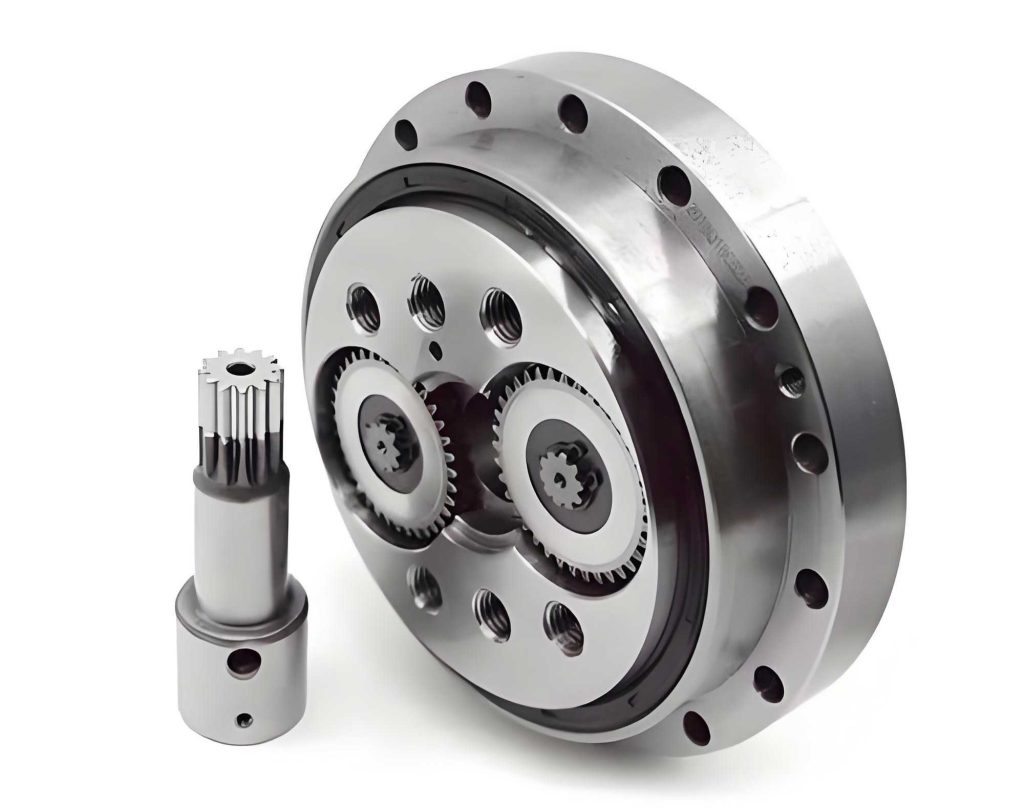
The precise and reliable operation of industrial robots is fundamentally dependent on the health of their core components. Among these, the RV reducer, a type of precision cycloidal drive, serves as a critical transmission element in robot joints, prized for its high torque capacity, compact size, and excellent positioning accuracy. However, due to complex internal meshing dynamics and sustained operational stresses, the RV reducer is susceptible to various mechanical faults such as pitting on the cycloidal gear, wear on the eccentric shaft, and damage to the planet carrier. Timely and accurate fault diagnosis is therefore paramount for ensuring robotic system reliability, preventing catastrophic failure, and minimizing downtime. This work presents a novel diagnostic methodology that synergizes the Nonlinear Output Frequency Response Function (NOFRF) spectrum with Kernel Principal Component Analysis (KPCA) to effectively identify and classify different health states of an industrial robot RV reducer.
Traditional fault diagnosis approaches for rotating machinery often rely on analyzing vibration signals collected from the system’s output. Techniques like time-domain statistical analysis, Fast Fourier Transform (FFT), wavelet transforms, and empirical mode decomposition are commonly employed to extract fault-related features. While effective for many applications, these methods primarily characterize the system based solely on its output response. For a complex nonlinear system like the RV reducer, the output signal alone may only represent partial dynamic information, potentially overlooking critical nonlinear interactions that are highly sensitive to incipient faults. A more comprehensive representation should account for the system’s input-output relationship. The concept of the Nonlinear Output Frequency Response Function (NOFRF) provides such a framework. Derived from the Volterra series representation of nonlinear systems, the NOFRF spectrum describes the system’s frequency response behavior under specific input excitations. It encapsulates rich information about the system’s inherent nonlinear characteristics, which are known to change distinctly when a fault occurs. By analyzing the NOFRF spectrum, one can potentially capture more discriminative fault features than from the output signal alone.
The theoretical foundation of this approach begins with the Volterra series model. A stable, time-invariant, nonlinear system with input $u(t)$ and output $y(t)$ can be represented as:
$$ y(t) = \sum_{n=1}^{\infty} \int_{-\infty}^{\infty} … \int_{-\infty}^{\infty} h_n(\tau_1, …, \tau_n) \prod_{i=1}^{n} u(t-\tau_i) d\tau_1 … d\tau_n $$
where $h_n(\tau_1, …, \tau_n)$ is the $n$-th order Volterra kernel. Under harmonic input, the system’s output frequency response can be expressed in a tractable form. The Generalized Frequency Response Function (GFRF), $H_n(j\omega_1, …, j\omega_n)$, is the multi-dimensional Fourier transform of the $n$-th order kernel. The NOFRF, $G_n(j\omega)$, is then defined as a weighted integral of the GFRF over a hyperplane, providing a one-dimensional frequency-dependent function for each nonlinear order $n$:
$$ G_n(j\omega) = \frac{ \int_{\omega_1+\omega_2+…+\omega_n=\omega} H_n(j\omega_1, …, j\omega_n) \prod_{i=1}^{n} U(j\omega_i) d\sigma }{ \int_{\omega_1+\omega_2+…+\omega_n=\omega} \prod_{i=1}^{n} U(j\omega_i) d\sigma } $$
where $U(j\omega)$ is the Fourier transform of the input $u(t)$, and the integral is taken over the hyperplane $\omega_1+\omega_2+…+\omega_n=\omega$. The total output spectrum $Y(j\omega)$ can be written as a superposition of contributions from different nonlinear orders:
$$ Y(j\omega) = \sum_{n=1}^{N} Y_n(j\omega) = \sum_{n=1}^{N} G_n(j\omega) U_n(j\omega) $$
Here, $U_n(j\omega)$ is the Fourier transform of $u^n(t)$, and $N$ is the maximum order considered. The NOFRF $G_n(j\omega)$ is thus input-dependent and reveals how energy is transferred between frequencies due to the system’s nonlinearity. Faults within the RV reducer, such as pitting or wear, will alter its internal stiffness, damping, and contact conditions, thereby modifying its nonlinear dynamic signature. This modification is reflected as measurable changes in the patterns and magnitudes of the NOFRF spectra across different harmonic orders.
To estimate the NOFRF spectra from experimental data, a batch estimation algorithm is employed. The RV reducer is excited by a series of harmonic inputs with varying amplitudes: $u_i(t) = A_i \cos(\Omega t)$, where $i=1, 2, …, M$ and $M > N$. The corresponding output vibration signals $y_i(t)$ are measured. For a specific frequency $\omega$, we can construct the following matrix equation from the discrete form of the output frequency response:
$$ \mathbf{Y}(\omega) = \mathbf{\Phi}(\omega) \mathbf{G}(\omega) $$
where:
$$\mathbf{Y}(\omega) = [Y_1(j\omega), Y_2(j\omega), …, Y_M(j\omega)]^T$$
$$\mathbf{G}(\omega) = [G_1(j\omega), G_2(j\omega), …, G_N(j\omega)]^T$$
$$\mathbf{\Phi}(\omega) =
\begin{bmatrix}
A_1 U_1(j\omega) & A_1^2 U_2(j\omega) & \cdots & A_1^N U_N(j\omega)\\
A_2 U_1(j\omega) & A_2^2 U_2(j\omega) & \cdots & A_2^N U_N(j\omega)\\
\vdots & \vdots & \ddots & \vdots\\
A_M U_1(j\omega) & A_M^2 U_2(j\omega) & \cdots & A_M^N U_N(j\omega)
\end{bmatrix}$$
The vector of NOFRF values at frequency $\omega$ is then estimated using the least-squares method:
$$ \mathbf{\hat{G}}(\omega) = (\mathbf{\Phi}^T(\omega) \mathbf{\Phi}(\omega))^{-1} \mathbf{\Phi}^T(\omega) \mathbf{Y}(\omega) $$
By calculating $\mathbf{\hat{G}}(\omega)$ across a range of frequencies, the full NOFRF spectra for orders $n=1$ to $N$ are obtained. In this study of the RV reducer, the first four orders ($N=4$) were found to contain sufficient discriminative information. For each health state, 100 frequency points were sampled from each of the four NOFRF spectral curves, resulting in a 400-dimensional feature vector per data sample. This high-dimensional feature set comprehensively represents the nonlinear dynamic fingerprint of the RV reducer’s condition.
Directly using such high-dimensional data for classification can lead to the “curse of dimensionality,” increased computational cost, and potential overfitting. Therefore, dimensionality reduction is essential. Principal Component Analysis (PCA) is a standard linear technique, but it may fail to capture complex nonlinear relationships within the NOFRF feature data. Kernel Principal Component Analysis (KPCA) overcomes this limitation by first mapping the original data into a higher-dimensional feature space $\mathcal{F}$ via a nonlinear mapping $\phi(\cdot)$, where linear PCA is then performed. The mapping is performed implicitly using a kernel function $k(\mathbf{x}_i, \mathbf{x}_j) = \langle \phi(\mathbf{x}_i), \phi(\mathbf{x}_j) \rangle$. The Gaussian Radial Basis Function (RBF) kernel is a common and effective choice:
$$ k(\mathbf{x}_i, \mathbf{x}_j) = \exp\left(-\frac{\|\mathbf{x}_i – \mathbf{x}_j\|^2}{2\sigma^2}\right) $$
where $\sigma$ is the kernel width parameter. The principal components in $\mathcal{F}$ are found by solving the eigenvalue problem for the kernel matrix $\mathbf{K}$. The resulting nonlinear principal components provide a low-dimensional representation that optimally preserves the nonlinearly structured variance in the original high-dimensional NOFRF feature data of the RV reducer.
The experimental study focused on diagnosing six distinct states of an industrial RV reducer: one healthy state and five fault states. The fault states included three single faults—cycloidal gear pitting, eccentric shaft wear, and planet carrier pitting—and two compound faults—cycloidal gear pitting combined with eccentric shaft wear, and cycloidal gear pitting combined with planet carrier pitting. Data was acquired using a dedicated RV reducer performance test bench. A servo motor provided the controlled rotational input to the RV reducer, and the input torque/rotation speed was measured. The output vibration acceleration signal, which is highly sensitive to mechanical faults, was measured in the axial direction using a mounted accelerometer. Multiple tests were conducted with input signals $u(t) = A_i \cos(0.4\pi t)$, where $A_i$ took values of 300, 350, 400, and 450 r/s.
Following data acquisition, the NOFRF spectra for orders 1 through 4 were estimated for each test run under each RV reducer state. A clear visual and quantitative difference was observed between the spectral patterns of different states. The following table summarizes the range of NOFRF spectral magnitudes (in dB) for the first four orders across all six states, highlighting their distinctiveness:
| RV Reducer State | NOFRF Order | Maximum Magnitude (dB) | Minimum Magnitude (dB) |
|---|---|---|---|
| Healthy | 1 | 0.5146 | 1.5154e-6 |
| Healthy | 2 | 0.0023 | 1.3869e-9 |
| Healthy | 3 | 1.6870e-7 | 1.4107e-12 |
| Healthy | 4 | 2.1230e-10 | 1.5159e-15 |
| Cycloidal Gear Pitting | 1 | 0.2210 | 1.9469e-6 |
| Cycloidal Gear Pitting | 2 | 1.6751e-4 | 2.3579e-9 |
| Cycloidal Gear Pitting | 3 | 4.5308e-7 | 2.8968e-12 |
| Cycloidal Gear Pitting | 4 | 3.8722e-10 | 3.4625e-15 |
| Eccentric Shaft Wear | 1 | 0.1537 | 3.4718e-6 |
| Eccentric Shaft Wear | 2 | 1.0942e-4 | 3.1935e-9 |
| Eccentric Shaft Wear | 3 | 6.7286e-7 | 3.2511e-12 |
| Eccentric Shaft Wear | 4 | 1.1339e-9 | 3.4957e-15 |
For each state, 100 samples of the 400-dimensional NOFRF feature vector were compiled. This dataset was then processed by KPCA for feature compression. The cumulative contribution rate of the principal components was used as the criterion for selecting the optimal reduced dimension. Setting a threshold (e.g., 95-99%) allowed the compression of the original 400-dimensional data down to a much lower-dimensional space, often to just 5 or 6 principal components, while retaining the most critical variance information related to the condition of the RV reducer.
The low-dimensional features extracted by KPCA were subsequently fed into a Support Vector Machine (SVM) classifier for fault identification. The SVM seeks to find the optimal hyperplane that maximizes the margin between different classes in the feature space. For multi-class classification, a one-vs-one strategy was employed. The Gaussian RBF kernel was also used for the SVM to handle potential nonlinear class boundaries in the KPCA-transformed space. The performance of the proposed NOFRF-KPCA-SVM methodology was rigorously evaluated and compared against two baseline methods that are more conventional in vibration-based diagnosis. The first baseline used the raw time-domain vibration signal (TS) as features, and the second used its frequency-domain magnitude spectrum obtained via FFT (FS) as features. Both baseline feature sets were also processed by KPCA and SVM under identical experimental and parameter settings to ensure a fair comparison. The diagnostic results, in terms of classification accuracy for each RV reducer state, are presented below:
| Diagnostic Method | RV Reducer State | Test Samples | Misclassifications | Accuracy (%) | Average Accuracy (%) |
|---|---|---|---|---|---|
| Proposed: NOFRF+KPCA+SVM | Healthy | 20 | 0 | 100.00 | 96.67 |
| Cycloidal Gear Pitting | 20 | 2 | 90.00 | ||
| Eccentric Shaft Wear | 20 | 0 | 100.00 | ||
| Planet Carrier Pitting | 20 | 0 | 100.00 | ||
| Compound Fault 1 | 20 | 1 | 95.00 | ||
| Compound Fault 2 | 20 | 1 | 95.00 | ||
| Baseline 1: FS+KPCA+SVM | Healthy | 20 | 2 | 90.00 | 88.33 |
| Cycloidal Gear Pitting | 20 | 4 | 80.00 | ||
| Eccentric Shaft Wear | 20 | 1 | 95.00 | ||
| Planet Carrier Pitting | 20 | 2 | 90.00 | ||
| Compound Fault 1 | 20 | 1 | 95.00 | ||
| Compound Fault 2 | 20 | 4 | 80.00 | ||
| Baseline 2: TS+KPCA+SVM | Healthy | 20 | 5 | 75.00 | 69.17 |
| Cycloidal Gear Pitting | 20 | 9 | 55.00 | ||
| Eccentric Shaft Wear | 20 | 11 | 45.00 | ||
| Planet Carrier Pitting | 20 | 3 | 85.00 | ||
| Compound Fault 1 | 20 | 2 | 90.00 | ||
| Compound Fault 2 | 20 | 7 | 65.00 |
The results demonstrate the superior efficacy of the proposed method. The NOFRF-based approach achieved an average fault diagnosis accuracy of 96.67% for the RV reducer, significantly outperforming the frequency-spectrum-based method (88.33%) and the time-domain-signal-based method (69.17%). This performance gap can be attributed to the fundamental advantage of the NOFRF spectrum. Unlike conventional features that analyze only the system’s output, the NOFRF spectrum is derived from the input-output relationship, thereby encapsulating a more complete representation of the system’s intrinsic nonlinear dynamics. Faults in the RV reducer induce specific changes in these nonlinear dynamic characteristics, which are prominently and uniquely captured in the NOFRF spectral patterns. In contrast, features from the output signal alone may represent only a subset of the system’s response, leading to less discriminative feature sets that are more prone to misclassification, especially for compound faults.
Furthermore, the critical role of KPCA was validated by comparing it with linear PCA for feature reduction on the NOFRF data. Using the same NOFRF features and SVM classifier, the KPCA-based method maintained its high accuracy of 96.67%, whereas the PCA-based method’s accuracy dropped sharply to 60.83%. This stark contrast underscores the strongly nonlinear nature of the manifold formed by the NOFRF feature data from different RV reducer states. Linear PCA is unable to unravel this nonlinear structure effectively, resulting in poor feature separation in the reduced space. KPCA, with its nonlinear kernel mapping, successfully transforms the data into a space where the different fault classes become linearly separable, thereby enabling the subsequent SVM classifier to perform with high precision.
The mathematical process within KPCA involves centering the kernel matrix $\mathbf{K}$ and solving the eigenvalue problem $\mathbf{K}\boldsymbol{\alpha} = M\lambda \boldsymbol{\alpha}$, where $M$ is the number of samples. The projection of a test sample $\mathbf{x}$ onto the $k$-th nonlinear principal component in $\mathcal{F}$ is given by:
$$ \text{PC}_k(\mathbf{x}) = \sum_{i=1}^{M} \alpha_i^k k(\mathbf{x}_i, \mathbf{x}) $$
where $\boldsymbol{\alpha}^k$ is the $k$-th eigenvector. This projection effectively distills the essential, discriminative nonlinear variance from the high-dimensional NOFRF feature vector of the RV reducer.
In conclusion, this research successfully developed and validated a novel fault diagnosis framework for the critical industrial robot RV reducer. The methodology leverages the high sensitivity of Nonlinear Output Frequency Response Function spectra to mechanical faults, which provide a rich and discriminative high-dimensional feature set. The Kernel Principal Component Analysis technique is then adeptly employed to compress these features into a low-dimensional space that preserves the essential nonlinear separability between different health states of the RV reducer. Finally, a Support Vector Machine classifier performs robust fault identification. Experimental results confirm that this integrated approach significantly outperforms conventional methods based solely on output signal analysis, achieving a high diagnostic accuracy of 96.67%. This work contributes a powerful and theoretically sound tool for the condition monitoring and predictive maintenance of industrial robots, enhancing their operational reliability and lifespan. Future work may explore the application of this NOFRF-KPCA framework to other complex nonlinear mechanical systems and investigate adaptive or deep learning-based classifiers for the final decision-making stage.