
As an observer and analyst of the global technological landscape, I firmly believe that the emergence of the humanoid robot marks a pivotal moment in our industrial evolution. Integrating cutting-edge advancements in artificial intelligence, advanced manufacturing, and new materials, the humanoid robot stands poised to become the disruptive product that follows in the footsteps of the personal computer, the smartphone, and the new energy vehicle. Its potential to profoundly transform human production and lifestyle, while reshaping the global industrial development paradigm, cannot be overstated. This convergence of technologies within a humanoid robot platform represents not merely an incremental improvement but a fundamental shift, creating a new, versatile agent capable of operating in human-centric environments. In this analysis, I will examine the current global innovation trajectory, assess a specific regional industrial foundation, and propose a strategic framework for fostering a competitive ecosystem in this burgeoning field.
The global race for dominance in humanoid robot technology is intensifying, characterized by strategic national initiatives, massive market projections, and rapid technological convergence. The industry is at a critical juncture, transitioning from laboratory prototypes to the cusp of industrialization. With the catalytic combination of aggressive capital investment, iterative breakthroughs in generative AI large models, and supportive industrial policies, the year 2025 is widely anticipated to be the starting point for mass production.
| Region/Country | Key Initiatives & Focus | Strategic Objective |
|---|---|---|
| United States | National Robotics Plan; Significant private investment in companies like Figure AI (backed by OpenAI, NVIDIA) and Tesla’s Optimus project. | Leading in foundational AI integration and full-stack system development, aiming for general-purpose robots for diverse applications. |
| European Union | Planned EU-wide AI robotics strategy for 2025 to ensure collaborative development and ethical application. | Fostering synergistic technological advancement and establishing robust regulatory and ethical frameworks. |
| China | National “Guiding Opinions on Innovation and Development of Humanoid Robots” (2023); Establishment of national and local innovation centers (e.g., in Shanghai, Beijing). | Achieving breakthroughs in key technologies (“brain,” “cerebellum,” “limbs,” “body”) and building a secure, reliable industry supply chain by 2027. |
| Other Provinces (e.g., Anhui, Guangdong) | Establishing dedicated research institutes and prioritizing humanoid robots as a future industry within modern industrial systems. | Cultivating regional innovation hubs and capturing early-mover advantages in specific application niches. |
Market forecasts paint a picture of a staggering “blue ocean.” Goldman Sachs predicts the global market for humanoid robots could exceed a trillion dollars by 2035. Elon Musk has speculated that the market size could be ten times that of the automotive industry. The industrial layout is taking shape, with three major forces emerging: dedicated humanoid robot startups, automotive giants leveraging their manufacturing and mechatronics prowess, and consumer electronics firms applying their expertise in miniaturization and user interaction. The pace is breathtaking: from Tesla applying its automotive platform strategy to drastically reduce development costs, to Figure AI demonstrating powerful human-environment interaction powered by advanced vision and language models, and NVIDIA building the computational foundation with its general-purpose foundation models for embodied AI.
The path to产业化 is becoming clearer due to accelerated breakthroughs across four core technological domains of a humanoid robot: Perception & Decision (“Brain”), Motion Control (“Cerebellum”), Limbs & Dexterous Hands, and Body Structure. Using the Technology Readiness Level (TRL) framework, most current platforms reside at TRL 6-7, meaning system prototypes are being demonstrated in relevant environments. The recent leaps in AI chips and multimodal large language models are directly accelerating capabilities in perception and decision-making. Simultaneously, the maturation of the new energy vehicle industry has advanced core components like high-performance motors, servo drives, precision reducers, and sensors, providing a solid supply chain for actuators. Breakthroughs in lightweight materials like carbon fiber and PEEK (Polyether Ether Ketone) are crucial for developing durable and energy-efficient body structures.
The fundamental challenge in motion control for a humanoid robot often boils down to solving complex real-time dynamics and control problems. A simplified model for the dynamics of a bipedal system can be represented using the Lagrangian formulation:
$$
L = T – V
$$
where \( T \) is the total kinetic energy and \( V \) is the total potential energy of the system. The equations of motion are then given by:
$$
\frac{d}{dt} \left( \frac{\partial L}{\partial \dot{q}_i} \right) – \frac{\partial L}{\partial q_i} = \tau_i
$$
Here, \( q_i \) represents the generalized coordinates (e.g., joint angles), \( \dot{q}_i \) are their time derivatives, and \( \tau_i \) are the generalized forces (torques) applied at each joint. Stabilizing and controlling such an underactuated, high-degree-of-freedom system in real-time requires sophisticated algorithms for trajectory optimization, whole-body control (WBC), and robust balancing, often formulated as quadratic programming (QP) problems:
$$
\begin{aligned}
\min_{x} \quad & \frac{1}{2} x^T Q x + c^T x \\
\text{s.t.} \quad & A_{eq} x = b_{eq} \\
& A_{ineq} x \leq b_{ineq}
\end{aligned}
$$
where \( x \) contains the control variables (e.g., joint accelerations, contact forces), \( Q \) is a cost matrix defining the control objective (e.g., tracking desired motion, minimizing effort), and the constraints \( A_{eq}x = b_{eq} \) and \( A_{ineq}x \leq b_{ineq} \) enforce physical laws (like dynamics) and limitations (like friction cones, torque limits).
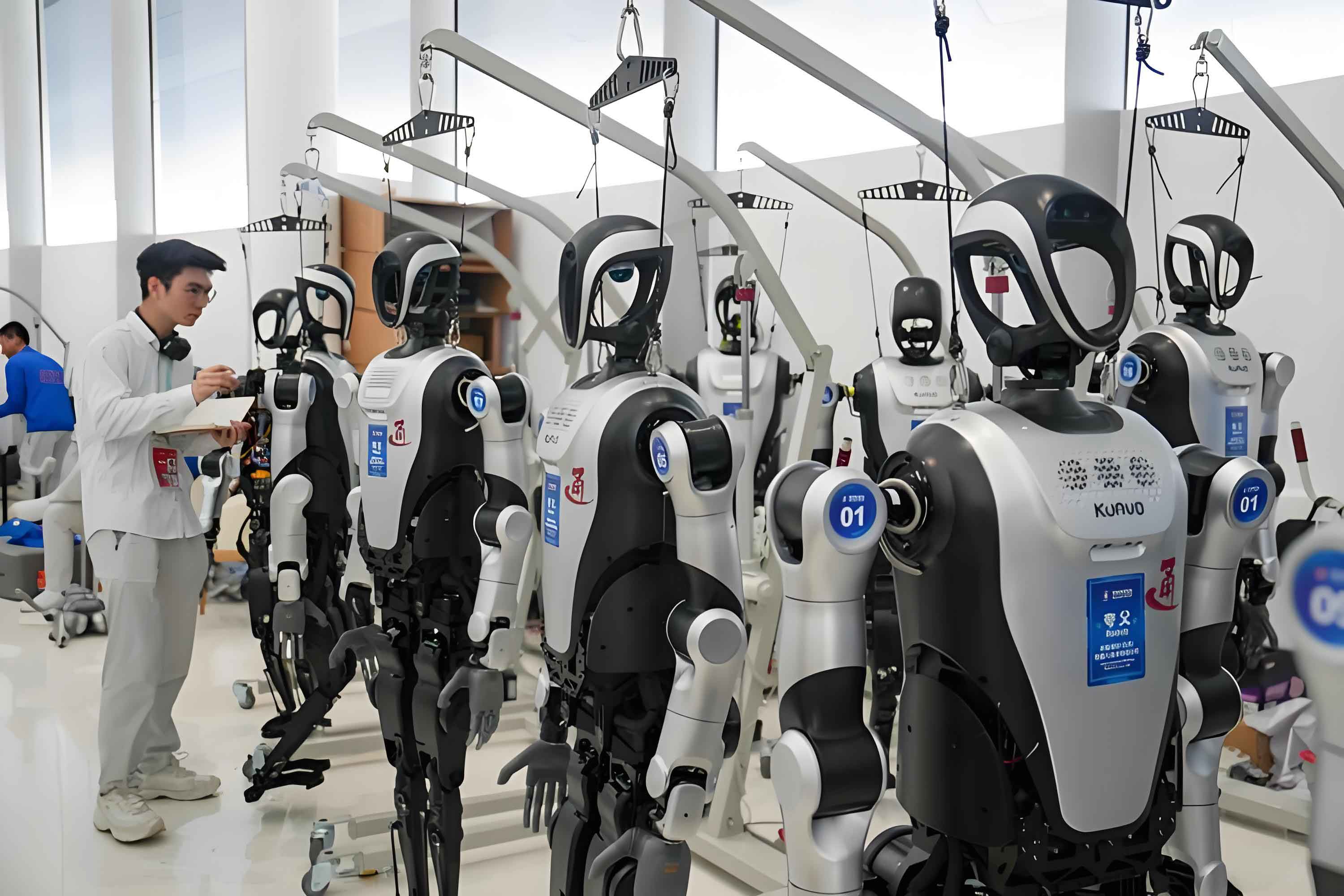
Turning our focus to a specific regional context with strong manufacturing heritage, we can identify a foundation with distinct advantages for entering the humanoid robot arena. The core strengths can be summarized under three pillars: pioneering research, a robust robotics industrial cluster, and rich application demand.
| Pillar | Key Assets & Capabilities | Potential Contribution to Humanoid Robot Value Chain |
|---|---|---|
| Research & Development | Leading universities with nationally recognized programs in control science, intelligent systems, and robotics. Historic achievements include some of the country’s first bipedal and仿人 robots. Strong patent portfolio in related technologies. | Core algorithm development for perception, decision-making, and motion control. Advanced research in robot vision, force control, and human-robot interaction. |
| Industrial Ecosystem | Established robotics industrial agglomeration zone ranked among the national top ten. Cluster of over 200 key enterprises spanning components, industrial robots, and AI vision systems. Proven capability in delivering industry-leading automation solutions for heavy manufacturing. | Potential for component supply (actuators, sensors, structural parts), subsystem integration, and leveraging advanced manufacturing know-how. Readiness for technology transfer from industrial robotics to humanoid platforms. |
| Application Scenarios & Demand | Global hub for construction machinery manufacturing. Major and growing production base for new energy vehicles. Rich cultural heritage and large tourism industry, alongside a rapidly growing cultural-tech sector. | Immediate, large-scale demand in complex manufacturing tasks (welding, assembly, inspection) and potential for service applications in guided tours, customer interaction, and specialized healthcare procedures. |
Despite this promising foundation, significant gaps must be addressed to build a globally competitive humanoid robot industry. Challenges include a lack of a unified, high-level industrial platform to create aggregation effects, insufficient policy focus and inter-departmental coordination specifically for this future industry, relatively weak technical攻关 and product development capabilities within existing enterprises regarding full-stack humanoid robot systems, and a scarcity of典型 application scenarios and demonstration projects to validate technology and drive iterative improvement.
Based on this analysis, I propose a three-pronged strategic framework to systematically nurture a humanoid robot innovation and industrial ecosystem.
1. Develop a Top-Level Design and Deploy the “One Zone, One Center, One Entity” System
A clear, actionable strategic plan is the cornerstone. This should manifest in a tangible industrial architecture:
- The “One Zone” – A Humanoid Robot Industry Pioneer Zone: Transform the existing robotics cluster into a dedicated hub for humanoid robot development. The strategy should focus on attracting leading international and domestic整机 manufacturers while actively supporting local champions from construction machinery, automotive, and medical equipment to diversify into the humanoid robot sector. Concurrently, nurture a dense network of specialized SMEs (“little giants,” hidden champions) across the upstream (materials, core components) and downstream (application integration, services) value chain.
- The “One Center” – A Humanoid Robot Science & Innovation Center: Establish a premier R&D hub, ideally co-located within a broader science city规划, to attract global humanoid robot firms to set up research centers and regional headquarters. This center would serve as the intellectual engine, aligning with broader strategies to build a global R&D city, focusing on pre-competitive research, talent cultivation, and pioneering下一代 humanoid robot technologies.
- The “One Entity” – A Humanoid Robot Industry Innovation Consortium: Form a dynamic, mission-driven alliance led by industry leaders and key research institutions. This consortium would integrate resources across the产业链, conduct both fundamental and applied research, aggregate top-tier talent, incubate spin-off companies, and function as the central platform for technology development, talent pooling, and commercial translation, thereby strengthening, extending, and complementing the industrial chain.
2. Launch Major Scientific Projects to Break Through Key Core Technologies
Targeted, well-funded research initiatives are crucial to overcome technical bottlenecks. A dedicated humanoid robot重大专项 should be established, focusing on:
| Technology Domain | Research Focus | Expected Outcome |
|---|---|---|
| Perception & Decision (“Brain”) | Multi-modal sensor fusion (vision, tactile, audio); Scene understanding and reasoning under uncertainty; Natural language interaction and task planning powered by embodied AI models. | Robots capable of complex perception, causal reasoning, and natural human-robot dialogue in unstructured environments. |
| Motion Control (“Cerebellum”) | Real-time whole-body dynamics and control (WBC); Agile locomotion and robust balancing on uneven terrain; Learning-based control for adaptive movement. | Stable, dynamic, and adaptive bipedal locomotion and whole-body manipulation skills. |
| Limbs & Dexterous Manipulation | High-power-density actuators (e.g., hydraulic, novel electric); Tactile sensing and compliant control for dexterous hands; Force-impedance control for safe human-robot collaboration. | Strong, precise, and sensitive limbs capable of performing delicate and powerful tasks safely alongside humans. |
| Body Structure & Power | Lightweight, high-strength composite materials; Efficient thermal management systems; High-energy-density batteries and power distribution. | Lightweight, durable, and energy-efficient platforms enabling extended operational periods. |
The control objective for a humanoid robot‘s dexterous hand can be formulated around impedance control, which regulates the relationship between force and position at the end-effector:
$$
M_d (\ddot{x} – \ddot{x}_d) + B_d (\dot{x} – \dot{x}_d) + K_d (x – x_d) = F_{ext}
$$
where \( x, \dot{x}, \ddot{x} \) are the actual position, velocity, and acceleration of the hand; \( x_d, \dot{x}_d, \ddot{x}_d \) are the desired trajectories; \( M_d, B_d, K_d \) are the desired inertia, damping, and stiffness matrices (which can be tuned for task compliance); and \( F_{ext} \) is the external force sensed. This allows the humanoid robot to interact gently and responsively with objects and people.
3. Drive Development Through Industrial Demand and Cultivate Five Major Application Scenarios
Leveraging the region’s inherent strengths, focused efforts should be made to deploy humanoid robots in high-impact, high-visibility scenarios. This application pull will drive technological iteration, validate business models, and build market confidence.
| Application Scenario | Potential Use Cases | Value Proposition |
|---|---|---|
| Advanced Manufacturing (NEVs, Construction Machinery) | Precision assembly of vehicle interiors, wiring harnesses; Final inspection in hard-to-reach areas; Flexible part handling and machine tending in heavy machinery workshops. | Address labor shortages in repetitive/complex tasks; enhance flexibility in mixed-production lines; improve quality control. |
| Cultural Tourism & Public Services | Museum and scenic spot guides providing multi-lingual, interactive tours; Information kiosks and customer service assistants in transportation hubs. | Create immersive visitor experiences; provide 24/7 consistent service; reduce staffing burdens during peak times. |
| Healthcare & Assisted Living | Rehabilitation training assistants; Logistics support in hospitals (delivering supplies, linens); Companionship and basic monitoring for the elderly. | Augment healthcare workforce; support aging-in-place; provide data for personalized care. |
| Emergency Response & Special Operations | Reconnaissance in hazardous environments (fire, chemical spills); Basic manipulation tasks in disaster zones. | Perform tasks too dangerous for humans; extend operational reach of rescue teams. |
| Smart Agriculture & Logistics | Selective harvesting of high-value crops; Palletizing and sorting in warehouses designed for human workers. | Automate delicate agricultural tasks; enable automation in existing logistics infrastructure without major retrofit. |
To accelerate this process, a tiered funding mechanism involving government guidance funds, industry investment platforms, and venture capital should be established. Furthermore, the government and leading enterprises can sponsor “Challenge Prizes” and openly solicit示范 application projects. The goal is to create a virtuous cycle from “场景” (scenario) to “workshop” to “factory” to “supply chain,” ultimately探索出 standardized, modular, and scalable pathways for the widespread adoption of the humanoid robot.
In conclusion, the window of opportunity for establishing a significant presence in the humanoid robot industry is open but narrowing. Success requires a deliberate, holistic, and aggressively executed strategy that connects world-class research, a vibrant and adaptive industrial base, and real-world application pilots. By implementing a coherent framework centered on strategic zoning, focused technological攻关, and demand-driven场景 cultivation, regions with strong engineering and manufacturing DNA can position themselves not just as participants, but as leaders in the era of embodied intelligence. The humanoid robot is more than a machine; it is the physical embodiment of our most advanced technologies, and its development will be a defining endeavor of the coming decades.