
As a researcher deeply engaged in the field of robotics and future industries, I have been closely monitoring the rapid evolution of the humanoid robot sector. The humanoid robot, a bipedal machine designed to mimic human form and function, represents a convergence of advanced technologies such as artificial intelligence, precision manufacturing, and new materials. It is poised to become a disruptive product following computers, smartphones, and new energy vehicles, fundamentally transforming production and lifestyles. In this article, I will analyze the global landscape, assess Hangzhou’s position, and propose strategic recommendations to accelerate the development of the humanoid robot industry in this region, leveraging my firsthand perspective on technological trends and industrial dynamics.
The global development of humanoid robots is characterized by parallel efforts in R&D and industrial transformation, though widespread adoption still requires time. The journey of humanoid robots can be traced through distinct phases: from conceptual sketches in the 15th century to the first functional humanoid robot WABOT-1 in 1973, followed by breakthroughs in dynamic motion with robots like ATLAS, and more recently, the push for commercialization exemplified by Tesla’s Optimus. Currently, the industry is in the early stages of industrialization, with key players such as Boston Dynamics, Tesla, and startups like UBTech and Agility Robotics driving innovation. The integration of generative AI has further accelerated progress, with models like Google DeepMind’s RT-2 enhancing vision, language, and action capabilities. According to Goldman Sachs projections, under ideal technological breakthroughs, the global market for humanoid robots could see a compound annual growth rate (CAGR) of 94% from 2025 to 2035, reaching a market size of $154 billion by 2035. More optimistic forecasts suggest that with the explosion of AI, the humanoid robot market could exceed expectations, emerging as the next trillion-dollar “blue ocean.” This growth can be modeled as a exponential function: $$ M(t) = M_0 \cdot e^{rt} $$ where \( M(t) \) is the market size at time \( t \), \( M_0 \) is the initial market size, and \( r \) is the growth rate. For instance, if \( r = 0.94 \) (reflecting 94% CAGR), the market expansion is rapid, underscoring the urgency for regions like Hangzhou to stake their claim.
In China, the humanoid robot industry has accelerated its R&D and industrial layout, driven by national policies such as the “Guidance on the Innovation and Development of Humanoid Robots.” Cities like Beijing, Shanghai, and Shenzhen have released action plans, leading to a surge in industrial momentum. For example, Beijing has established an innovation center focused on a “hardware mother platform,” while Shanghai is building an international algorithm innovation base. The Chinese market is projected to grow rapidly, with estimates indicating the industry scale will exceed ¥20 billion by 2026. To contextualize this growth, the following table summarizes the distribution of humanoid robot enterprises across major Chinese cities, based on industry reports:
| City | Number of Enterprises | Key Focus Areas |
|---|---|---|
| Shenzhen | 42 | Complete humanoid robot产业链, including sensors, actuators, and software |
| Beijing | 19 | Research platforms, AI algorithms, and policy initiatives |
| Shanghai | 14 | Industrial ecology, vertical applications, and funding mechanisms |
| Suzhou | 12 | Manufacturing and component supply chain |
| Hangzhou | 10 | Upstream components, software, and niche humanoid robot本体 |
This table highlights Hangzhou’s position in the fifth spot, indicating room for growth compared to leaders like Shenzhen. The humanoid robot产业链 is complex, involving upstream components (e.g., sensors, actuators), midstream integration (humanoid robot本体 manufacturing), and downstream applications. In Hangzhou, the industry foundation is relatively strong, with advantages in basic research and innovation platforms. Institutions such as Zhejiang University and local labs have pioneered humanoid robot development, creating robots like the “Wukong” series with advanced mobility features. For instance, the motion performance of these humanoid robots can be quantified using kinematic equations: $$ v = \sqrt{2gh} $$ where \( v \) is velocity, \( g \) is acceleration due to gravity, and \( h \) is jump height. One humanoid robot from Hangzhou achieves speeds over 3.3 m/s, setting global records. Additionally, companies in Hangzhou are excelling in upstream segments; for example, firms specialize in planetary roller screws—a critical component for linear actuators in humanoid robots—which can be described by the efficiency formula: $$ \eta = \frac{F_{out}}{F_{in}} $$ where \( \eta \) is efficiency, and \( F \) represents forces in the screw mechanism. This technological edge provides a solid base for advancing the humanoid robot industry.
However, Hangzhou faces several challenges that hinder the rapid development of its humanoid robot sector. First, industrial policies are not yet fully developed, with lagging support compared to cities like Beijing and Shanghai. While Hangzhou has drafted an implementation opinion for smart robots, formal policies specific to humanoid robots are lacking, leading to insufficient attraction of capital, talent, and technology. Second, the industrial ecosystem is immature, with core technologies requiring breakthroughs. The humanoid robot as a product demands synergistic innovation across AI, manufacturing, and materials science. Currently, Hangzhou’s upstream enterprises often occupy low-value positions, and there is a scarcity of midstream and downstream players, resulting in a fragmented产业链. The cost of humanoid robots remains a barrier; for mass production, costs need to fall below ¥200,000. Although some local humanoid robot models are priced around ¥99,000, issues like funding and application scenarios delay量产. This cost challenge can be expressed as: $$ C_{total} = \sum_{i=1}^{n} (C_{component_i} + C_{assembly_i}) $$ where \( C_{total} \) is the total cost, and \( n \) represents the number of components. Reducing \( C_{component_i} \) through localization is key. Third, application scenarios are limited, and R&D talent is scarce. Humanoid robots are primarily used in research, with defects in capabilities such as bending or squatting for industrial tasks. The talent pool is small; for example, two leading humanoid robot companies in Hangzhou have fewer than 400 employees combined, impeding large-scale industrialization. The talent gap can be modeled as: $$ T_{demand} – T_{supply} = \Delta T $$ where \( T \) represents talent, and \( \Delta T \) highlights the shortfall that needs addressing.
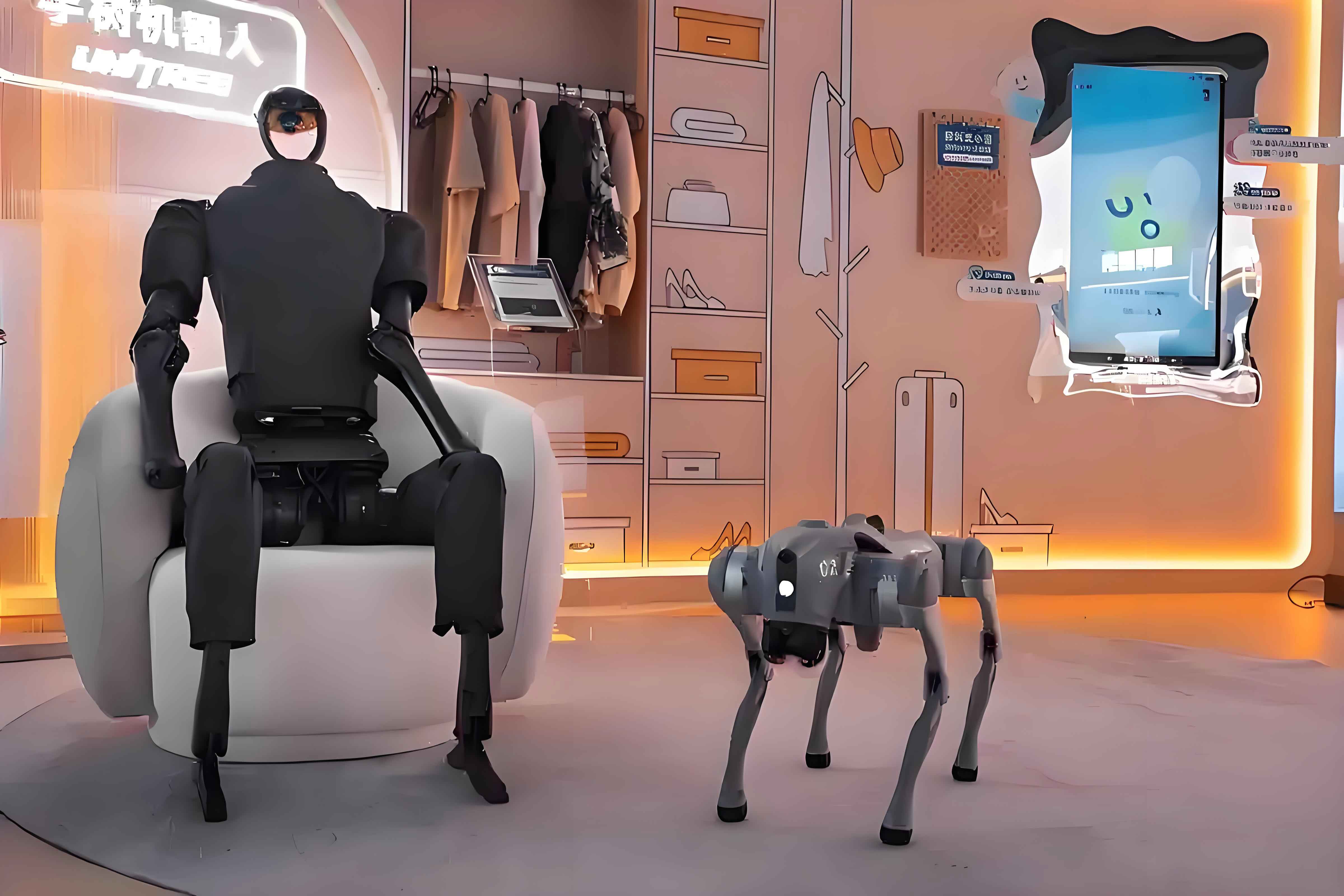
The image above illustrates the dynamic nature of humanoid robots and related robotic systems, showcasing their potential in diverse environments. To overcome these challenges and accelerate the humanoid robot industry in Hangzhou, I propose the following recommendations based on my analysis and firsthand insights into technological trends.
Strengthen Top-Level Design: Hangzhou must elevate the strategic importance of humanoid robots in its future industry portfolio, positioning them as a breakthrough for developing new quality productive forces. The city should quickly introduce forward-looking and operable industrial policies, such as establishing a dedicated industry fund focused on early-stage investments. A technology roadmap for humanoid robots should be drafted, outlining key milestones like achieving cost targets: $$ C_{target} \leq ¥200,000 $$ within five years. Additionally, building a humanoid robot industrial park can foster clustering effects and innovation ecosystems, similar to initiatives in other cities.
Deploy Key Technologies: Proactive布局 of converging technologies is essential. Hangzhou should explore integrations with AI, new materials, and brain-computer interfaces, targeting core components like neuromorphic chips and biomimetic muscles. A government-led common technology platform for humanoid robots can address foundational issues, such as improving actuator efficiency: $$ P_{out} = \tau \cdot \omega $$ where \( P_{out} \) is power output, \( \tau \) is torque, and \( \omega \) is angular velocity. Leveraging digital strengths, Hangzhou can accelerate innovations in “brain” (AI) and “cerebellum” (motion control) systems, while advancing localization of components to reduce dependencies. The following table summarizes key technological focus areas and potential metrics for humanoid robots in Hangzhou:
| Technology Area | Current Status in Hangzhou | Target Metrics | Formula/Indicator |
|---|---|---|---|
| Actuators (e.g., planetary roller screws) | Leading in efficiency | Increase load capacity by 30% | $$ F_{max} = k \cdot \eta \cdot P $$ |
| AI and Machine Learning | Strong in cloud models | Achieve real-time decision-making under 100ms | $$ t_{response} \propto \frac{1}{compute} $$ |
| Motion Control | Record-setting speeds | Enable complex terrain navigation | $$ v_{stable} = f(terrain, balance) $$ |
| Sensor Fusion | Advanced vision sensors | Improve accuracy to <1mm | $$ \sigma_{error} \rightarrow 0 $$ |
Cultivate Leading Enterprises: Enhancing policy support and precision services for humanoid robot companies is crucial. Hangzhou should establish a梯队 cultivation system, helping local leaders like Unitree Robotics and CloudMinds to scale up. Encouraging upstream specialists in core components, such as precision motor manufacturers, to deepen R&D can strengthen the产业链. Simultaneously,挖掘 and nurturing promising整机 enterprises and “little giant” firms will foster a robust cluster. The growth of these enterprises can be modeled using a logistic function: $$ N(t) = \frac{K}{1 + e^{-r(t-t_0)}} $$ where \( N(t) \) is the number of leading firms, \( K \) is the carrying capacity, and \( r \) is the growth rate. By supporting both hardware and software advancements, Hangzhou can build a competitive humanoid robot industry.
Construct an Industrial Ecosystem: Guiding innovation elements toward regions with potential, such as Lin’an, Yuhang, and Xiaoshan, can create优势集聚区. Cross-sector collaboration among enterprises, universities, and research institutes should be promoted through platforms for joint攻关 and成果转化. Hosting high-profile humanoid robot competitions or exhibitions in Hangzhou will attract global developers and firms, fostering产学研用 integration. This ecosystem approach can be quantified by an innovation index: $$ I = \alpha \cdot R + \beta \cdot C + \gamma \cdot M $$ where \( I \) is the innovation index, \( R \) represents R&D investment, \( C \) collaboration density, and \( M \) market access, with \( \alpha, \beta, \gamma \) as weights. By optimizing these factors, Hangzhou can enhance its humanoid robot industry’s global influence.
Attract and Nurture Professional Talent: Addressing the talent gap is imperative. Key positions in humanoid robot technology should be included in紧缺 talent directories, with intensified efforts to recruit high-level R&D personnel. Partnerships between humanoid robot companies and academic institutions can establish specialized training bases, offering定向培养 programs. The talent pipeline can be described by a supply-demand equation: $$ \frac{dT}{dt} = I(t) – O(t) + G(t) $$ where \( T \) is talent stock, \( I(t) \) is inflow, \( O(t) \) outflow, and \( G(t) \) growth through education. By building a全链条 talent cultivation system, Hangzhou can secure the human capital needed for humanoid robot innovation.
In conclusion, the humanoid robot industry presents a transformative opportunity for Hangzhou, given its existing strengths in digital economy and robotics. By implementing these strategies—ranging from policy design to talent development—Hangzhou can overcome current hurdles and emerge as a leader in the global humanoid robot landscape. The journey requires sustained commitment, but with concerted efforts, the vision of a thriving humanoid robot hub in Hangzhou is within reach, driving economic growth and technological advancement for years to come.