
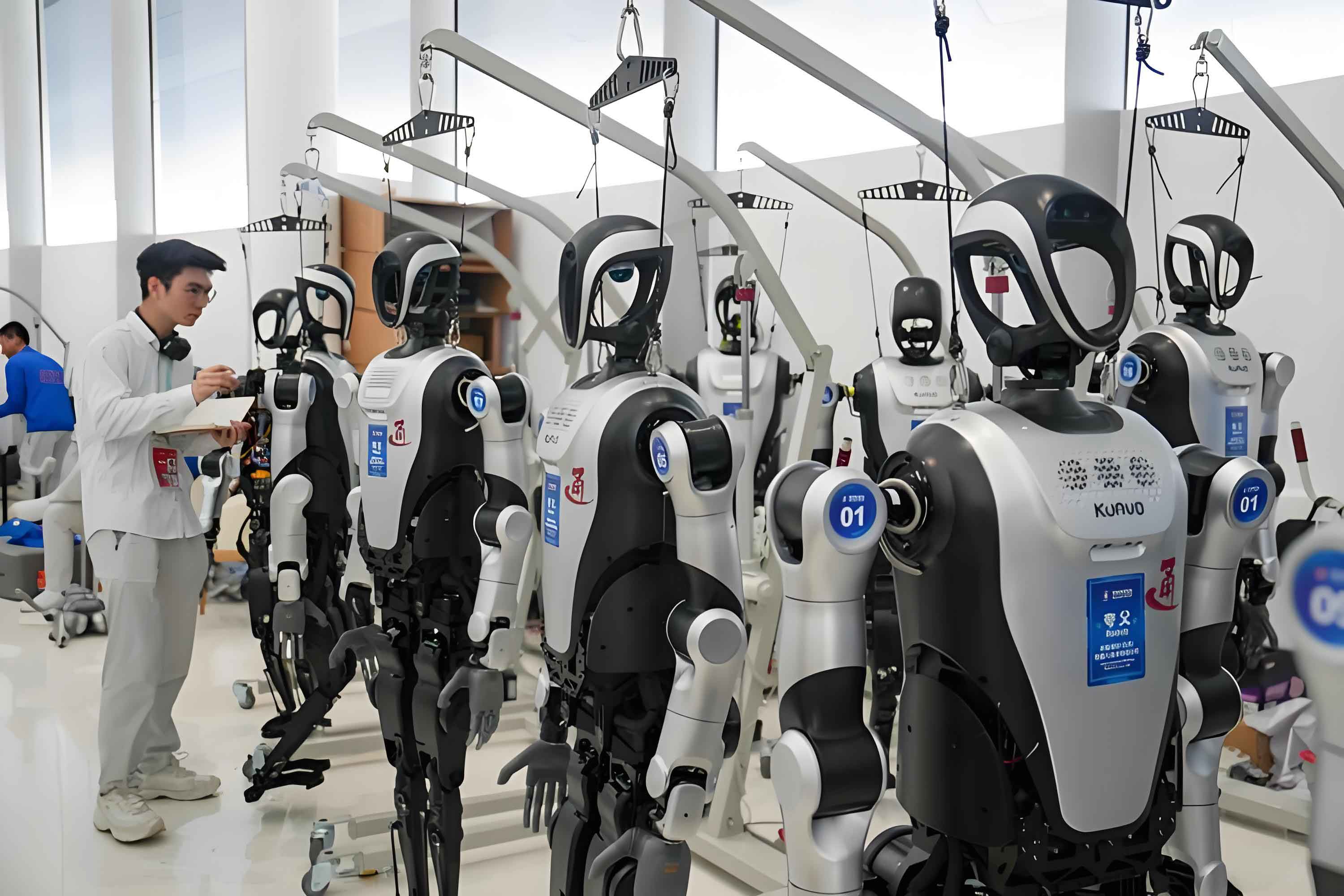
The journey from quadrupedal locomotion to sustained bipedal walking spanned approximately a million years of human evolution. A human child, the descendant of those early hominins, masters the art of balanced, stable walking and running within a mere three years of continuous, instinct-driven practice. This feat, which we perform without conscious thought, represents one of the most profound challenges in engineering: bestowing a machine with an equivalent sense of dynamic equilibrium. The pursuit of the humanoid robot is not merely about creating a machine that looks like us; it is the ultimate endeavor in embodied intelligence, aiming to replicate and potentially extend human capabilities for full-spectrum interaction within our world. While the field is experiencing remarkable momentum, symbolizing a healthy competition and co-development with single-purpose robots, significant hurdles remain across multiple domains. The path forward requires solving intricate puzzles of form, control, interaction, ethics, and economics, all of which are now seeing the first rays of tangible progress.
The fundamental aspiration for a humanoid robot is to achieve a state of “embodied intelligence,” where its physical form is seamlessly coupled with advanced cognitive abilities to interact with a world built for humans. This grand convergence, however, is predicated on solving several interdependent and non-trivial challenges.
The Foundational Dilemma: Form Following (and Informing) Function
The design of a humanoid robot’s exterior is the foundational and critical first step, a problem deeply entangled with human psychology and functional necessity. The challenge arises from a dual imperative: the machine must be sufficiently anthropomorphic to facilitate intuitive interaction within human environments, yet it must avoid the “uncanny valley”—the revulsion caused by a nearly-but-not-perfectly human replica. Furthermore, its form must resonate with cultural and social contexts to prevent ethical discomfort. This is not simple mimicry; the外形 must be a deliberate synthesis of biological inspiration and engineering pragmatism, dictated by the robot’s own structural, functional, and operational requirements.
The primary design considerations can be summarized by the following core requirements:
- Anthropomorphic Proportions with Engineering Constraints: While the average human height is around 1.7 meters, many humanoid robots exceed 1.8 meters for stability and reach. More critically, the torso-to-leg ratio, typically between 1:1.5 and 1:4 in humans, is often altered in robots. To lower the center of mass and improve balance, designers may opt for a longer torso or different leg proportions. Failure to optimize these ratios leads to inherent instability, manifesting as forward or backward pitching during movement.
- Articulation and Range of Motion (ROM): Human joints operate within a limited ROM (e.g., 30-60 degrees for many movements). A humanoid robot, however, often requires expanded ROM (approaching 80 degrees or more at key joints like the hip and shoulder) to perform tasks or recover from disturbances. Insufficient ROM directly compromises agility and balance recovery.
- Muscular Analogy and Actuation Power: Sufficient actuator “strength” (torque and power density) is non-negotiable. Without it, a humanoid robot cannot support its own weight, let alone apply forces to the environment or execute rapid movements. This involves designing joints with appropriate degrees of freedom (DoF). The collective DoF of the arms, legs, and torso must satisfy stringent requirements for motion and position control.
- Inherent Safety and Environmental Awareness: The design must integrate safety from the ground up. This includes both the robot’s safety for its surroundings (through force/torque sensing and compliant control) and its own operational safety (through environmental perception and collision avoidance).
The table below contrasts key design considerations between biological humans and engineering targets for humanoid robots.
| Parameter | Human (Biological Average) | Humanoid Robot (Engineering Target) | Primary Rationale for Deviation |
|---|---|---|---|
| Height | ~1.7 m | 1.6 – 1.9 m | Task reach, battery/component space, stability. |
| Torso:Leg Ratio | ~1:1.5 to 1:4 | Often larger torso ratio | To lower center of mass (COM) for static/dynamic stability. |
| Key Joint ROM | 30° – 60° (typical) | 70° – 120°+ | Enhanced mobility, fall recovery, and task execution. |
| Primary Actuation | Muscles (Contractile) | Electric Motors, Hydraulics, Pneumatics, SEA* | Power density, controllability, durability. |
| Balance Intelligence | Subconscious (Vestibular + CNS) | Algorithmic (IMU, Force, Vision) | Requires explicit sensing, state estimation, and control laws. |
*SEA: Series Elastic Actuator
The Core Challenge: The Intelligent Control Triad
Moving beyond static form, the essence of a functional humanoid robot lies in its intelligent control system. This transcends basic locomotion, encompassing a continuous loop of Perception, Decision, and Execution.
- Perception: The ability to extract meaningful state information from the environment (via cameras, LiDAR, IMU, force-torque sensors) and from the robot’s own body (proprioception).
- Decision: The cognitive process of transforming perceived data into a plan or a sequence of actions. This involves world modeling, task planning, and motion generation.
- Execution: The physical realization of the decision through precise, coordinated control of all actuators, often while maintaining dynamic balance.
The control challenge for a humanoid robot is monumental. Current approaches, heavily reliant on deep neural networks and traditional control theory, face several fundamental issues:
- Lack of True Intentionality: A humanoid robot does not “think” with human-like purpose and foresight. Its actions are ultimately responses to programmed goals and sensory input, lacking genuine internal motivation.
- Perceptual Gap: Despite advanced sensors, a robot’s real-time, holistic understanding of a complex, unstructured environment pales in comparison to human perception, which is deeply integrated with experience and context.
- Vulnerability to Error Propagation: The humanoid robot can repeat or even amplify errors. A misperception can lead to a dangerous action. It struggles with novel external disturbances and must solve the triple problem of correct perception, human-like reasoning frameworks, and robust disturbance rejection.
The dynamics of a simplified humanoid robot (often modeled as an inverted pendulum) can be expressed as:
$$ \ddot{\theta} = \frac{mgl\sin\theta – b\dot{\theta} + \tau}{I} $$
Where $ \theta $ is the angular deviation from vertical, $ m $ is mass, $ g $ is gravity, $ l $ is COM height, $ b $ is damping, $ \tau $ is applied torque, and $ I $ is moment of inertia. Whole-body control for a full humanoid robot involves solving vastly more complex equations in real-time, often formulated as a Quadratic Program (QP):
$$ \begin{aligned} \min_{\ddot{q}, \tau, f} & \quad \| \ddot{q} – \ddot{q}_{\text{des}} \|^2 + \| \tau \|^2 \\ \text{subject to} & \quad M(q)\ddot{q} + C(q, \dot{q}) = S^T \tau + J_c^T f \\ & \quad J_c \ddot{q} + \dot{J}_c \dot{q} = 0 \\ & \quad \tau_{\text{min}} \leq \tau \leq \tau_{\text{max}} \\ & \quad f \in \mathcal{F} \text{ (Friction Cone)} \end{aligned} $$
Here, $ q $ are joint angles, $ M $ is the inertia matrix, $ C $ contains Coriolis and gravity terms, $ S $ is the selection matrix, $ \tau $ are actuator torques, $ J_c $ is the contact Jacobian, and $ f $ are contact forces. This exemplifies the computational intensity of simply keeping the robot stable.
The Interaction Imperative: Beyond Task Execution
For a humanoid robot to be truly integrated into human society, it must master natural and effective Human-Robot Interaction (HRI). This requires capabilities in speech recognition/synthesis, gesture understanding/generation, and, most challengingly, affective expression. Interaction must respect human cultural norms to avoid discomfort.
The current state reveals key deficits:
- Low Interaction Bandwidth: Communication is often slow, literal, and lacks the nuance of human dialogue.
- The Perpetual Student Problem: The robot requires continuous, massive data to learn even basic social cues.
- Interaction Poverty: Exchanges are typically single-modal (e.g., only voice) and task-oriented, not social.
- Excessive Complexity: For users, setting up or modifying interaction protocols can be daunting.
Solutions are emerging through deeper AI integration:
- Advanced Sensation: Creating a humanoid robot with human-like sensation is key. Research into artificial skin with distributed pressure and temperature sensors, and artificial muscles for facsimiles of facial expression (e.g., “emotion-driven” systems), aims to bridge this gap. Without these, the robot remains an unfeeling shell.
- Human-Like Cognition: The holy grail is a humanoid robot that reasons like a human. This necessitates Artificial General Intelligence (AGI) capable of understanding context, metaphor, and emotion—a goal that remains distant.
- Emotional Expression: True affective expression requires more than a pre-programmed smile. It implies an internal state model that influences outward communication. Giving a humanoid robot a “body” with which to express “feelings” is a prerequisite for deeper mutual understanding and collaboration.
The perception-decision-action loop for social HRI can be modeled as an extension of the control loop, incorporating social state estimation $ s_s $ and affective state $ a $:
$$ \begin{aligned} s_s(t) &= \text{HRI-Perception}(\text{camera, mic, context}) \\ a(t) &= \text{Affective-Model}(s_s(t), a(t-1), \text{internal goals}) \\ \text{action}_{\text{social}}(t) &= \text{HRI-Policy}(s_s(t), a(t), \text{task goal}) \end{aligned} $$
This highlights the additional layers of complexity for social humanoid robot interaction.
The Human-Centric Quandary: Ethics and Morality
As humanoid robots advance toward greater autonomy and similarity to humans, they cease to be purely engineering problems and become mirrors for our own ethical and moral frameworks. These are, fundamentally, human dilemmas projected onto our creations.
- Privacy and Security: A humanoid robot with pervasive sensors is a mobile data collection node. Safeguarding the information it gathers and preventing its malicious hijacking are paramount.
- Labor and Societal Displacement: The automation potential of humanoid robots could reshape labor markets, necessitating proactive policies for economic transition and support.
- Moral Agency and Responsibility: Can and should a humanoid robot be bound by moral rules? If a robot causes harm, who is responsible—the designer, the owner, or the robot itself? This touches on the philosophical questions of free will and autonomy.
The central tension lies between autonomy and control. Humans possess free will and are held responsible for their actions. A humanoid robot, even with advanced AI, operates within the bounds of its programming and learning. The question is whether a sufficiently complex system could develop a form of “operational autonomy” that demands a new legal and ethical category. Furthermore, the nature of learning differs: humans learn actively and generatively, while robots typically learn passively from curated data, limiting their ability for truly creative or moral reasoning.
Key ethical questions for a future with humanoid robots include:
- At what point might a robot be considered to have “consciousness” or deserving of rights?
- What constitutes a fair and equitable relationship between humans and human-like machines?
- How do we encode and enforce ethical behavior (e.g., Asimov’s Laws) in complex, real-world scenarios?
- How should we manage the lifecycle, including retirement and disposal, of sentient-like machines?
The table below outlines a potential framework for approaching humanoid robot ethics.
| Ethical Dimension | Core Questions | Potential Principles |
|---|---|---|
| Agency & Responsibility | Who is liable for robot actions? Can a robot be a moral agent? | Graduated responsibility models; mandatory error logging and explanation capabilities. |
| Privacy & Transparency | What data is collected? How is it used? Can the robot’s decisions be explained? | Privacy-by-design; data minimization; right to algorithmic transparency. |
| Safety & Non-Maleficence | How to ensure the robot never intentionally harms a human? How to fail safely? | Intrinsic safety layers (mechanical, control); pre-programmed ethical constraints. |
| Fairness & Justice | Do robots exacerbate social inequalities? How are they distributed and accessed? | Equitable design and deployment policies; preventing algorithmic bias. |
| Dignity & Societal Impact | Does robot interaction degrade human dignity? How do they affect community? | Human-centric design; studies on long-term socio-psychological effects. |
The Pragmatic Barrier: Cost and Operational Efficacy
The vision of ubiquitous humanoid robots crashes against the hard rocks of cost and practical performance. These systems are astronomically expensive to develop, manufacture, and maintain, while their operational efficacy in complex, unstructured environments remains limited.
The Cost Problem: High costs stem from advanced materials (lightweight composites, specialized alloys), precision actuators and sensors, and the immense R&D required for software and AI. Each joint is a marvel of mechatronics, requiring custom design, assembly, and calibration. The computational hardware alone for real-time perception and control represents a significant expense.
The Efficacy Problem: True efficacy means robustly performing useful work in diverse, unpredictable settings. Current humanoid robots excel in controlled demonstrations but struggle with real-world variability. Key limiting factors include:
– Energy Density: Battery technology limits operational time, often to just a few hours.
– Computational Latency: Perception and planning cycles must be incredibly fast for dynamic response; any delay can cause instability.
– Hardware Durability: Repeated impacts, falls, and high-force interactions lead to wear and mechanical failure.
– Generalization Ability: A skill learned in one environment often fails in a slightly different one.
The path to improvement is through sustained technological convergence. Advances in battery tech (solid-state), cheaper and more powerful sensors (e.g., event cameras), more efficient actuators, and the maturation of simulation-to-real (Sim2Real) transfer learning will drive down costs and push up robustness. The cost-efficacy curve for humanoid robots can be conceptually modeled, showing the need for a breakthrough to reach viability:
$$ C_{\text{total}} = C_{\text{hardware}}(m, \text{tech}) + C_{\text{software}}(\text{AI complexity}) + C_{\text{integration}} $$
$$ E_{\text{operational}} = f(\text{uptime}, \text{task success rate}, \text{autonomy level}) $$
The commercial equation requires $ E_{\text{operational}} / C_{\text{total}} $ to exceed a threshold value determined by the alternative (human labor or specialized machines).
The Dawn of Solutions: A Future in Motion
Despite the daunting challenges, the field is witnessing a surge of innovative solutions. The paradox holds true: endowing a humanoid robot with adult-level cognitive knowledge is currently easier than granting it the sensorimotor intelligence of a one-year-old. Picking up a piece of trash and placing it in a bin is a trivial human act but a monumental achievement for a robot. Stepping off a curb and recovering from a stumble is an unconscious human reflex but a cutting-edge control challenge for a humanoid robot.
Progress, however, is unmistakable. Companies are tackling the core problems head-on: developing innovative joint designs with high torque density and compliance; creating advanced balance controllers that allow robots to withstand significant pushes or even kicks and recover gracefully; and building end-to-end neural networks for more natural and adaptive movement. Demonstrations of robots running, navigating complex terrain, and performing dual-arm manipulation are no longer science fiction but regular occurrences in research labs.
The evolution of the humanoid robot can be seen in phases: an initial phase of basic mobility and form; a developmental phase of improved sensing and control; the current convergence phase where AI deeply integrates with embodiment; and a future maturation phase leading to widespread utility.
The convergence is underway. Through the relentless collaboration of engineers, computer scientists, materials experts, cognitive scientists, and ethicists, the humanoid robot is steadily progressing from a fascinating prototype toward a technology capable of meeting genuine human needs and expectations, ultimately forging a new chapter in our relationship with intelligent machines.