
In the contemporary era of rapid technological revolution, I observe that the labor market is undergoing profound transformations. The development of new quality productivity necessitates high-caliber skilled talent, yet the widespread application of humanoid robots is deeply reshaping employment structures and professional ecosystems. As a researcher examining this phenomenon, I contend that the challenges faced by workers are becoming increasingly complex, encompassing the rupture of traditional promotion pathways, mismatches in training supply and demand, erosion of autonomy, and exacerbation of re-employment barriers. This leads to technological unemployment with new characteristics, such as pervasive job penetration, skill obsolescence, and irreversible displacement, which collectively undermine workers’ career development rights and employment opportunities. Therefore, I believe it is imperative to reconstruct a legal safeguard system grounded in human dignity, social contract, the essence of labor, and state responsibility to ensure the comprehensive development of individuals in a human-machine symbiotic age.
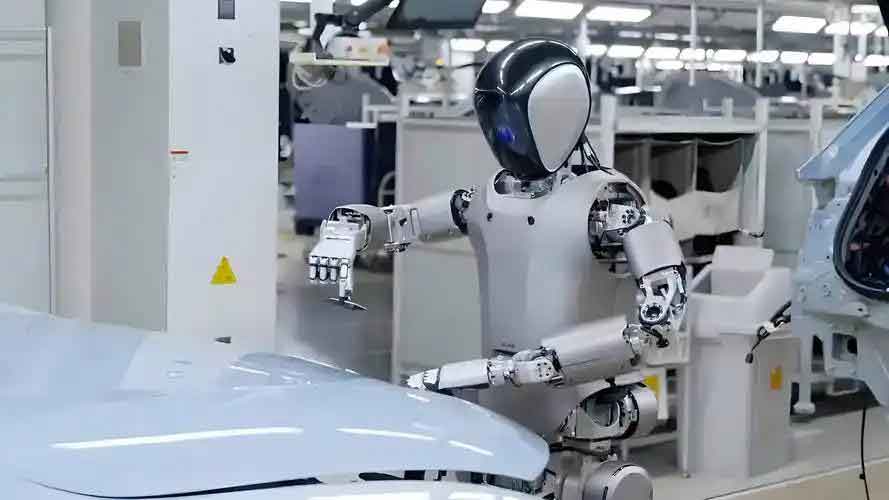
From my perspective, the advent of humanoid robots marks a significant leap beyond traditional automation. These entities, characterized by bipedal locomotion, multimodal perception, and autonomous learning capabilities, are infiltrating diverse sectors like manufacturing, logistics, healthcare, and education. The integration of humanoid robots into the workforce is not merely a substitution of manual tasks; it represents a fundamental shift in how labor is organized and valued. I will analyze the multifaceted impacts on career development, explore the evolving nature of technological unemployment, and propose a robust legal framework to protect workers’ rights in this new paradigm.
First, I identify several critical challenges that humanoid robots pose to workers’ career development. The traditional linear career path—where progression relies on experience accumulation and seniority—is being dismantled. Humanoid robots, with their ability to learn and perform complex tasks efficiently, are replacing mid- to low-skilled positions that once served as stepping stones for advancement. This leads to career fragmentation and increased precariousness. Furthermore, the rise of non-standard employment forms, driven by cost-saving measures facilitated by humanoid robot adoption, blurs the boundaries of traditional labor relations, leaving many workers outside the protective scope of existing labor laws.
To summarize these challenges systematically, I present the following table:
| Challenge Category | Key Manifestations | Impact on Career Development |
|---|---|---|
| Disruption of Traditional Paths | Replacement of experience-based roles; fragmentation of career ladders; increased non-standard work. | Loss of stable progression opportunities; weakened job security. |
| Training Mismatch and Skill Lag | Rapid skill obsolescence; inadequate training resources; high costs of reskilling. | Structural unemployment; barriers to transitioning into new roles. |
| Erosion of Autonomy and Identity | Algorithmic management; task sharing with humanoid robots; diminished sense of professional value. | Reduced worker agency; crisis in professional identity and dignity. |
| Re-employment Barriers and Risks | Digital divide; insufficient social security for flexible workers; algorithmic bias in hiring. | Prolonged unemployment; systemic inequality and survival risks. |
In my analysis, the skill lag is particularly concerning. The pace at which humanoid robots update their capabilities through machine learning far outstrips the rate at which humans can retrain. This can be conceptualized by a simple formula representing the skill gap: $$ \Delta S(t) = S_r(t) – S_w(t) $$ where $\Delta S(t)$ is the skill gap at time $t$, $S_r(t)$ is the skill level of humanoid robots (which grows exponentially with data and iterations), and $S_w(t)$ is the skill level of the workforce (which grows linearly or stagnates due to training limitations). A positive $\Delta S(t)$ indicates increasing obsolescence of human skills, leading to what I term “skill滞后型失业” (skill-lag-induced unemployment).
Second, I delve into the new forms of technological unemployment catalyzed by humanoid robots. Unlike past technological shifts, the impact here is more pervasive and insidious. I categorize these forms as follows:
| Form of Technological Unemployment | Description | Key Drivers |
|---|---|---|
| Job-Penetration Unemployment | Humanoid robots, due to their anthropomorphic design, infiltrate a wide range of occupations previously reliant on human dexterity and interaction, from manual labor to care work. | Versatility and adaptability of humanoid robots; cost-effectiveness. |
| Skill-Lag Unemployment | Workers’ skills become obsolete faster than they can be updated, creating a persistent mismatch between workforce capabilities and job requirements. | Rapid upskilling of humanoid robots via AI; slow human training cycles. |
| Persistent and Irreversible Unemployment | Displacement is not temporary; once a role is fully automated by humanoid robots, re-entry into that field becomes nearly impossible, leading to long-term marginalization. | Systemic integration of humanoid robots into production networks; shift to flexible labor arrangements. |
| Hidden Reassignment Unemployment | Workers are ostensibly reassigned to lower-value tasks or nominal positions while being effectively phased out, masking true unemployment statistics. | Emotional simulation by humanoid robots; economic incentives to reduce labor costs. |
I argue that these forms collectively signify a structural erosion of career development rights. The penetration of humanoid robots into labor markets can be modeled as a diffusion process. Let $J_h(t)$ be the number of jobs predominantly performed by humans, and $J_r(t)$ be those performed by humanoid robots. The rate of substitution might follow: $$ \frac{dJ_h}{dt} = -\alpha J_h \cdot I_r $$ where $\alpha$ is a substitution coefficient, and $I_r$ represents the penetration intensity of humanoid robots. This leads to a decline in $J_h$, exacerbating unemployment unless new job creation compensates.
Third, from a jurisprudential standpoint, I base the need to safeguard career development rights on four pillars. Human dignity demands that workers not be reduced to “technological redundancies” by humanoid robots; the social contract requires balancing efficiency with equity; the essence of labor emphasizes human fulfillment through work; and state responsibility obligates proactive measures to ensure decent work. These principles justify legal intervention.
Fourth, I propose a comprehensive legal framework to reconstruct the safeguarding system for career development rights in the age of humanoid robots. This involves multiple interdependent components, which I summarize in the table below:
| Legal Component | Core Measures | Expected Outcomes |
|---|---|---|
| Establishing Career Development Rights as Fundamental Rights | Explicitly enshrine career development rights in labor law as an independent entitlement, encompassing continuous learning, skill advancement, and occupational mobility. | Enhanced legal recognition; provides basis for claims and policy formulation. |
| Strengthening Vocational Education and Retraining Systems | Clarify state responsibility for public training programs and mandate enterprise obligations for reskilling when introducing humanoid robots; establish individual training accounts and “job-card” systems. | Reduced skill gaps; facilitated transitions; lifelong learning culture. |
| Building Composite Labor Protection Rules for Human-Machine Symbiosis | Implement procedural reviews for layoffs due to humanoid robot adoption; strengthen collective bargaining over technology impacts; develop regulations for algorithmic management and data rights. | Greater worker participation; prevention of covert displacement; fair working conditions. |
| Perfecting Synergistic Mechanisms for Employment Security and Social Protection | Expand unemployment insurance to cover technological displacement; link benefits to training participation; integrate platform workers into social security; govern algorithmic bias in employment. | Income security during transitions; inclusive safety nets; mitigated inequality. |
In designing these measures, I emphasize the role of quantitative assessments. For instance, the effectiveness of retraining can be evaluated using a formula: $$ E_t = \frac{N_s}{N_t} \times \Delta I $$ where $E_t$ is training efficacy, $N_s$ is the number of workers successfully reskilled, $N_t$ is the total trainees, and $\Delta I$ is the average income increase post-training. This helps optimize resource allocation.
Moreover, the interaction between humanoid robot deployment and labor markets necessitates dynamic modeling. Consider a labor market where the demand for human labor $L_h$ is affected by the stock of humanoid robots $R$. A simplified relationship could be: $$ L_h = \beta_0 – \beta_1 R + \beta_2 G $$ where $\beta_1$ captures the substitution effect of humanoid robots, and $\beta_2$ represents the compensation effect from new job creation $G$ in sectors spurred by technological advancement. Policymakers must ensure $\beta_2$ outweighs $\beta_1$ through innovation and education investments.
I also stress the importance of algorithmic governance. As humanoid robots often operate under AI systems, transparency is crucial. Let $A$ represent an algorithmic decision-making process affecting hiring or promotions. We can demand: $$ \text{Transparency Index } T(A) = \frac{\text{Explainable Decisions}}{\text{Total Decisions}} $$ requiring $T(A)$ to exceed a threshold to prevent discrimination and protect career opportunities.
In conclusion, I assert that the era of humanoid robots presents both formidable challenges and unique opportunities for labor. The pervasive influence of humanoid robots on employment structures necessitates a paradigm shift in labor law—from merely preserving jobs to actively fostering career development. By anchoring protections in human dignity and social equity, and implementing the proposed legal framework, we can navigate technological disruption toward a future where human-machine symbiosis enhances, rather than diminishes, human potential. This journey requires sustained commitment to education, fair regulation, and inclusive social policies, ensuring that the benefits of humanoid robot innovations are shared broadly and contribute to the comprehensive development of all individuals in society.