
The evolution of intelligent manufacturing is inextricably linked to the advancement of robotics. The humanoid robot, as a pinnacle of this field, integrates a confluence of advanced technologies including mechanical engineering, automation, electronics, and artificial intelligence. Its inherent interdisciplinary nature makes it an ideal pedagogical tool for cultivating the next generation of innovative engineers. However, traditional laboratory instruction centered on physical humanoid robot platforms faces significant, often insurmountable, barriers. These include the prohibitive cost of high-quality hardware, stringent requirements for laboratory space and safety, limited operational time for each student, and the inherent risk of damaging expensive components during the learning process. These constraints severely restrict students’ opportunities for comprehensive, hands-on exploration of the complete humanoid robot design, control, and integration pipeline.
To transcend these physical and economic limitations, we have pioneered the development of an immersive Virtual Simulation Experiment System. This system is designed not as a replacement for physical interaction, but as a foundational and complementary pedagogical layer that de-risks and democratizes access to humanoid robot education. By creating a high-fidelity digital twin, students can freely assemble, program, and debug a virtual humanoid robot in an environment where failure is a cost-free learning opportunity. This paper details the architecture of this system, its core modules grounded in a knowledge graph, and its transformative application in our engineering curriculum.
The Imperative for Virtual Simulation in Robotics Education
The pedagogical challenges associated with physical humanoid robot platforms are multifaceted. A comparative analysis highlights the advantages of the virtual paradigm.
| Aspect | Traditional Physical Lab | Virtual Simulation Platform |
|---|---|---|
| Accessibility & Cost | Limited by number of expensive robot units; high maintenance costs. | Unlimited instances; negligible marginal cost per student. |
| Safety & Risk | Risk of physical injury or hardware damage from incorrect commands. | Inherently safe environment; allows exploration of edge-case behaviors. |
| Experiment Flexibility | Hardware setup is fixed; modifying kinematics or dynamics is impossible. | Parameters (link lengths, masses, motor specs) can be modified instantly. |
| Learning Depth & Pace | Time-bound lab sessions; limited opportunity for iterative debugging. | Self-paced, anytime-anywhere learning; encourages iterative experimentation. |
| Assessment & Feedback | Manual, subjective evaluation of physical outcomes. | Automated, objective assessment based on simulation data and knowledge mastery. |
The virtual platform directly addresses these constraints. It provides a sandbox for mastering foundational concepts—such as forward/inverse kinematics, dynamics, and control theory—before applying them to fragile, real-world hardware. This “simulate first” approach builds competence and confidence. For instance, students can derive and test the Denavit-Hartenberg (D-H) parameters for a manipulator arm. The forward kinematics for a series of $n$ joints can be computed by the homogeneous transformation matrix:
$$
^0T_n = ^0T_1 \cdot ^1T_2 \cdot … \cdot ^{n-1}T_n
$$
Where each $^{i-1}T_i$ is defined by its D-H parameters $(\theta_i, d_i, a_i, \alpha_i)$. In the virtual environment, students can visually validate their derived matrix by comparing the calculated end-effector position with the simulated model’s position, an iterative process impractical with a single physical unit shared among dozens.
System Architecture: A Knowledge-Graph-Centric Design
Our Virtual Simulation Experiment System is architected around three core technical modules—Mechanical Assembly, Component-Level Control, and Integrated Motion Control—unified and navigated by a dynamic Robotics Knowledge Graph. This graph structures the domain knowledge (concepts, procedures, relationships) and serves as both an intelligent learning map and an assessment framework.
| System Module | Core Concepts Covered | Primary Pedagogical Goal |
|---|---|---|
| Mechanical Assembly | Part recognition, geometric constraints, kinematic chain assembly, actuation placement. | Understand the physical embodiment and mechanical design of a humanoid robot. |
| Component-Level Control | Circuit wiring, servo motor control (PWM), DC motor control (PID), sensor interfacing. | Master low-level actuation and sensing, the building blocks of robot behavior. |
| Integrated Motion Control | Forward/Inverse Kinematics, trajectory planning, gait generation, balance control. | Synthesize component-level skills to achieve coordinated whole-body motion. |
| Knowledge Graph Navigator | Conceptual relationships, prerequisite mapping, learning progress visualization. | Provide structured, adaptive learning pathways and automated competency assessment. |
The knowledge graph is the system’s “brain.” Nodes represent entities (e.g., “servo motor,” “PID controller,” “Denavit-Hartenberg convention”) and learning objectives. Edges represent relationships like “is-a,” “part-of,” “prerequisite-for,” or “used-in.” As students complete tasks, corresponding nodes are “activated” or “lit up,” providing a real-time, visual dashboard of their conceptual mastery. This structure enables the system to recommend subsequent learning activities and generate personalized assessments by traversing connected concepts. The strength of a student’s understanding between two concepts $C_i$ and $C_j$ can be modeled based on their performance on connecting tasks:
$$
S_{ij} = \frac{\sum_{k=1}^{N} (w_k \cdot P_k)}{N}
$$
where $S_{ij}$ is the association strength, $N$ is the number of tasks linking the concepts, $P_k$ is the performance score on task $k$, and $w_k$ is a weight reflecting the task’s importance.
Experimental Pedagogy: A Four-Phase Learning Journey
The curriculum integration is structured as four sequential, yet flexible, experimental projects that guide students from awareness to synthesis.
Phase 1: System Immersion & Kinematic Exploration
This initial phase serves as an interactive primer. Students are immersed in a high-fidelity 3D environment with a fully functional virtual humanoid robot. They can interactively explore the robot’s history, its anatomical components (arms, legs, torso, head, end-effectors), and most importantly, directly manipulate its joints through sliders or direct kinematics input. This tactile exploration demystifies abstract concepts. For example, by directly altering a joint angle $\theta$ and observing the end-effector position $(x, y, z)$, they internalize the essence of forward kinematics, $X = f(\theta)$, before ever seeing the formal D-H derivation.
Phase 2: Cognitive Disassembly & Virtual Assembly
Here, the focus shifts to constructive understanding. The humanoid robot is decomposed into its constituent subsystems: head/neck assembly, anthropomorphic arm, dexterous hand, and mobile base. Each subsystem features a dedicated virtual assembly bench with a part library containing motors, brackets, links, and fasteners. Students perform guided, constraint-based assembly. The process reinforces mechanical design principles, the importance of kinematic chains, and actuation placement. Hovering over a part reveals its technical specifications, linking form to function. Successful assembly triggers a motion animation of that subsystem, providing immediate positive feedback.
Phase 3: Component-Level Control & Algorithm Tuning
This phase transitions from mechanics to electronics and control. It consists of three integrated sub-modules:
- Circuit Wiring: A virtual breadboard and components (Arduino microcontroller, servos, motors, sensors) are provided. Students learn correct wiring practices by dragging connections, for instance, connecting a servo’s PWM signal, power, and ground lines to the correct microcontroller pins. The system validates the circuit logically before allowing progression.
- Servo Control Principle: Students explore the relationship between Pulse Width Modulation (PWM) duty cycle and servo angle. A visual oscilloscope shows the PWM signal while the virtual servo rotates to the corresponding position, cementing the control law: $\theta_{servo} = k \cdot (PWM_{width} – PWM_{neutral})$.
- PID Motor Control: For the wheeled base, students engage with closed-loop control. They tune the Proportional (P), Integral (I), and Derivative (D) gains for a simulated DC motor to achieve desired performance (e.g., fast step response without overshoot). The motor’s transfer function model, $G(s) = \frac{K}{s(\tau s + 1)}$, responds in real-time to their tuned controller $C(s) = K_p + \frac{K_i}{s} + K_d s$, displaying the step response. This experimentation is risk-free and far more efficient than tuning a physical motor.
Phase 4: Virtual-Physical Integration & Teleoperation
The final phase bridges the virtual and physical worlds, completing the learning cycle. After perfecting control strategies in simulation, students deploy them on a physical humanoid robot platform. One powerful application is teleoperation via motion capture. A student wears inertial measurement unit (IMU) sensors. Their pose data is streamed to the control system, which solves the inverse kinematics to map human movements to the robot’s joint angles in real-time.
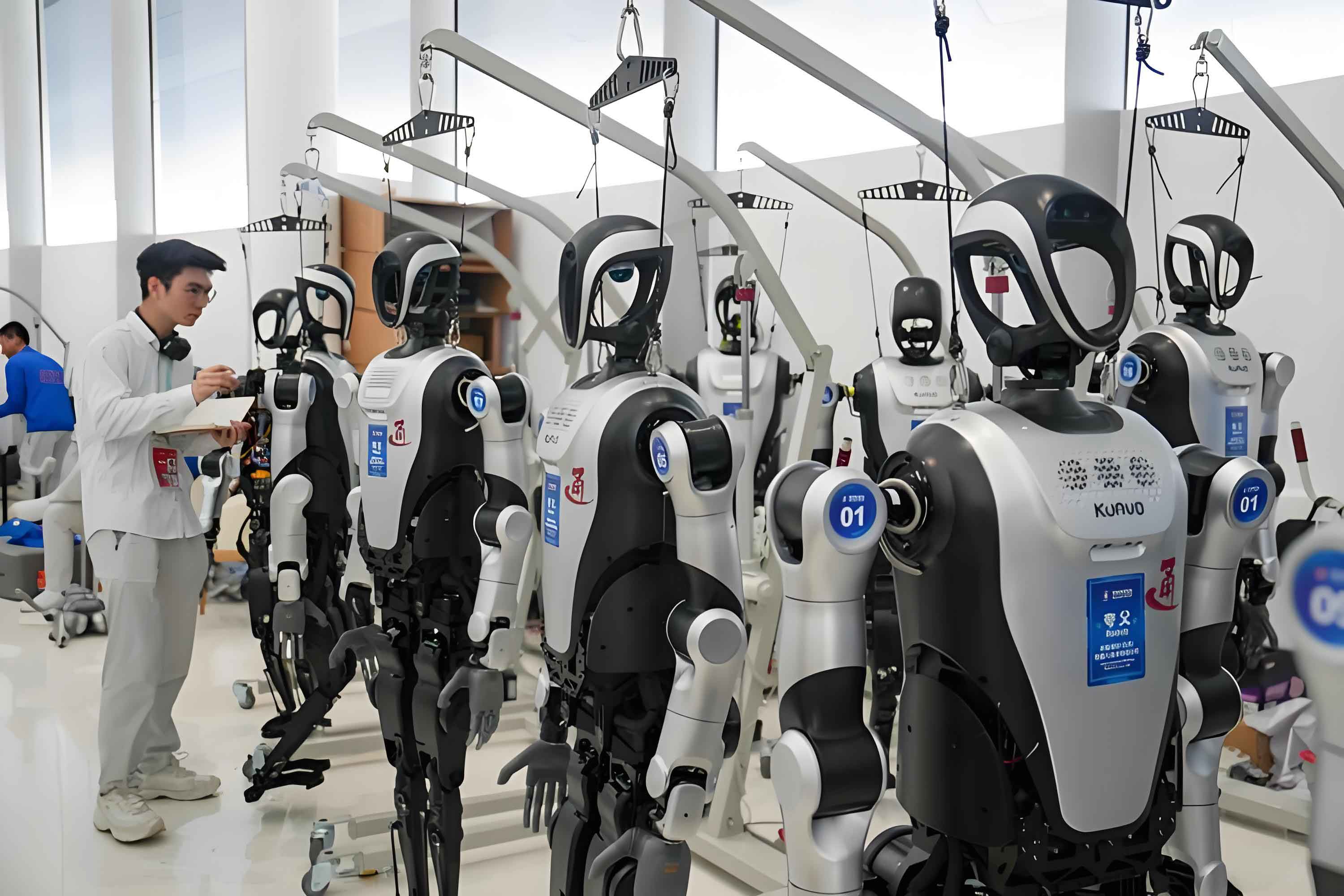
Furthermore, using VR headsets, students can see through the robot’s cameras, creating a profound sense of embodiment. This humanoid robot avatar experience, as suggested by applications like quality inspection, solidifies the connection between algorithm, simulation, and physical manifestation. It demonstrates how a virtually-validated control pipeline can be directly ported to real hardware, a fundamental workflow in modern robotics.
Problem-Based Assessment & Teaching Methodology
The system enables a shift from time-bound, instructor-led labs to a flexible, student-centered, and problem-driven model.
Teaching Methodology: Experiments are assigned as asynchronous tasks. Students access the platform independently, allowing them to learn at their own pace and repeat complex procedures as needed. This alleviates scheduling pressure and hardware contention. The platform serves as a continuous complement to lectures. When a theoretical concept like Jacobian-based velocity control is introduced, $v = J(\theta) \dot{\theta}$, students can immediately experiment with it in the simulation, observing how singularities affect manipulability.
Automated, Knowledge-Graph-Driven Assessment: Evaluation is seamlessly integrated and automated. The knowledge graph is linked to a question bank categorized by concept node. Upon completing a module, students are presented with targeted problems. These can be multiple-choice questions on theory, or performance-based tasks like “Tune the PID gains to achieve a settling time $t_s < 2s$ with less than 5% overshoot.” The system automatically scores these, updating the knowledge graph visualization. This provides immediate, objective feedback and allows instructors to track class-wide competency dashboards, identifying topics that require further elaboration. The assessment score $A$ for a module can be a composite metric:
$$
A = \alpha \cdot (C_{avg}) + \beta \cdot (P_{avg}) + \gamma \cdot (T_{completion})
$$
where $C_{avg}$ is the average score on conceptual questions, $P_{avg}$ is the average score on performance tasks, $T_{completion}$ is a factor for time efficiency, and $\alpha, \beta, \gamma$ are weighting coefficients.
| Assessment Dimension | Example | Measurement Method |
|---|---|---|
| Conceptual Understanding | “What is the role of the I-term in a PID controller?” | Automated grading of quiz questions tied to knowledge graph nodes. |
| Procedural Skill | Correctly assemble the robotic arm from a set of parts. | System validates assembly constraints and kinematic connectivity. |
| Analytical & Tuning Skill | Achieve a specified step-response performance for a motor. | Algorithmic analysis of simulation output data (overshoot, settling time). |
| Synthesis & Application | Program a walking gait for the full humanoid robot. | Evaluation of gait stability, smoothness, and success in traversing terrain. |
Conclusion and Impact
The development and deployment of this Knowledge-Graph-Navigated Virtual Simulation Experiment System for humanoid robot education represent a significant advancement in pedagogical methodology for complex cyber-physical systems. By breaking down the barriers of cost, safety, and access, it ensures every student can engage in deep, repetitive, and creative experimentation with a sophisticated humanoid robot platform. The structured learning journey—from assembly and component control to integrated motion planning and final physical deployment—builds a robust and comprehensive understanding. The integration of the knowledge graph provides an intelligent backbone for personalized learning and objective assessment, moving beyond simple simulation to an adaptive educational ecosystem.
In our teaching practice, this system has markedly increased student engagement, deepened conceptual mastery, and accelerated the transition from theory to functional physical implementation. It embodies a “simulate-first, deploy-confidently” philosophy that is essential for training engineers capable of innovating in the field of humanoid robotics. This platform is not merely a substitute for physical labs; it is a foundational tool that expands what is pedagogically possible, preparing a more skilled and experimentally bold generation of robotics engineers to advance the frontier of intelligent systems.