
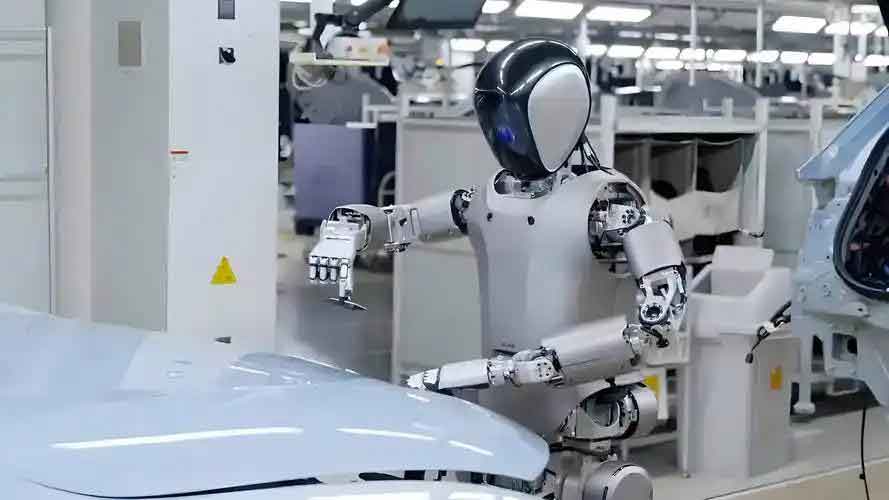
The convergence of artificial intelligence, advanced control systems, and multimodal sensing is propelling humanoid robot research to the forefront of intelligent technology. The concept of embodied intelligence, which emphasizes the generation of intelligent behavior through the dynamic interaction between a physical agent and its environment, provides a crucial theoretical framework for advancing humanoid robot capabilities beyond simple pre-programmed tasks. This field represents a significant paradigm shift from traditional, disembodied AI, aiming to create machines that can learn, adapt, and operate autonomously in human-centric environments. To systematically understand the evolution, current focus, and collaborative landscape of this rapidly evolving domain, a bibliometric analysis is conducted. This investigation maps the intellectual structure, identifies key trends, and highlights critical challenges, particularly the pressing need for standardized frameworks to guide future development and safe deployment.
Data and Methodology
The analysis is based on literature data retrieved from the Web of Science (WOS) core collection. The search query was designed to capture the core concepts of humanoid robot and embodied intelligence: TS=(“humanoid robot*” OR “humanoid robotics” OR “human-like robot*” OR “embodied intelligence”). The timespan was set from January 1, 2015, to May 3, 2025, yielding a final corpus of 2,686 relevant publications. These documents include articles, conference proceedings, and reviews, providing a comprehensive view of the field’s scholarly output.
For data processing and visualization, two specialized bibliometric tools were employed: CiteSpace (version 6.3.R1) and VOSviewer (version 1.6.20). CiteSpace was configured to analyze the data in one-year time slices, with a selection threshold set to the top 10% of most cited or occurred items per slice. This allows for the detection of emerging trends, pivotal publications, and the evolution of research frontiers. VOSviewer was primarily used for constructing and visualizing network maps based on co-authorship, co-occurrence of keywords, and citation relationships, which help elucidate the collaborative patterns and thematic clusters within the humanoid robot and embodied intelligence research community.
Bibliometric Results and Landscape Analysis
The analysis of 2,686 publications from 2,098 institutions across 78 countries/regions, involving 7,742 authors, reveals a dynamic and growing field.
Publication Volume and Growth Trajectory
The annual publication count demonstrates sustained and significant growth interest in humanoid robot and embodied intelligence research. Following a period of steady increase, output has stabilized at a high level in recent years.
| Year | Publication Count | Cumulative Count |
|---|---|---|
| 2015 | 168 | 168 |
| 2016 | 185 | 353 |
| 2017 | 193 | 546 |
| 2018 | 213 | 759 |
| 2019 | 237 | 996 |
| 2020 | 313 | 1,309 |
| 2021 | 293 | 1,602 |
| 2022 | 283 | 1,885 |
| 2023 | 269 | 2,154 |
| 2024 | 311 | 2,465 |
| 2025 (Partial) | 221 | 2,686 |
This table confirms that the field has entered a phase of mature, high-output research activity, with annual publications consistently exceeding 250 since 2020.
Geographical Distribution and Collaboration Networks
The research landscape is geographically concentrated, with a few nations dominating the scholarly output. This indicates high entry barriers related to funding, infrastructure, and technical expertise.
| Rank | Country/Region | Publication Count | Percentage (%) |
|---|---|---|---|
| 1 | China | 701 | 26.1 |
| 2 | Japan | 358 | 13.3 |
| 3 | USA | 327 | 12.2 |
| 4 | Germany | 173 | 6.4 |
| 5 | England | 132 | 4.9 |
| 6 | Italy | 128 | 4.8 |
| 7 | South Korea | 127 | 4.7 |
| 8 | France | 124 | 4.6 |
| 9 | India | 109 | 4.1 |
| 10 | Canada | 78 | 2.9 |
Despite the high volume, international collaboration networks among the leading countries are not densely connected. Analysis reveals that while major players like the USA, England, and Germany collaborate frequently with multiple partners, cross-continental collaborations, particularly between Eastern and Western research powerhouses, are less prevalent than expected. This suggests potential for greater global synergy.
Influential Authors and Research Institutions
The field exhibits a pronounced “head effect,” where a small number of prolific authors and institutions contribute a substantial share of the literature.
| Rank | Author | Publication Count |
|---|---|---|
| 1 | Ishiguro, H. | 55 |
| 2 | Parhi, D.R. | 42 |
| 3 | Huang, Q. | 34 |
| 4 | Yu, Z. | 32 |
| 5 | Kheddar, A. | 32 |
The institutional landscape is similarly concentrated. The top 10 institutions, predominantly major national research organizations and elite universities, account for nearly 40% of the total publications.
| Rank | Institution | Publication Count |
|---|---|---|
| 1 | Istituto Italiano di Tecnologia | 189 |
| 2 | Centre National de la Recherche Scientifique (CNRS) | 156 |
| 3 | Chinese Academy of Sciences | 146 |
| 4 | National Institute of Advanced Industrial Science & Technology (AIST), Japan | 99 |
| 5 | University of Osaka | 87 |
Co-authorship network analysis shows that collaboration often occurs within institutional or national clusters. While some global hubs exist, a truly integrated, worldwide collaborative web is still forming. Domestic collaborations within major countries like China are active but could be further strengthened among top-tier universities and institutes.
Thematic Focus and Research Evolution
The field is inherently multidisciplinary. The distribution of Web of Science categories underscores the convergence of disciplines required to build an advanced humanoid robot.
| Research Area | Record Count | Percentage (%) |
|---|---|---|
| Robotics | 1200 | 44.7 |
| Engineering | 842 | 31.3 |
| Computer Science | 830 | 30.9 |
| Automation & Control Systems | 322 | 12.0 |
| Materials Science | 268 | 10.0 |
Keyword co-occurrence and cluster analysis reveal the core research themes. The strongest clusters identify several interconnected frontiers:
- Motion Control & Dynamics: This cluster centers on the physical “cerebellum” of the humanoid robot. Keywords include control, simulation, dynamics, stability, walking, and optimization. The fundamental challenge is maintaining balance and generating efficient, robust locomotion. The Zero-Moment Point (ZMP) criterion remains a cornerstone for gait stability analysis:
$$ \text{ZMP} = \frac{\sum_{i=1}^n m_i ( \ddot{z}_i + g ) x_i – \sum_{i=1}^n m_i \ddot{x}_i z_i – \sum_{i=1}^n I_{iy} \dot{\omega}_{iy}}{\sum_{i=1}^n m_i ( \ddot{z}_i + g )} $$
where \( m_i \), \( x_i \), \( z_i \) are the mass and coordinates of link \( i \), \( g \) is gravity, and \( I_{iy} \), \( \omega_{iy} \) are the moment of inertia and angular acceleration. Research increasingly focuses on model predictive control (MPC) and whole-body control (WBC) to manage complex, dynamic interactions. - Learning, Interaction & Perception: This cluster represents the “cerebrum” of embodied intelligence. Key terms are human-robot interaction (HRI), learning, recognition, deep learning, and artificial intelligence. The integration of large language models (LLMs) and vision-language models (VLMs) is a recent explosive trend, enabling humanoid robot systems to understand natural language instructions, perform semantic reasoning about their environment, and generate task plans. Reinforcement learning (RL) is crucial for motor skill acquisition:
$$ \pi^* = \arg\max_\pi \mathbb{E}_{ \tau \sim \pi } \left[ \sum_{t=0}^T \gamma^t R(s_t, a_t) \right] $$
where \( \pi^* \) is the optimal policy that maximizes the expected cumulative discounted reward \( R \). - Sensors & Hardware: This cluster focuses on the physical embodiment itself. Keywords include sensor, design, mechanism, actuator, and force. Research here deals with developing novel compliant actuators (e.g., series elastic actuators – SEAs), tactile sensing skins, lightweight materials, and biomimetic joint designs to enable safe and efficient physical interaction.
The burst detection analysis of keywords clearly shows the temporal evolution: early bursts in “walking pattern” and “stability” have given way to powerful recent bursts in “large language model,” “deep reinforcement learning,” “trajectory optimization,” and “anthropomorphism,” signaling the field’s shift toward data-driven, cognitive, and socially-aware humanoid robot development.
Technology Integration and Development Trends
The current trajectory of humanoid robot research is defined by the deep integration of breakthroughs from several adjacent fields. This convergence is pushing the capabilities of these systems toward greater autonomy and generality.
First, advancements in control theory and real-time computation are solving critical problems in dynamic motion. Adaptive and nonlinear control strategies allow the humanoid robot to compensate for uncertainties and disturbances in real-time. The integration of these algorithms with powerful onboard computing hardware enables complex whole-body motion planning and execution in unstructured environments, moving beyond static, pre-computed motions.
Second, and most transformative, is the emergence of AI foundation models. Large Language Models (LLMs) and Vision-Language Models (VLMs) provide a form of “common sense” and reasoning capability previously absent. When integrated into a humanoid robot‘s cognitive architecture, these models allow for:
- High-level Task Understanding and Decomposition: A robot can parse a natural language command like “tidy up the workshop” into a sequence of actionable sub-tasks (locate tools, classify objects, grasp, place in storage).
- Contextual Adaptation: The robot can use multimodal sensor input (vision, audio, force) to understand the current state of its environment and adjust its plan accordingly.
- Interactive Learning: Through natural language dialogue and demonstration, humans can more intuitively teach and correct the humanoid robot.
This leads to a new paradigm where the robot’s “brain” (the AI model) and “body” (the physical dynamics and sensors) are tightly coupled in a closed loop of perception, reasoning, and action. The mathematical formulation of a goal-conditioned policy powered by such models can be conceptualized as:
$$ a_t = \pi_\theta(o_t, g, H) $$
where \( a_t \) is the action at time \( t \), \( \pi_\theta \) is the policy network, \( o_t \) is the current multimodal observation, \( g \) is the language-specified goal, and \( H \) represents the historical context maintained by the model. This trend is steering humanoid robot applications from structured industrial settings toward versatile roles in healthcare assistance, domestic support, educational companionship, and customer service, demanding not only functional efficacy but also social intelligence.
The Standardization Gap: A Critical Impediment
Despite the vibrant research activity and technological convergence, the field faces a significant systemic challenge: the absence of a comprehensive and unified standard system. This gap exists at multiple levels—technical, safety, performance, and ethical—and acts as a major impediment to coherent progress, industrial scaling, and societal acceptance.
The bibliometric analysis indirectly highlights this issue. The observed fragmentation in collaboration networks and the concentration of research in isolated clusters can be partially attributed to the lack of common technical frameworks. Without standardized interfaces, evaluation benchmarks, and data formats, research outcomes become siloed and difficult to replicate, compare, or integrate. The consequences are multifaceted:
- Fragmented Innovation and High Barriers to Entry: Research teams develop bespoke software stacks, hardware interfaces, and testing protocols. This redundancy wastes resources and creates high technical barriers for new entrants, especially from institutions or regions with limited funding. It stifles the open innovation that drives faster progress in other tech sectors.
- Impeded Collaboration and Technology Transfer: The lack of interoperability standards makes it difficult for organizations to combine their complementary technologies. A breakthrough in actuation from one lab may be hard to integrate with an advanced control algorithm from another, slowing down the synthesis of holistic solutions and hindering the transition from academic research to commercial products.
- Undefined Safety and Performance Benchmarks: How does one objectively evaluate the stability of a humanoid robot walking on uneven terrain? What are the pass/fail criteria for safe physical human-robot handover? The absence of widely accepted metrics and testing scenarios means safety and performance claims are often qualitative or based on non-comparable in-house tests. This creates uncertainty for regulators, investors, and end-users.
- Ambiguous Ethical and Operational Boundaries: As humanoid robot systems become more capable and autonomous, questions about data privacy, decision-making transparency, liability in case of failure, and appropriate social behavior become critical. The current lack of ethical guidelines and operational standards leaves a void that could lead to public distrust, unethical applications, or regulatory backlash.
This standardization gap is not merely an administrative issue; it is a fundamental technological risk that constrains the entire field’s potential. Addressing it is paramount for moving from a phase of demonstrative prototypes to one of reliable, scalable, and trustworthy embodied intelligent systems.
The Pivotal Role of Testing and Standardization Bodies
To bridge the standardization gap and ensure the healthy development of the humanoid robot industry, specialized testing and certification institutions must assume a central and proactive role. Their function extends far beyond passive compliance checking; they should be key enablers and facilitators of the ecosystem.
Contributions of a Robust Standard System
A well-developed standard system provides the necessary infrastructure for growth:
- Accelerates Technology Maturation: Standards define clear technical targets and best practices, reducing trial-and-error and focusing R&D efforts. They establish common “levels” of capability (e.g., mobility levels, manipulation skill levels), helping the community track progress objectively.
- Builds Trust for Market Adoption: Independent verification against safety and performance standards provides crucial assurance to customers, insurers, and regulators. This trust is essential for deploying humanoid robot systems in sensitive environments like homes, hospitals, and public spaces.
- Facilitates Industrialization: Standardized components, communication protocols (e.g., for sensor data, motor commands), and software interfaces enable a modular industry supply chain. This lowers production costs, improves quality control, and accelerates time-to-market.
- Ensures Ethical Guardrails: Standards can codify ethical principles into technical requirements—for example, mandating privacy-by-design in sensor data processing, defining immutable safety constraints in control software, or setting protocols for human oversight.
Strategic Functions of Testing Institutions
To deliver these benefits, testing institutions should evolve into hubs of expertise with the following mandates:
- Co-Development of Standards: Institutions must actively participate in national and international standard-setting committees (e.g., ISO, IEC). They contribute ground truth from their testing experience, ensuring standards are scientifically rigorous, technically feasible, and practically relevant. They can pioneer the development of test methods for novel capabilities like “social intelligence” or “long-term autonomy.”
- Third-Party Conformity Assessment & Certification: As neutral entities, they provide authoritative testing and certification services. This includes:
- Safety Certification: Testing for electrical safety, mechanical integrity, functional safety (e.g., ISO 13849, ISO 10218 for collaborative operation extended to humanoids), and emergency stop reliability.
- Performance Benchmarking: Operating standardized test arenas where different humanoid robot platforms can be evaluated on identical tasks (e.g., the “HRI Benckmarking” concept for manipulation, navigation, and human interaction). Performance can be quantified using metrics like task completion time \( T_{task} \), success rate \( SR \), and energy efficiency \( \eta = \frac{W_{useful}}{E_{consumed}} \).
- Software and AI Evaluation: Assessing the robustness, explainability, and bias of AI-driven perception and decision-making modules.
- Development of Advanced Testing Platforms and Scenarios: Institutions should invest in state-of-the-art testing infrastructure. This includes:
- High-fidelity simulation environments for cost-effective and safe early-stage testing.
- Physical testbeds that replicate real-world complexity (e.g., homes with clutter, uneven outdoor terrain, crowded public spaces).
- Instrumentation for precise measurement of forces, positions, timing, and environmental conditions.
- Risk Research and Early Warning: By testing at the edge of capabilities, institutions can identify novel failure modes, security vulnerabilities, and emergent risks before they manifest in real-world deployments. They can issue technical alerts and contribute to safety databases.
Conclusion
The field of humanoid robot and embodied intelligence is at a pivotal juncture, energized by unprecedented convergence in AI, robotics, and materials science. Bibliometric analysis confirms its status as a high-growth, multidisciplinary frontier with research concentrated in key global hubs. The thematic evolution from basic locomotion control toward AI-integrated, interactive, and learning-based systems charts a clear path toward more general and capable machines.
However, this promising trajectory is contingent upon overcoming a critical structural challenge: the lack of a cohesive standard system. The current fragmentation in research, collaboration, and technology validation poses a significant risk to efficient progress, industrial scaling, and safe societal integration. Establishing robust standards is not a constraint on innovation but rather its essential foundation. It provides the common language, trusted benchmarks, and safety assurances needed for collaborative advancement and market creation.
In this endeavor, independent testing and standardization bodies are indispensable actors. By transitioning from passive assessors to active co-developers of the technological ecosystem—spearheading standard creation, providing authoritative certification, building advanced testbeds, and conducting proactive risk research—they can play a decisive role in ensuring that the development of embodied intelligence in humanoid robots proceeds in a safe, reliable, ethical, and ultimately successful manner. The future of this transformative technology depends as much on the strength of its collaborative foundations as on the brilliance of its individual breakthroughs.