
As a researcher deeply immersed in the field of robotics and artificial intelligence, I find the evolution of humanoid robots to be one of the most captivating technological narratives of our time. These machines, designed to mimic human form and behavior, are poised to revolutionize industries and daily life. From manufacturing floors to household chores, the potential applications of humanoid robots are vast and varied. In this analysis, I will explore the current state, trends, challenges, and opportunities surrounding humanoid robots, drawing on extensive research and data. The journey of humanoid robots from crude prototypes to sophisticated systems reflects broader advancements in AI, sensor technology, and materials science. Here, I aim to provide a comprehensive overview, leveraging tables and formulas to encapsulate key insights, while emphasizing the term “humanoid robot” throughout to underscore its centrality in this discourse.
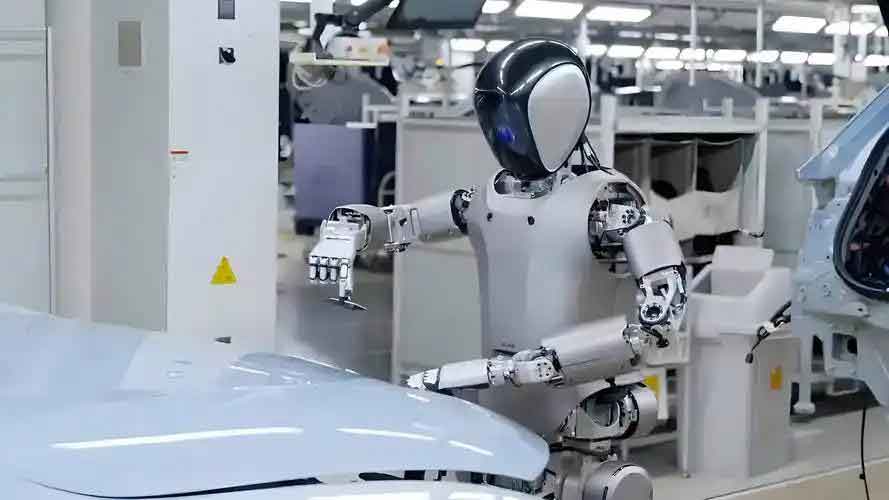
To begin, let me define what constitutes a humanoid robot. A humanoid robot is an artificial entity that replicates human morphology and capabilities, utilizing advanced technologies to perceive, interact, and operate in human-centric environments. These robots typically feature bipedal locomotion, articulated limbs, and sensory systems that enable them to perform tasks across diverse scenarios. The core technologies underpinning humanoid robots can be categorized into four areas: perception, intelligent decision-making, human-robot interaction, and motion control. Perception involves equipping the humanoid robot with sensors to gather environmental data, such as through vision, auditory, and tactile inputs. For instance, visual perception often relies on a combination of cameras and depth sensors, with fusion algorithms integrating data from multiple sources. A simplified formula for sensor fusion in perception might be expressed as:
$$ P_{\text{fused}} = \alpha \cdot P_{\text{visual}} + \beta \cdot P_{\text{auditory}} + \gamma \cdot P_{\text{tactile}} $$
where \( \alpha, \beta, \gamma \) are weighting coefficients based on sensor reliability and context. Intelligent decision-making leverages AI techniques like machine learning and neural networks to enable autonomous planning. The decision process can be modeled as:
$$ \text{Decision} = \arg\max_{a \in A} Q(s, a) $$
where \( Q(s, a) \) represents the expected utility of action \( a \) in state \( s \), often learned through reinforcement learning algorithms. Human-robot interaction focuses on natural communication, employing speech recognition and emotion detection. Motion control is critical for maintaining balance and executing precise movements, involving control theory principles. For example, the Zero Moment Point (ZMP) criterion for dynamic balance in a humanoid robot can be described as:
$$ \text{ZMP} = \frac{\sum_{i} m_i ( \mathbf{r}_i \times \mathbf{a}_i )}{\sum_{i} m_i g} $$
where \( m_i \) is the mass of segment \( i \), \( \mathbf{r}_i \) is its position vector, \( \mathbf{a}_i \) is its acceleration, and \( g \) is gravitational acceleration. These foundational elements collectively drive the functionality of humanoid robots, making them versatile tools for future applications.
The development of humanoid robots has progressed through distinct historical phases, each marked by technological leaps. I have summarized these stages in Table 1 to provide a clear timeline of key milestones and characteristics. This evolution reflects the growing integration of AI and hardware advancements, shaping the humanoid robot into a more capable and intelligent entity.
| Stage | Time Period | Key Features | Example Models |
|---|---|---|---|
| Early Development | 1970–2000 | Basic walking and simple hand movements; low intelligence and limited interaction | WABOT-1, Honda ASIMO (first gen) |
| Integrated Development | 2001–2011 | Improved perception and interaction; increased degrees of freedom | Toyota’s music robots, ASIMO (third gen) |
| Dynamic Motion and Interaction | 2012–2020 | Enhanced mobility and emotional recognition; rise of diverse participants | Boston Dynamics Atlas, SoftBank Pepper |
| High Intelligence Phase | 2020–present | Advanced AI integration, commercialization acceleration | Tesla Optimus, Ubtech Walker X |
From a strategic standpoint, the humanoid robot represents more than just a technological marvel; it is a catalyst for national advancement and economic growth. In my view, fostering humanoid robot innovation can elevate a country’s manufacturing capabilities, alleviate labor shortages due to aging populations, and spur cross-disciplinary scientific progress. The economic potential is staggering, with projections suggesting that the humanoid robot market could become a multi-billion-dollar industry. To quantify this, I present Table 2, which compiles market forecasts from various sources, highlighting the optimistic growth trajectory for humanoid robots globally and in specific regions.
| Source | Forecast Year | Global Market Size | Regional Highlights | Compound Annual Growth Rate (CAGR) |
|---|---|---|---|---|
| Goldman Sachs | 2035 | $1540 billion | Worldwide | Approx. 25% (2023–2035) |
| GGII | 2030 | $200 billion | China: $50 billion | High double-digit |
| Industry Analysis | 2035 | $1103 billion (manufacturing & service) | Global adoption | 68.6% (2025–2035) |
The current landscape for humanoid robots is dynamic, characterized by robust investment and competitive fervor. Investment in humanoid robot startups and projects has surged, with billions flowing into the sector. For instance, in China alone, funding events have reached significant sums, indicating strong confidence in the humanoid robot’s future. The competitive arena features giants like Tesla and Boston Dynamics alongside agile startups, each pushing the boundaries of what a humanoid robot can achieve. Patent activity further underscores this vitality, with China now leading in patent filings related to humanoid robots, though quality gaps persist in core technologies. Talent development is equally crucial; universities and companies are collaborating to cultivate expertise in robotics and AI, ensuring a pipeline of innovators for the humanoid robot field.
Policy frameworks play a pivotal role in shaping the humanoid robot ecosystem. Governments worldwide have enacted strategies to support research and deployment of humanoid robots. I have tabulated key international policies in Table 3 to illustrate this global commitment. These initiatives often provide funding and regulatory guidance, addressing both innovation incentives and ethical concerns surrounding humanoid robots.
| Country/Region | Policy/Initiative | Focus Areas | Funding/Support |
|---|---|---|---|
| United States | National AI R&D Strategic Plan | AI leadership, robotics innovation | Over $930 million allocated |
| Japan | New Robot Strategy | Manufacturing, healthcare, infrastructure | Comprehensive national strategy |
| European Union | Horizon Europe Program | Research and innovation across sectors | €943 billion budget (2021–2027) |
| China | Guidance on Humanoid Robot Innovation | Core technology breakthroughs, ecosystem building | Policy directives for industry growth |
Looking ahead, I identify several transformative trends for humanoid robots. Firstly, large-scale AI models are empowering humanoid robots with embodied intelligence, enabling more natural interactions and decision-making. The integration of multimodal models like GPT-4V allows a humanoid robot to process visual and linguistic inputs simultaneously, enhancing its environmental understanding. This can be modeled as:
$$ \text{Embodied Intelligence} = f(\text{LLM}, \text{Sensory Inputs}, \text{Motor Controls}) $$
where \( f \) represents a fusion function that combines large language models (LLMs) with real-time sensorimotor data. Secondly, industrialization is accelerating, with 2024 poised as a potential “year of mass production” for humanoid robots. The scalability of humanoid robot manufacturing hinges on cost reduction and supply chain maturity. Thirdly, commercial applications are likely to debut in structured environments like manufacturing, where humanoid robots can handle repetitive tasks with precision. The efficiency gain from deploying a humanoid robot in a factory setting can be approximated by:
$$ E_{\text{gain}} = \frac{T_{\text{human}} – T_{\text{robot}}}{T_{\text{human}}} \times 100\% $$
where \( T_{\text{human}} \) and \( T_{\text{robot}} \) denote task completion times for humans and humanoid robots, respectively.
However, the path forward for humanoid robots is fraught with challenges. Technically, achieving seamless multi-sensor fusion and real-time control remains difficult. The latency in robot response when using large models can be a bottleneck, as seen in systems where action cycles are prolonged. Moreover, the cost of producing a humanoid robot is prohibitively high for widespread adoption; current models can cost millions, limiting accessibility. Ethical dilemmas also loom, such as privacy issues and the moral status of humanoid robots. To balance this, opportunities abound. Breakthroughs in perception algorithms and actuator design are driving performance improvements. Component suppliers stand to benefit early from the humanoid robot supply chain, and automotive companies are leveraging their expertise in sensors and automation to cross over into humanoid robot development. For example, Tesla’s reuse of FSD technology in its Optimus humanoid robot exemplifies this synergy.
To encapsulate the dichotomy of challenges and opportunities, I present Table 4, which contrasts the key hurdles and prospects facing the humanoid robot industry. This analysis draws from my observations of market dynamics and technological trajectories.
| Challenges | Opportunities |
|---|---|
| Immature core technologies (e.g., sensor fusion, soft control) | Innovation in AI and materials science driving new capabilities |
| High production costs limiting commercialization | Cost reductions via scalable manufacturing and component reuse |
| Ethical and regulatory uncertainties | Early-mover advantage in setting standards and norms |
| Data scarcity for training robot-specific models | Leveraging transfer learning from other AI domains |
| Real-time processing constraints with large models | Advancements in edge computing and optimized algorithms |
Based on these insights, I propose several recommendations to foster the growth of humanoid robots. Firstly, strategic planning at the national level should outline clear roadmaps for humanoid robot development, prioritizing R&D in critical technologies. Secondly, focused efforts on key technical bottlenecks—such as perception algorithms and motion control systems—are essential. This might involve funding collaborative projects that address formulas like the ZMP for dynamic stability or novel sensor fusion techniques. Thirdly, optimizing the innovation ecosystem through support for startups, academic partnerships, and open platforms can accelerate progress. Finally, establishing robust standards and regulations will ensure the safe and ethical deployment of humanoid robots, addressing public concerns while promoting industry health.
In conclusion, the humanoid robot stands at the forefront of a technological revolution, with the potential to reshape economies and societies. My analysis underscores the rapid advancements and complex hurdles defining this field. From historical evolution to future trends, the journey of the humanoid robot is one of continuous innovation and adaptation. As we navigate challenges like cost and ethics, the opportunities for growth and impact remain immense. By embracing collaborative research, strategic policies, and ethical frameworks, we can unlock the full potential of humanoid robots, ushering in an era where these machines become integral to our daily lives and industrial processes. The humanoid robot, in essence, represents not just a tool, but a transformative force for the future.