
In the era of global technological revolution and industrial transformation, humanoid robots have emerged as a pivotal fusion of artificial intelligence and advanced manufacturing, serving as a critical benchmark for assessing national innovation capabilities and industrial competitiveness. As we delve into this domain, it is evident that the development of humanoid robots is not merely a technical endeavor but a strategic imperative for future economic and social systems. China has made significant strides in key areas such as perception, control, actuation, and system integration, yet structural challenges persist, including reliance on imported core components, gaps in original innovation, and a lack of comprehensive standardization. This article explores the path toward technological autonomy, application scenarization, and ecosystem integration for the humanoid robot industry in China, offering insights and recommendations based on a first-person perspective analysis. We will employ tables and formulas to summarize key points, ensuring a detailed and structured discussion.
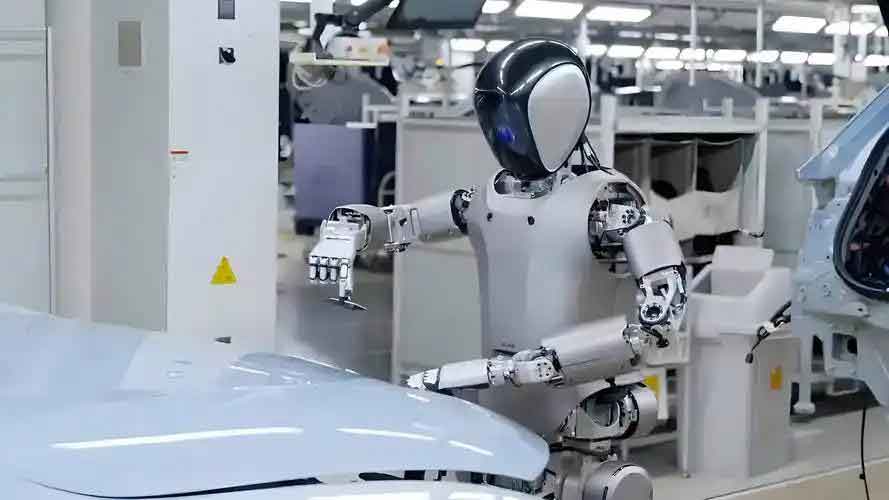
The rise of humanoid robots is driven by advancements in AI, machine learning, and robotics, positioning them as ideal agents for human-like tasks in diverse environments. From industrial settings to service domains, the humanoid robot represents a convergence of multiple disciplines, including computer vision, mechanical engineering, and cognitive science. In China, national strategies such as the “AI+” initiative have highlighted the importance of humanoid robots as a component of new quality productive forces, aiming to transition from a manufacturing powerhouse to a smart manufacturing leader. We will examine the core technological architecture, global trends, and China’s unique approach to fostering innovation in this sector.
The technological architecture of a humanoid robot encompasses four primary systems: the本体 structure, perception and decision-making, control, and human-machine interaction. Each system is intricately coupled to enable adaptive and intelligent behavior. For instance, the本体 structure mimics human biomechanics, with modular designs using lightweight materials like carbon fiber composites to enhance mobility. The perception system integrates multi-modal sensors, such as vision, auditory, and tactile inputs, processed through deep learning algorithms for environment understanding. The control system relies on servo motors and dynamic algorithms to ensure stability and precision, often expressed through formulas like the dynamics equation:
$$ \tau = M(q)\ddot{q} + C(q, \dot{q})\dot{q} + g(q) $$
where $\tau$ represents joint torques, $M$ is the mass matrix, $C$ denotes Coriolis forces, and $g$ accounts for gravitational effects. This formula underpins the motion control of humanoid robots, enabling complex actions like walking or grasping. The human-machine interaction system leverages natural language processing and emotion recognition to facilitate seamless communication, making the humanoid robot more accessible in service scenarios. Below is a table summarizing the key components of a humanoid robot’s technology stack:
| System | Key Components | Function |
|---|---|---|
| 本休 Structure | High-degree-of-freedom joints, lightweight materials | Provides physical framework and mobility |
| Perception | Cameras, microphones, force sensors | Gathers environmental data for decision-making |
| Control | Servo motors, IMU, control algorithms | Ensures stable and precise motion execution |
| Interaction | NLP models, emotion recognition software | Enables natural communication with humans |
Globally, the humanoid robot industry is evolving toward high performance, scenarization, and cost reduction. Leading countries like the United States, Japan, and South Korea have adopted distinct strategies based on their technological strengths. For example, the U.S. focuses on general AI and engineering integration, with models like Boston Dynamics’ Atlas excelling in dynamic movements, while Japan emphasizes service-oriented applications, such as SoftBank’s Pepper in customer service. The commercialization of humanoid robots follows multiple paths, including scenario-first approaches and cost-control measures, as seen with Tesla’s Optimus leveraging automotive supply chains. We can model the cost evolution of humanoid robots using a simplified formula:
$$ C(t) = C_0 e^{-kt} $$
where $C(t)$ is the cost at time $t$, $C_0$ is the initial cost, and $k$ is the rate of cost reduction due to economies of scale and technological advancements. This trend is critical for making humanoid robots viable in mass markets. The table below compares the approaches of key countries in humanoid robot development:
| Country | Focus Area | Representative Models | Commercial Strategy |
|---|---|---|---|
| USA | High-performance hardware and AI integration | Atlas, Optimus | Leveraging existing supply chains for cost control |
| Japan | Service and emotional interaction | Pepper, T-HR3 | Policy-driven adoption in healthcare and education |
| South Korea | Industrial collaboration and sensor fusion | HUBO series | Focus on precision manufacturing and rescue operations |
| Europe | Medical and flexible control systems | BionicSoftHand, Nao | Emphasis on ethics and human-robot collaboration |
In China, the journey toward technological autonomy for humanoid robots has seen progress in multi-modal perception, actuator performance, and algorithm development. Domestic enterprises have enhanced capabilities in vision sensors, force feedback systems, and AI-driven control frameworks. However, bottlenecks remain, particularly in core components like reducers and high-precision servos, which still rely on imports. The lack of original innovation and standardized systems hampers ecosystem growth. To address this, a tripartite mechanism involving national strategy, corporate R&D, and academic support is essential. The innovation output can be expressed as:
$$ I = \alpha S + \beta E + \gamma R $$
where $I$ represents innovation index, $S$ is strategic guidance, $E$ denotes enterprise investment, and $R$ stands for research input, with $\alpha$, $\beta$, and $\gamma$ as weighting factors. This model highlights the synergistic effect of different stakeholders in advancing humanoid robot technology. Below is a table outlining China’s technological advancements and challenges:
| Aspect | Progress | Challenges |
|---|---|---|
| Perception Systems | Multi-modal sensor integration for environment awareness | Dependency on imported high-end sensors |
| Actuation | Improved servo motor performance and lightweight designs | Gaps in precision and longevity of core components |
| Control Algorithms | Adoption of deep learning and reinforcement learning | Limited original frameworks for dynamic control |
| System Integration | Development of simulation platforms for rapid iteration | Fragmented standards and interoperability issues |
The application scenarization of humanoid robots in China spans industrial, service, and public domains, each with unique demands and evolution paths. In industrial settings, humanoid robots are transitioning from simple task replacement to human-robot collaboration, enhancing flexibility in manufacturing lines. For service scenarios, such as healthcare and education, the focus is on emotional interaction and personalized assistance, driven by natural language processing and affective computing. Public applications include security patrols and disaster response, where humanoid robots operate in unstructured environments. The effectiveness of a humanoid robot in a scenario can be quantified using a utility function:
$$ U = \sum_{i=1}^{n} w_i f_i(x) $$
where $U$ is the utility score, $w_i$ are weights for different tasks, and $f_i(x)$ represents performance metrics for task $i$. This helps in optimizing humanoid robot designs for specific scenarios. The table below categorizes application scenarios for humanoid robots:
| Scenario Type | Key Tasks | Technological Requirements |
|---|---|---|
| Industrial | Assembly, logistics, quality inspection | High precision, durability, and real-time control |
| Service | Elderly care, education, customer service | Natural interaction, emotion recognition, safety |
| Public | Security, emergency response, guidance | Autonomous navigation, robustness, adaptability |
Product design for humanoid robots is increasingly task-customized, with modularity and standardization enabling cross-scene compatibility. The shift from hardware-defined to software-defined systems allows for functional updates via algorithms, reducing lifecycle costs. Business models are evolving from outright sales to subscription-based services, where data analytics and continuous improvement add value. For instance, in educational settings, humanoid robots can be deployed as platforms for programming courses, generating revenue through content subscriptions. The revenue model can be expressed as:
$$ R = P \times Q + S \times T $$
where $R$ is total revenue, $P$ is unit price, $Q$ is quantity sold, $S$ is subscription fee, and $T$ is subscription duration. This reflects the dual revenue streams in the humanoid robot market. The integration of humanoid robots into broader ecosystems involves upstream components, midstream integration, and downstream applications, supported by standards, finance, and talent development. China’s ecosystem is characterized by regional clusters, such as the Greater Bay Area for hardware and Yangtze River Delta for service applications, fostering collaborative innovation. The ecosystem health index can be modeled as:
$$ H = \frac{\sum \text{Synergy Scores}}{\text{Fragmentation Index}} $$
where $H$ indicates ecosystem robustness, with higher values denoting better integration. Institutional supports, including ethical governance and financial mechanisms, are crucial for sustainable growth. For example, policy incentives like tax breaks for R&D can accelerate innovation in humanoid robot technologies. The table below outlines the core components of the humanoid robot ecosystem:
| Ecosystem Layer | Elements | Role in Development |
|---|---|---|
| Upstream | Core components (e.g., sensors, motors), raw materials | Provides technological foundation and supply chain security |
| Midstream | System integration, software platforms | Enables productization and customization |
| Downstream | Application services, maintenance | Drives market adoption and value realization |
| Support Systems | Standards, finance, education, ethics | Ensures regulatory compliance and talent pipeline |
Looking ahead, the humanoid robot industry in China is poised for systemic evolution toward higher intelligence, adaptability, and ecosystem dominance. Trends include the integration of large language models for enhanced cognition, flexible materials for improved durability, and cost reductions through mass production. Policy pathways should emphasize foundational research, scenario-driven demonstrations, and institutional frameworks to support this transition. For instance, national projects can focus on breakthrough technologies like neuromorphic computing for humanoid robot brains. The growth trajectory can be projected using a logistic function:
$$ G(t) = \frac{L}{1 + e^{-k(t-t_0)}} $$
where $G(t)$ is the market size at time $t$, $L$ is the carrying capacity, $k$ is the growth rate, and $t_0$ is the inflection point. This model captures the S-curve adoption pattern of humanoid robots. Recommendations include fostering open innovation platforms, strengthening intellectual property management, and promoting international collaboration. By embracing these strategies, China can shift from being a technology follower to an ecosystem leader in the global humanoid robot landscape.
In conclusion, the development of humanoid robots in China represents a complex interplay of technological innovation, market forces, and policy support. As we analyze this field, it becomes clear that achieving autonomy, scenarization, and ecosystem integration requires a holistic approach. Humanoid robots are not just tools but transformative agents that will reshape industries and societies. Through continued investment in R&D, scenario-based testing, and collaborative ecosystems, China can harness the potential of humanoid robots to drive economic growth and social progress. The journey from prototypes to pervasive adoption will demand resilience and creativity, but the rewards—in terms of productivity gains and improved quality of life—are substantial. As the humanoid robot industry evolves, it will undoubtedly play a pivotal role in shaping the future of automation and human-machine collaboration.