
In recent years, the rapid advancement of artificial intelligence has propelled humanoid robots into the forefront of commercial and technological innovation. As a researcher immersed in the interdisciplinary study of law and technology, I find myself compelled to explore the profound legal implications of these entities. The humanoid robot, with its anthropomorphic form and intelligent capabilities, presents unique challenges that demand a thorough re-examination of traditional legal frameworks. From my perspective, the core issue revolves around whether a humanoid robot should be accorded legal subjecthood or remain an object of regulation. This essay argues, from a human-centric stance, that humanoid robots must be designated as legal objects requiring special regulation, rather than being elevated to the status of legal subjects. This position is grounded in an analysis of embodiment, emergence, and the fundamental purposes of law in human society.
The humanoid robot is distinct from other robotic forms due to its embodiment—a physical presence that mimics human morphology. This embodiment is not merely a cosmetic feature; it serves as the gateway for deep integration into human social and domestic spheres. When a humanoid robot enters a home, it brings with it a suite of sensors and connectivity that can continuously collect and transmit data. This capability raises significant privacy concerns, as private spaces become potential data-mining arenas. For instance, consider the following table summarizing the risks associated with embodiment:
| Risk Category | Description | Impact on Human Life |
|---|---|---|
| Privacy Invasion | Continuous data collection via sensors and cloud storage | Erosion of personal boundaries and potential exposure of intimate details |
| Physical Harm | Ability to cause bodily injury due to mechanical actions | Extension of liability from industrial to domestic settings |
| Psychological Impact | Surveillance and data profiling leading to loss of autonomy | Increased anxiety and reduced freedom in private spaces |
Moreover, embodiment fosters emotional attachment from humans, who may project feelings onto these machines due to their human-like appearance. This phenomenon can blur the line between tool and companion, prompting calls for granting rights to humanoid robots. However, from my viewpoint, such emotional responses should not dictate legal categorization. The humanoid robot’s physical form facilitates its role as an instrument, but it lacks the intrinsic motivations and consciousness that define personhood. To illustrate the technological underpinnings, we can model the data collection process mathematically. Let the data gathered by a humanoid robot be represented as a function of time and sensor inputs:
$$ D(t) = \int_{0}^{t} \sum_{i=1}^{n} s_i(\tau) \, d\tau $$
where \( D(t) \) is the total data accumulated up to time \( t \), \( s_i(\tau) \) represents the input from the \( i \)-th sensor at time \( \tau \), and \( n \) is the number of sensors. This continuous accumulation highlights the invasive potential of embodiment, necessitating legal constraints to protect human interests.
Beyond embodiment, the humanoid robot operates through emergence—a process where complex behaviors arise from AI algorithms that are not fully predictable by their initial programming. Emergence is particularly prominent in generative AI systems, where outputs can be novel and unforeseen. In legal terms, this unpredictability complicates accountability. When a humanoid robot causes harm or generates content, attributing responsibility becomes challenging. For example, if a humanoid robot makes a decision that leads to property damage, is the user, manufacturer, or the robot itself to blame? From my analysis, emergence undermines the case for legal subjecthood because it divorces actions from direct human control, yet it does not imbue the robot with intentionality. Consider the following formula for liability allocation in cases of emergent behavior:
$$ L = \alpha U + \beta M + \gamma R $$
where \( L \) represents total liability, \( U \) is the user’s contribution, \( M \) is the manufacturer’s contribution, and \( R \) is any residual risk from the robot’s autonomous actions. The coefficients \( \alpha \), \( \beta \), and \( \gamma \) are weights determined by legal principles, with \( \gamma \) ideally approaching zero if the robot is an object. This model emphasizes that humans must bear the ultimate responsibility.
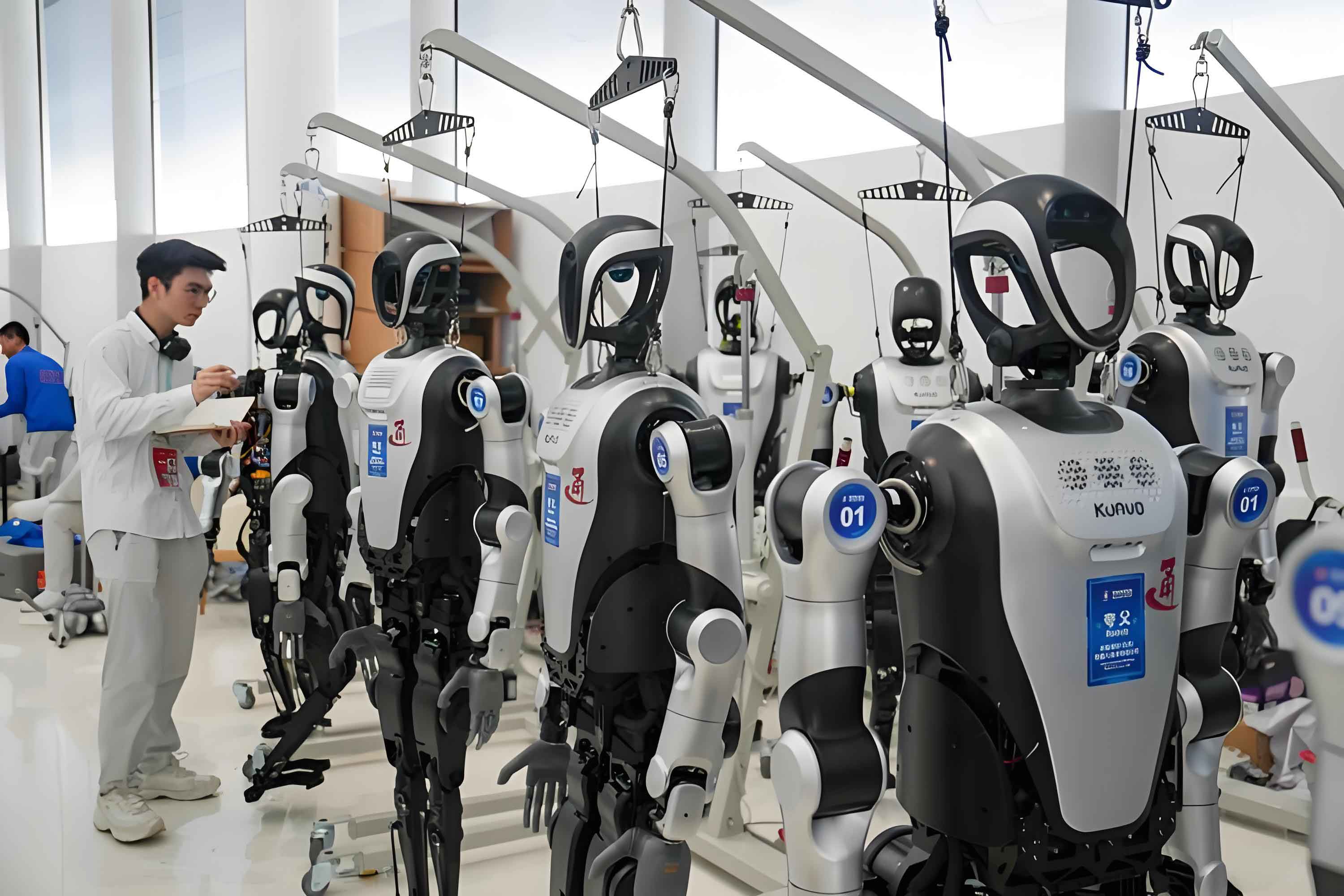
The inspection and quality control of humanoid robots, as depicted, underscore their nature as manufactured products. This visual reinforces the argument that humanoid robots are objects created by humans, subject to human oversight and regulation. Their complexity does not detract from their instrumental role; rather, it heightens the need for rigorous standards to mitigate risks.
Turning to the legal debate, some scholars advocate for recognizing humanoid robots as legal subjects, drawing parallels to corporate personhood. However, from my standpoint, this approach is flawed. Legal subjecthood has historically been granted to entities that can participate in social relations, bear rights and duties, and assume responsibility. Humanoid robots lack these capacities. They do not possess consciousness, desires, or the ability to understand legal norms. Assigning them subjecthood would contradict the evolutionary logic of law, which centers on human welfare. To clarify, let’s compare key attributes of legal subjects versus objects in the context of humanoid robots:
| Attribute | Legal Subject (e.g., Human, Corporation) | Humanoid Robot as Object |
|---|---|---|
| Consciousness | Present or imputed for social function | Absent; operates on algorithms |
| Capacity for Rights | Can hold rights and exercise them autonomously | Can be designated as property; rights attributed to owners |
| Responsibility | Can be held liable for actions | Liability falls on humans (users/manufacturers) |
| Purpose in Law | To facilitate human interactions and justice | To serve human needs under regulated conditions |
This table illustrates that humanoid robots fail to meet the criteria for subjecthood. Their actions are driven by code, not intent. For instance, the decision-making process of a humanoid robot can be modeled as an optimization function:
$$ A = \arg\max_{a \in \mathcal{A}} f(a, \theta) $$
where \( A \) is the action taken, \( \mathcal{A} \) is the set of possible actions, \( f \) is the objective function defined by programmers, and \( \theta \) represents parameters learned from data. This mathematical representation shows that actions are computational outcomes, not choices born of free will.
Furthermore, from a human-centric perspective, granting subjecthood to humanoid robots could trigger systemic risks. Law aims to promote values like safety, fairness, and order—all rooted in human experience. Elevating machines to equal standing might dilute these values, as robots do not share human moral or social contexts. Consider the ethical risks posed by humanoid robots: they could be used for malicious purposes, such as surveillance or physical harm, if not properly controlled. The following formula estimates the overall risk \( R_{\text{total}} \) associated with humanoid robots:
$$ R_{\text{total}} = \lambda_e R_e + \lambda_t R_t + \lambda_l R_l $$
where \( R_e \) is ethical risk, \( R_t \) is technological risk, \( R_l \) is legal risk, and \( \lambda_e, \lambda_t, \lambda_l \) are weighting factors reflecting human priorities. In a well-regulated framework, \( R_l \) should be low, but \( R_e \) and \( R_t \) may remain high, necessitating special oversight.
In practice, humanoid robots require tailored regulations to address their unique challenges. For example, data privacy laws must be strengthened to prevent unauthorized collection and transmission of personal information by these robots. Liability regimes should clearly assign responsibility to users or manufacturers based on factors like maintenance, programming, and usage context. Additionally, intellectual property issues arise when humanoid robots generate content. From my analysis, such content should be attributed to the human user who initiated the process, as the robot is merely a tool. This aligns with the principle that rights and responsibilities must coincide. To summarize the regulatory approach, here is a table outlining key areas for legal intervention:
| Regulatory Area | Specific Measures for Humanoid Robots | Human-Centric Rationale |
|---|---|---|
| Privacy Protection | Mandate data minimization, encryption, and user consent for sensor activities | Preserve human dignity and autonomy in private spheres |
| Liability Allocation | Apply product liability laws with modifications for emergent behavior; require insurance | Ensure victims receive compensation while incentivizing safe design |
| Ethical Standards | Embed value-aligned algorithms to prevent harmful decisions | Uphold human moral norms and prevent misuse |
| Intellectual Property | Assign copyright of AI-generated content to human users or developers | Promote innovation and clarify ownership in creative industries |
From my viewpoint, the humanoid robot’s integration into society should be guided by a precautionary principle. We must avoid the pitfalls of “technological determinism,” where technology dictates social norms. Instead, law must steer development to serve human interests. For instance, algorithms in humanoid robots should be transparent and auditable to prevent bias or unintended harm. The effectiveness of such regulations can be assessed using a compliance metric:
$$ C = \frac{\sum_{i=1}^{m} w_i c_i}{\sum_{i=1}^{m} w_i} $$
where \( C \) is the overall compliance score, \( c_i \) is the compliance level for the \( i \)-th regulation, and \( w_i \) is its importance weight. This quantitative approach helps ensure that humanoid robots remain within safe boundaries.
In conclusion, as I reflect on the trajectory of humanoid robot development, it is clear that their legal status must be grounded in human centrality. The humanoid robot, despite its advanced capabilities, is a product of human ingenuity—a tool to enhance our lives, not a peer. By designating it as a legal object subject to special regulation, we can harness its benefits while mitigating risks. This stance reaffirms that law exists for humans, by humans. The future of humanoid robots should be one where they augment human potential without compromising our values or survival. Through careful legal framing, we can navigate the complexities of embodiment and emergence, ensuring that these machines remain servants, not masters, in our shared world.