
The dawn of a new era in automation is upon us, not with clanking industrial arms confined to cages, but with machines built in our own image. The humanoid robot, long a staple of science fiction, is transitioning from laboratory prototype to a tangible component of our technological future. As a participant and observer in this transformative field, I perceive a critical juncture: the pace and success of this transition will be determined not solely by breakthroughs in artificial intelligence or advanced actuators, but fundamentally by the availability and ingenuity of financial support. The development pathway for humanoid robots presents unique economic challenges that traditional financial models are ill-equipped to handle. This article explores the current landscape, the specific financial bottlenecks, and proposes a framework for innovative financial instruments and strategies essential for nurturing a robust global humanoid robot industry.
The Technological and Industrial Landscape of Humanoid Robotics
The journey of the humanoid robot is a chronicle of escalating ambition in robotics. Its evolution can be systematically segmented into distinct phases, each marked by a leap in capability and complexity.
| Phase | Timeframe | Key Characteristics & Milestones | Primary Focus |
|---|---|---|---|
| I: Static Walking | ~1969-1995 | First bipedal robots; slow, static gait; foundational mechanics. | Basic Locomotion Stability |
| II: Dynamic Walking | ~1996-2015 | Continuous, dynamic walking; integration of basic balance systems. | Smooth, Continuous Motion |
| III: High-Dynamic Performance | ~2016-Present | Advanced parkour, running, complex object manipulation; emphasis on agility and resilience. | Extreme Athleticism & Environmental Interaction |
| IV: Commercial Incubation | Present & Future | Focus on reliability, cost reduction, and specific application validation in industrial, logistics, and service settings. | Commercial Viability & Ecosystem Development |
We are now entering Phase IV, the commercial incubation stage. This phase is less about performing backflips and more about executing repetitive tasks reliably and affordably in warehouses, factories, and eventually homes. The catalyst for this new phase is the convergence of two powerful trends: advances in physical actuation and control, and the explosion of generative AI and large language models (LLMs). LLMs provide the cognitive framework for humanoid robots to understand natural language commands, reason about their environment, and generate complex action sequences from high-level goals. The humanoid robot is thus positioned as the ultimate embodied AI, the physical agent that translates digital intelligence into action in the human world, potentially becoming the next ubiquitous human-computer interaction terminal.
The core value proposition of a humanoid robot form factor is tripartite and can be expressed relative to other robotic forms:
| Value Dimension | Humanoid Robot Advantage | Comparison to Alternative Forms (Wheeled, Tracked, etc.) |
|---|---|---|
| Environmental Adaptation | Inherently compatible with human-centric environments (stairs, doors, uneven terrain, standard vehicle cabins). | Require significant and costly environmental modification (ramps, smooth floors, enlarged pathways). |
| Tool & Interface Utilization | Can directly use the vast universe of existing human tools, vehicles, and control interfaces (levers, buttons, keyboards). | Require specialized end-effectors or complete re-engineering of workstations and tools. |
| Social Interaction & Acceptance | Anthropomorphic shape facilitates more natural human-robot interaction, leveraging non-verbal cues and intuitive communication. | Often perceived as mere machines, potentially causing unease or requiring specific training for human collaboration. |
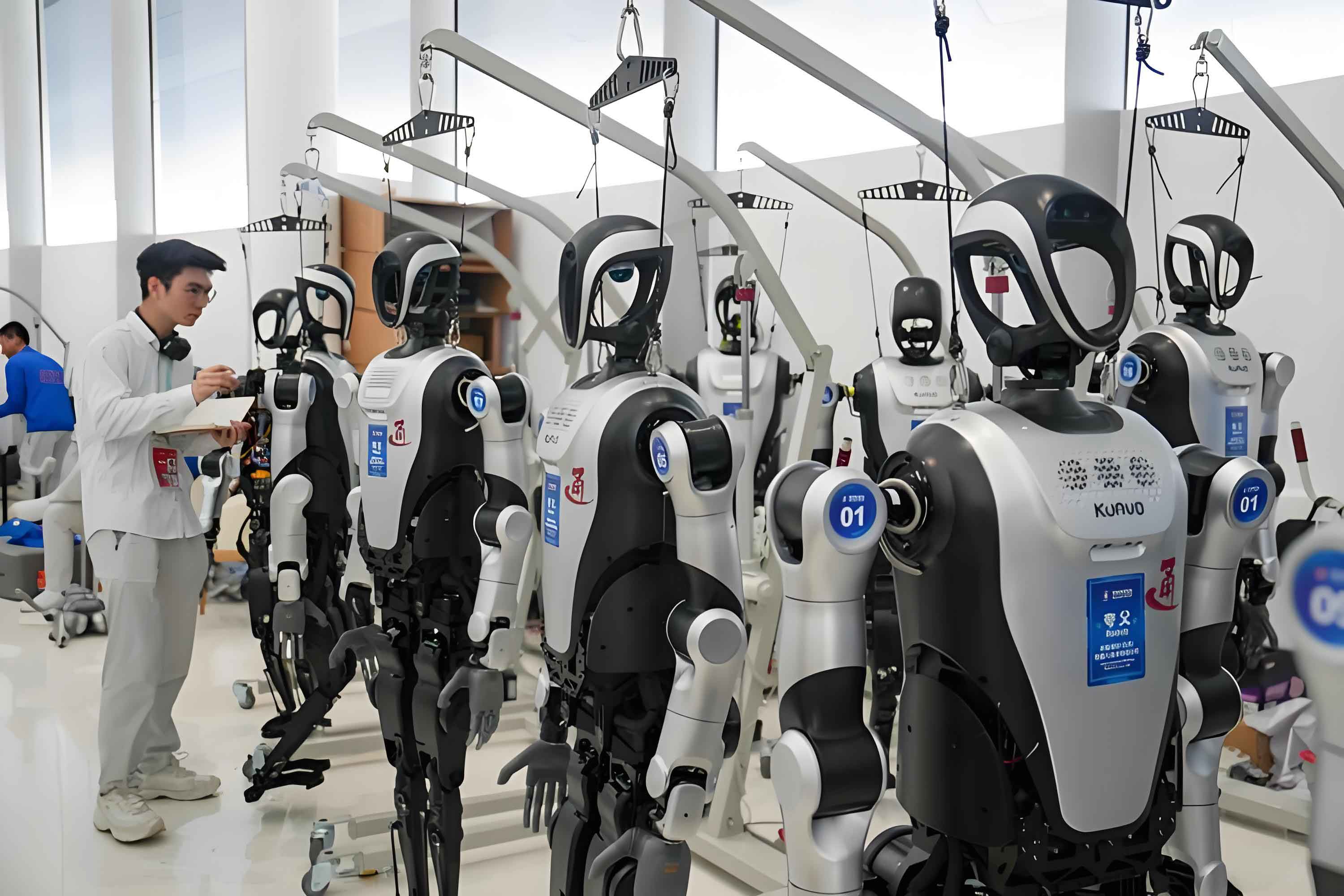
This value proposition is driving intense global competition. Technology giants across the United States, Asia, and Europe are investing heavily, either through in-house development (e.g., Tesla’s Optimus) or strategic investments in specialized startups. The race is not just for technological supremacy but for defining the standards and architecture of a potentially massive new industry.
Countries with synergistic strengths in advanced manufacturing and AI software, particularly China, possess a significant first-mover advantage. The ecosystem includes not only end-product companies but also critical component suppliers specializing in harmonic reducers, force-torque sensors, specialized actuators, and machine vision systems. However, a complete, self-reliant industrial ecosystem—from core AI chips and high-performance motors to standardized software frameworks—remains under construction. The journey from a functional prototype to a cost-effective, reliable, mass-produced humanoid robot is a marathon, not a sprint, and it is a marathon that demands sustained capital infusion.
The Financial Conundrum: Why Traditional Finance Falls Short
The inherent characteristics of the humanoid robot industry create a fundamental mismatch with conventional financial products and investment horizons. These challenges can be modeled and categorized as follows.
1. The Intangible Asset Valuation Problem
A humanoid robot company’s balance sheet is dominated by intangible assets: patents, proprietary algorithms (e.g., for whole-body motion control, SLAM, force-control grasping), trade secrets in actuator design, and accumulated software stacks. The valuation of these assets is highly speculative and lacks a liquid secondary market. Traditional debt financing, which relies on tangible collateral, is therefore exceedingly difficult to secure. The R&D intensity of the sector can be described by the ratio:
$$
\text{R&D Intensity} = \frac{\text{Annual R&D Expenditure}}{\text{Total Operating Revenue}} \gg 1 \quad \text{(for early/mid-stage companies)}
$$
For many years, this ratio is significantly greater than 1, as revenue is minimal while R&D costs are enormous. The assets created—primarily intellectual property (IP)—are illiquid. A bank cannot easily repossess and sell a motion planning algorithm in case of default. This creates a financing gap where the company’s most valuable creations cannot be leveraged for growth capital.
2. The Extended Gestation Period and Capital Maturity Mismatch
The timeline from foundational research to profitable commercialization in humanoid robotics is exceptionally long, often spanning 10-20 years. This timeline, $T_{total}$, can be broken down into sequential, capital-intensive phases:
$$
T_{total} = T_{research} + T_{prototyping} + T_{pre-production} + T_{ramp-up}
$$
where each phase $T_i$ requires continuous investment with zero or negative cash flow. Contrast this with the typical horizons of private capital:
– Venture Capital (VC): Targets exits often within 5-7 years ($T_{VC} \approx 5-7$ years).
– Private Equity (Growth): May have slightly longer horizons but still seeks returns well before $T_{total}$.
– Bank Debt: Typically has maturities of 3-7 years, requiring repayment or refinancing long before the company generates stable cash flow from product sales.
The mismatch is clear: $T_{VC} < T_{total}$. This forces companies into a perpetual cycle of fundraising to “bridge” to the next milestone, consuming immense management focus and often leading to down-rounds if technological or market progress slows.
3. The “Cold Start” Problem in Supply Chain and Scale
Achieving cost reduction requires volume production, but achieving volume requires demand, which is contingent on lower costs—a classic technological adoption paradox. The cost of a humanoid robot, $C_{robot}$, is a function of unit volume $N$:
$$
C_{robot}(N) = C_{BOM}(N) + C_{assembly}(N) + \frac{C_{R&D amortized}}{N}
$$
Here, $C_{BOM}$ (Bill of Materials cost) decreases with $N$ due to supplier volume discounts and design-for-manufacturing optimizations. $C_{assembly}$ decreases with learning curve effects. The amortized R&D cost, however, is a large fixed sum divided by $N$. Initially, when $N$ is small (e.g., hundreds of units), $C_{robot}$ is prohibitively high for most applications. Crossing the chasm to an $N$ large enough to bring $C_{robot}$ below a customer’s ROI threshold requires a massive, patient investment in manufacturing capability and inventory before clear market demand has materialized. Traditional project finance is averse to such “field of dreams” risk.
| Challenge | Description | Consequence |
|---|---|---|
| Intangible-Dominant Balance Sheet | High R&D creates IP, not physical collateral. No liquid market for patent/algorithm valuation. | Limited access to debt financing; equity dilution becomes primary funding source. |
| Capital Maturity Mismatch | Commercialization timeline (10-20 yrs) exceeds typical VC/PEC fund life (5-10 yrs). | Premature exit pressure, funding gaps at critical late-stage scaling points. |
| Scale-Cost Deadlock | High unit cost at low volume prevents demand; high demand requires low cost achieved only at high volume. | Difficulty securing manufacturing/scaling capital; requires “patient” capital willing to fund capacity ahead of orders. |
| Systemic & “Chokepoint” Risk | Dependence on few global suppliers for key components (e.g., specialized chips, high-performance motors). | Supply chain fragility; necessitates parallel investment in domestic supply chains, adding to capital needs. |
A Framework for Financial Innovation in Humanoid Robotics
Overcoming these hurdles requires a tailored financial toolkit, inspired by mechanisms developed for other long-gestation, high-tech industries like biopharma and aerospace. The following proposals form a multi-pronged approach.
1. Milestone-Based, Staged Financing Instruments
Drawing from the biotech “license-in” model, capital infusion can be tied to achieving specific, verifiable technical and commercial milestones ($M_i$). Instead of a large lump-sum equity investment, funding is structured as a series of contingent tranches. A financial model for a company could include a valuation “step-up” at each milestone:
$$
\text{Post-Money Valuation}_{t} = \text{Post-Money Valuation}_{t-1} \times (1 + \alpha_i)
$$
$$
\text{where } \alpha_i \text{ is the agreed premium for achieving milestone } M_i.
$$
These milestones could include: completion of a beta prototype, successful field validation for 10,000 hours of cumulative operation, signing of first major enterprise purchase order, achievement of a targeted unit production cost, or certification for use in specific regulated environments. This aligns investor risk-taking with de-risking events and provides capital precisely when needed to overcome the next “valley of death.”
2. Intellectual Property Securitization and Royalty-Backed Finance
To unlock the value trapped in patents, a securitization vehicle can be created. A pool of IP assets (e.g., patents related to actuator control, robotic grasping, stability algorithms) from multiple companies or a dominant player is assembled. The future royalty streams ($R_t$) expected from licensing this IP portfolio are forecasted and used as the underlying asset to issue bonds. The bondholders receive periodic payments from these royalty streams.
The present value of the securitization ($PV_{sec}$) can be estimated as:
$$
PV_{sec} = \sum_{t=1}^{T} \frac{E[R_t]}{(1 + r)^t}
$$
where $E[R_t]$ is the expected royalty income in period $t$, $r$ is the discount rate reflecting the risk of the IP pool, and $T$ is the term. This provides immediate, non-dilutive capital to the IP contributors while creating a new asset class for institutional investors. Government credit enhancement or first-loss guarantees could catalyze the initial market.
3. Mobilization of “Tenacious” Long-Term Capital
The extended timeline necessitates investors with aligned, long-term horizons. Key sources include:
– Government Strategic Investment Funds: Modeled on successful precedents in semiconductors and electric vehicles, these funds can make direct equity investments or provide subordinated debt with extended maturities (15+ years). Their mandate is industrial policy and technological sovereignty, not short-term IRR.
– Corporate Strategic Investors (from Adjacent Industries): Automotive, electronics, logistics, and construction companies have a strategic interest in humanoid robot applications. Their investment horizons can be longer, seeking strategic advantage and future supply/partnership agreements.
– Pension Funds and Sovereign Wealth Funds (SWFs): These institutions manage assets over generational timescales. A small allocation to a dedicated “frontier technology” fund focusing on humanoid robotics and its enabling technologies fits their profile for seeking uncorrelated, long-term growth.
4. Enhanced Risk-Sharing Mechanisms: Insurance and Guarantees
To catalyze debt markets, public-private risk-sharing schemes are crucial. For instance:
– IP Portfolio Insurance: An insurance product that protects a lender against a catastrophic devaluation of the pledged IP collateral (e.g., due to patent invalidation).
– First-Loss Loan Guarantees: A government agency or dedicated fund could guarantee 70-80% of the principal on loans made to humanoid robot companies meeting certain R&D or employment criteria. This dramatically reduces the risk for commercial banks, encouraging them to lend.
– R&D Tax Credit Monetization: Advanced, refundable tax credits for qualifying R&D expenditures can provide direct cash flow to pre-revenue companies, acting as a form of non-dilutive government co-investment.
| Innovation | Primary Mechanism | Targeted Challenge | Key Actors |
|---|---|---|---|
| Milestone-Based Financing | Contingent capital tranches released upon achieving technical/commercial KPIs. | Capital Maturity Mismatch; High early-stage risk. | Venture Capital, Corporate VC, Specialized Funds. |
| IP Securitization | Pooling patents and issuing bonds backed by future licensing royalties. | Intangible Asset Valuation; Lack of collateral. | IP-rich firms, Investment Banks, Institutional Investors. |
| Long-Term Strategic Funds | Direct patient capital with 15-20 year horizons focused on industrial strategy. | Extended Gestation Period; Scale-Cost Deadlock. | Sovereign Funds, National/Regional Development Banks. |
| Public Risk-Sharing Facilities | Loan guarantees, IP insurance, advanced R&D credit refunds. | Systemic & High Perceived Risk; Chokepoint investment. | Government Agencies, Multilateral Development Banks, Insurers. |
Conclusion: Financing the Bridge to a Humanoid Future
The development of a viable humanoid robot industry represents one of the most complex engineering and entrepreneurial challenges of our time. Its success promises not merely a new product category, but a fundamental shift in how work is performed across manufacturing, logistics, healthcare, and domestic services. However, the path is littered with financial roadblocks that cannot be bypassed by engineering brilliance alone. The long gestation period, the dominance of intangible assets, and the severe scale-cost bootstrap problem create a perfect storm that scares away conventional finance.
Addressing this requires a concerted, innovative effort in financial engineering, paralleling the innovation happening in the lab. It demands the creation of new instruments like milestone-driven capital and IP-backed securities. It necessitates the active participation of patient, strategic capital from public and corporate sources willing to play a decades-long game. Most importantly, it requires a shift in mindset from financiers—viewing investment in humanoid robotics not as a quick-turn venture bet, but as a strategic, infrastructure-like commitment to building a foundational technology platform for the coming century.
The historical analogies are clear: the development of the semiconductor industry, the commercialization of the internet, and the scaling of renewable energy all required symbiotic partnerships between visionary technologists and equally visionary financiers and policymakers. The humanoid robot stands at a similar inflection point. The question is not if it will become an integral part of our economy, but how quickly and which ecosystems will lead its development. The answer will be written as much in balance sheets and investment theses as in lines of code and mechanical schematics.