
As an industry analyst closely monitoring advancements in automation and robotics, I have witnessed a significant surge in interest and development surrounding humanoid robots. The recent confirmation of key partnerships and product unveilings marks a pivotal moment for the integration of humanoid robots into industrial settings, particularly within automotive manufacturing. This article delves into these developments, providing a detailed analysis from my perspective, supported by data tables and technical formulations to elucidate the trends and implications.
The convergence of artificial intelligence, precision engineering, and industrial demand is driving the rapid evolution of humanoid robots. These machines, designed to mimic human form and function, are transitioning from research labs to factory floors. The verification of two major corporate announcements underscores this shift. First, the debut of a new-generation industrial humanoid robot prototype by a joint venture, and second, the expansion of a critical automotive component supplier into next-generation vehicle platforms. Both instances highlight the growing synergy between traditional manufacturing expertise and cutting-edge robotics.
Strategic Collaboration for Humanoid Robot Development
In the realm of humanoid robotics, strategic alliances are crucial for accelerating commercialization. A prominent example is the collaboration between a listed automation equipment firm and a leading humanoid robot technology company. This partnership, formalized through a joint venture established in late 2023, aims to develop humanoid robots specifically for industrial scenarios like automotive production, 3C electronics, and smart logistics. The core objective is to leverage the robot technology company’s prowess in AI and mechanical design with the manufacturing firm’s deep-rooted industry resources and technical know-how in automotive smart equipment.
The joint venture, with a registered capital of 1 billion RMB, has a clear ownership structure, as summarized in the table below:
| Partner | Capital Contribution (Million RMB) | Equity Stake | Primary Contribution |
|---|---|---|---|
| Automation Equipment Firm | 22.0 | 22% | Industrial expertise, automotive sector resources |
| Humanoid Robot Tech Company & Core Team | 78.0 | 78% | AI algorithms, robot structural design, software platform |
This capital allocation reflects the weight placed on intellectual property and core technology in the humanoid robot value chain. The joint venture’s first major milestone was the official unveiling of its flagship industrial humanoid robot, Walker S, during a high-profile stock exchange listing ceremony in December 2023. This event served as a powerful validation of the prototype’s readiness. The humanoid robot is now scheduled for delivery to automotive production lines for real-world training and integration, a critical step towards practical deployment.
The technical challenges in developing a viable industrial humanoid robot are immense. Key performance metrics often involve stability, dexterity, and energy efficiency. The dynamic balance of a bipedal humanoid robot, for instance, can be modeled using the Linear Inverted Pendulum Model (LIPM). The condition for maintaining balance is given by keeping the Zero Moment Point (ZMP) within the support polygon. The ZMP position $(x_{zmp}, y_{zmp})$ can be approximated as:
$$ x_{zmp} = \frac{\sum_{i=1}^{n} m_i (\ddot{z}_i + g) x_i – \sum_{i=1}^{n} m_i \ddot{x}_i z_i}{\sum_{i=1}^{n} m_i (\ddot{z}_i + g)} $$
where $m_i$ is the mass of link $i$, $g$ is gravitational acceleration, and $(x_i, z_i)$ are the coordinates of the center of mass of link $i$. For a humanoid robot to operate effectively on an assembly line, its manipulation capabilities are equally important. The force exerted by an end-effector can be derived from the joint torques $\boldsymbol{\tau}$ using the Jacobian transpose $\mathbf{J}^T$:
$$ \mathbf{F} = (\mathbf{J}^T)^{-1} \boldsymbol{\tau} $$
These formulas underscore the complex interplay of mechanics and control that defines the performance envelope of an industrial humanoid robot.
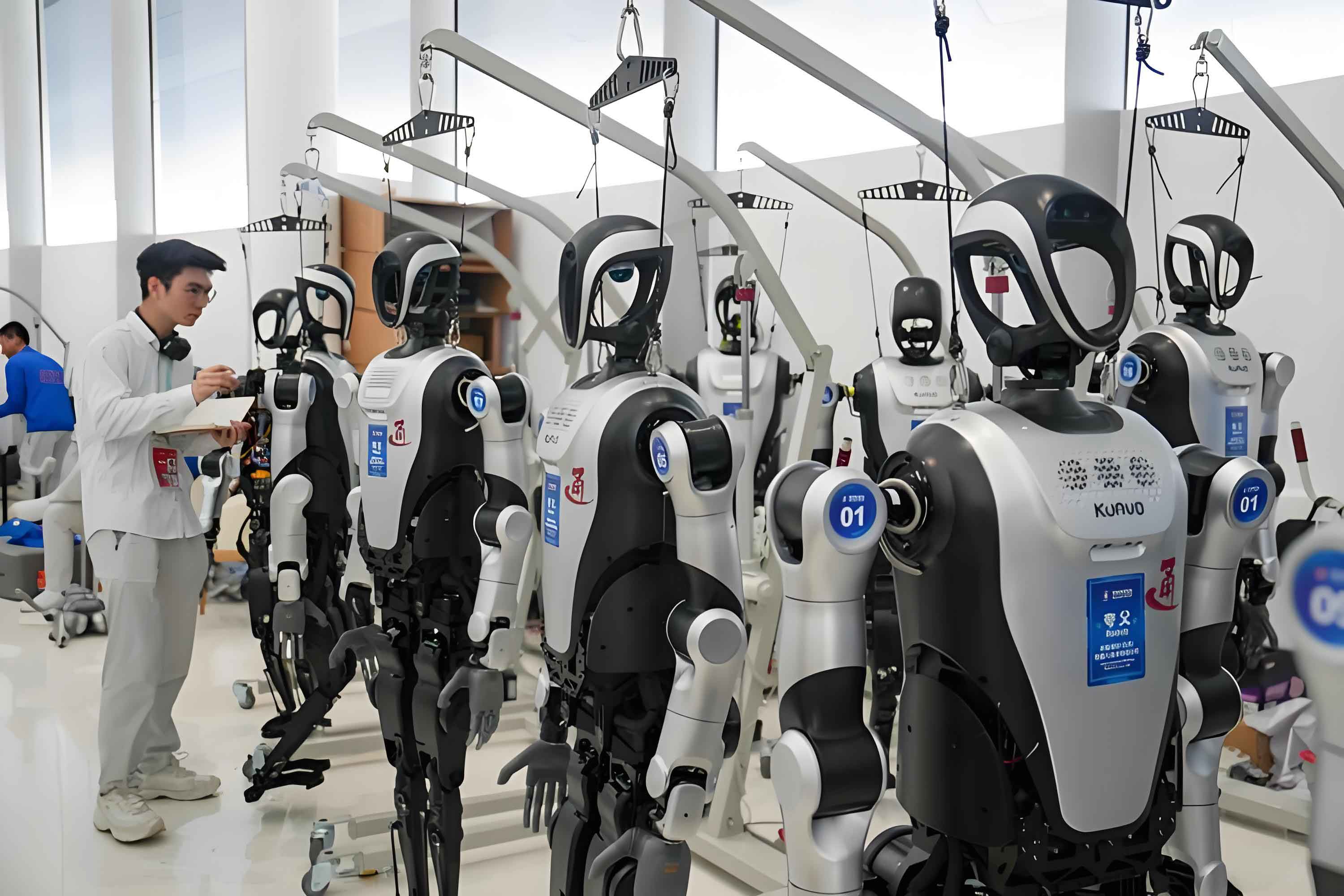
The visual inspection and quality assurance processes for humanoid robots, as suggested by the image, are paramount. Before deployment, every joint, sensor, and actuator in a humanoid robot must undergo rigorous testing. The reliability $R(t)$ of such a complex system with $n$ independent components can be modeled as:
$$ R_{system}(t) = \prod_{i=1}^{n} R_i(t) $$
where $R_i(t)$ is the reliability function of the $i$-th component. This multiplicative nature makes achieving high overall reliability for a humanoid robot a significant engineering challenge, necessitating partnerships that combine design innovation with manufacturing rigor.
Automotive Supply Chain Integration and Component Specialization
Parallel to the advancements in humanoid robots, the automotive supply chain is undergoing a transformation driven by electrification and smart features. A key supplier recently confirmed its role as the exclusive provider of the intake air system for a flagship smart SUV model, the M9, under a leading technology brand’s automotive division. This confirmation highlights the critical nature of specialized components in next-generation vehicles and the supplier’s deepening integration into high-growth platforms.
The supplier’s financial performance and project pipeline provide insight into the business impact of such contracts. The table below summarizes its recent financial data and confirmed project timelines:
| Metric | 2023 Q1-Q3 Value | Year-on-Year Change | Key Project (M9) | Status & Forecast |
|---|---|---|---|---|
| Total Revenue | 5.69 Billion RMB | +10.66% | Exclusive Intake System Supplier | Mass production started Q4 2023; ramp-up ongoing |
| Net Profit | 787.33 Million RMB | +0.99% | Other Components for M9 | Under development, details confidential |
| N/A | N/A | N/A | M7 Model Project | Development phase; mass production expected H1 2024 |
The supplier has also established itself as a primary intake system provider for a major traditional automaker, with a partnership spanning over 15 years, covering multiple vehicle series. Furthermore, it is in discussions with a new electric vehicle entrant for the development of intake and related components, signaling its active pursuit of opportunities in the evolving automotive landscape.
The growth trajectory for a component supplier tied to a high-demand vehicle model can be analyzed using a logistic growth model, often applicable to production ramp-up and market penetration. The forecasted quarterly revenue $Q(t)$ from the M9 project can be expressed as:
$$ Q(t) = \frac{K}{1 + e^{-r(t – t_0)}} $$
where $K$ is the maximum quarterly revenue potential (carrying capacity), $r$ is the growth rate, and $t_0$ is the inflection point. Given the announced expectation of a significant order and performance increase in Q1 2024, $t_0$ would likely align with that period. The profitability of such projects depends on scale and efficiency. The net profit margin $\pi$ can be broken down as:
$$ \pi = \frac{P \cdot Q – (C_f + C_v \cdot Q)}{P \cdot Q} = 1 – \frac{C_f}{P \cdot Q} – \frac{C_v}{P} $$
where $P$ is average unit price, $Q$ is quantity, $C_f$ is fixed cost, and $C_v$ is variable cost per unit. As production volumes for the M9 climb, the margin is expected to improve due to economies of scale, barring significant cost variances.
Industrial Applications and Market Potential for Humanoid Robots
The primary impetus behind developing industrial humanoid robots is their potential to perform complex, unstructured tasks in environments built for humans. Automotive manufacturing, with its mix of assembly, inspection, and logistics tasks, presents a prime testing ground. The versatility of a humanoid robot stems from its anthropomorphic design, which allows it to use tools designed for human workers and navigate spaces without extensive re-engineering of the workplace.
A comparative analysis of potential application scenarios for humanoid robots in automotive plants reveals a gradient of complexity and value, as shown in the following table:
| Application Scenario | Task Complexity | Key Technical Requirements for Humanoid Robot | Estimated Value Add per Robot (Annual) |
|---|---|---|---|
| Final Assembly (e.g., wire harnessing, trim installation) | High | Fine manipulation, tactile sensing, visual recognition | $150,000 – $300,000 |
| Quality Inspection (e.g., panel gap measurement, paint finish check) | Medium | High-resolution vision, anomaly detection algorithms | $80,000 – $150,000 |
| Parts Feeding and Logistics | Low to Medium | Mobile navigation, load capacity, grasp planning | $50,000 – $100,000 |
| Maintenance and Repair Assistance | Very High | Problem diagnosis, tool use adaptability, human-robot collaboration | $200,000+ |
The economic justification for deploying a humanoid robot hinges on the total cost of ownership (TCO) versus the value it generates. The TCO over a period of $N$ years can be calculated as:
$$ TCO = C_{capex} + \sum_{t=1}^{N} \frac{C_{opex, t} + C_{maintenance, t}}{(1 + d)^t} $$
where $C_{capex}$ is the initial capital expenditure (purchase price), $C_{opex}$ covers operational costs like energy, $C_{maintenance}$ covers repairs and software updates, and $d$ is the discount rate. For humanoid robots to be widely adopted, the net present value (NPV) of the benefits must exceed the TCO.
The market adoption of industrial humanoid robots can be forecasted using diffusion models. The Bass diffusion model, which splits adopters into innovators and imitators, is a useful tool. The number of new adopters $n(t)$ at time $t$ is:
$$ n(t) = \frac{dN(t)}{dt} = p \cdot [m – N(t)] + q \cdot \frac{N(t)}{m} [m – N(t)] $$
Here, $m$ is the total market potential (maximum number of humanoid robots installed in industrial settings), $p$ is the coefficient of innovation (external influence), $q$ is the coefficient of imitation (internal influence), and $N(t)$ is the cumulative number of adopters by time $t$. Successful real-world deployments, like the one planned for the Walker S humanoid robot, will directly influence the imitation parameter $q$ by demonstrating proven use cases.
Technological Synergies and Future Trajectory
The development of capable humanoid robots is not an isolated endeavor; it feeds into and benefits from broader trends in automation, IoT, and AI. The sensors and control systems that enable a humanoid robot to perceive and interact with its environment are cousins to those used in advanced driver-assistance systems (ADAS) and autonomous mobile robots. Similarly, the demand for precision components in electric vehicles elevates the capabilities of suppliers who may later provide parts for humanoid robots, such as high-torque density actuators or compact power systems.
From my analytical viewpoint, the progression of humanoid robot technology follows an S-curve common to many disruptive innovations. The current phase is characterized by prototype validation and early niche applications. The performance $P$ of humanoid robots, measured by a composite metric like the capacity to perform a standardized set of industrial tasks, may improve over time $t$ according to a sigmoidal function:
$$ P(t) = \frac{P_{max}}{1 + e^{-k(t – t_m)}} $$
where $P_{max}$ is the maximum anticipated performance level, $k$ is a growth constant, and $t_m$ is the time at which performance reaches half of $P_{max}$. The collaboration between a manufacturing specialist and a humanoid robot tech firm is strategically aimed at accelerating this curve by reducing $t_m$ through applied industrial testing.
Another critical area is the learning efficiency of humanoid robots. In reinforcement learning setups often used for training robot policies, the expected cumulative reward $J(\pi)$ under a policy $\pi$ is maximized. The update rule for policy parameters $\theta$ using a gradient method can be:
$$ \theta_{k+1} = \theta_k + \alpha \widehat{\nabla_\theta J(\pi_\theta)} $$
where $\alpha$ is the learning rate. The speed at which a humanoid robot like the Walker S can “learn” new tasks on the production line through simulation and real-world training will be a major determinant of its economic viability and flexibility.
To encapsulate the multifaceted drivers of the humanoid robot ecosystem, consider the following interdependence matrix, which scores the influence of various factors on the development timeline:
| Influencing Factor | Impact on Mechanical Design (1-10) | Impact on AI/Software (1-10) | Impact on Cost Reduction (1-10) | Estimated Time to Critical Mass (Years) |
|---|---|---|---|---|
| Advances in Actuator Technology | 9 | 3 | 7 | 3-5 |
| Progress in Sim-to-Real Transfer Learning | 2 | 10 | 8 | 2-4 |
| Maturity of Solid-State Batteries | 6 | 1 | 9 | 5-7 |
| Standardization of Robot Operating Systems | 4 | 9 | 6 | 4-6 |
| Demand Pull from Labor-Intensive Industries | 5 | 5 | 10 | 1-3 |
The data suggests that software and AI advancements, particularly in learning, may have a more immediate impact on shortening the development cycle for functional humanoid robots, while breakthroughs in energy storage are on a longer horizon but crucial for endurance and cost.
Conclusion and Forward Look
The recent confirmations in the market serve as tangible proof points in the ongoing narrative of industrial automation’s evolution. The unveiling of a new industrial humanoid robot prototype and the deepening ties between a specialized component supplier and a leading EV brand are interconnected threads. They both speak to a future where manufacturing flexibility and intelligence are paramount. The humanoid robot, once a staple of science fiction, is steadily becoming a calculated engineering and business proposition.
The path forward will be iterative. The initial deployment of humanoid robots like the Walker S into automotive production lines will generate invaluable data. This data will feed back into the design loop, leading to more robust, capable, and cost-effective subsequent generations. The learning curve, both for the robots themselves and for the industries adopting them, can be modeled. If we let $C_n$ represent the unit cost of the $n$-th humanoid robot produced, experience curve theory suggests:
$$ C_n = C_1 \cdot n^{-b} $$
where $b$ is the learning elasticity, typically between 0 and 1. A high $b$ value, indicating rapid cost reduction with cumulative production, will be essential for widespread adoption beyond pilot projects.
In conclusion, the integration of humanoid robots into industrial workflows is no longer a matter of “if” but “how soon and how effectively.” The strategic partnerships being formed today are laying the groundwork. As these humanoid robots begin their real-world training and as supply chains adapt to new vehicle architectures, the next few years will be critical in determining the scale and scope of this transformation. The synergy between mechanical innovation, artificial intelligence, and industrial pragmatism will write the next chapter in manufacturing history, with the humanoid robot playing an increasingly central role.