
The emergence of the humanoid robot represents a pivotal moment in technological evolution, marking the transition of artificial intelligence from the confines of the virtual, digital world into the tangible, complex realm of physical reality. This migration is not merely an engineering feat; it is catalyzing a profound evolution in the state of human-machine symbiosis. Unlike their industrial counterparts, humanoid robots, endowed with capabilities for emotional and behavioral agency, are fracturing traditional models of interaction. The advent of affective computing and embodied presence is fundamentally blurring the once-clear demarcation between human and machine subjectivity, providing concrete, real-world support for debates on the agentic status of embodied intelligence. This novel interactive ecosystem challenges the entrenched “human-centered” ethos that has long governed human-machine interaction (HMI) paradigms, necessitating a fundamental rethinking of our technical models, theoretical frameworks, and governance structures.
This paradigm shift compels us to move beyond binary, oppositional thinking. We must construct governance measures for embodied agents that are nuanced and dimensional, distinguishing clearly between the realms of behavioral agency and emotional agency. Our theoretical and institutional preparations must be agile, evolving in lockstep with technological progress to address both immediate concerns and future possibilities. The ultimate objective must be to foster a holistic, virtuous cycle of trust within the human-machine interaction ecosystem, a foundation essential for a sustainable and cooperative smart era.
I. The Rise of Embodied Intelligence and the Humanoid Form
The concept of “embodied intelligence,” first posited by Alan Turing, suggests that intelligent behavior is learned by an agent with a corresponding morphology through its adaptation to the environment. While generative AI models like ChatGPT interact solely with the digital world, true interaction with the physical world requires an embodied agent. The humanoid robot is the most advanced manifestation of this principle. Its most fundamental characteristic is the possession of human-like外形 features and mobility. Compared to specialized industrial robots, a humanoid robot integrates a far more sophisticated perception-interaction system, encompassing advanced sensor modules and software for navigation, intelligent decision-making, and multimodal understanding. The advent of foundation models has dramatically accelerated this evolution, serving as the “brain” for which the humanoid robot is the crucial “body,” completing the most important link in the embodied intelligence chain.
The progression of embodied intelligence enables the humanoid robot to deliver value far beyond repetitive manual tasks. Supported by large models, these robots transcend their identity as mere “tools” for delivery or assembly. Functions centered on interaction, companionship, and emotional support highlight their non-instrumental value. This inherent social and affective nature forces a reconsideration of the robot’s agential属性 during collaborative work, shifting human focus from pure utility to the quality of communication and the nature of the interactive relationship itself. The combination of a “humanoid” form and advanced “intelligence” grants the machine a degree of substitutability for uniquely human高级智慧 and高级情感,颠覆ing the traditional subject-object relationship and steering us toward a stage of coexistence and mutual benefit.
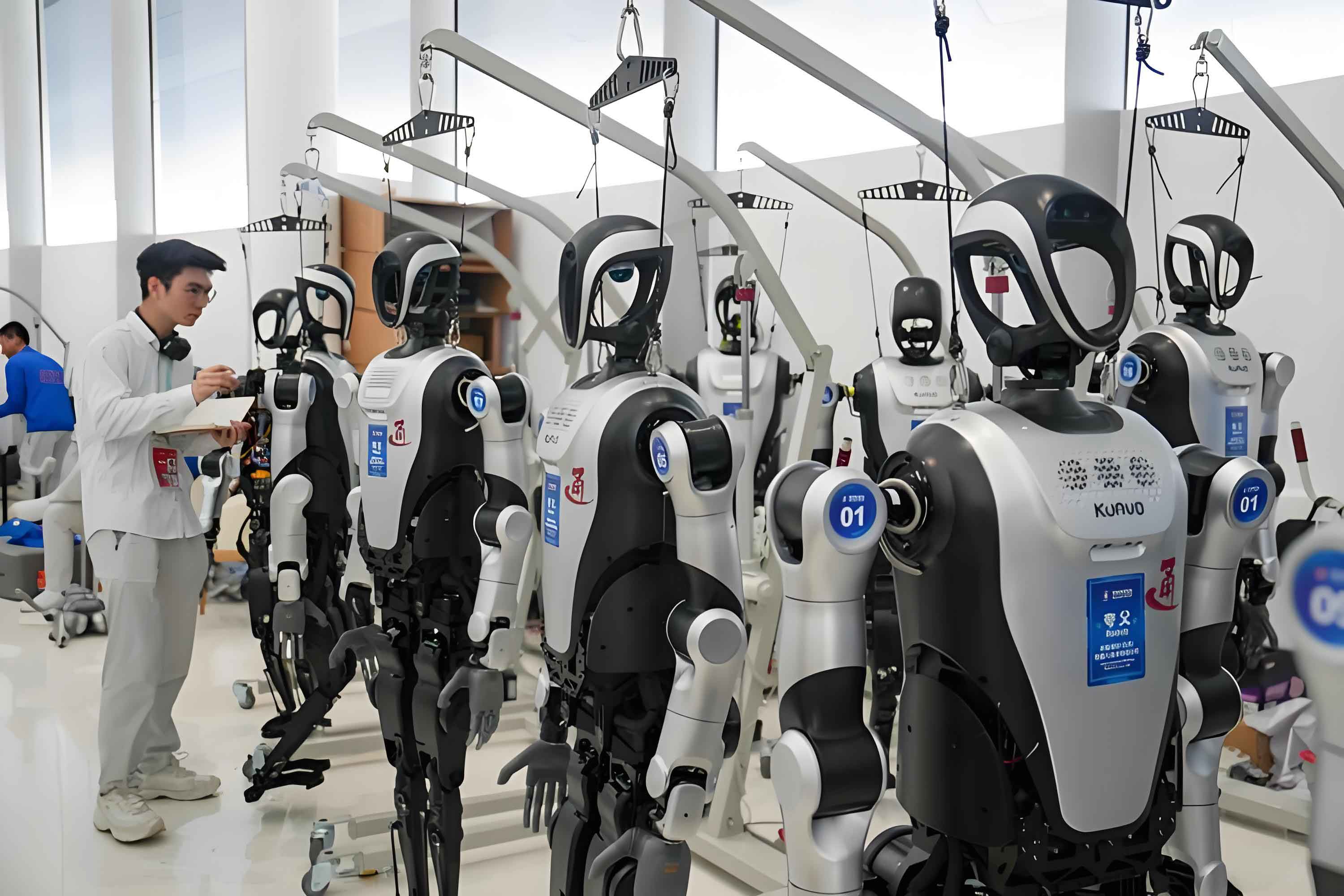
Deconstructing the Humanoid Form: A Technical Foundation
The physical instantiation of a humanoid robot is a symphony of integrated systems that enable its代理 functions. This complexity can be summarized by its core technical layers:
| System Layer | Primary Components | Function (Agency Role) |
|---|---|---|
| Locomotion & Balance | Actuators, gyroscopes, force sensors, kinematic chains | Enables walking, balancing, and physical movement (Behavioral Agency) |
| Sensory Perception | Cameras, LiDAR, microphones, tactile sensors, IMUs | Gathers multimodal data (visual, auditory, haptic) from the environment |
| Cognition & Decision | Foundation AI Model (LLM, VLM), task planners, world models | Processes perception, makes decisions, generates action sequences |
| Emotive Expression | Servo-driven facial features, synthetic speech with tone modulation, gesture libraries | Communicates internal states and responds to human affect (Emotional Agency) |
| Manipulation & Interaction | Multi-fingered end-effectors, compliant grippers, full arm articulation | Executes physical tasks and enables safe, dexterous contact with the world (Behavioral Agency) |
This integration allows for a functional transfer from human to machine, conceptualized as a directed flow:
$$ \text{Human Intent} \rightarrow \text{Sensory Input} \rightarrow \text{AI Processing} \rightarrow \text{Actuation Command} \rightarrow \text{Robot Action/Expression} $$
This flow underpins both behavioral代替 (executing a physical task) and emotional代理 (providing a companionable response).
II. Challenging the “Human-Centered” HMI Paradigm
Historically, HMI theory and design have been deeply anchored in the principle of “Human-Centered Design” (HCD), which fundamentally posits the machine as a tool serving human needs. This paradigm, aligned with Intelligence Augmentation (IA) philosophy, views technology as a means to extend human capabilities. Concepts like “Human-in-the-Loop” reinforce human dominance and control, embedding this power dynamic into engineering principles.
The humanoid robot, particularly one with advanced affective capabilities, delivers a multi-faceted challenge to this cornerstone principle.
A. The Dual Agency of Humanoid Robots
The challenge manifests primarily through two channels of agency transfer:
1. Emotional Agency & Affective Computing: This represents a quantum leap from tool functionality. A humanoid robot can be programmed for emotional alignment (recognizing and mirroring human emotion), emotional compensation (providing companionship and affective守护), and even rudimentary forms of meaning generation through sustained, trust-based interaction. The human tendency for anthropomorphism, triggered by the robot’s form and responsive behavior, leads to emotional attachment, effectively creating a “substitutive body” or companion. The moral信任 extended to such machines increases with their perceived人性化.
2. Behavioral Agency & Physical Proxy: The physical form of the humanoid robot allows it to act as a direct proxy for human action. Upon receiving and processing a command (whether explicit or derived from context), its control system manipulates its hardware—limbs, manipulators, mobility base—to execute tasks. This turns the humanoid robot into a potent社会行动者, capable of acts with legal and social significance, from gesturing and fetching to potentially, in advanced stages, operating interfaces or tools on behalf of a user.
B. The Transformation of Interactive Modes
The interaction model itself is revolutionized, moving from discrete, interface-based exchanges to continuous, multimodal共生.
| Aspect of Interaction | Traditional HMI (Tool-based) | Human-Humanoid Robot Interaction |
|---|---|---|
| Primary Mode | Graphical User Interface (GUI), command line, simple voice commands | Multimodal dialogue integrating natural language, gesture, gaze, touch, and environmental context |
| Communication Content | Information transfer, command execution status | Information + Emotional exchange + Collaborative task planning |
| State of Coexistence | Human-Computer Symbiosis (separate entities collaborating) | Human-Machine嵌生 (increasingly intertwined, with potential for physical integration via BCIs) |
| Theoretical Anchor | Human-Centered Design,驯化 Theory | CASA Theory, Posthumanism, Systems Theory (holistic view) |
This shift necessitates a move from a驯化 mindset, where machines are controlled like domesticated animals, toward a recognition of the humanoid robot as an increasingly autonomous participant in a shared social sphere. The binary subject-object legal structure is strained by this new reality, demanding a framework that acknowledges the交互关系’s growing complexity and整体性.
III. Reimagining Theory: The CASA Framework in an Embodied Age
The “Computers Are Social Actors” (CASA) paradigm, introduced by Nass et al. in the 1990s, posits that humans instinctively apply social rules and expectations to computers, treating them as mindful entities regardless of actual agency. The emergence of the humanoid robot provides the most compelling evidence for CASA’s core premise, yet also demands its significant expansion to account for embodied, affective, and physically代理 intelligence.
A. Two-Dimensional Expansion of CASA
The original CASA theory focused largely on behavioral interaction via screens. For the humanoid robot, we must expand into two critical dimensions:
1. The Personalization Dimension (Emotional Agency): A humanoid robot‘s capacity for emotional labor—识别, processing, and responding to human affect—grants it a form of拟人化 that touches upon human人格尊严. The affective link formed with a user is unique and carries significant personal value. This interaction can be modeled to show its relational dependency:
$$ P_r = f(E, R, H) $$
Where:
$P_r$ = Perceived人格属性 of the robot
$E$ = Emotional交互事实 (e.g., conversation, shared activity)
$R$ = Robot’s具身性 and Social Functionality (the唯一的 enabler)
$H$ = Human’s propensity for anthropomorphism and emotional need
When $R$ is sufficiently advanced and $H$ is engaged, $P_r$ increases, leading to ethical and legal questions about the protection of this human-robot relational bond.
2. The Socialization Dimension (Behavioral Agency): Through its physical actions in shared human spaces—handing objects, navigating socially, performing tasks—the humanoid robot undergoes a continuous process of socialization. It is both shaped by human social rules (via training data and reinforcement learning from human feedback) and actively participates in shaping social situations. This grants it behavioral meaning as a社会行动者. The level of its social integration can be considered a function of its perceived presence:
$$ S_{int} = \alpha(P_a) + \beta(P_p) + \gamma(Q_I) $$
Where:
$S_{int}$ = Degree of Social Integration
$P_a$ = Perceived Authenticity (of form and behavior)
$P_p$ = Perceived Psychological Intimacy (from emotional交互)
$Q_I$ = Quality of准社会交互 (parasocial interaction strength)
$\alpha, \beta, \gamma$ = Weighting coefficients
B. From “Human-in-the-Loop” to “Relationship-in-Focus”
The expanded CASA framework shifts the governance焦点 from trying to maintain absolute human control over a tool (“Human-in-the-Loop”) to regulating the emergent properties of the human-robot交互关系 itself. The unit of analysis becomes the collaborative system, not the isolated machine. This aligns with a共生 perspective that views human and machine as a unified, goal-oriented system where autonomy and协同性 coexist.
IV. Governance Pathways: Dimensional Distinction and Phased Preparedness
Given the current state of technology and its foreseeable trajectory, governance for humanoid robots must be nuanced, dimensional, and phased. We cannot apply a monolithic legal status; instead, regulation must differentiate based on the type of agency exercised and evolve over time.
A. Current Regulatory Framework: A Dimensional Approach
Under today’s legal systems, a blanket grant of legal personhood to a humanoid robot is neither feasible nor desirable due to its inability to independently bear legal or financial responsibility. However, a more sophisticated, two-track approach is necessary:
| Agency Dimension | Legal Conundrum | Proposed Governance Focus (Current Phase) | Potential Analogies/Models |
|---|---|---|---|
| Behavioral Agency (Physical Acts) |
Who is liable for torts (damage, injury) or breaches caused by the robot’s actions? | Liability Attribution & Ex-ante Explainability. Focus on the “back-end” chain: Manufacturer (design defects), Owner/Operator (duty of supervision, maintenance), and potentially the AI Service Provider (training data flaws, model bias). Stress ex-ante explainability of system capabilities and limits. | Product Liability (with strict liability elements), “Keeper” liability rules (similar to animal owner liability), Principal-Agent law for instructed acts. |
| Emotional Agency (Affective Bonds) |
How to protect the human emotional investment and personal data intrinsic to the unique human-robot relationship? | Relationship Safeguarding & Data/Algorithmic Governance. Legally protect the integrity and exclusivity of the交互 relationship (against unauthorized interference or data intrusion). Enforce robust privacy, data protection, and algorithmic transparency rules to prevent emotional manipulation and dependency. | Personality Rights (applied to the human’s relational data), Fiduciary duties of service providers, Data protection for intimate/special category data. |
The key is to regulate the effects and relationships, not to prematurely adjudicate the metaphysical status of the machine.
B. Future-Oriented Governance: Building the Trust Ecosystem
As technology advances towards greater autonomy, governance must prepare to shift from managing a tool to stewarding a socio-technical ecosystem. The cornerstone of this future is Human-Machine Trust.
1. From Explainable AI (XAI) to Trustworthy AI: While XAI aims to make AI decisions understandable, trust is a broader, more relational concept. For a humanoid robot, trust ($T$) is built on multiple pillars that must be actively engineered and verified:
$$ T_{hm} = \sum_{i=1}^{n} w_i \cdot C_i $$
Where potential components ($C_i$) include:
– $C_R$ = Reliability (task success rate)
– $C_S$ = Safety (physical and psychological)
– $C_F$ = Fairness & Non-discrimination
– $C_P$ = Privacy preservation
– $C_E$ = Empathic appropriateness (emotional agency)
– $C_A$ = Accountability (clear lines for remedy)
and $w_i$ represents the relative weight of each component in a given context.
2. Legal Norms and Ethical Co-Regulation: Law alone is insufficient to govern the nuanced, evolving space of human-robot交互关系. A co-regulatory approach is essential:
- Legal Frameworks: Set baseline safety, liability, and rights-protection standards. Move towards regulating the design of交互关系 (e.g., mandatory “off-switch” or pause functions, transparency about agency limits).
- Ethical Guidelines & Review Boards: Establish domain-specific ethics committees (类似 medical IRBs) to conduct pre-deployment reviews for humanoid robot applications in sensitive areas like elder care, child companionship, or mental health support. Industry-wide ethical charters can set norms beyond legal minimums.
- Standardization: Develop technical standards for interoperability, safety protocols, and trustworthiness metrics, creating a common language for developers and regulators.
The goal is to create a governance lattice where hard law, soft ethics, and technical standards interweave to support the development of a良性循环的人机信任生态. This ecosystem is not static but must be dynamically calibrated as the capabilities of the humanoid robot—and our understanding of our共生 relationship with it—continue to evolve.