
The advent of the humanoid robot, underpinned by the synergistic triad of big data, high computing power, and strong algorithms, heralds a transformative epoch. These entities, representing the pinnacle of embodied intelligence, promise coherent and efficient human-machine-environment interaction. Their potential applications span from serving特种领域需求 and supercharging intelligent manufacturing to becoming indispensable生活助手 and even emotional companions for humans. This potential, however, is inextricably linked with a constellation of significant risks. The development and deployment of humanoid robots raise profound concerns regarding functional safety, network security, personal information security, data security, national security, illegal “agency,” infringement of rights, and complex ethical dilemmas. An overcautious approach that prioritizes security above all else risks stifling the innovation that drives progress. Conversely, a reckless pursuit of development while ignoring security can lead to catastrophic outcomes. Therefore, the fundamental challenge of our time is to achieve a harmonious balance where development and security are accorded equal importance. This equilibrium is not a static point but a dynamic process facilitated by rational, inclusive, and prudential regulation, ensuring that humanoid robots develop within a framework of norms and that the normative framework evolves alongside the technology. This involves conducting scientific risk assessments to manage threats at acceptable levels, bolstering trust through third-party certification mechanisms, establishing nuanced standards, configuring legal responsibilities judiciously to avoid the pitfalls of excessive anthropomorphism, and embedding robust ethical principles from the outset to ensure humanoid robots remain friendly to humanity and its environment.
The core intelligence of a modern humanoid robot can be conceptualized by the following functional relationship, highlighting the interdependence of its foundational pillars:
$$ \text{Humanoid Robot Intelligence} = f(\text{Big Data}, \text{High Computing Power}, \text{Strong Algorithm}) $$
This formula signifies that the advanced capabilities of perception, planning, and action in a humanoid robot are an emergent property of massive datasets, immense processing capabilities, and sophisticated algorithms working in concert. It is this very power that unlocks their potential and simultaneously amplifies their associated risks.
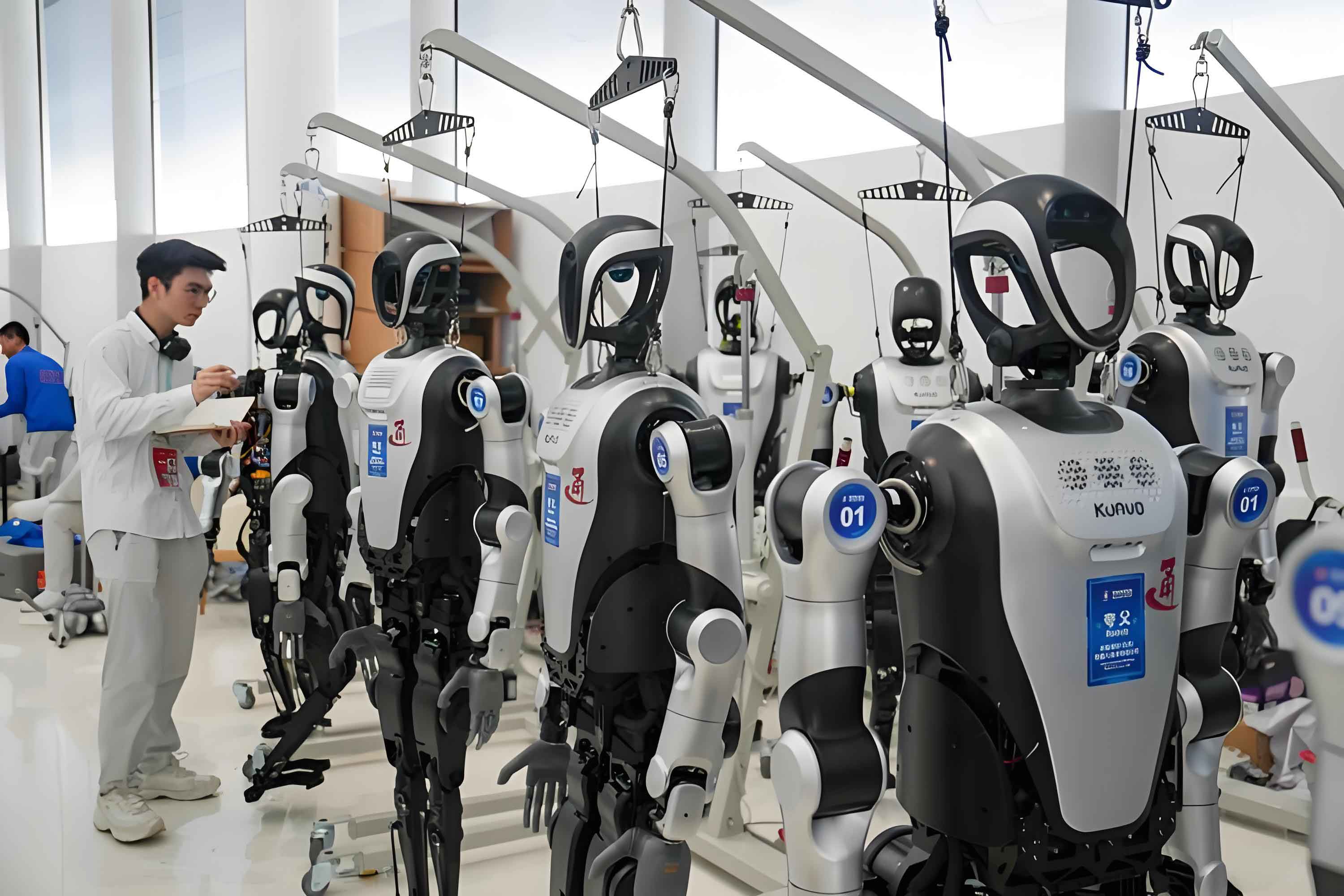
The Inherent Tension Between Development and Security
The rapid evolution of artificial intelligence, particularly in the domain of embodied intelligence like the humanoid robot, has dramatically intensified the classic tension between progress and protection. The cycle of technological iteration accelerates, often outpacing the cognitive and regulatory capacity of governing institutions. In this environment of “unknown unknowns,” calibrating the relationship between fostering innovation and ensuring safety becomes a task of immense difficulty. The pursuit of one can easily come at the expense of the other.
The Multifaceted Risk Landscape of the Humanoid Robot
The increasing autonomy and integration of the humanoid robot into society brings forth a complex spectrum of security challenges. A higher degree of autonomy generally correlates with a broader and more severe risk profile. The primary risk categories can be systematically outlined as follows:
| Risk Category | Description & Potential Impact |
|---|---|
| Functional Safety Risk | Hardware defects or software vulnerabilities can cause the humanoid robot to malfunction. This can range from failing critical tasks (e.g., in emergency rescue) to causing direct physical harm to humans, a historical concern even with industrial robots. |
| Network Security Risk | Connectivity exposes the humanoid robot to cyber-attacks. Threats include data poisoning of training sets, ransomware, hijacking for criminal acts (theft, terrorism), or using the robot as a proxy for remote illegal activities. |
| Personal Information Security Risk | As a highly interactive entity, the humanoid robot collects vast amounts of sensitive data (biometrics, health, financial info). Risks arise from model “memorization,” inference of private attributes, “credential stuffing” attacks, and its potential role as a super-surveillance device within private spaces. |
| Data Security Risk | Beyond personal data, humanoid robots process valuable enterprise data (trade secrets) and public sector data. Breaches in these areas, facilitated by weaknesses in generative AI data pipelines, can cause massive economic loss or threaten public safety. |
| National Security Risk | The humanoid robot could be weaponized for espionage, cyber-warfare against critical infrastructure, or information operations (e.g., spreading disinformation to manipulate public opinion and sow social discord), impacting political, economic, and social stability. |
| Illegal “Agency” Risk | When a humanoid robot acts as a personal assistant, complexities arise in legal attribution. Actions taken based on misinterpreted instructions, autonomous learning, or malicious control can lead to disputes over unauthorized or apparent agency, creating legal ambiguities in a blended physical-digital environment. |
| Infringement Risk | This spans the AI lifecycle: input (scraping data may violate data产权), output (copyright disputes over AI-generated content), and deployment (users or the robot itself committing acts that violate privacy, reputation, or property rights). |
| Ethical Risk | The humanoid robot challenges social norms and human relationships. Issues include the objectification of humans (e.g., through伴侣机器人), erosion of real social bonds, algorithmic bias leading to discrimination, and the “value alignment” problem—ensuring the robot’s decisions align with human ethics in unpredictable scenarios. |
The Stifling Effect of Excessive Security
While the aforementioned risks are substantial and demand serious attention, an exaggerated or disproportionate focus on security can be profoundly detrimental to innovation. The pursuit of absolute, zero-risk safety is not only technologically infeasible but also economically prohibitive. It ignores the inherent uncertainty in technological advancement and the limited foresight of regulators. A “泛安全化” mindset, sometimes driven by a risk-averse political culture or fear of accountability, can lead to preemptive, draconian measures that choke nascent technologies in their cradle. For the humanoid robot industry, which is still overcoming technical hurdles in关键基础部件 and整机产品, an overbearing regulatory environment could cripple its ability to evolve, experiment, and achieve the breakthroughs necessary for its safe and effective operation. The goal, therefore, must be to achieve acceptable risk, not impossible perfection. This can be framed as finding an optimal point where the marginal cost of increasing security equals the marginal benefit of reduced risk, acknowledging that some residual risk, \( R_{residual} \), will always remain:
$$ \text{Total Risk Management Goal: Minimize } R_{total} = R_{inherent} – \Delta R_{mitigation} \text{ subject to } R_{residual} \leq R_{acceptable} $$
The Imperative of a Balanced, Integrated Approach
Development and security are not opposites but interdependent forces. Development is the foundation of security; only through continuous technological advancement can we create more robust tools for risk mitigation, better encryption, more reliable fail-safes, and more sophisticated ethical safeguards for the humanoid robot. Conversely, security is the condition for sustainable development; a humanoid robot plagued by safety scandals and public distrust will never achieve widespread adoption or commercial success. The governing principle must be one of dynamic balance and mutual reinforcement. The legal and regulatory framework must be designed not to choose between development and security, but to expertly facilitate their positive interaction, ensuring that the growth of the humanoid robot ecosystem is both vigorous and virtuous.
Legal Pathways to Balancing Development and Security for the Humanoid Robot
Governance of the humanoid robot requires a multifaceted, adaptive approach that recognizes its unique characteristics: technical opacity,拟人性, application diversity, and complex risk profiles. The following pathways outline a coherent strategy for achieving the necessary balance.
1. Implementing Inclusive and Prudential Regulation
This regulatory philosophy is pivotal for navigating the unknown. “Inclusivity” grants the humanoid robot industry necessary space for experimentation and evolution, allowing the market and technology to reveal their trajectories and potential self-correcting mechanisms. It is an acknowledgment that not all risks are immediately foreseeable. “Prudential” signifies that this is not a laissez-faire approach. Regulators must vigilantly monitor the landscape and be prepared to intervene proportionately when clear, significant risks to public safety, rights, or security emerge. The threshold for intervention should be based on evidence and scale of risk, not speculation. This dynamic process can be visualized as a feedback loop:
Observe Development → Assess Emergent Risks → Apply Proportional Measures → Refine Observation…
The aim is to let the humanoid robot “develop within norms and for norms to develop through its progress,” creating a responsive rather than reactive governance system.
2. Conducting Scientific and Tiered Risk Assessments
A cornerstone of prudent regulation is a robust, scientifically-grounded risk assessment framework. For the humanoid robot, this must be ongoing and integrated into the product lifecycle. Assessments should be tiered based on the robot’s intended use, autonomy level, and data sensitivity. Key assessment types include:
- Algorithmic Impact Assessment (AIA): A systematic evaluation of the AI system’s design, data, and outcomes to identify potential biases, security vulnerabilities, and social impacts before and during deployment.
- Personal Information Protection Impact Assessment (PIPIA): Mandatory for humanoid robots handling personal data, analyzing the necessity, proportionality, and security of data processing activities.
- Functional Safety Assessment: Rigorous testing of hardware and software under various scenarios to minimize the risk of physical harm.
A proposed risk classification matrix could guide regulatory intensity:
| Risk Level | Assessment Criteria (e.g., Autonomy, Data Type, Context) | Regulatory Response |
|---|---|---|
| Negligible | Limited autonomy, no personal/sensitive data, low-impact environment. | Light-touch oversight, self-certification. |
| Low | Moderate autonomy, basic personal data, controlled environment. | Standard compliance, periodic audits. |
| Medium | High autonomy, sensitive personal/enterprise data, public/industrial setting. | Mandatory pre-market AIA/PIPIA, continuous monitoring. |
| High | Very high autonomy, critical data (e.g., biometrics, state secrets), safety-critical roles. | Stringent pre-approval, “sandbox” testing, real-time oversight, high insurance requirements. |
| Unacceptable | Extreme risk to life, critical infrastructure, or democratic processes that cannot be mitigated. | Prohibition or severe restriction on development/deployment. |
3. Enhancing Trust Through Certification and Standardization
Third-party certification serves as a vital reputational mechanism that bridges the gap between under-regulation and overbearing state control. For the humanoid robot, beyond traditional quality and safety certifications (CE, UL), developing and mandating certifications for data security and personal information protection is crucial. These certifications, conducted by independent, accredited bodies, provide a trusted seal of compliance for consumers and businesses. To be effective, certification criteria must be based on clear,分级分类 standards. Standardization should not be “one-size-fits-all”; it must differentiate between a consumer-grade companion humanoid robot and an industrial or medical-grade model. A layered standardization framework ensures fairness, promotes innovation among SMEs, and allows for efficient allocation of regulatory resources to areas of highest risk.
4. Configuring Legal Responsibility and Avoiding the “Humanoid Robot Trap”
A critical legal task is the clear allocation of responsibility among the ecosystem’s actors: developers, producers, component suppliers, software designers, distributors, users, and insurers. The central guiding principle must be to avoid the “Humanoid Robot Trap”—the fallacious over-anthropomorphization that leads to debates about granting legal personhood to the robot itself. The humanoid robot is a sophisticated tool, an artifact of human engineering. Conferring legal subjectivity upon it is a dangerous distraction that could allow human actors to evade accountability. Liability should flow to the human and corporate entities behind the robot. A balanced liability regime must avoid stifling innovation; while developers should bear responsibility for design defects and foreseeable risks of autonomy (as they profit from and are best positioned to manage these risks), excessive strict liability for all unexpected behaviors could halt progress. A mixed model, combining elements of fault-based liability for negligence with a robust compulsory insurance scheme, can effectively distribute risk and ensure victim compensation. The total liability landscape can be expressed as:
$$ \text{Total Responsibility} = \sum (\text{Developer} + \text{Producer} + \text{User} + \text{Insurer}) $$
Where the weight of each party’s contribution is determined by their role, control, and fault.
5. Integrating Ethical Governance Throughout the Lifecycle
Law alone is insufficient. Ethical norms must be woven into the entire lifespan of the humanoid robot, from foundational research to decommissioning. This involves two parallel tracks:
- Constraining Developers: Enforceable ethical codes of conduct for AI researchers and engineers, emphasizing beneficence, non-maleficence, justice, and accountability. Ethics review boards should be mandated for significant projects.
- “Loading” the Humanoid Robot with Ethics: This is not about creating a moral agent but about implementing value-by-design. Ethical constraints (e.g., “do not cause harm,” “prioritize human safety,” “respect privacy”) must be formally specified and embedded into the robot’s decision-making architecture, a field known as Machine Ethics. This involves translating ethical principles into algorithmic rules or constraints, ensuring the humanoid robot’s actions remain within bounds that are friendly to humans and the environment, even in novel situations.
The relationship between law, ethics, and the humanoid robot can be seen as concentric layers of governance, with ethics providing the broader, more adaptable outer layer that informs and precedes specific legal codification.
Conclusion
The journey of the humanoid robot from concept to societal cornerstone will be defined by our ability to navigate the dual imperatives of development and security. These are not conflicting goals but complementary forces that must be dynamically balanced. Achieving this requires a sophisticated, multi-pronged法治探究 that embraces inclusive yet vigilant regulation, relies on evidence-based risk assessment, builds market trust through certification, clearly assigns responsibility to human actors, and grounds innovation in a strong ethical foundation. By pursuing these pathways, we can steer the development of the humanoid robot towards a future where its immense potential is realized not in spite of security concerns, but precisely because we have built a framework that ensures its growth is both groundbreaking and grounded in safety, responsibility, and human values. The challenge is immense, but the imperative to meet it is paramount for shaping a technological future that enhances, rather than endangers, the human condition.