
As an educator and researcher immersed in the field of educational technology, I have witnessed firsthand the transformative potential of humanoid robots in learning environments. The integration of humanoid robots into education is not merely a trend but a profound shift that engages students in multidisciplinary exploration, blending artificial intelligence, mechanics, computer science, and beyond. In this article, I will delve into the extensive applications, benefits, and challenges of using humanoid robots in education, drawing from my experiences and observations. My goal is to provide a comprehensive overview that highlights how these advanced tools can foster critical skills while addressing current limitations. Throughout this discussion, the term “humanoid robot” will be frequently emphasized to underscore its centrality in this educational revolution.
Humanoid robots, with their anthropomorphic design and interactive capabilities, offer a unique platform for hands-on learning. From primary schools to universities, educators are increasingly adopting humanoid robots to create immersive, engaging lessons that go beyond traditional textbooks. In my own teaching practice, I have seen how a humanoid robot can captivate students’ attention, turning abstract concepts into tangible experiences. For instance, when students program a humanoid robot to walk or speak, they are not just coding—they are engineering behaviors that mimic human actions. This process inherently cultivates a range of cognitive and social skills, which I will explore in detail. The following sections will break down the core educational values, supported by tables and formulas to summarize key points, and address the hurdles we face in widespread implementation.
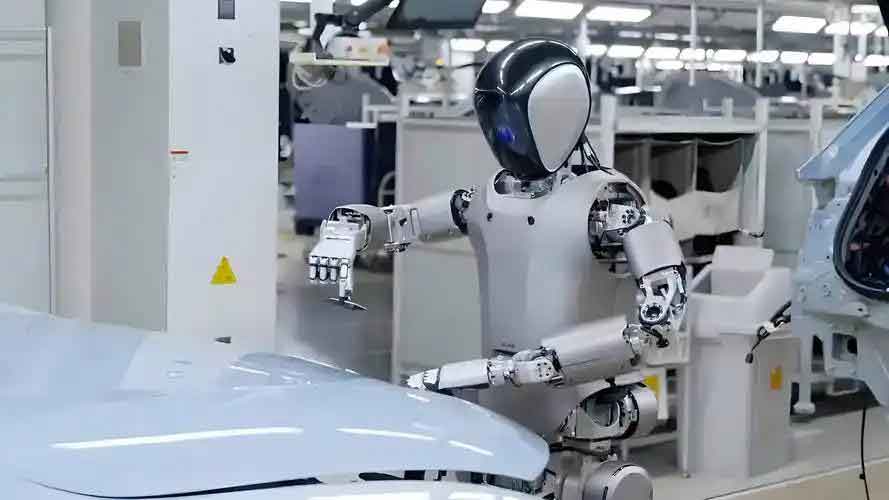
One of the most significant benefits of incorporating humanoid robots into education is the enhancement of logical thinking abilities. When students engage in programming a humanoid robot, they must deconstruct complex tasks into sequential steps, akin to solving a puzzle. This involves understanding the robot’s sensors, actuators, and control systems, then writing code that dictates its actions. For example, to make a humanoid robot navigate a maze, students need to develop algorithms that process sensor data and execute movements. This programming exercise strengthens their logical reasoning, as even a minor error in logic can cause the humanoid robot to malfunction. To illustrate, consider a simple pathfinding algorithm for a humanoid robot. The logic can be expressed using pseudocode or mathematical formulas, such as defining the robot’s decision-making process based on environmental inputs. A formula representing this might involve conditional probabilities:
$$P(a_t | s_t) = \frac{\exp(Q(s_t, a_t))}{\sum_{a’ \in A} \exp(Q(s_t, a’))}$$
where \(P(a_t | s_t)\) is the probability of taking action \(a_t\) (e.g., move forward) given state \(s_t\) (e.g., obstacle detected), and \(Q(s_t, a_t)\) is the value function learned through programming. This equation mirrors the logical structures students must grasp when coding a humanoid robot. Moreover, I often use tables to summarize the logical steps involved in programming a humanoid robot for different tasks. Table 1 below outlines a typical programming workflow for a humanoid robot in an educational setting:
| Step | Description | Logical Skill Developed |
|---|---|---|
| 1. Problem Analysis | Define the task (e.g., humanoid robot greeting a person) | Decomposition and abstraction |
| 2. Algorithm Design | Create a flowchart or pseudocode for the humanoid robot’s behavior | Sequential and conditional reasoning |
| 3. Code Implementation | Write actual code in a language like Python or Blockly for the humanoid robot | Syntax and semantic logic |
| 4. Debugging and Testing | Run the program on the humanoid robot and fix errors | Critical thinking and error analysis |
| 5. Optimization | Refine the code to improve the humanoid robot’s efficiency | Algorithmic efficiency and logical optimization |
Through such structured activities, students gradually build a strong foundation in logical thinking, which transfers to other academic areas like mathematics and science. The humanoid robot serves as a concrete tool that makes abstract logic visible and manipulable.
Another crucial aspect is how humanoid robots foster problem-solving and analytical skills. In educational projects involving humanoid robots, students encounter real-world challenges that require systematic analysis. For instance, when a humanoid robot fails to perform a task as expected, students must diagnose the issue—whether it’s a hardware flaw, a software bug, or an environmental factor. This process teaches them to break down problems into manageable parts and apply iterative solutions. I have observed students working on a humanoid robot project where the robot needed to recognize objects. They had to analyze image data, adjust parameters in machine learning models, and test various approaches. This analytical journey can be summarized using formulas related to sensor data processing. For example, the error in a humanoid robot’s vision system might be minimized by optimizing a loss function:
$$L(\theta) = \frac{1}{N} \sum_{i=1}^{N} (y_i – f(x_i; \theta))^2$$
where \(L(\theta)\) is the mean squared error, \(y_i\) is the true label, \(f(x_i; \theta)\) is the humanoid robot’s prediction based on input \(x_i\) and parameters \(\theta\), and \(N\) is the number of samples. Students learn to tweak \(\theta\) to reduce \(L(\theta)\), thereby enhancing their analytical abilities. To further illustrate the problem-solving process, Table 2 compares different types of problems encountered with humanoid robots and the analytical strategies employed:
| Problem Type | Example with Humanoid Robot | Analytical Strategy | Outcome |
|---|---|---|---|
| Hardware Issue | Humanoid robot’s joint motor overheats during movement | Check power supply, examine mechanical load, use thermal sensors | Identify and replace faulty motor |
| Software Bug | Humanoid robot crashes when executing a complex sequence | Review code for infinite loops, test modules individually, use debugging tools | Fix logical error in control algorithm |
| Environmental Challenge | Humanoid robot struggles to navigate on uneven surfaces | Analyze sensor feedback, adjust gait parameters, simulate conditions | Implement adaptive walking algorithm |
| Integration Problem | Humanoid robot’s speech module conflicts with motion control | Trace system dependencies, prioritize tasks, optimize resource allocation | Synchronize modules via multi-threading |
By engaging with such multifaceted problems, students develop a holistic approach to analysis, preparing them for future STEM careers. The humanoid robot acts as a microcosm of engineering systems, offering endless opportunities for inquiry and solution-finding.
The hands-on nature of working with humanoid robots significantly enhances practical skills. Unlike passive learning, where students merely consume information, interacting with a humanoid robot requires active manipulation of physical components. From assembling parts to calibrating sensors, students gain tactile experience that bridges theory and practice. In my classes, I often start with kit-based humanoid robots that students build from scratch. This assembly process involves following technical diagrams, using tools, and understanding mechanical principles. For example, aligning the servos in a humanoid robot’s arm requires precision, which can be described by kinematic equations. The forward kinematics of a humanoid robot arm might be expressed as:
$$x = l_1 \cos(\theta_1) + l_2 \cos(\theta_1 + \theta_2)$$
$$y = l_1 \sin(\theta_1) + l_2 \sin(\theta_1 + \theta_2)$$
where \(x\) and \(y\) are the end-effector coordinates, \(l_1\) and \(l_2\) are link lengths, and \(\theta_1\) and \(\theta_2\) are joint angles. Students apply these formulas to configure their humanoid robot for tasks like picking up objects, thereby reinforcing their practical geometry knowledge. Additionally, I use tables to track skill development over time. Table 3 outlines the progression of practical skills through humanoid robot projects:
| Stage | Activity Involving Humanoid Robot | Tools and Techniques Used | Skill Acquired |
|---|---|---|---|
| Beginner | Basic assembly of humanoid robot kit | Screwdrivers, pliers, instruction manuals | Mechanical assembly and fine motor skills |
| Intermediate | Wiring and connecting sensors to humanoid robot | Multimeters, soldering irons, circuit diagrams | Electrical troubleshooting and connectivity |
| Advanced | Programming humanoid robot for autonomous tasks | IDEs, version control, simulation software | Software integration and system testing |
| Expert | Designing custom modules for humanoid robot (e.g., new gripper) | 3D printers, CAD software, prototyping tools | Innovative design and fabrication |
This hands-on engagement not only builds technical proficiency but also boosts confidence, as students see their creations come to life. The humanoid robot becomes a personal project that motivates sustained effort and learning.
Innovation is at the heart of humanoid robot education. By encouraging students to modify and improve their humanoid robots, we nurture creative thinking and originality. Unlike pre-packaged solutions, humanoid robot projects often have open-ended goals, allowing students to experiment with novel ideas. For instance, in a competition I organized, students were tasked with designing a humanoid robot that could assist in a classroom—some added features like emotion recognition or adaptive tutoring algorithms. This innovative process can be modeled using design thinking frameworks, which I often summarize with formulas for creativity metrics. One simple measure of innovation in a humanoid robot project could be the diversity of solutions generated:
$$I = \frac{S}{T}$$
where \(I\) is an innovation index, \(S\) is the number of unique solutions proposed for a humanoid robot task, and \(T\) is the total number of teams. Higher \(I\) values indicate greater creative output. To capture the breadth of innovation, Table 4 lists common innovative extensions students have developed for humanoid robots:
| Innovation Area | Description for Humanoid Robot | Technologies Integrated | Educational Impact |
|---|---|---|---|
| Social Interaction | Humanoid robot programmed to mimic human gestures during conversations | Computer vision, NLP, servo control | Enhances empathy and communication studies |
| Environmental Sensing | Humanoid robot equipped with air quality sensors to monitor classrooms | IoT, data analytics, wireless communication | Promotes awareness of sustainability and data science |
| Assistive Technology | Humanoid robot adapted to help students with disabilities (e.g., guiding visually impaired) | Haptic feedback, voice assistants, path planning | Fosters inclusivity and ethical design thinking |
| Artistic Expression | Humanoid robot used to create digital art or music based on sensor inputs | Generative algorithms, actuators, multimedia software | Bridges STEM and arts, encouraging cross-disciplinary creativity |
These innovations demonstrate how humanoid robots can serve as catalysts for out-of-the-box thinking. Students learn that technology is not static but something they can reshape to address new challenges—a mindset essential for future innovators.
Team collaboration is another vital skill honed through humanoid robot education. Most projects involve group work, where students must coordinate roles, share ideas, and resolve conflicts to achieve common goals. In my experience, a well-functioning team can accomplish far more with a humanoid robot than any individual alone. For example, in a robotics club, one student might focus on programming the humanoid robot’s navigation, while another handles mechanical adjustments, and a third documents the process. This collaboration mirrors real-world engineering teams and teaches valuable interpersonal skills. To optimize team performance, I often use formulas from game theory or cooperation models. For instance, the synergy in a humanoid robot project team can be approximated by:
$$C = \alpha \sum_{i=1}^{n} s_i + \beta \cdot \text{Communication\_Score}$$
where \(C\) is the collaboration effectiveness, \(s_i\) is the individual skill contribution of team member \(i\), \(\alpha\) and \(\beta\) are weighting factors, and Communication_Score is assessed through peer reviews. This formula helps students understand the importance of both technical and soft skills. Table 5 outlines typical roles and responsibilities in a humanoid robot project team:
| Role | Responsibilities Related to Humanoid Robot | Skills Emphasized | Collaboration Examples |
|---|---|---|---|
| Project Manager | Oversee timeline, allocate tasks for humanoid robot development | Leadership, organization | Coordinates meetings and ensures milestones are met |
| Hardware Specialist | Assemble and maintain physical components of humanoid robot | Mechanical engineering, troubleshooting | Works with software team to integrate sensors |
| Software Developer | Write and debug code for humanoid robot’s behaviors | Programming, algorithm design | Collaborates on API development with other coders |
| Testing Analyst | Conduct experiments and validate humanoid robot performance | Analytical thinking, attention to detail | Provides feedback to improve robot functionality |
| Documentation Lead | Record processes and create reports on humanoid robot project | Communication, writing | Shares findings with entire team for iterative learning |
Through such collaborative endeavors, students learn to appreciate diverse perspectives and develop teamwork skills that are invaluable in any profession. The humanoid robot serves as a shared focus that unites team members toward a common objective.
Despite these benefits, the integration of humanoid robots in education faces several significant challenges. From my observations, the primary issue is technological immaturity. Many humanoid robots available for educational use are still in early development stages, with limitations in durability, cost, and ease of use. For instance, some humanoid robots have restricted battery life or lack robust software libraries, hindering prolonged classroom activities. This technological gap can be quantified using reliability metrics. For example, the mean time between failures (MTBF) for a humanoid robot in a school setting might be modeled as:
$$MTBF = \frac{T_{\text{total}}}{\sum_{i=1}^{N} f_i}$$
where \(T_{\text{total}}\) is the total operational time, and \(f_i\) are failure incidents. Low MTBF values indicate frequent breakdowns, which disrupt learning. Additionally, the high cost of humanoid robots poses a barrier, especially for underfunded schools. Table 6 summarizes key technological and economic challenges:
| Challenge Category | Specific Issue with Humanoid Robot | Impact on Education | Potential Mitigation |
|---|---|---|---|
| Technical Limitations | Humanoid robot sensors often lack accuracy in dynamic environments | Reduces reliability of interactive lessons | Invest in R&D for better sensor fusion algorithms |
| High Costs | Purchase and maintenance of humanoid robots strain school budgets | Limits access to affluent institutions only | Develop low-cost open-source humanoid robot platforms |
| Lack of Standardization | Diverse humanoid robot brands with incompatible software/hardware | Creates confusion and complicates curriculum design | Establish educational standards for humanoid robot interfaces |
| Insufficient Teacher Training | Educators unprepared to integrate humanoid robot into pedagogy | Leads to underutilization or misuse of technology | Provide professional development workshops and resources |
Another challenge is the lack of widespread recognition in educational circles. Many policymakers and administrators still view humanoid robots as niche toys rather than essential learning tools. This mindset limits funding and support for robotics programs. Moreover, the rapid evolution of humanoid robot technology can outpace curriculum development, leaving educators struggling to keep up. To address this, we need concerted efforts to showcase successful case studies and research on the efficacy of humanoid robots in education. Formulas like cost-benefit analysis can help make the case:
$$ROI = \frac{B – C}{C}$$
where \(ROI\) is the return on investment, \(B\) represents educational benefits (e.g., improved test scores, skill acquisition), and \(C\) is the cost of implementing humanoid robots. Positive ROI values can persuade stakeholders to invest in these technologies.
Furthermore, the “old thinking” problem persists, where humanoid robot development often mimics traditional industries like automotive, leading to fragmented markets with little innovation. This results in a plethora of brands that offer similar features, stifling creative applications in education. In my view, we need a shift toward modular, customizable humanoid robots that empower students to tinker and invent. For example, open-source platforms like ROS (Robot Operating System) for humanoid robots can foster innovation by allowing users to share code and designs. The innovation potential here can be expressed through network effects:
$$V \propto n^2$$
where \(V\) is the value of the humanoid robot ecosystem, and \(n\) is the number of active contributors. As more educators and students participate, the collective knowledge base grows, benefiting all.
In conclusion, humanoid robots hold immense promise for revolutionizing education by developing logical thinking, problem-solving, practical skills, innovation, and teamwork. However, realizing this potential requires overcoming technological, financial, and perceptual hurdles. As an educator, I advocate for increased collaboration between technologists, teachers, and policymakers to create sustainable humanoid robot programs. By investing in robust, affordable humanoid robots and comprehensive training, we can unlock new dimensions of learning. The future of education may well be shaped by these anthropomorphic machines, not as replacements for teachers, but as powerful companions that inspire the next generation of thinkers and creators. The journey with humanoid robots is just beginning, and I am excited to see how it unfolds in classrooms worldwide.