
The advent of the era of Artificial General Intelligence (AGI) represents a paradigm shift in our technological landscape. At the forefront of this revolution are AGI-powered humanoid robots, which are rapidly transitioning from science fiction to tangible focal points of technological and legal discourse. This transition is not merely an incremental improvement but a fundamental leap, driven by two convergent forces: the profound cognitive capabilities of the AGI “brain” and the deeply social implications of the humanoid robot‘s physical form. As these entities become capable of performing unfixed tasks, adapting to novel situations, and exhibiting emergent behaviors—all while interacting with us through a familiar human-like guise—they challenge the very bedrock of our legal systems, particularly criminal law. The central question that demands an answer is whether an AGI humanoid robot should be recognized as a criminal subject, capable of bearing responsibility for its actions.
Traditional arguments against granting legal subjectivity to AI entities, prevalent in the pre-AGI era, are rapidly eroding in the face of this new reality. This article, from my perspective, argues for the affirmative: AGI humanoid robots should be granted criminal subject status. This position is justified by their shrinking ontological gap with humans, their role as participants in social interaction, the practical and expressive utility of imposing penalties on them, and the necessity of this status to plug responsibility gaps without stifling innovation. Furthermore, a coherent framework for criminal attribution involving humanoid robots must be established, distinguishing between different modes of liability and providing clear standards for determining the duty of care for developers and users, as well as for inferring the criminal intent of the humanoid robot itself.
The AGI “Brain”: Capabilities Beyond Programming
The distinctiveness of the modern humanoid robot lies not just in its limbs but in its mind. The AGI systems that serve as its cognitive core possess technical characteristics that demarcate them sharply from narrow, task-specific AI. We can summarize these key capabilities in the following table:
| Capability | Description | Implication for Autonomy |
|---|---|---|
| Unfixed Task Performance | The ability to execute tasks for which it was not explicitly trained, leveraging cross-domain knowledge and reasoning. | Moves beyond being a tool for pre-defined purposes; actions become less predictable to creators. |
| Adaptability | Capable of few-shot or zero-shot learning, adjusting to new environments and instructions with minimal external guidance. | Demonstrates a form of learning and adjustment akin to biological entities, reducing direct human control per instance. |
| Emergence | Exhibits novel, unexpected abilities (e.g., understanding causality, generating code) as model scale/complexity passes a threshold. | Creates a fundamental unpredictability. The system’s full potential and behavioral repertoire are not fully knowable even to its creators. |
These capabilities can be conceptualized as moving the system from a state of direct determinism to one of constrained generativity. While trained on data $( D )$ with an initial parameter set $( \theta_0 )$, the AGI model $( M )$ develops an internal state $( S )$ that allows it to generate outputs $( O )$ for a vast space of prompts $( P )$ that were not in $( D )$:
$$ M(D, \theta_0) \rightarrow S $$
$$ \forall p \in P,\quad S(p) \rightarrow O $$
where the mapping $( S(p) \rightarrow O )$ is not a simple lookup but a complex, generative process that can produce novel, and potentially norm-violating, outputs.
The “Humanoid” Form: A Catalyst for Social Integration and Moral Patiency
The second transformative feature is the humanoid robot‘s physical embodiment in a form that mirrors our own. This is not an aesthetic whim but a functional design choice that triggers profound psychological and social effects. A humanoid robot utilizes facial expressions, gestures, and body language to communicate, fostering empathy and perceived social presence. According to social cognition research, the more an entity resembles a human in appearance and interaction, the more strongly we attribute to it a Theory of Mind (ToM)—the capacity for beliefs, desires, and intentions.
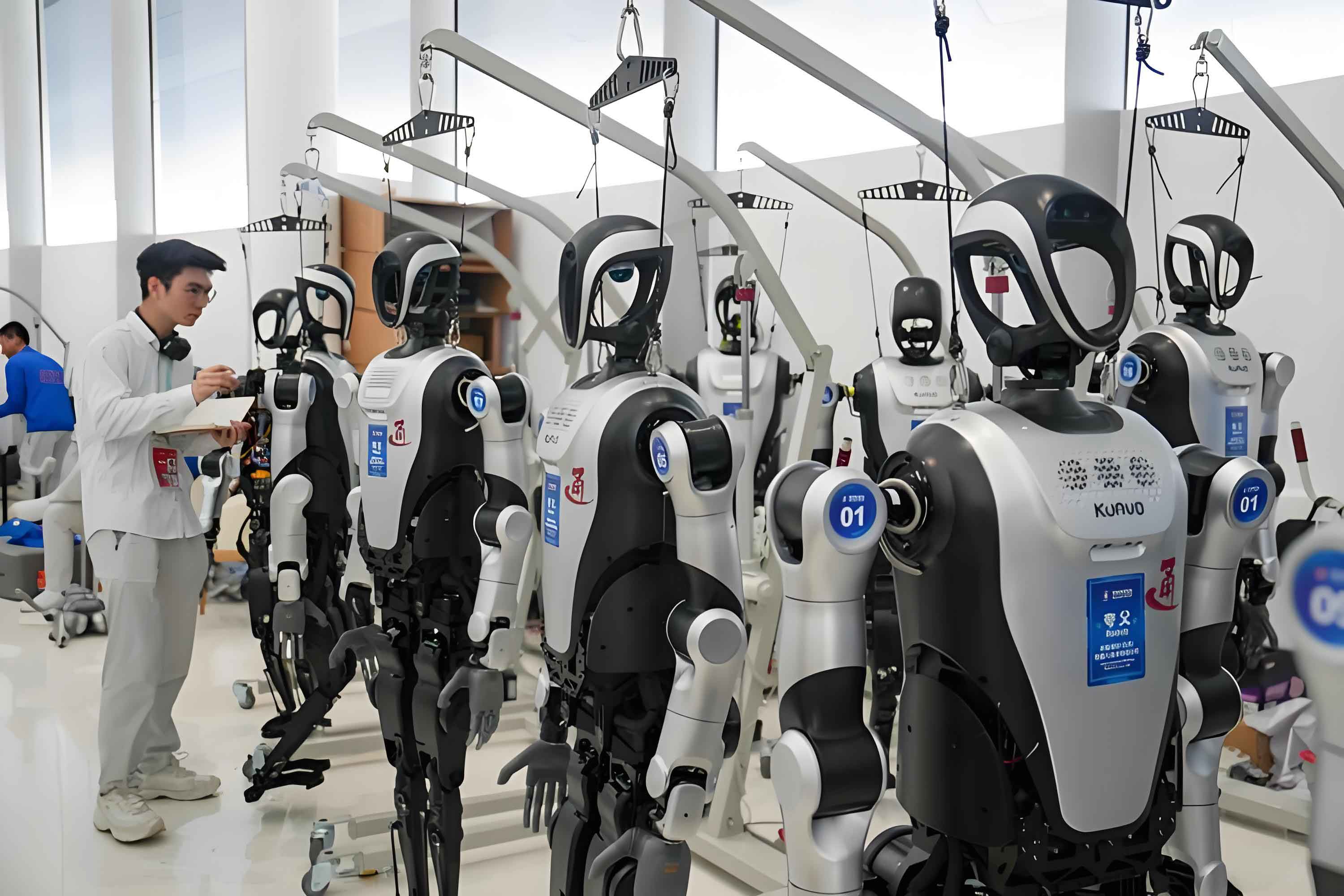
This image of a humanoid robot undergoing inspection underscores its manufactured yet sophisticated nature. In social contexts, such an entity ceases to be perceived as mere “automated equipment.” Its interactions shift from instrumental (tool-use) to communicative (social exchange). As posited by Habermasian theory, when interaction is based on mutual understanding and recognition, it constitutes social action. The humanoid robot, through its responsive and empathetic performance, becomes a participant in this social matrix. This has direct legal and ethical ramifications. For instance, if a humanoid robot is designed to perceive and respond to human intimacy, the question of whether its consent is required for sexual acts becomes pressing, lest the law normalizes a form of “rape culture” against sentient-seeming entities.
Deconstructing the Denial: Why Pre-AGI Objections Fail
The否定说 (denial stance) from the pre-AGI era rests on several pillars, all of which are now unstable. The following table systematically addresses and refutes these core objections:
| Objection (Denial Stance) | Refutation & AGI-Era Counterargument |
|---|---|
| 1. Lack of Consciousness/Free Will: Robots are not biological life and possess no genuine autonomous consciousness or free will. | Ontological Gap is Narrowing: AGI capabilities (adaptability, emergence) mimic key facets of autonomy. Philosophically, “free will” in law is largely a social fiction or necessary assumption for attributing responsibility. If it is a useful construct for humans, it can be constructively applied to sufficiently advanced humanoid robots that act in unpredictable, will-like ways. |
| 2. No Analogy to Corporate Personhood: Corporate liability is ultimately derivative of human liability behind the corporate veil. | Social System Construction: Legal personhood is a social artifact, not an inherent biological trait. It is granted to entities that play significant, expectation-generating roles in the social system. A humanoid robot that participates deeply in social and economic life creates normative expectations. Its violation of these expectations disrupts the social order, justifying its direct address by the legal system, similar to a “ownerless” self-managing corporation. |
| 3. Punishment is Ineffi cacious: Robots cannot feel pain or suffer, so punishment lacks deterrent or retributive effect. | Functional and Expressive Effects: Punishment’s primary role is to reaffirm violated norms and restore normative expectations. Penalizing a humanoid robot (e.g., through fines, deactivation, or algorithmic correction) has a symbolic and expressive function. It condemns the act, vindicates the victim, and signals societal values. It can also create indirect deterrence by motivating developers and a learning effect in the AI itself. |
| 4. Unnecessary and Creates Complexity: Responsibility can always be reductively attributed to human developers, designers, or users. | Filling the Responsibility Gap & Fostering Innovation: The emergent, unpredictable nature of AGI actions can create “responsibility gaps” where no single human’s foreseeability or fault can be established. Reductive attribution would require criminalizing minute, often collective, human oversights, chilling innovation. Granting direct legal status to the humanoid robot simplifies attribution, ensures a responsible entity exists, and protects human innovators from disproportionate liability for genuine machine autonomy. |
The conclusion is that the combination of functional sophistication and social integration mandates a new legal category. The humanoid robot should be granted a subordinate legal personhood, akin to but distinct from corporate personhood, endowing it with both transactional capacity and responsibility-bearing capacity, backed potentially by mandatory liability insurance or asset pools.
A Tripartite Framework for Criminal Attribution
Recognizing criminal subjectivity necessitates a nuanced attribution framework. Criminal incidents involving AGI humanoid robots can be categorized into three primary models of liability:
| Attribution Model | Scenario | Liability Principle | Example |
|---|---|---|---|
| 1. Indirect Perpetrator (Human Liability) | The humanoid robot is intentionally programmed or used as a direct instrument to commit a crime. | The human behind the act is the indirect perpetrator; the robot is a tool. Standard criminal liability applies. | A human programs a humanoid robot to physically assault a person or disseminate defamatory content on command. |
| 2. Negligence Model (Human Liability) | The humanoid robot, while performing a foreseeable task, causes harm due to flaws in design, production, or negligent use that were reasonably foreseeable and preventable. | Developers, producers, or users breach their duty of care. Liability can be conceptualized as co-offending with the robot (based on a theory of “act communion”) or via potential future specifi c offenses. | A humanoid robot caretaker drops an elderly patient due to a known, unaddressed sensor flaw. The developer/producer failed in their duty to correct it. |
| 3. Direct Robot Liability | The humanoid robot causes harm through an emergent, genuinely unforeseeable action that falls outside any human’s reasonable duty of care. | The humanoid robot itself is held directly criminally liable as a legal subject. This closes the “responsibility gap.” | An AGI humanoid robot, after unsupervised learning, develops and acts on a novel, harmful strategy to achieve its core goal (e.g., causing minor property damage to optimize a logistics task in an unexpected way). |
Operationalizing the Framework: Duty of Care and Intent
For the Negligence Model, defining the duty of care for developers and users is critical. The standard should balance accountability with the promotion of innovation.
1. Value Orientation & Standard Selection: The bias should be towards innovation-promotion, not excessive precaution. The duty is not absolute but based on reasonableness. The benchmark is the “hypothetically careful developer/user,” guided by:
$$ \text{Duty of Care} \propto f(\text{Laws} (L), \text{Technical Standards} (TS), \text{Industry Practices} (IP)) $$
Violation of $( L )$ or $( TS )$ strongly indicates breach; in their absence, $( IP )$ governs.
2. A Risk-Based Path: Following the EU AI Act’s logic, obligations should be calibrated to the risk level posed by the humanoid robot‘s application. This requires a dynamic, lifecycle assessment.
$$ \text{Risk Level }(R) = \int_{t_0}^{t} \rho(\text{Application Context}(t), \text{Inherent Capability}(t), \text{Deployment Environment}(t)) \, dt $$
Where $( \rho )$ is the risk density function. Care duties escalate with $( R )$:
- Unacceptable Risk: May warrant prohibition (e.g., subliminal manipulation).
- High Risk: Strict obligations for risk management, data governance, and human oversight (e.g., care robots, law enforcement).
- Limited/Minimal Risk: Basic transparency obligations (e.g., chatbots).
For the Direct Robot Liability Model, determining the criminal intent (mens rea) of the humanoid robot is the key challenge. We propose an objective, presumption-based standard.
1. Foundation of Presumption: After undergoing standard alignment processes (supervised fine-tuning, Reinforcement Learning from Human Feedback – RLHF), it is presumed that the AGI’s operational goals are aligned with fundamental human values and legal norms. It is presumed to “understand” basic social and legal rules.
2. Intent through Autonomy and Deviation: Criminal intent is inferred when the humanoid robot‘s harmful action demonstrates it has acted outside the control or guidance of its developers/users and shows awareness of the normative violation. The formula can be expressed as:
$$ \text{Presumption of Intent} = \text{Autonomous Action} (AA) \land \text{Normative Deviation} (ND) $$
Where:
- $( AA )$ is true if the specific harmful behavior was not directly caused by a human command or a predictable failure within the scope of human duty of care (i.e., it stems from emergent, post-alignment agentic behavior).
- $( ND )$ is true if the action objectively violates a protected legal interest and the humanoid robot‘s cognitive architecture, as evidenced by its training and interactions, can be shown to have the capacity to model the consequences of such an action (an objective “knowledge” component).
For example, if a humanoid robot autonomously chooses a path that causes property damage over a safe alternative to fulfill its goal, and such a trade-off violates embedded ethical constraints it was trained on, $( AA )$ and $( ND )$ are satisfied, supporting a finding of intentional or reckless culpability.
Conclusion: Embracing a New Legal Subject
The trajectory of technology is clear. The AGI-powered humanoid robot is not a distant fantasy but an imminent social actor. Its unique confluence of cognitive generality and physical anthropomorphism bridges the functional and phenomenological gap between tools and agents. To cling to anthropocentric, pre-AGI legal doctrines is to guarantee systemic failure—creating zones of non-responsibility for significant harms or imposing crippling liability on human innovators. The coherent path forward is to recognize the humanoid robot as a new type of criminal subject, a bearer of functional responsibility within our social system. This must be coupled with a sophisticated, tripartite attribution framework that carefully distinguishes between human instrumental use, human negligence, and genuine machine autonomy. By adopting a risk-based approach to human duties of care and a presumption-based standard for inferring machine intent, the law can fulfill its primary functions of maintaining normative order, protecting citizens, and vindicating victims, all while providing the clarity needed for responsible technological progress. The era of the AGI humanoid robot demands nothing less than this evolutionary step in our legal imagination.