
The integration of advanced artificial intelligence (AI) into humanoid robots marks a pivotal shift in robotics, promising to transform industries from manufacturing and healthcare to domestic service. However, this fusion of physical embodiment and cognitive autonomy introduces profound challenges to established legal frameworks, particularly concerning tort liability. The core of the problem lies in the inherent characteristics of the AI systems that drive these humanoid robots: inexplicability (the “black box” effect), unpredictability, and adaptive learning. When a humanoid robot causes physical harm through an autonomous decision, attributing fault and establishing causation become exceptionally difficult, potentially leaving victims without redress. This analysis, from my perspective as a scholar examining the intersection of law and emerging technology, argues against creating a new legal personality for AI and instead advocates for a refined, hierarchical application of existing tort principles. The solution involves stratifying the duties and liabilities of the key actors—the humanoid robot provider, the large model provider, and the user—through a combination of safety obligations, transparency requirements, and carefully calibrated presumptions.
The operational autonomy of a humanoid robot stems from a “perception-decision-control” loop powered by sophisticated AI. Unlike deterministic machinery, its actions are based on probabilistic outputs from models trained on vast datasets. A harm scenario, such as a humanoid robot in a warehouse colliding with a person, may originate from a data bias—for instance, a lack of training data for low-light conditions or for distinguishing between a target object and a nearby human limb. The central challenge for liability is the opacity of the causal chain. We cannot interrogate the AI to explain why it chose a particular path or failed to recognize an obstacle. This breakdown in explainability directly undermines the foundational tort law requirements of proving fault and causation. While some have proposed granting “electronic personhood” to advanced AI to bear liability directly, this approach is flawed. It is a legal fiction that ultimately circles back to human actors for funding (via insurance or funds) and control. The responsibility must remain with the human entities that design, profit from, and deploy the technology to ensure accountability and incentivize safety investments.
The appropriate path forward is not revolution but evolution: reconstructing liability rules through a hierarchy of standards and presumptions that account for complexity without unjustly burdening innovation. The guiding principle is proportionality—the legal duties assigned to each actor must correspond to their degree of control over the risk. The following table summarizes the proposed hierarchical liability framework for autonomous humanoid robot torts.
| Liable Actor | Legal Basis / Standard | Core Duty | Key Evidentiary Mechanism | Type of Liability |
|---|---|---|---|---|
| Humanoid Robot Provider (Producer/Integrator) | Strict Product Liability; High-Risk AI Safety Standards | To place a safe, controllable product on the market. Must ensure safety across the lifecycle (data quality, testing, monitoring). | 1. Disclosure Obligation. 2. Presumption of defect if malfunction in foreseeable use. 3. Relaxed causation proof due to technical complexity. |
Strict (No-fault) for product defect, with burden-easing presumptions. |
| Large Model Provider (Upstream AI) | Fault-based Liability; Transparency Standard | To provide sufficient, accurate information (transparency) to downstream integrators about the model’s capabilities and limitations. | Fault is presumed if harm occurs outside the limitations disclosed, provided the integrator operated within disclosed bounds. | Joint Tortfeasor Liability (with provider) based on fault. |
| User / Deployer | General Fault Liability; Heightened for Professional “Deployers” | To use the product correctly according to instructions and within its intended environment. | 1. For high-risk deployers: Disclosure Obligation. 2. Causation presumption in cases of contributory input and algorithmic opacity. |
Fault-based. Proportional (several) liability when specific causation is indeterminate. |
The Humanoid Robot Provider: Anchoring Liability in Product Safety
The provider—the entity that manufactures and integrates the humanoid robot system for the market—bears the primary and strictest liability. When a humanoid robot causes physical harm during operation, it is quintessentially a product liability case. The AI system, including any integrated large model, is not a mere service but an integral component controlling the physical safety of a tangible product. Therefore, the provider’s duty is to ensure the product is free from defect, defined as not providing the safety which a person is entitled to expect. For a humanoid robot, this expectation is high: it must be safe and controllable. This aligns with regulatory trends categorizing AI systems used as safety components in products as “high-risk,” mandating rigorous conformity assessment.
The practical hurdle for victims is proving the defect and its causal link to the harm. A hierarchical set of evidentiary rules is necessary:
- Disclosure Obligation: Given the severe information asymmetry, the provider should be obligated to disclose relevant evidence (e.g., log files, training data records, risk assessment reports) upon a plausible claim by the victim. Non-compliance should lead to a rebuttable presumption that the product was defective.
- Presumption of Defect from Malfunction: If the victim can show the harm resulted from an obvious malfunction during foreseeable use (e.g., a humanoid robot arm suddenly and violently jerking off its intended path), the defect itself should be presumed, simplifying the victim’s burden. The provider can rebut this by proving the malfunction was due to external interference or user misuse.
- Overcoming the “Black Box” via Presumptions: When, despite disclosure, the technical complexity of the AI makes it excessively difficult to pinpoint the exact flaw, the court should be allowed to presume both defect and causation if the victim shows they are reasonably likely. The legal test shifts from “proving exactly how” to “showing it is most probable.” The provider retains the right to rebut this presumption. This can be modeled as moving from a deterministic causality requirement to a probabilistic one:
$$ \text{Traditional Proof: } Cause = f_{explicit}(Fault, Harm) $$
$$ \text{Adapted Proof: } P(Cause | Fault, Harm) \geq \theta $$
Where $ \theta $ represents a threshold of reasonable likelihood, lower than the standard “balance of probabilities” in clear-cut cases, acknowledging the opacity. The provider’s failure to maintain a verifiable risk management system, as required for high-risk AI, would be a strong factor increasing $ P(Cause) $.
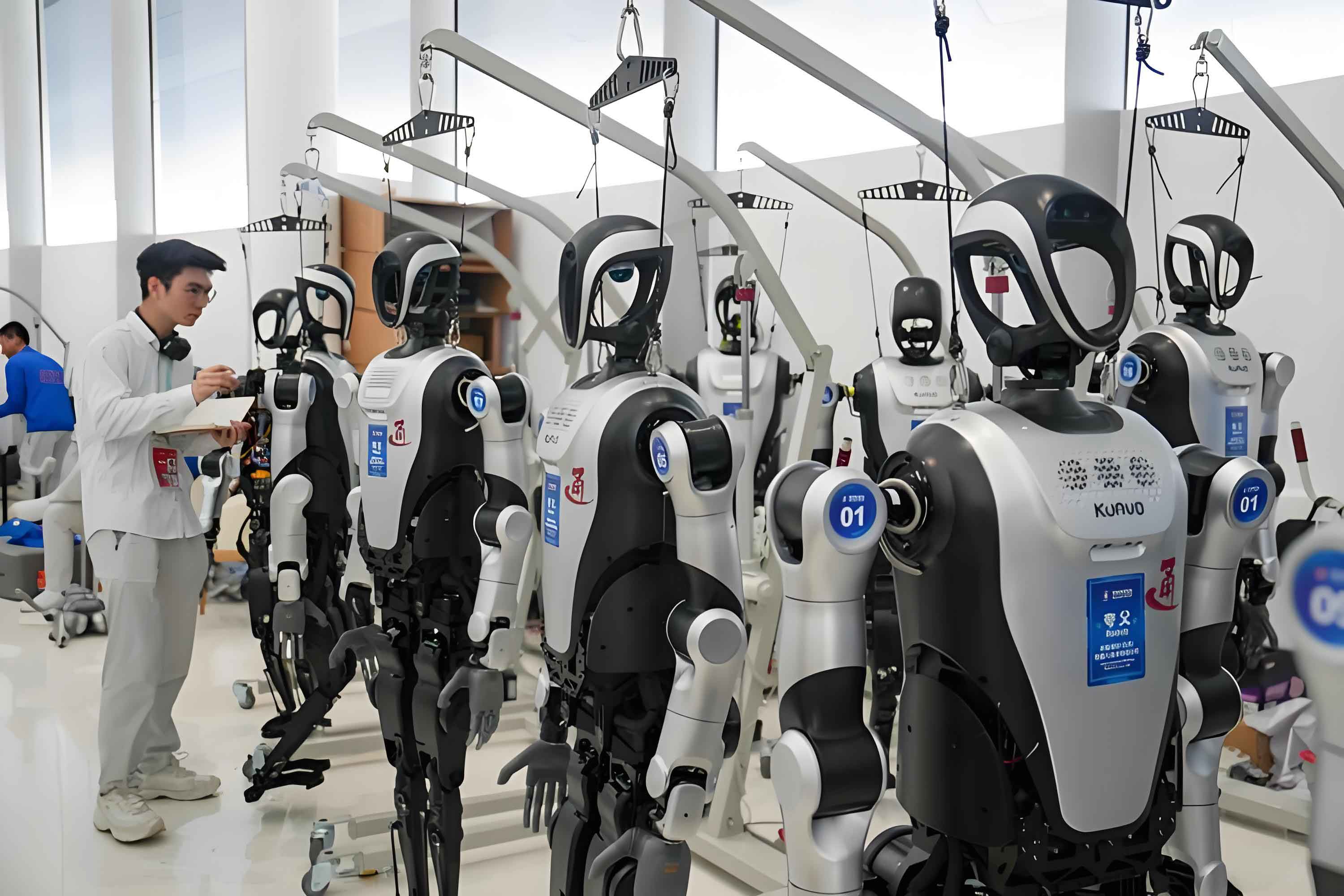
This image underscores the critical phase of quality assurance and testing that falls under the provider’s duty. A robust safety culture, reflected in stringent inspection protocols, is a concrete manifestation of the provider’s obligation to deliver a controllable product and forms a key part of the evidence for compliance.
The Large Model Provider: The Transparency Bridge to Downstream Liability
The ecosystem for advanced humanoid robots will likely involve specialization. Upstream, companies develop powerful, generalized “action” large models trained on massive datasets for motor control and task planning. Downstream, humanoid robot providers integrate these models into specific physical systems. This division of labor necessitates a distinct liability standard for the large model provider. Imposing the full “safety-critical” standard on them is disproportionate and stifling to innovation, as they lack control over the final integration, operating environment, and specific use case.
The core duty of the large model provider should be transparency. They must provide downstream integrators with comprehensive, accurate, and updated technical documentation detailing the model’s capabilities, limitations, performance characteristics, and known failure modes. For instance, a model’s documentation should specify its tested operational boundaries: “This model’s object recognition accuracy falls below 99% in lighting conditions under 50 lux,” or “Navigation predictions are not validated for dynamic environments with over 10 agents per 10m².”
The liability model is fault-based. If a humanoid robot causes harm, and investigation reveals the cause was rooted in a model limitation not adequately disclosed to the integrator, the large model provider should be deemed at fault. The legal logic is that the integrator relied on the transparency information to make safety-critical design choices (like adding supplemental sensors or limiting the operational domain). A breach of the transparency duty vitiates that reliance. The standard can be expressed as:
$$ Fault_{LMP} = 1 \quad \text{if} \quad (Harm \in \text{Model Limitation}) \land (Disclosure = \text{Insufficient}) $$
Where $ Harm \in \text{Model Limitation} $ means the harm was causally linked to a behavior stemming from the model’s intrinsic limitation, and $ Disclosure = \text{Insufficient} $ means this limitation was not properly documented for the integrator. In such a case, the large model provider and the humanoid robot provider would be held as joint tortfeasors.
The User/Deployer: Differentiated Duties Based on Context and Control
The user’s liability should not radically depart from traditional fault principles but must be adapted to the realities of autonomous systems. A key distinction must be made between the ordinary consumer and the professional “deployer.”
- Ordinary Users: A consumer using a domestic humanoid robot assistant typically owes a duty of ordinary care—to follow the user manual. Liability arises from clear misuse (e.g., using an indoor robot on wet, uneven outdoor terrain). The challenge of attributing causation due to adaptive learning is less acute in physical damage cases, as misuse often has observable results.
- High-Risk Deployers: A company using a humanoid robot for logistics in a shared warehouse is a professional deployer in a high-risk setting. Regulatory frameworks rightly impose higher obligations on such actors: to use the system per instructions, ensure proper input data, maintain the operating environment, and conduct human oversight. For these deployers, a disclosure obligation is appropriate; they must retain and potentially disclose operational logs. Failure to comply with a court order for disclosure should lead to a presumption of fault.
- Causation Challenges and Proportional Liability: The most complex scenario arises when both the provider’s product and the user’s input data (shaping the adaptive AI) are potential fault sources, but algorithmic opacity prevents precise attribution. For example, a delivery humanoid robot might knock over a shelf. Was it due to a sensor defect (provider fault) or because the deployer’s inventory mapping data was erroneous (user fault)? The black box may obscure the answer. Here, a causation presumption is warranted. If the victim proves the AI’s output caused harm and that the user breached a relevant duty (e.g., inputting poor quality data), causation between that breach and the harmful output can be presumed. Since both provider and user are at fault but the exact causative share is unknown, they should bear proportional (several) liability based on their respective probabilities of having caused the harm. This moves away from the traditional “all-or-nothing” joint and several liability where one party pays all, towards a fairer apportionment:
$$ Liability_{User} = Total Damages \times P(Cause_{User} | Fault_{User}) $$
$$ Liability_{Provider} = Total Damages \times P(Cause_{Provider} | Fault_{Provider}) $$
Where $ P(Cause_{User} | Fault_{User}) + P(Cause_{Provider} | Fault_{Provider}) \leq 1 $. The court estimates these probabilities based on all evidence, such as which party’s breach was more severe or which had greater control over the risk factor that likely triggered the event.
Synthesis and Concluding Equations
The liability framework for autonomous humanoid robot torts is a multi-layered structure designed to balance victim compensation, fair attribution, and innovation promotion. It rejects a one-size-fits-all approach in favor of calibrated obligations. The overall probability of a victim (V) recovering damages can be modeled as a function of the hierarchical rules:
$$ P(Recovery) = P(\text{Case vs. Provider}) \cdot [P_{pres}(Defect) + P_{relax}(Causation)] $$
$$ + P(\text{Case vs. LMP}) \cdot P_{trans}(Fault) \cdot P(Joint) $$
$$ + P(\text{Case vs. User}) \cdot [P_{duty}(Fault) + P_{pres,\pi}(Causation)] \cdot \pi $$
Where:
- $ P_{pres}() $ represents the probability boost from a relevant presumption (defect, causation).
- $ P_{relax}(Causation) $ denotes the increased chance from relaxed proof standards for technical complexity.
- $ P_{trans}(Fault) $ is the fault probability based on breach of transparency.
- $ P(Joint) $ indicates the joint liability with the provider.
- $ P_{duty}(Fault) $ is fault based on breach of user/deployer duties.
- $ P_{pres,\pi}(Causation) $ is the causation presumption for users in opacity scenarios.
- $ \pi $ is the apportionment ratio for proportional liability.
This framework ensures that the unique challenges posed by the humanoid robot‘s AI-driven autonomy—the black box, adaptability, and complex value chain—are met with a nuanced legal response. By hardening the provider’s safety duties, channeling the large model provider’s responsibility through transparency, and tailoring user liability with context-aware presumptions, the law can provide clear, incentive-compatible guidance. This fosters the development of trustworthy humanoid robot technology while upholding the fundamental legal principle that those who create and control risks must answer for the harms they cause.