
As I delve into the realm of humanoid robotics, it becomes increasingly clear that we are standing at the precipice of a technological revolution. The convergence of artificial intelligence, advanced manufacturing, and embodied intelligence is propelling humanoid robots from niche research projects to potential mainstream applications. In this article, I will explore the current status, international landscapes, policy frameworks, and future trajectories of the humanoid robot industry, drawing insights from global developments and offering perspectives on its growth.
The term “humanoid robot” refers to robots designed to mimic human form and behavior, capable of operating in human-centric environments, using tools intended for people, and interacting with humans. This field has evolved significantly since the early prototypes, with today’s humanoid robots integrating sophisticated sensors, actuators, and AI algorithms. The market for humanoid robots is projected to expand rapidly; for instance, one analysis estimates the global market size could grow from $1.5 billion in 2022 to $17.3 billion by 2027, representing a compound annual growth rate (CAGR) of approximately 63.5%. This growth can be modeled using the formula for exponential increase: $$M(t) = M_0 \times (1 + r)^t$$ where \(M(t)\) is the market size at time \(t\), \(M_0\) is the initial market size, \(r\) is the growth rate, and \(t\) is the time in years. For humanoid robots, if we set \(M_0 = 1.5\) billion dollars, \(r = 0.635\), and \(t = 5\) years, we get: $$M(5) = 1.5 \times (1 + 0.635)^5 \approx 17.3 \text{ billion dollars}$$ This underscores the explosive potential of this sector, driven by advancements in AI and robotics.
The humanoid robot industry chain encompasses upstream components, midstream integration, and downstream applications, similar to but more complex than traditional industrial robots. Below is a table summarizing the key elements:
| Segment | Components | Description |
|---|---|---|
| Upstream | Sensors, actuators, processors, batteries | Includes vision sensors, force sensors, joint actuators (e.g., harmonic drives), AI chips, and power systems. These are critical for enabling human-like movement and perception in humanoid robots. |
| Midstream | Robot manufacturing, software development | Involves the assembly of humanoid robots, integration of hardware and software, and development of control algorithms and AI models for tasks like locomotion and interaction. |
| Downstream | Military, healthcare, logistics, entertainment | Applications range from search and rescue operations to elderly care and customer service, highlighting the versatility of humanoid robots. |
This产业链 highlights the interdisciplinary nature of humanoid robotics, requiring expertise in mechanics, electronics, and computer science. As the industry matures, innovations in upstream components—such as lightweight materials and efficient actuators—will be pivotal for reducing costs and enhancing performance. For example, the torque density of actuators can be expressed as: $$\tau_d = \frac{T}{m}$$ where \(\tau_d\) is the torque density, \(T\) is the torque output, and \(m\) is the mass. Improving \(\tau_d\) is essential for humanoid robots to achieve agile movements without excessive weight.
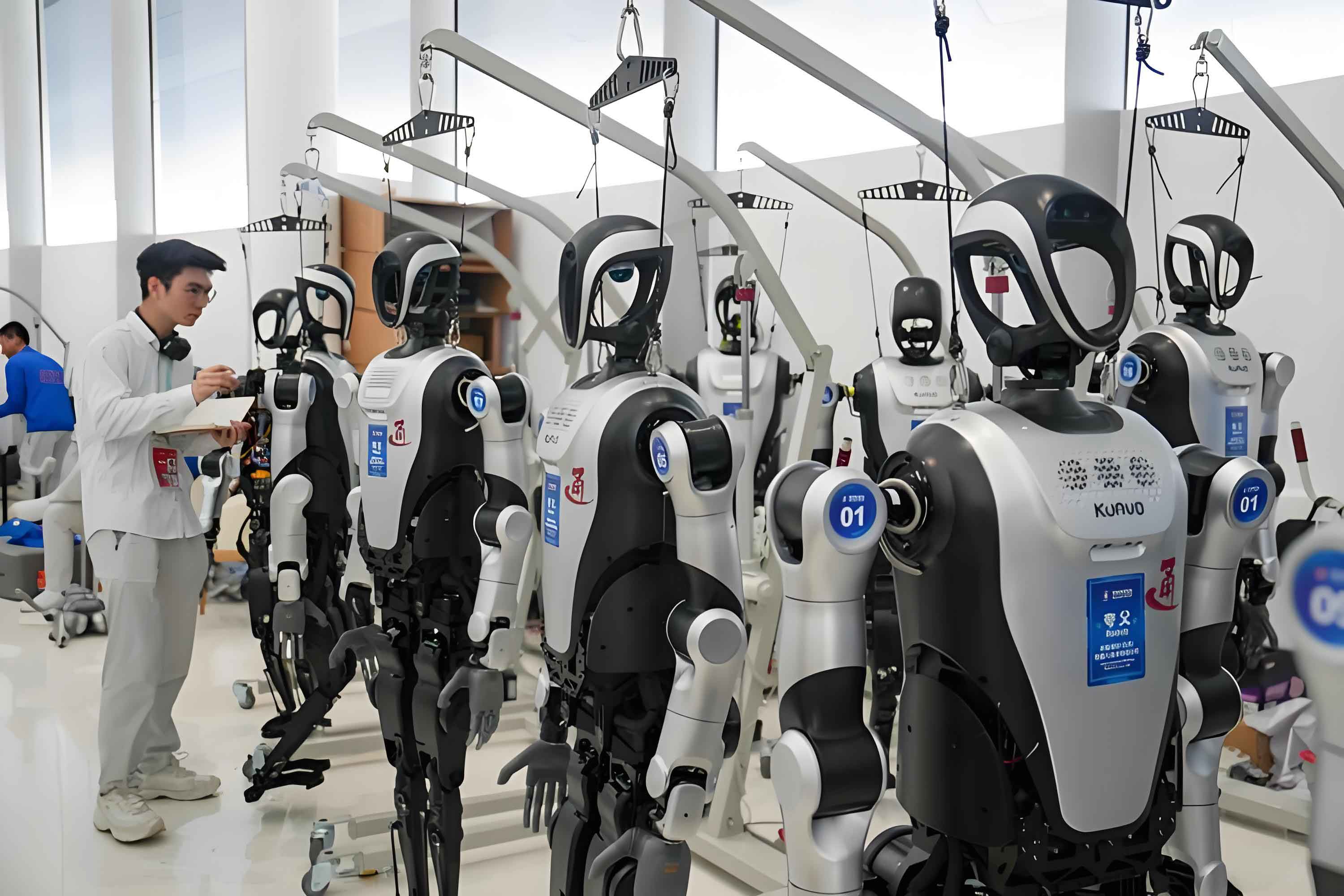
Internationally, the development of humanoid robots exhibits distinct characteristics across regions. The United States and Japan, as leaders in this field, offer contrasting approaches that reflect their technological strengths and societal needs. In Japan, the focus has historically been on hardware excellence and applications in daily life services. Japanese companies like Honda and Sony pioneered early humanoid robots such as ASIMO and AIBO, leveraging precision manufacturing and robotics expertise. The Japanese approach often involves close collaboration between academia, industry, and government, as seen in projects like the Humanoid Robotics Project (HRP). This has led to humanoid robots that excel in structured environments, with an emphasis on reliability and human interaction. In contrast, the United States emphasizes software and AI integration, with applications skewed toward industrial and military domains. American advancements, driven by entities like Boston Dynamics and Tesla, showcase humanoid robots with advanced mobility and autonomy, powered by machine learning algorithms. For instance, the dynamics of bipedal locomotion can be modeled using equations like: $$\sum F = m \frac{d^2x}{dt^2}$$ where \(\sum F\) is the net force, \(m\) is mass, and \(x\) is position. American humanoid robots often prioritize adaptability to unstructured environments, such as disaster zones or space exploration.
To better understand these differences, I have compiled a comparative table of the development features in the U.S. and Japan:
| Aspect | Japan | United States |
|---|---|---|
| Primary Focus | Hardware and daily life services (e.g., entertainment, caregiving) | Software/AI and industrial/military applications |
| Key Drivers | Automotive and electronics manufacturers (e.g., Toyota, SoftBank) | Tech companies and defense agencies (e.g., Tesla, DARPA) |
| Technological Strengths | Precision actuators, reliable mechanics, human-robot interaction | Machine learning, sensor fusion, autonomous navigation |
| Notable Projects | ASIMO, HRP series, Pepper robot | Atlas, Optimus, Robonaut |
| Policy Support | National robotics strategies (e.g., Robot New Strategy) | Initiatives like the National Robotics Initiative |
This comparison reveals how cultural and economic factors shape humanoid robot development. Japan’s aging population drives demand for assistive humanoid robots, while the U.S.’s innovation ecosystem fosters cutting-edge AI research. Both approaches contribute to the global advancement of humanoid robotics, with lessons for other regions aiming to enter this space.
Policy frameworks play a crucial role in nurturing the humanoid robot industry. Governments worldwide have implemented strategies to support research, development, and deployment of robotics technologies. Below is a summary of key policies from major economies, adapted to focus on humanoid robots:
| Region | Policy/Initiative | Key Objectives Related to Humanoid Robots |
|---|---|---|
| United States | National Robotics Initiative (NRI) 3.0 | Promote collaborative human-robot systems, with funding for AI integration and embodied intelligence in humanoid robots. |
| Japan | Robot New Strategy (2015) | Aim to make Japan a global robot innovation hub, supporting humanoid robot applications in healthcare and services. |
| European Union | Horizon 2020 Robotics Projects | Fund research in industrial and service robotics, including humanoid robot platforms for manufacturing and assistive tasks. |
| China | “Robotics+” Application Action Plan (2023) | Accelerate the adoption of humanoid robots in sectors like manufacturing and logistics, with goals to double robot density by 2025. |
These policies often include targets for technology adoption, such as increasing the density of humanoid robots in factories. The robot density \(\rho\) can be defined as: $$\rho = \frac{N_{\text{robots}}}{N_{\text{workers}}}$$ where \(N_{\text{robots}}\) is the number of humanoid robots and \(N_{\text{workers}}\) is the number of human workers. For instance, China’s plan targets a \(\rho\) value that supports productivity gains in key industries. Additionally, investment in research is critical; the funding allocation \(F\) for humanoid robot projects can be modeled as: $$F = F_0 + \alpha \times I$$ where \(F_0\) is base funding, \(\alpha\) is a multiplier, and \(I\) is the innovation index of a region. Such investments help address technical challenges, such as improving the energy efficiency of humanoid robots, which can be expressed as: $$\eta = \frac{P_{\text{out}}}{P_{\text{in}}}$$ where \(\eta\) is efficiency, \(P_{\text{out}}\) is useful power output, and \(P_{\text{in}}\) is power input. Enhancing \(\eta\) is vital for extending the operational time of humanoid robots in field applications.
In China, the humanoid robot industry has gained momentum with supportive policies at both national and local levels. For example, the “14th Five-Year Plan” for robotics emphasizes innovation in humanoid robot technologies, while cities like Beijing and Shenzhen have launched action plans to foster local ecosystems. These initiatives often include funding for humanoid robot prototypes and pilot applications in scenarios like elderly care and hazardous environment inspection. The growth of China’s market can be attributed to its robust manufacturing base and large consumer pool, which provide testing grounds for humanoid robot deployments. However, challenges remain, such as reliance on imported core components and the need for stronger interdisciplinary collaboration. To quantify progress, we can use metrics like the technology readiness level (TRL) for humanoid robots, where TRL ranges from 1 (basic research) to 9 (commercial deployment). Many humanoid robot projects are currently at TRL 4-6, indicating prototype development and testing phases.
Based on my analysis, I offer several insights for the future development of the humanoid robot industry. First, strategic planning is essential; governments should formulate comprehensive action plans that outline clear goals for humanoid robot innovation, such as achieving cost reductions through economies of scale. The cost \(C\) of a humanoid robot can be broken down as: $$C = C_{\text{materials}} + C_{\text{labor}} + C_{\text{R&D}}$$ where each component can be optimized via supply chain improvements and automation. Second, technical breakthroughs require collaborative efforts; establishing innovation consortia that bring together universities, research institutes, and companies can accelerate progress in key areas like actuator design and AI algorithms. For instance, the performance of a humanoid robot’s joint can be evaluated using the stiffness \(k\) and damping \(c\) coefficients in the equation: $$m \ddot{x} + c \dot{x} + k x = F_{\text{ext}}$$ where \(x\) is displacement and \(F_{\text{ext}}\) is external force. Improving these parameters enhances stability and agility. Third, scenario-driven applications will drive adoption; by deploying humanoid robots in real-world settings—from warehouses to hospitals—we can gather data to refine functionalities. This aligns with the concept of embodied intelligence, where humanoid robots learn through interaction with their environment. The learning rate \(\alpha\) in reinforcement learning for humanoid robots can be modeled as: $$\alpha = \frac{\Delta Q}{R}$$ where \(\Delta Q\) is the change in action-value and \(R\) is the reward. Higher \(\alpha\) values enable faster adaptation to new tasks.
Moreover, the integration of large AI models, like those behind ChatGPT, with humanoid robots promises to unlock new capabilities in natural language processing and decision-making. This synergy can be represented as: $$P(\text{action} \mid \text{sensor data}) = \text{AI Model}(\text{data})$$ where the probability of an action is conditioned on sensor inputs processed by an AI model. As these technologies mature, we may see humanoid robots transitioning from specialized tools to general-purpose assistants, akin to the vision of “universal robots.” The market potential for such humanoid robots is vast; projections suggest that in optimistic scenarios, the industry could reach hundreds of billions of dollars within a decade, driven by demand from sectors facing labor shortages. To sustain growth, continuous investment in R&D is crucial, with a focus on making humanoid robots more affordable and user-friendly. International cooperation can also play a role, as shared standards and open-source platforms could lower barriers to entry for developers worldwide.
In conclusion, the humanoid robot industry is at a pivotal juncture, characterized by rapid technological advancements and growing policy support. From my perspective, the journey ahead will involve overcoming hardware and software hurdles while exploring diverse applications that benefit society. By learning from global leaders like the U.S. and Japan, and leveraging initiatives in regions like China, we can collectively steer the humanoid robot revolution toward a future where these machines enhance human productivity and quality of life. The key will be to maintain a balance between innovation and practicality, ensuring that humanoid robots evolve from laboratory curiosities into integral components of our daily lives. As I reflect on this field, I am optimistic that with continued collaboration and investment, humanoid robots will soon become commonplace, transforming industries and redefining human-robot interaction.