
As an embodied intelligent agent, the humanoid robot is emerging as a pivotal subject of interdisciplinary study. From the perspective of communication media, the humanoid robot possesses not only the general properties of media affordances but also unique attributes such as reflexivity, affinity, and adaptability. This embodied form represents a distinct technological evolution. The following table summarizes these key technological affordances that distinguish humanoid robots from other robotic forms.
| Affordance Attribute | Core Principle | Manifestation in Humanoid Robots |
|---|---|---|
| Reflexivity | Human self-questioning projected onto technology. | Serves as a “digital twin” for exploring human consciousness, identity, and existence, acting as a mirror for philosophical inquiry. |
| Affinity & Social Presence | Media Equation and anthropomorphism. | Human-like form lowers interaction barriers, fosters trust, and can elicit social and emotional responses from users, enhancing collaborative efficiency. |
| Adaptability & Ecological Fit | Gibson’s affordance and human-centered design. | Designed to the human “scale,” enabling operation in existing human environments (homes, workplaces) without major retrofitting, ensuring practical utility. |
The development of this form can be framed through Paul Levinson’s media evolution theory, which posits three stages: Toy (novelty), Mirror (reflecting reality), and Art (creating new realities). The humanoid robot trajectory follows this path: beginning as a technical curiosity, evolving into a reflective tool for understanding humanity, and progressing toward an active agent capable of reshaping daily life. This progression is inherently linked to a process of socialization, analyzed effectively through the lens of technology domestication.
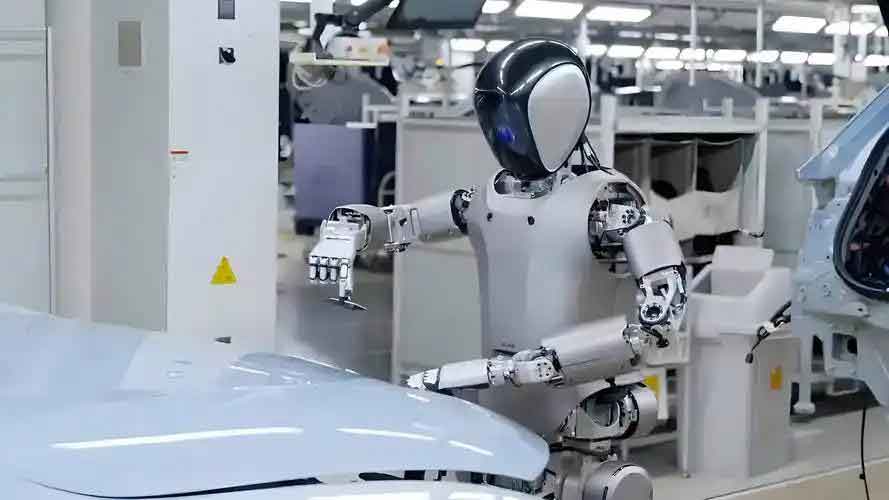
The domestication framework, originally applied to television and later to digital technologies, describes a four-stage process by which technology is tamed and integrated into social life: Appropriation, Objectification, Incorporation, and Conversion. This process is not one-way; it involves a mutual shaping between society and technology. The domestication of the humanoid robot provides a profound case study of this bidirectional dynamic.
The four stages of humanoid robot domestication can be formally represented as a sequential, feedback-driven process:
$$ \text{Appropriation} \rightarrow \text{Objectification} \rightarrow \text{Incorporation} \xrightarrow{\text{Feedback}} \text{Conversion} $$
Where each stage shapes and is shaped by social practices, ultimately leading to cultural transformation.
| Domestication Stage | Core Process | Humanoid Robot Example |
|---|---|---|
| 1. Appropriation | Transition from lab prototype to market commodity. | Pepper (SoftBank) for customer service; Atlas (Boston Dynamics) for research; commercial models from companies like Unitree showcasing dynamic mobility. |
| 2. Objectification | Finding a functional and symbolic role/identity within social structures. | Role assignment based on gender (e.g., female-coded care robots, male-coded security robots), authority level (teacher vs. companion), and physical attributes like height. |
| 3. Incorporation | Integration into daily routines, forming habits and trust. | Use in elderly care for companionship, therapy for children with autism, or as a personal fitness coach, leading to “human-robot symbiosis.” |
| 4. Conversion | Technology’s influence rebroadcast back into society, altering norms and culture. | Debates on robot “citizenship” (e.g., Sophia); emergence of human-robot emotional bonds; reflection and potential reinforcement of cultural norms in design. |
However, this domestication process is fraught with a dual set of risks. The integration of the humanoid robot into society is not a simple act of mastery but a complex dance that generates significant ethical and legal challenges. These challenges stem from two interrelated vectors of risk: the risks associated with human domestication of robots and the risks arising from the potential “counter-domestication” of humans by robots.
A comprehensive risk model for humanoid robot integration must account for this duality. The total risk $R_{total}$ can be expressed as:
$$ R_{total} = \alpha R_{human \to robot} + \beta R_{robot \to human} + \gamma R_{systemic} $$
where:
- $R_{human \to robot}$ represents risks from humans acting upon robots (e.g., immoral commands, abuse).
- $R_{robot \to human}$ represents risks from robots affecting humans (e.g., privacy invasion, emotional manipulation).
- $R_{systemic}$ represents systemic risks (e.g., liability gaps, societal bias).
- $\alpha, \beta, \gamma$ are weighting coefficients reflecting the contextual severity of each risk category.
| Risk Vector | Category of Risk | Specific Manifestations |
|---|---|---|
| Human-to-Robot Domestication Risks | Immoral Commands & Moral Atrophy | Humans issuing unethical orders; robots as extensions of human morality requiring design to refuse such commands based on role or norm-based communication. |
| Abuse, Violence, and Abandonment | Physical violence against robots during testing or use; ethical “demonstration effect” that may desensitize individuals to violence. | |
| Reinforcement of Social Biases | Design that perpetuates racial, gender, or cultural stereotypes (e.g., Eurocentric features, gendered role assignments), exacerbating social inequalities. | |
| Robot-to-Human Counter-Domestication Risks | Privacy & Data Security | Pervasive data collection via sensors (cameras, mics) in intimate settings; risk of breaches and unauthorized surveillance. |
| Emotional Dependency & Social Alienation | Over-reliance on robots for companionship, potentially impairing human social skills; “hypernudging” for emotional manipulation leading to isolation. | |
| Accountability & Liability Gaps | “Responsibility black hole” for damages caused by emergent, unpredictable behaviors from machine learning; challenges in applying traditional product liability laws. |
Confronting this dual-risk landscape necessitates a proactive, multi-layered, and collaborative governance framework. Given the innovative and evolving nature of humanoid robot technology, a prudent and inclusive approach is required, integrating technical, legal, and social-cultural strategies.
The governance framework $G$ for humanoid robots can be conceptualized as a multi-dimensional function:
$$ G = f(T_{vsd}, L_{chain}, S_{culture}) $$
where effective governance is a function of Value-Sensitive Design in technology ($T_{vsd}$), a Chained Legal Responsibility system ($L_{chain}$), and a nurtured Sociocultural context ($S_{culture}$).
1. Technical Layer: Value-Sensitive Design (VSD) at the Source.
Ethical considerations must be embedded into the design process itself. VSD moves beyond user-centered design to prioritize core human values. For the humanoid robot, key design values include:
- Safety & Reliability: Implementing “kill switches” and fail-safe mechanisms.
- Transparency & Explainability: Ensuring robot decisions and actions are interpretable and auditable.
- Fairness & Non-discrimination: Actively avoiding bias in appearance, behavior, and algorithmic processing.
- Prevention of Emotional Manipulation: Maintaining clear machine identity to avoid the “uncanny valley” and excessive dependency.
- Accountability by Design: Incorporating audit trails and ensuring human oversight remains possible.
The design process can be guided by an equation prioritizing these values:
$$ \text{Design Priority} = \max_{Design}(w_1 S + w_2 T + w_3 F + w_4 A) $$
where $S$=Safety, $T$=Transparency, $F$=Fairness, $A$=Accountability, and $w_i$ are weights assigned to each value based on the robot’s intended context (e.g., higher $w_1$ for healthcare robots).
2. Legal Layer: Constructing a Full-Chain Responsibility Distribution System.
Traditional liability frameworks are strained by the autonomy of humanoid robots. A nuanced, chain-based model is needed, distributing responsibility across the lifecycle:
| Responsible Actor | Basis of Potential Liability | Governance Mechanism |
|---|---|---|
| Manufacturer / Designer | Design defects, inherent safety flaws, failure to meet VSD principles. | Strict liability or negligence-based regimes; mandatory safety certifications. |
| Algorithm Developer / Trainer | Biased training data, flawed learning algorithms leading to harmful emergent behavior. | Auditability requirements for models; standards for training data integrity. |
| Operator / Owner / User | Negligent use, failure to maintain, issuing clearly unethical commands. | Duty of care obligations; user training and licensing for high-risk applications. |
This can be supplemented by mandatory insurance schemes or compensation funds to ensure victim redress. The core legal principle should be that liability is proportional to the level of control and autonomy granted, with the “least-cost avoider” often bearing primary responsibility, balanced by regulatory safe harbors to encourage innovation.
3. Social-Cultural Layer: Fostering a Healthy Human-Robot Interaction Culture.
Governance must extend beyond top-down regulation to cultivate societal literacy and norms. Key strategies include:
- Media Responsibility: Encouraging accurate, non-sensationalized portrayal of humanoid robot capabilities and risks in news and entertainment media.
- Formal Education: Integrating AI and robot ethics into school curricula to build critical digital literacy from a young age.
- Public Engagement: Creating forums like “citizen’s juries” on technology ethics to include diverse public voices in policy discussions about robot integration.
- Professional Ethics: Developing and enforcing codes of ethics for roboticists and HRI researchers.
The goal is to create a society where users interact with humanoid robots with informed caution, healthy skepticism, and a clear understanding of their own responsibilities.
In conclusion, the journey of the humanoid robot from laboratory prototype to social agent is a profound domestication process marked by mutual adaptation. This process unlocks immense potential for assistance, companionship, and economic efficiency but simultaneously unleashes a dual spectrum of ethical and legal risks. A singular approach to governance is destined to fail. The path forward requires a synergistic framework—Value-Sensitive Design to ethically shape technology at its source, a Chained Responsibility System to legally navigate the complexities of autonomy and harm, and a concerted effort to cultivate a mature societal culture around human-robot interaction. Only through this collaborative, tripartite approach can we hope to domesticate the humanoid robot in a way that truly serves humanity, mitigates its risks, and navigates the uncharted social territory it brings into our homes and workplaces.