
With the rapid evolution of foundation models in artificial intelligence, the field of robotics is undergoing a paradigm shift. The humanoid robot, as a frontier achievement integrating advanced AI with physical embodiment, has captured significant attention across academia and industry. This convergence positions the humanoid robot not merely as a machine, but as a potential platform for embodied intelligence. Libraries, as central pillars of public knowledge service, have always evolved in tandem with technological progress. The current wave of AI and robotics represents a critical force driving the smart transformation of libraries, enhancing service quality, depth, and efficiency. This paper, from my perspective as a researcher engaged in this intersection, systematically examines the status, applications, and future of humanoid robot technology within library ecosystems. Through analysis of academic discourse, major products, and practical implementations, I aim to identify existing bottlenecks and, by tracking the latest technological trends, propose strategic outlooks for future innovation paths.
1. The Evolutionary Journey of the Humanoid Robot
The development of the humanoid robot, a pinnacle of multidisciplinary integration showcasing the highest levels of mechatronics and intelligence, can be categorized into four distinct phases based on technological iteration. The trajectory has moved from simple morphological mimicry towards a holistic biomimetic system encompassing multimodal perception, cognitive decision-making, and motion control. The complexity of a humanoid robot increases exponentially compared to traditional industrial or service robots. A key metric illustrating this is the Degree of Freedom (DOF), which quantifies a robot’s kinematic flexibility. While traditional robots typically possess 3-7 DOF, a humanoid robot often requires 20-40 or more, imposing stringent demands on mechanical design, hardware composition, control algorithms, and component precision.
| Development Phase | Timeframe | Core Characteristics | Representative Platforms |
|---|---|---|---|
| Germination & Exploration | 1960s – 2000 | Morphology-first approach, emphasizing anthropomorphic appearance and basic mobility (bipedal walking). | WABOT-1 (Waseda University, Japan) |
| System Integration | 2000 – 2010 | Integration of perception systems and intelligent control, enabling preliminary environmental awareness and adjustment. Initial exploration of limited commercial scenarios like exhibition and education. | ASIMO (Honda, Japan), NAO (Aldebaran Robotics, France) |
| High-Dynamic Motion | 2010 – 2022 | Leap in locomotion performance and task complexity. Enhanced interactive capabilities. Emergence of “emotional robots.” | Atlas (Boston Dynamics, USA), Pepper (SoftBank Robotics, Japan) |
| Intelligent Embodiment | 2022 – Present | Deep empowerment by AI, drastically improving perception, decision-making, and control. Electric actuation and modular design become mainstream. | Optimus (Tesla, USA), H1 (Unitree Robotics, China), Figure 01 (Figure AI, USA) |
The kinematic chain of a humanoid robot can be fundamentally described using the Denavit-Hartenberg (D-H) parameters, which systematically define the relationship between consecutive links. The transformation from joint i-1 to joint i is given by the homogeneous transformation matrix:
$$ ^{i-1}T_i = \begin{bmatrix}
\cos\theta_i & -\sin\theta_i\cos\alpha_i & \sin\theta_i\sin\alpha_i & a_i\cos\theta_i\\
\sin\theta_i & \cos\theta_i\cos\alpha_i & -\cos\theta_i\sin\alpha_i & a_i\sin\theta_i\\
0 & \sin\alpha_i & \cos\alpha_i & d_i\\
0 & 0 & 0 & 1
\end{bmatrix} $$
where $\theta_i$ is the joint angle, $d_i$ is the link offset, $a_i$ is the link length, and $\alpha_i$ is the link twist. The total DOF ($N$) is the sum of all independent joint variables: $N = \sum_{i=1}^{n} m_i$, where $m_i$ is the number of DOF for the $i$-th joint (typically 1 for revolute or prismatic joints). The high value of $N$ in a humanoid robot directly translates to immense control complexity.
2. Pioneering Humanoid Robots in Library Contexts
Within library applications, the definition of a humanoid robot has often been conflated with any service robot possessing an anthropomorphic shell. However, considering core attributes of true humanoid platforms—human-like intelligence, anthropomorphic form, and broad applicability—two early commercial platforms stand out for their systematic integration and documented library use: NAO and Pepper. Their technical specifications reveal a significant gap in complexity and openness compared to later, simplified service robots.
| Parameter | NAO Robot | Pepper Robot |
|---|---|---|
| Height / Weight | 58 cm / 5.5 kg | 121 cm / 29.1 kg |
| Degrees of Freedom (DOF) | 25 (Head:2, Arms:10, Hips:1, Legs:10, Hands:2) | 20 (Head:2, Arms:8, Hands:4, Base:3, Legs:3*) |
| Locomotion | Bipedal with 8 pressure sensors | Tri-wheel omnidirectional base with laser sensors |
| Manipulation | Simple 3-finger grip | 5-finger dexterous hand |
| Core Processor | Intel Atom Quad-core | Intel Atom Quad-core |
| Operating System | NAOqi (Linux-based) | NAOqi (Linux-based) |
| Key Feature | Open platform for research/education | Emotion recognition via multi-camera system |
*Pepper’s “legs” are fixed; mobility is provided by the wheeled base.
The system openness of these platforms, powered by the Linux-based NAOqi OS, allowed for seamless integration of emerging AI, such as connecting to large language model APIs for natural language Q&A. This flexibility contrasted sharply with the closed systems of many subsequent single-purpose service robots.
3. Application Landscape and Inherent Challenges
The integration of these humanoid robot platforms into libraries worldwide has demonstrated a range of service models, yet also revealed critical bottlenecks that have limited their widespread adoption.
| Library | Country | Robot | Primary Application(s) |
|---|---|---|---|
| Westport Library | USA | NAO | Programming instruction, testing, and book fetching |
| Noosa Library | Australia | Pepper | Reception, guided tours, general inquiry |
| Yamanakako Information Creation Museum | Japan | Pepper | Guidance and interactive entertainment |
| Cologne Public Library | Germany | NAO | Programming workshops for children |
| National Library of China | China | NAO | Guided tours in the digital experience zone |
| National Public Information Library | Taiwan | NAO | Storytelling for children, basic inquiries |
Application scenarios can be synthesized into five categories: 1) Reception & Guided Tours, 2) Information Inquiry & Transaction Handling, 3) Education & Interactive Learning, 4) Promotional Ambassador & Staff Assistant, and 5) Specialized & Niche Services (e.g., for neurodiverse patrons). Despite this variety, fundamental challenges emerged. The high cost-performance imbalance was significant; the complex multi-DOF hardware offered limited functional return in most library tasks compared to simpler, purpose-built robots. Functionality remained relatively singular, often lacking a deep, indispensable integration with core library workflows like inventory management or logistics, leading to a perception of being technological novelties rather than essential tools. Consequently, many libraries shifted towards more cost-effective, functionally dedicated service robots, causing these early humanoid robot pioneers to gradually recede from the spotlight.
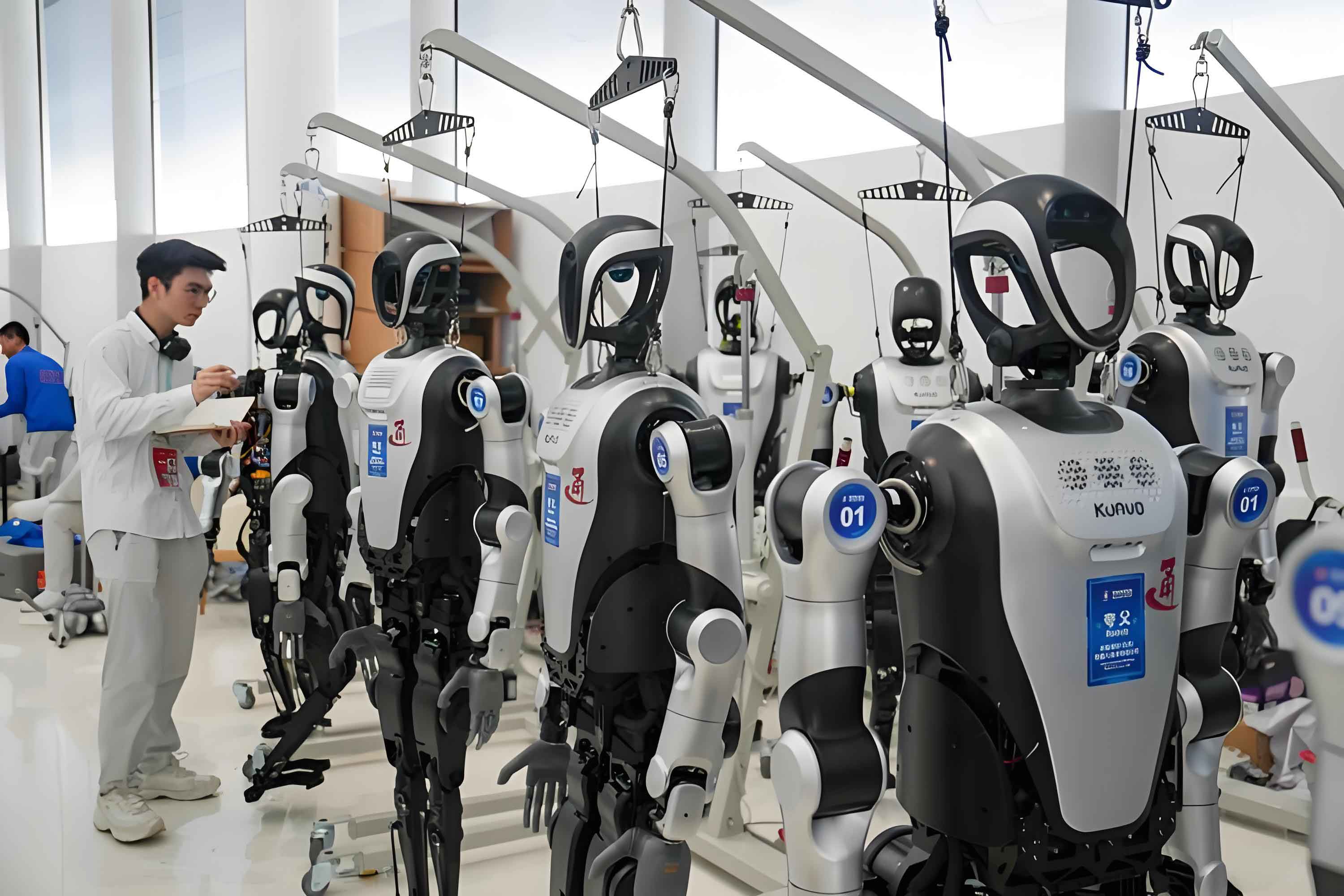
4. Frontier Advancements: Re-defining the Humanoid Robot
The recent resurgence in the humanoid robot field is intrinsically linked to breakthroughs in AI, particularly large foundation models. This represents a shift from a primary focus on advanced locomotion to a new core driver: intelligent task generalization. The architecture of a modern humanoid robot is conceptualized as a triad: the “Brain” (high-level cognition and planning), the “Cerebellum” (low-level motion coordination and balance), and the “Limb” (physical actuators). Today, large models are becoming the optimal solution for the “Brain,” enabling task-level interaction, environmental understanding, and complex planning.
These embodied AI models, which ground intelligence in physical interaction, are evolving along two primary technical pathways. Let $S$ represent the sensory input space, $L$ the language instruction, and $A$ the action/output space (e.g., joint torques or trajectories).
- End-to-End (E2E) Model: Learns a direct mapping from perception and instruction to low-level actions.
$$ f_{E2E}: (S, L) \rightarrow A $$
Examples include RT-2 (Google DeepMind) and Figure’s Helix. The advantage is strong task generalization, but it requires massive, high-quality paired data $(S, L, A)$. - Hierarchical Model: Employs a “Large Model + Small Model” architecture. A large language or vision-language model (LLM/VLM) acts as the high-level planner $g$, processing $(S, L)$ to generate a symbolic plan or sub-goal $P$. A separate, trained control policy $h$ then executes this plan.
$$ P = g(S, L), \quad A = h(P, S) $$
$$ \therefore f_{Hierarchical}: (S, L) \xrightarrow{g} P \xrightarrow{h} A $$
This approach, used by many current platforms, leverages existing LLM capabilities and offers modular flexibility but can suffer from latency and information loss between modules.
Concurrently, the very form of the humanoid robot is being reconsidered under the principle of “scenario-defined morphology.” While bipedal designs (e.g., Tesla Optimus, Unitree H1) remain prevalent for their environmental compatibility, other forms are gaining traction for efficiency: wheeled humanoids (e.g., 1X Technologies’ EVE for logistics) and modular designs that can switch between bipedal and wheeled configurations (e.g., LimX Dynamics’ Tron-1). This trend towards “one brain, multiple forms” enhances practical applicability.
5. Strategic Implementation Pathways for Libraries
The modern library presents a dual demand for robotic technology: the efficient, precise execution capability of industrial robots and the interactive intelligence of service robots. Next-generation humanoid robot technology, with its improved generality and intelligence, offers a novel path to address the fragmentation (multiple specialized robots) and limited autonomy of current library robotic systems. A strategic implementation framework is proposed.
5.1. Scenario Mining and Service Mode Standardization
A systematic, tiered scenario library should be developed:
$$ \text{Scenario Library} = \{ \text{High-Frequency Core}, \text{Customized Special}, \text{Exploratory Future} \} $$
High-frequency core tasks suitable for initial humanoid robot deployment, based on proven industrial applications, include intra-library material handling (fetching, sorting, shelving) and after-hours inventory management. Standard Operating Procedures (SOPs) and Key Performance Indicator (KPI) frameworks must be established to measure effectiveness, such as task completion rate ($R_c$) and user satisfaction score ($S_u$):
$$ R_c = \frac{N_{\text{completed}}}{N_{\text{assigned}}} \times 100\%, \quad S_u = \frac{1}{M}\sum_{j=1}^{M} r_j \quad (r_j \in [1,5]) $$
5.2. Demonstration Projects and Knowledge Replication
Pilot projects should be launched in technologically adept, large libraries. The focus should be on adapting mature humanoid robot solutions from adjacent fields (e.g., warehouse logistics for sorting, pharmacy automation for precise fetching and shelving). Successful pilots must be thoroughly documented to create reproducible blueprints for broader adoption, reducing risk for other institutions.
5.3. Deepening Ecosystem Collaboration
Libraries should actively engage in industry-academia-research collaboration with leading humanoid robot companies and research institutes. Partnerships can take the form of “paired engineering” for specific application development. Furthermore, libraries can serve as public demonstration and科普 hubs, establishing humanoid robot experience zones to foster public understanding and acceptance of this transformative technology, thereby aiding its social integration.
6. Conclusion
The humanoid robot is poised at a critical juncture, transitioning from a research prototype to a potential cornerstone of future smart industries. For libraries, this represents more than just an upgrade in automation; it is an opportunity to reimagine service paradigms. The inherent versatility and growing cognitive capabilities of the humanoid robot promise to break down functional silos, enable 24/7 operational cycles, and introduce unprecedented levels of personalized, context-aware interaction. By strategically focusing on high-value scenarios, fostering demonstrative pilots, and engaging in collaborative ecosystem development, libraries can proactively shape the integration of this powerful technology. The journey from a “knowledge repository” to an “intelligent, empathetic service nexus” is complex, but the humanoid robot may well be a key protagonist in that evolution, heralding a new chapter for libraries in the age of embodied AI.