
In recent years, the integration of humanoid robots into daily life and commercial service scenarios has accelerated, making human-robot interaction more frequent and intimate. As a researcher focused on human-centered design, I recognize that the appearance of a humanoid robot significantly influences user acceptance, trust, and emotional engagement. A lack of affinity in design can evoke discomfort or resistance, thereby hindering adoption. Therefore, this study aims to systematically explore the design features that enhance the affinity of humanoid robot appearances and develop an AI-driven methodology using Stable Diffusion (SD) models to generate high-affinity design concepts efficiently. By combining Kansei Engineering with quantitative analysis, we establish a robust framework for evaluating and generating亲和力-focused designs, ultimately contributing to more welcoming and effective humanoid robots.
The concept of affinity in product design refers to the degree to which an object aligns with human physiological, psychological, and emotional expectations, fostering feelings of comfort, approachability, and warmth. For humanoid robots, affinity is not merely aesthetic but functional, as it directly impacts collaboration and usability. Previous studies have highlighted elements such as rounded forms, soft materials, and温和色调 as contributors to亲和力, but a comprehensive, quantified approach linking specific design elements to affective responses is lacking. This gap motivates our work, where we employ Kansei Engineering to translate subjective perceptions into objective design parameters. Kansei Engineering is a well-established method that correlates emotional responses (Kansei) with product attributes, enabling data-driven design decisions. Our focus is on生活 and商业服务 humanoid robots, which require a balance of functionality and empathy to succeed in diverse environments.
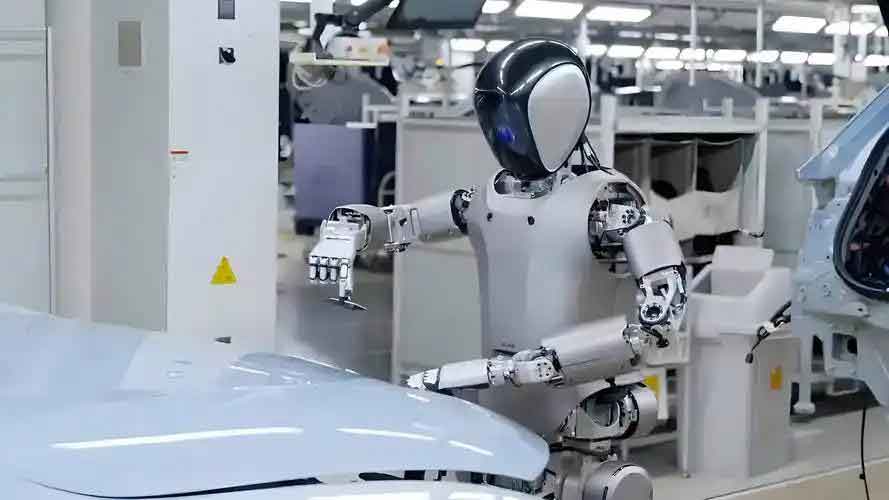
To operationalize affinity, we first define its evaluation dimensions through a Kansei Engineering approach. We gather a set of意象词 pairs related to亲和力 and categorize them into three groups: social impression (e.g.,冷漠-亲和), temperament style (e.g.,冷硬-温柔), and vitality (e.g.,严肃-活泼). After expert screening and voting, we select three primary dimensions: Affinity Degree (直接衡量亲近程度), Gentleness Degree (气质与风格角度), and Liveliness Degree (生机与活力角度). These dimensions are used to assess how design elements influence user perceptions. We then design a questionnaire featuring抽象处理 representations of humanoid robot components, including head shapes (e.g., square, circle, oval), eye shapes (e.g., circular, rectangular), body proportions (from幼态 to成年), materials (plastic, fabric, metal, transparent), and colors (冷暖色调 with variations in saturation and brightness). The goal is to isolate each element’s impact on亲和力 through quantitative analysis.
The questionnaire is distributed to a diverse group of participants, yielding 645 valid responses. We analyze the data using statistical methods tailored to the variable types: Kendall’s correlation for ordinal data and Pearson’s correlation for continuous, normally distributed data. The results reveal the relative importance of design elements in influencing亲和力. Specifically, head shape has the highest impact, followed by facial expression, color, material, and body proportion. To quantify these relationships, we compute affinity scores for each design feature, creating a comprehensive scoring table. This table serves as a precise design requirement and evaluation mechanism, guiding subsequent AI model training. The mathematical formulation for the overall affinity score \( A \) can be expressed as a weighted sum of individual element scores:
$$ A = \sum_{i=1}^{n} w_i \cdot s_i $$
where \( w_i \) represents the weight of design element \( i \) (derived from statistical analysis), and \( s_i \) is the affinity score for that element’s specific feature (e.g., round head shape scores 3). This equation allows for systematic affinity assessment.
The analysis of the three affinity dimensions shows strong consistency across most design elements. For instance, Kendall’s correlation coefficients between Affinity Degree and Gentleness Degree for head shape, eye shape, body proportion, material type, and color are all positive and significant ( \( \tau > 0.1 \), \( p < 0.01 \) ), indicating that higher亲和力 is associated with greater温柔度和活泼度. However, for material surface treatments and暖色 saturation levels, we observe negative correlations between Affinity Degree and Liveliness Degree, suggesting that reducing surface glossiness or saturation can enhance亲和力. These insights are summarized in the following tables, which detail the affinity scores for various design features.
| Design Element | Feature | Affinity Score (0-4) | Statistical Significance |
|---|---|---|---|
| Head Shape | Horizontal Oval (A4) | 3 | Kruskal-Wallis H test, \( p < 0.01 \) |
| Head Shape | Circle (A2) | 3 | Kruskal-Wallis H test, \( p < 0.01 \) |
| Head Shape | Square (A3) | 0 | Kruskal-Wallis H test, \( p < 0.01 \) |
| Eye Shape | Vertical Oval (B3) | 3 | Kruskal-Wallis H test, \( p < 0.01 \) |
| Eye Shape | Circle (B1) | 1 | Kruskal-Wallis H test, \( p < 0.01 \) |
| Eye Shape | Horizontal Oval (B4) | 0 | Kruskal-Wallis H test, \( p < 0.01 \) |
| Design Element | Feature | Affinity Score (0-4) | Correlation Analysis |
|---|---|---|---|
| Body Proportion | Childlike Slender (C3) | 4 | Spearman’s \( \rho = -0.340 \), \( p < 0.01 \) |
| Body Proportion | Teen Slender (C4) | 3 | Spearman’s \( \rho = -0.340 \), \( p < 0.01 \) |
| Body Proportion | Adult Sturdy (C6) | 1 | Spearman’s \( \rho = -0.340 \), \( p < 0.01 \) |
| Material | Fabric with Texture (D3) | 3 | Mann-Whitney U test, \( p < 0.01 \) |
| Material | Plastic Matte (D2) | 2 | Mann-Whitney U test, \( p < 0.01 \) |
| Material | Metal Smooth (D5) | 0 | Mann-Whitney U test, \( p < 0.01 \) |
Color analysis further refines our understanding. We evaluate hues in the HSB color space, where position influences亲和力. For暖色, colors偏向 left (e.g.,米黄) yield higher affinity scores, while for冷色, colors偏向 right (e.g.,浅蓝) are preferable. The relationship between color properties and affinity can be modeled using linear regression. For example, the affinity score \( A_c \) for a color is given by:
$$ A_c = \beta_0 + \beta_1 \cdot H + \beta_2 \cdot S + \beta_3 \cdot B $$
where \( H \) is hue position, \( S \) is saturation, \( B \) is brightness, and \( \beta \) coefficients are derived from questionnaire data. Results show that low-saturation, high-brightness colors in暖色调 or desaturated冷色调 maximize亲和力. White scores highest among neutral colors, followed by gray and black. This quantitative approach enables precise color selection for humanoid robot design.
With the affinity scoring table established, we transition to AI-assisted design using Stable Diffusion models. The goal is to train an SD model to generate humanoid robot appearances that inherently exhibit high affinity, thereby streamlining the design process. SD is a latent diffusion model that generates images by iteratively denoising random noise, conditioned on text prompts or images. Its architecture includes a text encoder (e.g., CLIP), a latent diffusion model (with U-Net), and an autoencoder decoder (VAE). However, standard SD models lack specificity for亲和力 features, necessitating fine-tuning with our affinity-focused dataset.
Our training methodology involves several steps: sample preparation, annotation, iterative training, and model selection. We create training samples by筛选 existing humanoid robot images and modifying them to align with high-affinity features identified in our scoring table. Using tools like ControlNet, inpainting, and Photoshop, we adjust造型,材质, and色彩 to meet affinity criteria. For instance, we round sharp edges, apply textured materials, and adjust colors to lower saturation. Each sample is then annotated with detailed tags describing its affinity attributes, such as “affinity robot, organic form, oval head, vertical eyes, fabric material, low-saturation warm color.” This ensures the model learns the correct associations.
We employ two training techniques: DreamBooth and LoRA. DreamBooth fine-tunes the entire SD model weights, capturing broad style and feature patterns, while LoRA adds lightweight adapters to the U-Net, enabling efficient training with fewer samples. We use DreamBooth for the main model to generate diverse humanoid robot designs, and train multiple LoRA models for stylistic variations, balancing quality and efficiency. The training process is iterative; we generate outputs, evaluate them against affinity scores, and refine samples over multiple epochs. The loss function during training is minimized to improve model performance, with typical loss values around 0.08 indicating optimal learning.
The training parameters are carefully set to achieve effective convergence. Key parameters include a learning rate of \( 1 \times 10^{-4} \), batch size of 5, 10 epochs, and the use of 8-bit Adam optimizer with Cosine scheduler. The dimensionality (DIM) is set to 128, and Alpha to 64, based on empirical testing. The training progress is monitored via loss curves and XY交叉图, which visualize output quality across different model weights and epochs. We select the best-performing model based on affinity scores of generated images, ensuring it aligns with our design goals. For example, a model at epoch 6 with weight 0.6-0.8 produces humanoid robot designs scoring 14-15 on our affinity scale, deemed excellent.
| Parameter | Value | Description |
|---|---|---|
| Learning Rate | \( 1 \times 10^{-4} \) | Step size for weight updates |
| Batch Size | 5 | Number of samples per iteration |
| Epochs | 10 | Full passes through the dataset |
| Optimizer | 8-bit Adam | Efficient optimization algorithm |
| Scheduler | Cosine | Learning rate schedule |
| DIM | 128 | Latent dimension size |
| Alpha | 64 | Scaling factor for LoRA adapters |
Once trained, the SD model can generate a wide array of humanoid robot appearances. By combining the main affinity model with different LoRA style models, we create a design matrix that offers varied aesthetic options while maintaining high亲和力. Each generated design is evaluated using our affinity scoring table, allowing rapid identification of optimal concepts. This approach significantly enhances design efficiency, producing hundreds of concepts in minutes that would take days through manual methods. The generated humanoid robot designs exhibit features like rounded heads, vertical oval eyes, slender teen proportions, matte fabrics, and温和色彩, all contributing to elevated亲和力.
The implications of this work are substantial for the field of humanoid robot development. By quantifying亲和力 and integrating it into AI-driven design, we bridge the gap between emotional user needs and technical implementation. This methodology not only accelerates the design process but also ensures that humanoid robots are more likely to be accepted and trusted in real-world applications. Future research could expand this approach to include cross-cultural studies, as亲和力 perceptions may vary across regions, or incorporate dynamic elements like movement and interaction into the affinity assessment. Additionally, further refinement of the SD training process, such as using larger datasets or advanced diffusion techniques, could yield even more precise and diverse humanoid robot designs.
In conclusion, this study successfully explores the affinity characteristics of humanoid robot appearances through Kansei Engineering and implements an AI-assisted design pipeline using Stable Diffusion models. The affinity scoring table derived from quantitative analysis provides a reliable guide for evaluating and generating designs, while the trained SD model enables efficient production of high-affinity concepts. This integrated approach advances the emotional design of humanoid robots, fostering better human-robot relationships and paving the way for more widespread adoption in生活 and商业服务 scenarios. As humanoid robots become increasingly prevalent, such亲和力-focused design strategies will be crucial for creating robots that are not only functional but also亲切 and engaging companions.