
As I reflect on the current technological landscape, I am convinced that the development of humanoid robots represents a pivotal shift in how we perceive and interact with machines. The integration of artificial intelligence, advanced manufacturing, and new materials has positioned humanoid robots as a cornerstone of future industries. In this article, I will delve into the multifaceted aspects of humanoid robot evolution, from policy frameworks to market dynamics, technical innovations, and application scenarios, all while emphasizing the critical role these machines play in shaping new quality productive forces.
The recent government work reports globally have underscored the importance of deepening research and application in big data and artificial intelligence, with initiatives like the “AI+” action aimed at fostering internationally competitive digital industrial clusters. From my perspective, humanoid robots embody this vision perfectly, as they integrate cutting-edge technologies to serve as key equipment in physical spaces. By continuously融入 industrial manufacturing and commercial service scenarios, humanoid robots are poised to help nations secure future industrial “ecological niches” and inject new momentum into economic development.
Policy tailwinds for humanoid robots have been accelerating. For instance, guidelines issued in recent years outline ambitious goals: by 2025, a preliminary innovation system for humanoid robots should be established; by 2027, technological innovation capabilities should significantly improve, with overall strength reaching world-advanced levels. This regulatory support has catalyzed investment and research, making humanoid robots a focal point in the Fourth Industrial Revolution.
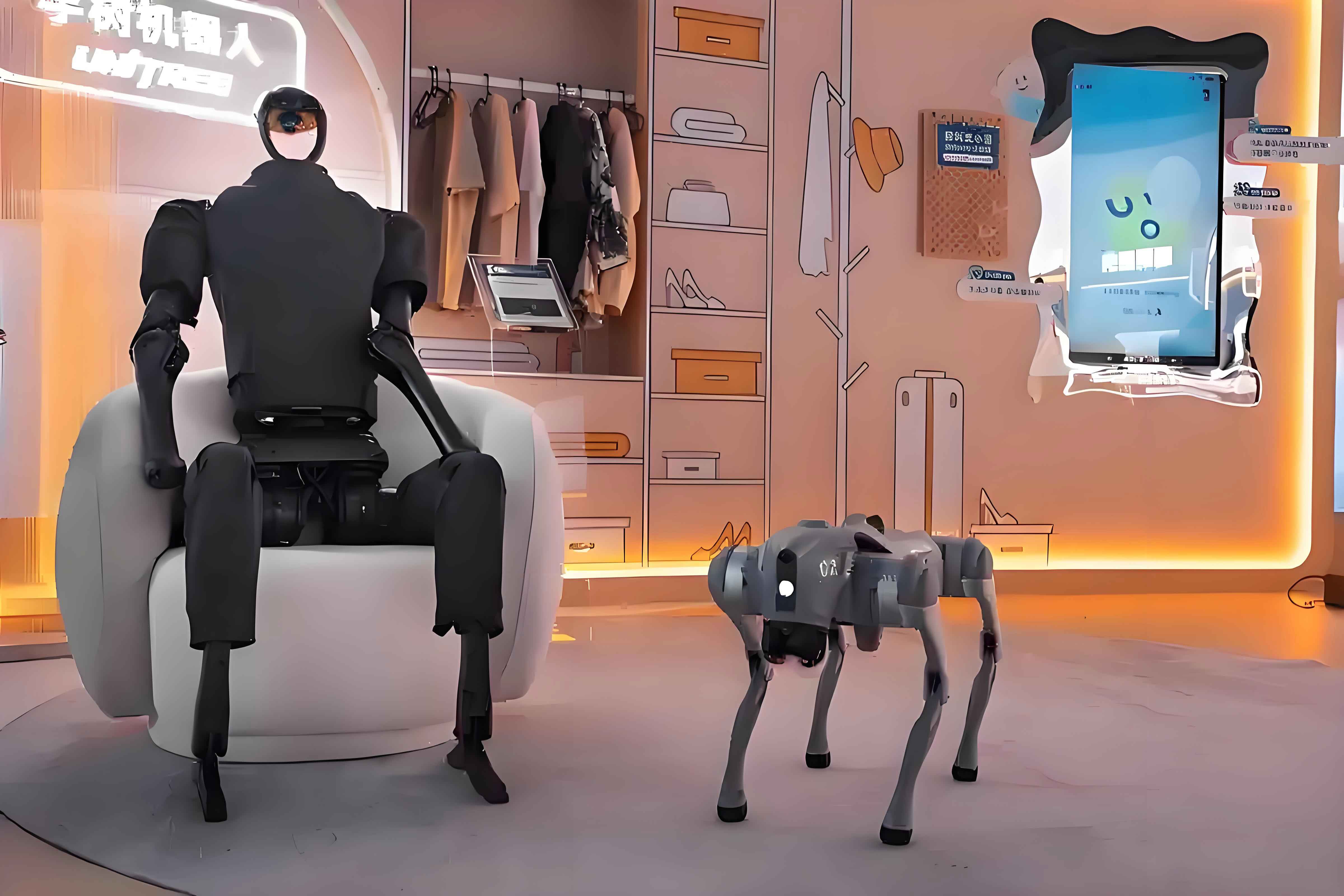
From a market standpoint, the potential for humanoid robots is staggering. According to industry analyses, the global humanoid robot market is on the brink of explosive growth. Below is a table summarizing key market projections based on various reports:
| Metric | Value | Timeframe | Assumptions |
|---|---|---|---|
| Compound Annual Growth Rate (CAGR) | 94% | 2025-2035 | Ideal scenario with revolutionary technological breakthroughs |
| Market Size | $1540 billion | 2035 | High adoption in industrial and service sectors |
| Funding Raised (2023) | Over $2.9 billion | 2023 | Cumulative investment across multiple companies |
| Number of Companies Funded | 9 | 2023 | Focus on humanoid robot startups |
This growth is driven by the versatility of humanoid robots. As I see it, humanoid robots are not merely machines; they are advanced tools that combine mechanics, electronics, communications, sensing, control, and artificial intelligence. Their human-like form allows them to adapt seamlessly to human environments, utilize human tools, and engage in emotional interactions, making them ideal for diverse applications.
In terms of technological foundations, humanoid robots rely on a complex interplay of components. The core technologies can be summarized using the following formula for overall performance:
$$ P_{robot} = \alpha \cdot S_{AI} + \beta \cdot M_{mech} + \gamma \cdot C_{sensor} + \delta \cdot E_{power} $$
where \( P_{robot} \) represents the overall performance of the humanoid robot, \( S_{AI} \) denotes the AI algorithm efficiency, \( M_{mech} \) is the mechanical stability factor, \( C_{sensor} \) accounts for sensor integration, and \( E_{power} \) signifies power management efficiency. The coefficients \( \alpha, \beta, \gamma, \delta \) are weighting factors based on application priorities.
Patent analysis reveals significant strides in humanoid robot innovation. Over the past decade, China has transitioned from lagging behind to leading in patent filings, surpassing early adopters like Japan, the United States, and South Korea. As of recent data, China holds the top spot in both patent applications and valid patents for humanoid robot technology. The table below illustrates this global landscape:
| Country/Region | Patent Applications (Last 10 Years) | Valid Patents (As of 2023) | Key Players |
|---|---|---|---|
| China | 6618 | 3110 | Leading firms in humanoid robotics |
| Japan | Approx. 4500 | Approx. 2000 | Historical giants in robotics |
| United States | Approx. 4000 | Approx. 1800 | Tech and automotive companies |
| South Korea | Approx. 3000 | Approx. 1500 | Electronics and manufacturing firms |
| Europe | Approx. 3500 | Approx. 1600 | Research institutions and automakers |
From my analysis, this patent leadership underscores the competitive edge in humanoid robot development. Companies with robust patent portfolios, such as those领先 in valid patents, are better positioned to set industry standards and drive innovation. The humanoid robot ecosystem thrives on such intellectual property, which acts as a barrier to entry and a catalyst for advancement.
Turning to applications, I believe that smart manufacturing will be the first domain to witness large-scale adoption of humanoid robots. In industrial settings, humanoid robots can collaborate with traditional automation equipment to perform tasks like torque tightening, flexible assembly, and material handling. This enhances flexibility and enables unmanned operations in complex scenarios. For example, in新能源 vehicle factories, humanoid robots have demonstrated capabilities in inspecting door locks, seat belts, and light covers, as well as applying labels with precision. This showcases their dexterity and autonomy, driven by high-performance servo joints and multi-sensory perception systems.
The technical specifications of a typical industrial humanoid robot can be modeled as follows. Let \( N_{joints} \) be the number of servo joints, \( F_{torque} \) the torque output per joint, and \( V_{vision} \) the visual processing speed. The operational efficiency \( E_{op} \) in a manufacturing line is given by:
$$ E_{op} = \frac{N_{joints} \cdot F_{torque} \cdot V_{vision}}{T_{cycle}} $$
where \( T_{cycle} \) is the task cycle time. Optimizing these parameters allows humanoid robots to achieve seamless integration into production workflows.
Beyond manufacturing, commercial service scenarios represent the fastest-growing market for humanoid robots. In sectors like retail, hospitality, and healthcare, humanoid robots can assist with customer service, logistics, and caregiving. Their ability to interact naturally makes them valuable in human-centric environments. Meanwhile, the home application场景 holds immense potential, as humanoid robots could evolve into companions or assistants, though this requires further technological maturation and cost reductions.
To elaborate on the economic impact, I consider the concept of new quality productive forces. Humanoid robots contribute to this by enhancing productivity through automation and intelligence. The growth in value added by humanoid robots can be expressed using a logistic growth model:
$$ V(t) = \frac{K}{1 + e^{-r(t – t_0)}} $$
where \( V(t) \) is the value at time \( t \), \( K \) is the carrying capacity (maximum market potential), \( r \) is the growth rate, and \( t_0 \) is the inflection point. For humanoid robots, \( r \) is influenced by factors like technological breakthroughs and policy support, leading to rapid adoption curves.
Innovation is the lifeblood of humanoid robot development. From my viewpoint, continuous investment in core technologies—such as AI algorithms, actuator design, and sensor fusion—is essential to maintain competitiveness. The following table breaks down key technological components and their innovation priorities:
| Technology Component | Description | Innovation Focus | Impact on Humanoid Robot Performance |
|---|---|---|---|
| AI and Machine Learning | Enables autonomous decision-making and learning | Deep reinforcement learning, neural networks | Enhances adaptability and task complexity handling |
| Servo Actuators | Provides motion and force control | High torque-density, energy efficiency | Improves agility and power longevity |
| Multi-modal Sensors | Integrates vision, force, tactile feedback | Miniaturization, real-time processing | Boosts environmental perception and safety |
| Power Systems | Supports energy supply and management | Battery technology, wireless charging | Extends operational duration and reduces downtime |
| Human-Robot Interaction | Facilitates communication and collaboration | Natural language processing, emotional AI | Increases usability in social contexts |
As I explore these innovations, it becomes clear that humanoid robots are not just products but platforms for broader technological convergence. The synergy between hardware and software, encapsulated in solutions like “hardware + software + service + operation,” enables scalable commercialization across education, smart logistics, wellness, and commercial services. This holistic approach accelerates the formation of new quality productive forces, driving sustainable economic growth.
However, challenges remain. The development of humanoid robots requires long-term commitment and sustainable mechanisms for innovation. From my perspective, stakeholders must foster ecosystems that support R&D, talent cultivation, and cross-industry collaboration. The cost of humanoid robots, currently high due to complex components, must decrease to achieve mass adoption. Economies of scale, driven by increased production, can be modeled as:
$$ C_{unit} = C_{fixed} + \frac{C_{variable}}{Q} $$
where \( C_{unit} \) is the unit cost, \( C_{fixed} \) represents fixed costs like R&D, \( C_{variable} \) denotes variable costs per unit, and \( Q \) is the production quantity. As \( Q \) grows, \( C_{unit} \) declines, making humanoid robots more accessible.
Looking ahead, I am optimistic about the trajectory of humanoid robots. They are set to redefine labor in the AI era, freeing humans from repetitive tasks and unlocking new creative potentials. In smart manufacturing, humanoid robots will work alongside humans and machines, optimizing efficiency. In services, they will enhance customer experiences through personalized interactions. And in homes, they may become integral to daily life, though this will depend on societal acceptance and regulatory frameworks.
To quantify the future impact, consider the potential job transformation. If humanoid robots automate certain tasks, the net effect on employment can be analyzed using a simple equation:
$$ \Delta J = A \cdot \eta_{auto} – B \cdot \eta_{create} $$
where \( \Delta J \) is the change in jobs, \( A \) is the number of tasks automated, \( \eta_{auto} \) is the automation efficiency, \( B \) is the number of new tasks created, and \( \eta_{create} \) is the job creation rate. Historically, technology shifts have led to net job growth in new sectors, and humanoid robots are likely to follow this pattern by spawning industries in maintenance, programming, and supervision.
In conclusion, the rise of humanoid robots signifies a transformative phase in industrial and social evolution. From policy incentives to technological breakthroughs and market expansions, every aspect points toward a future where humanoid robots are ubiquitous. As I emphasize throughout this discussion, the keyword “humanoid robot” encapsulates a vision of intelligent, adaptable machines that will drive progress. By fostering innovation and collaboration, we can harness the power of humanoid robots to build resilient economies and improve quality of life globally.
The journey of humanoid robots is just beginning, and I am excited to witness their continued integration into our world. Whether in factories, stores, or homes, these machines will undoubtedly play a central role in shaping the future, making the concept of “humanoid robot” not just a technical term but a symbol of human ingenuity and ambition.