
In the wake of the AI revolution, sparked by phenomena like ChatGPT, the realm of humanoid robotics has ignited into a fervent race. As an entrepreneur deeply immersed in this field, I have witnessed firsthand the rapid metamorphosis of humanoid robots from mere curiosities to tangible innovations. My journey began not in a lab, but in the mundane world of industrial robotics, where stationary arms performed repetitive tasks—devoid of the soul and adaptability that define humanoid robots. The encounter with early prototypes like Honda’s ASIMO was a revelation; it showcased a future where machines could walk, climb, and interact with fluidity. This vision propelled me into the tumultuous yet exhilarating world of humanoid robot development, where every step forward is a dance between ambition and engineering rigor.
The essence of a humanoid robot lies in its mimicry of human form and function, a pursuit fraught with complexity. To create a machine that mirrors humanity, one must first deconstruct human physiology and kinematics. For instance, the simple act of walking involves a symphony of joint movements, balance adjustments, and force distributions. In mathematical terms, the dynamics of a humanoid robot can be modeled using Lagrangian mechanics, where the equations of motion for a multi-link system are derived. Consider a simplified model of a bipedal humanoid robot with $n$ degrees of freedom (DOF). The dynamics are expressed as:
$$ M(q)\ddot{q} + C(q, \dot{q})\dot{q} + G(q) = \tau $$
Here, $q$ represents the generalized coordinates (joint angles), $M(q)$ is the inertia matrix, $C(q, \dot{q})$ captures Coriolis and centrifugal forces, $G(q)$ denotes gravitational forces, and $\tau$ is the vector of joint torques. This equation underscores the computational burden in simulating even basic movements—a challenge my team grappled with daily. Early in our development, we underestimated the intricacies; what seemed like trivial human actions required thousands of simulations. For example, determining the optimal height for our humanoid robot was not merely an aesthetic choice but a critical stability parameter. As shown in Table 1, we iterated through various heights, balancing human likeness with technical feasibility.
| Iteration | Height (m) | Stability Metric (Normalized) | Center of Mass Offset (cm) | Notes |
|---|---|---|---|---|
| 1 | 1.7 | 0.65 | 12.5 | Too tall; high inertia, poor balance during motion. |
| 2 | 1.6 | 0.78 | 8.3 | Improved user interaction, but torque demands increased. |
| 3 | 1.5 | 0.85 | 5.1 | Optimal for dance performances; reduced sway. |
This table highlights how each design decision reverberates through the system. The stability metric is derived from the robot’s ability to maintain equilibrium under disturbances, calculated as the inverse of the maximum allowable tilt angle before falling. For a humanoid robot, the zero-moment point (ZMP) criterion is paramount for bipedal locomotion, defined as:
$$ x_{ZMP} = \frac{\sum_{i=1}^{n} m_i (g + \ddot{z}_i) x_i – \sum_{i=1}^{n} m_i \ddot{x}_i z_i}{\sum_{i=1}^{n} m_i (g + \ddot{z}_i)} $$
where $m_i$ is the mass of link $i$, $g$ is gravitational acceleration, and $(x_i, z_i)$ are coordinates. Ensuring the ZMP stays within the support polygon is a constant battle, especially when programming dance routines—a task we embraced to demonstrate progress. From single-robot waltzes to synchronized ensembles, the evolution was staggering. Within three years, our humanoid robots advanced from rigid limb swings to fluid, coordinated group performances, a testament to iterative learning and control algorithm enhancements.
The aesthetic dimension of humanoid robots proved equally daunting. Human perception is finely tuned to detect subtle anomalies, making the “uncanny valley” a treacherous pitfall. We learned that beauty in a humanoid robot hinges on millimeter-precise proportions. For instance, the eye size ratio relative to the face must satisfy a golden-mean-like constraint to avoid a eerie appearance. If $E_w$ is the eye width and $F_w$ is the face width, we empirically found that the most pleasing ratio is:
$$ \frac{E_w}{F_w} \approx 0.2 \pm 0.02 $$
Deviations beyond this range led to robotic stares that unsettled viewers. Similarly, the hand—a marvel of human dexterity—became a focal point of mechanical innovation. Initially, our humanoid robot hands were static 3D-printed molds, but through material science and actuation design, we incorporated silicone skins with embedded flexor wires, allowing for delicate gestures. The kinematics of a five-fingered hand involve over 20 DOF, modeled using Denavit-Hartenberg parameters for each finger segment. The forward kinematics for a finger can be expressed as:
$$ T_{finger} = \prod_{i=1}^{4} A_i(\theta_i) $$
where $A_i$ are homogeneous transformation matrices based on joint angles $\theta_i$. To achieve lifelike motion, we minimized the error between desired and actual fingertip trajectories using inverse kinematics solvers, often resorting to numerical optimization due to non-linearities.
Internal architecture posed another frontier. Early prototypes had exposed wiring, compromising aesthetics and safety. We integrated cables into limb cavities, but this raised issues of heat dissipation and signal integrity. The thermal management equation for a humanoid robot’s actuator system is:
$$ Q_{generated} = \sum_{j=1}^{m} I_j^2 R_j = h A (T_{motor} – T_{ambient}) + \epsilon \sigma A (T_{motor}^4 – T_{ambient}^4) $$
Here, $I_j$ is current per motor, $R_j$ is resistance, $h$ is convection coefficient, $A$ is surface area, $\epsilon$ is emissivity, and $\sigma$ is Stefan-Boltzmann constant. By selecting lightweight alloys and active cooling systems, we reduced thermal loads by 30%, as summarized in Table 2.
| Component | Version 1 | Version 2 | Version 3 | Improvement (%) |
|---|---|---|---|---|
| Actuator Torque Density (Nm/kg) | 15 | 22 | 35 | 133% |
| Battery Energy Density (Wh/kg) | 120 | 150 | 200 | 67% |
| Control Board Latency (ms) | 50 | 25 | 10 | 80% |
| Material Cost per Unit ($) | 25,000 | 18,000 | 12,000 | 52% |
Such advancements were crucial for commercialization—a principle I rigidly adhere to: “sell every unit produced.” Without revenue, R&D stalls, so we targeted niches where humanoid robots could immediately add value. While skeptics dismissed humanoid robots as toys or impractical for fields like elderly care or pharmacy, we identified the cultural and tourism sector as a fertile ground. Here, humanoid robots serve as entertainers, guides, and educational tools, captivating audiences without requiring superhuman dexterity. Our sales data, reflected in Table 3, underscores this strategy’s success.
| Application Scenario | Market Size (Est. $M) | Our Penetration (%) | Key Requirements | Technical Readiness Level (1-10) |
|---|---|---|---|---|
| Cultural Exhibitions | 500 | 15 | High visual fidelity, basic interaction | 8 |
| Education & Research | 300 | 20 | Modular design, programmability | 9 |
| Retail Entertainment | 200 | 10 | Dance choreography, speech synthesis | 7 |
| Healthcare (Future) | 1000 | <1 | Precision manipulation, AI diagnostics | 4 |
Pricing each humanoid robot between $20,000 and $30,000 made them accessible to exhibition companies, schools, and media firms. Cost reduction stemmed from in-house core component design, material optimization, and lean manufacturing. The total cost function for a humanoid robot can be approximated as:
$$ C_{total} = C_{materials} + C_{labor} + C_{R&D} + C_{overhead} $$
By vertical integration, we slashed $C_{materials}$ by 40% through bulk sourcing and additive manufacturing. Furthermore, iterative design freeze points prevented perpetual upgrades—a common pitfall in robotics where perfectionism hinders productization. As Einstein noted, “Perfection of means and confusion of goals seem to characterize our age.” For humanoid robots, the goal is progressive enhancement, not overnight revolution.
Public reception has been overwhelmingly positive, a vivid reminder of the latent fascination with humanoid robots. At major tech expos, crowds swarmed our displays, touching and interacting with the machines—a behavior we initially encouraged but later moderated for safety. This enthusiasm fuels our conviction that humanoid robots are not mere novelties but harbingers of a symbiotic future. To ensure quality and reliability, each humanoid robot undergoes rigorous inspection, integrating computer vision and sensor fusion algorithms to verify limb alignment and functional integrity.
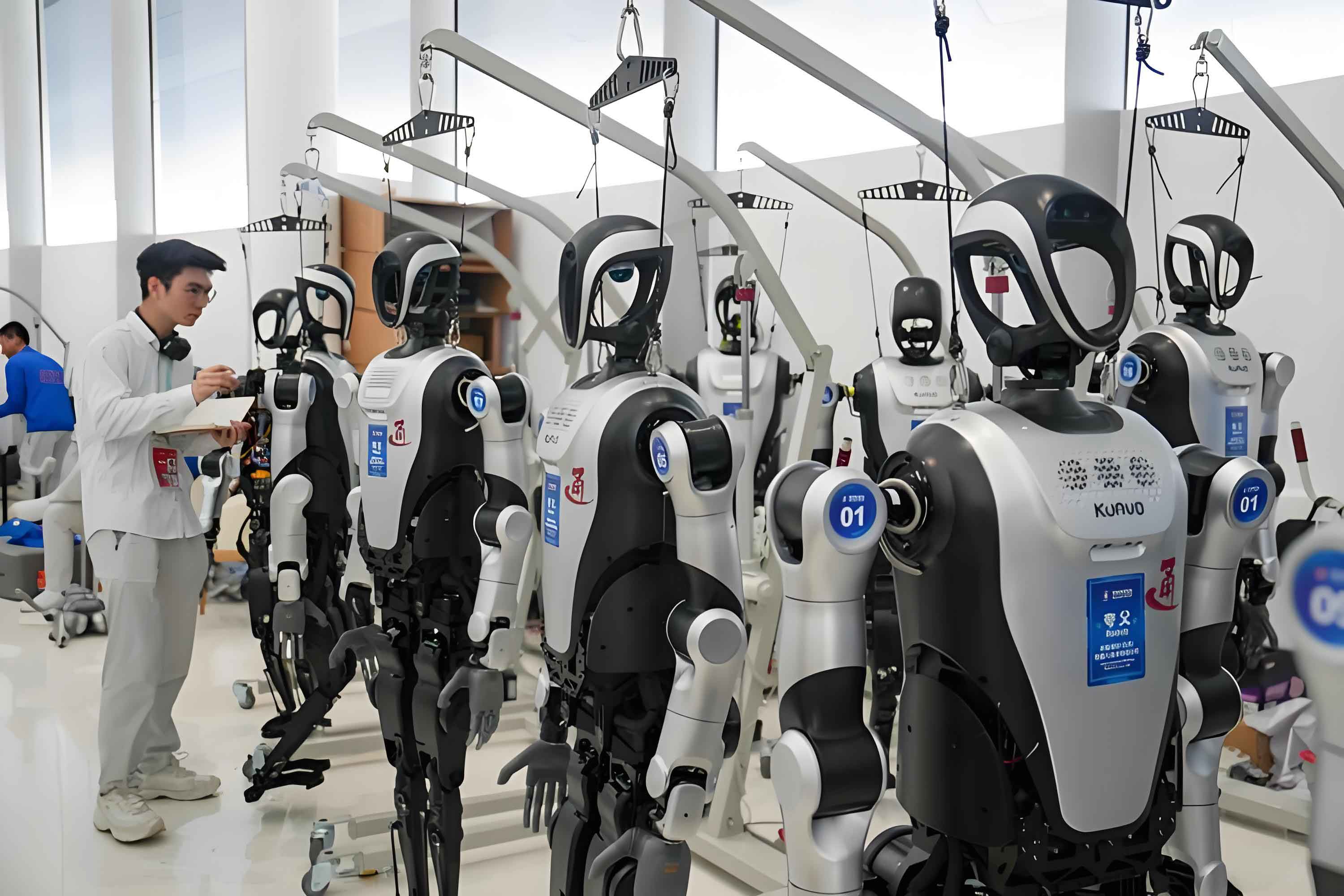
The inspection process leverages statistical quality control. For instance, the tolerance for joint angle calibration is ±0.5 degrees, monitored using high-resolution encoders. The probability of a humanoid robot passing all tests follows a binomial distribution if we assume independent checkpoints, but in reality, system dependencies require Bayesian networks. Let $P(A_i)$ be the probability of passing test $i$, then the overall reliability $R$ is:
$$ R = P\left( \bigcap_{i=1}^{k} A_i \right) $$
which we approximate through fault tree analysis to achieve $R > 0.95$ for field deployment.
Looking ahead, the trajectory of humanoid robotics is steeply inclined. Advances in AI, particularly reinforcement learning, are revolutionizing control paradigms. The reward function for training a humanoid robot to walk via deep reinforcement learning might be:
$$ R_t = w_1 \cdot v_{forward} – w_2 \cdot |\theta_{tilt}| – w_3 \cdot \tau_{effort} $$
where $w_i$ are weights, $v_{forward}$ is forward velocity, $\theta_{tilt}$ is body tilt, and $\tau_{effort}$ is torque expenditure. Such algorithms enable humanoid robots to learn complex behaviors in simulation before physical trials, slashing development cycles.
However, the path is littered with ethical and practical quandaries. Should humanoid robots in pharmacies hold certifications? How do we ensure safety in human-robot collaboration? These questions demand multidisciplinary dialogue. From a business standpoint, scalability hinges on finding more applications. We are exploring low-DOF humanoid robots for specific tasks, using modularity to customize. The design philosophy is encapsulated in a flexibility index $F$ for a humanoid robot:
$$ F = \frac{\sum_{i=1}^{N} \alpha_i \cdot DOF_i}{\text{Cost}} $$
where $\alpha_i$ are task-specific weighting factors. Maximizing $F$ drives innovation toward affordable versatility.
In conclusion, the journey of humanoid robotics is a marathon of passion and precision. Each breakthrough, from nuanced facial expressions to robust bipedalism, echoes a larger narrative of human ingenuity. As an entrepreneur, I remain a perpetual student, attending forums and collaborating with academia to stay abreast of materials science and algorithm breakthroughs. The humanoid robot is more than a machine; it is a mirror reflecting our aspirations and a canvas for tomorrow’s technology. The road ahead is long, but with each unit sold and each dance perfected, we step closer to a world where humanoid robots are not just curiosities, but companions and collaborators in the tapestry of daily life.