
As I observe the rapid convergence of technology and economics, I am increasingly convinced that the advent of humanoid robots will fundamentally reshape our societal fabric. The recent announcement from a leading electric vehicle manufacturer regarding the production of a versatile humanoid robot next year underscores this pivotal moment. This humanoid robot, designed to undertake tasks deemed undesirable by humans, heralds what I believe could be an era of unprecedented abundance. The optimism expressed about this humanoid robot’s world-altering potential resonates deeply with my own analysis, though it challenges conventional imagination. In parallel, I note that in turbulent global market conditions, the significance of robust domestic economic growth becomes even more pronounced—a perspective echoed in recent investment community reflections, where strategies emphasize resilience through value assets within one’s认知 circle, despite acknowledging operational challenges in risk management. This essay, from my first-person viewpoint, delves into the technological, economic, and systemic implications of humanoid robots, weaving in analytical frameworks, formulas, and data tables to elucidate their transformative role.
The core of my fascination lies in the engineering marvel that is the humanoid robot. Unlike specialized industrial arms, a humanoid robot mimics human form and mobility, enabling it to operate in environments built for people. The kinematics and dynamics of such a system are governed by complex equations. For instance, the Lagrangian formulation for a humanoid robot with $n$ degrees of freedom can be expressed as:
$$ \frac{d}{dt} \left( \frac{\partial L}{\partial \dot{q}_i} \right) – \frac{\partial L}{\partial q_i} = \tau_i, \quad i=1,\ldots,n $$
where $L = T – V$ is the Lagrangian, $T$ is the kinetic energy, $V$ is the potential energy, $q_i$ are the generalized coordinates, and $\tau_i$ are the generalized forces. This framework is crucial for simulating and controlling the motion of a humanoid robot. Furthermore, the balance and gait generation often rely on the Zero Moment Point (ZMP) criterion, given by:
$$ x_{ZMP} = \frac{\sum_{i=1}^N m_i ( \ddot{z}_i + g ) x_i – \sum_{i=1}^N m_i \ddot{x}_i z_i}{\sum_{i=1}^N m_i ( \ddot{z}_i + g ) } $$
where $m_i$ are segment masses, $(x_i, z_i)$ are coordinates, and $g$ is gravity. Ensuring stability in a humanoid robot requires real-time computation of such parameters, a task achieved through advanced sensors and processors.
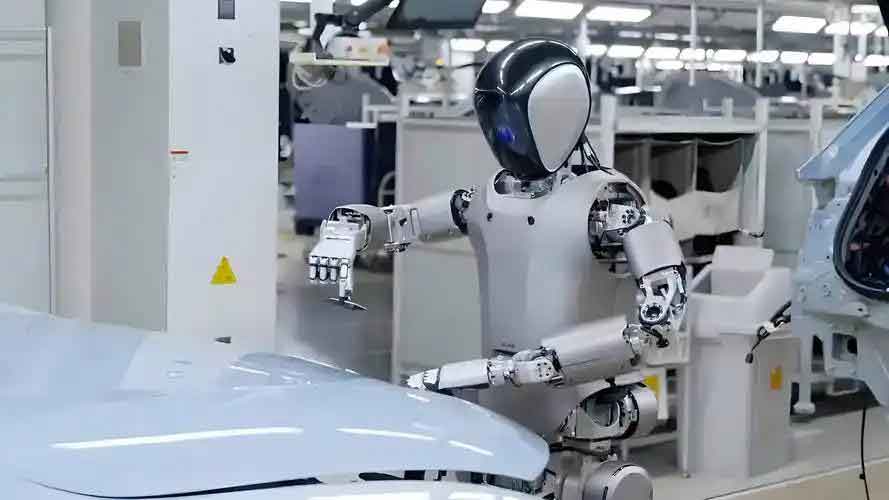
To appreciate the progression in this field, I have compiled a table comparing key specifications of notable humanoid robot projects, both announced and in development. This comparison highlights the technological trajectory toward more capable and accessible humanoid robots.
| Parameter | Optimus-Class Humanoid Robot | Previous Generation Humanoid Robots | Research-Focused Humanoid Robots |
|---|---|---|---|
| Height (cm) | ~173 | 120-180 | 100-200 |
| Weight (kg) | ~56 | 45-100 | 30-150 |
| Degrees of Freedom (DoF) | 40+ | 20-35 | 12-50 |
| Actuation Type | Electric Motors | Hydraulic/Electric Mix | Various |
| Battery Life (hours) | 8 (estimated) | 1-4 | 0.5-2 |
| Target Cost (USD) | <20,000 (long-term) | >100,000 | >500,000 |
| Primary Application | Industrial/Domestic Labor | Disaster Response, Research | Academic Study |
This table illustrates a clear trend: the next-generation humanoid robot aims for higher dexterity, longer endurance, and drastically reduced cost, enabling mass deployment. The implications are profound, as a affordable humanoid robot could permeate sectors from logistics to household assistance.
From an economic standpoint, I analyze the impact of humanoid robots through the lens of productivity growth and capital deepening. The Cobb-Douglas production function can be augmented to incorporate humanoid robot capital. Let $Y$ be output, $K_h$ be traditional capital, $L$ be human labor, and $R$ be the stock of humanoid robots. A modified form is:
$$ Y = A \cdot K_h^\alpha \cdot L^\beta \cdot R^\gamma $$
where $A$ is total factor productivity, and $\alpha + \beta + \gamma \leq 1$ for constant returns to scale. The elasticity $\gamma$ measures the output contribution of a humanoid robot. Historical analogies suggest that as a general-purpose technology, the humanoid robot could have $\gamma$ rising over time due to network effects and learning curves. The marginal product of a humanoid robot is:
$$ MP_R = \frac{\partial Y}{\partial R} = \gamma A K_h^\alpha L^\beta R^{\gamma-1} $$
This indicates that initial deployments of humanoid robots in capital-intensive sectors could yield high returns. To model adoption dynamics, I often refer to the Bass diffusion model, where the rate of adoption of humanoid robots is:
$$ \frac{dR(t)}{dt} = p \cdot [M – R(t)] + q \cdot \frac{R(t)}{M} [M – R(t)] $$
Here, $M$ is the market potential, $p$ is the innovation coefficient, and $q$ is the imitation coefficient. For a disruptive technology like the humanoid robot, $q$ might dominate as social proof accelerates uptake.
The investment perspective intertwines with this technological shift. In complex market environments, I believe that focusing on structural growth drivers—such as humanoid robot innovation—becomes paramount. A portfolio approach might allocate weights based on expected risk-adjusted returns. The Sharpe ratio for an investment in humanoid robot technology can be expressed as:
$$ S = \frac{E[R_{robot}] – R_f}{\sigma_{robot}} $$
where $E[R_{robot}]$ is the expected return, $R_f$ is the risk-free rate, and $\sigma_{robot}$ is the volatility. Given the nascent stage, $\sigma_{robot}$ may be high, but $E[R_{robot}]$ could be substantial due to scalability. I constructed a table to simulate potential economic outcomes from humanoid robot integration across industries over a decade.
| Sector | Current Labor Cost Share (%) | Projected Humanoid Robot Penetration by Year 10 (%) | Estimated Annual Productivity Gain (%) | Potential GDP Contribution Increase (basis points) |
|---|---|---|---|---|
| Manufacturing | 25 | 40 | 15-25 | 80-120 |
| Logistics & Warehousing | 30 | 50 | 20-30 | 100-150 |
| Healthcare (Support) | 20 | 20 | 10-15 | 30-50 |
| Retail & Hospitality | 35 | 25 | 12-18 | 50-80 |
| Agriculture | 40 | 30 | 18-28 | 70-110 |
These projections, while speculative, underscore that the humanoid robot could be a significant GDP multiplier. However, this transition necessitates parallel investments in workforce reskilling. The net effect on employment can be modeled using a labor market equation:
$$ L_{new} = L_0 – \lambda R + \mu \Delta Y $$
where $L_0$ is initial employment, $\lambda$ is the displacement per humanoid robot, and $\mu$ is the employment elasticity to output growth. If $\mu \Delta Y > \lambda R$, net job creation occurs—a scenario I anticipate as new industries emerge around the humanoid robot ecosystem.
Delving deeper into the artificial intelligence that animates a humanoid robot, I consider the learning algorithms essential for autonomy. Reinforcement learning, particularly deep Q-networks (DQN), enables a humanoid robot to master tasks through trial and error. The Bellman optimality equation for action-value is:
$$ Q^*(s,a) = \mathbb{E} \left[ r + \gamma \max_{a’} Q^*(s’,a’) \mid s,a \right] $$
In practice, a humanoid robot might use policy gradient methods for continuous control, with the objective function:
$$ J(\theta) = \mathbb{E}_{\pi_\theta} \left[ \sum_{t=0}^\infty \gamma^t r_t \right] $$
where $\theta$ are policy parameters. Training a humanoid robot in simulation before real-world deployment reduces costs and risks—a paradigm known as sim-to-real transfer, governed by domain adaptation metrics.
The societal integration of humanoid robots also raises ethical and regulatory questions that I ponder. As these entities become capable, frameworks for safety and accountability must evolve. A risk assessment formula I find useful is:
$$ \text{Total Risk} = \sum_{i} P(\text{Failure}_i) \cdot C(\text{Harm}_i) $$
where $P$ is probability and $C$ is cost. For a humanoid robot operating near humans, $C(\text{Harm}_i)$ can be high, necessitating rigorous verification. International standards might emerge, similar to ISO norms, specifically for humanoid robot design and operation.
From a macroeconomic policy angle, I advocate for proactive measures. Governments could implement tax incentives for humanoid robot R&D, modeled as:
$$ \text{Subsidy} = s \cdot I_{R\&D} \cdot e^{-t/\tau} $$
where $s$ is the subsidy rate, $I_{R\&D}$ is investment, $t$ is time, and $\tau$ is a decay constant to phase out support as the industry matures. Such policies can accelerate the development cycle of the humanoid robot, fostering a competitive edge.
In my reflection on market dynamics, I recognize that volatility often accompanies transformation. The investment philosophy that resonates with me—emphasizing long-term value in technological frontiers—aligns with the patience required for the humanoid robot sector to mature. While short-term fluctuations occur, the underlying trend points toward escalating adoption. A discounted cash flow (DCF) analysis for a humanoid robot manufacturing firm might incorporate high initial negative free cash flows followed by exponential growth:
$$ \text{NPV} = \sum_{t=0}^T \frac{FCF_t}{(1 + r)^t} $$
where $FCF_t$ is free cash flow in year $t$, and $r$ is the discount rate. Sensitivity analysis on adoption rates of humanoid robots would reveal the investment’s robustness.
To further quantify the technological progress, I examine Moore’s Law-like scaling for robot capabilities. A heuristic I use is “Robot Performance per Unit Cost,” which doubles approximately every 2-3 years, driven by advances in actuators, sensors, and AI chips. This can be expressed as:
$$ \frac{\text{Performance}(t)}{\text{Cost}(t)} = k \cdot 2^{t/\tau} $$
with $k$ a constant and $\tau$ the doubling period. For a humanoid robot, performance metrics might include tasks completed per hour or dexterity scores.
In conclusion, the dawn of the humanoid robot era is not merely a technological curiosity but a multifaceted revolution with deep economic ramifications. As I synthesize these insights, I am steadfast in my belief that the humanoid robot will be a cornerstone of future growth, driving efficiency, creating new markets, and challenging our socio-economic structures. The journey will require nuanced navigation—balancing innovation with inclusivity—but the potential for a more abundant world is tangible. I continue to monitor this space with keen interest, convinced that the humanoid robot narrative will unfold as one of the defining stories of our century, reshaping everything from daily chores to global supply chains. The imperative for stakeholders is to engage proactively, fostering an ecosystem where the humanoid robot can thrive responsibly and beneficially for all.