
As I reflect on the technological landscape, the concept of the humanoid robot has captivated my imagination and driven my research for years. The term “robot” itself originated from a Czech play in 1920, where “Robota” signified forced labor, a metaphor that still echoes in today’s discussions about automation and artificial beings. Humanoid robots, as products of applied artificial intelligence and robotics designed to mimic human appearance and behavior, have emerged as a focal point in both technological innovation and public discourse. In this article, I will explore the journey of humanoid robots from media representations to technical breakthroughs, delving into their development logic, current challenges, and industrial transformations, all while emphasizing the unique role of these anthropomorphic machines.
The narrative of humanoid robots often begins not in laboratories, but in the realm of media. Media mirrors—through films, television, and digital platforms—have played a pivotal role in shaping public perception long before technical feasibility was achieved. I recall how early science fiction movies introduced humanoid robots as characters, embedding societal expectations and fears into their depictions. For instance, the robotic Maria in Metropolis established a framework of human-machine conflict, while later works like I, Robot grappled with ethical dilemmas of autonomy. In my analysis, this media framing creates a cognitive prototype that influences how society accepts or resists real-world humanoid robots. A dynamic cycle exists: media images inspire technological pursuits, and technological advances, in turn, feed back into media narratives. This interplay was evident when a popular TV series drew inspiration from Boston Dynamics’ robotic videos, blurring the lines between fiction and reality. Such examples highlight how media mirrors not only reflect but also reconstruct our understanding of humanoid robots, making them a cultural artifact as much as a technical one.
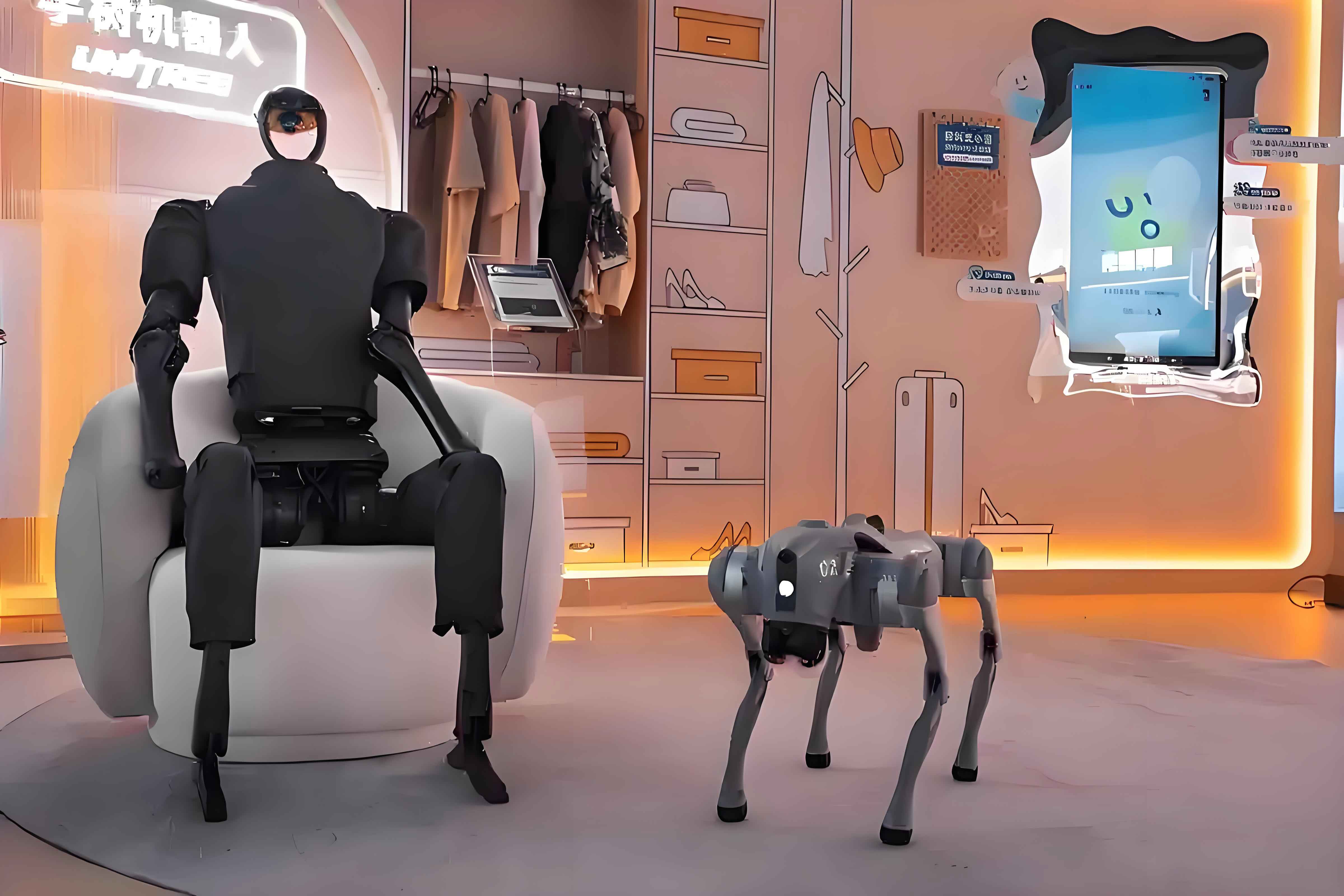
To comprehend the evolution of humanoid robots, it is essential to distinguish them from artificial intelligence (AI), as their developmental paths diverge significantly. In my experience, while both fields are often intertwined in media portrayals, their core differences lie in underlying logic, interaction objects, and system complexity. Humanoid robots integrate AI with mechanical and electronic systems to achieve biomimetic behaviors, but their foundation relies on processing continuous physical signals. For example, a humanoid robot must parse real-time data from sensors—such as force feedback, joint angles, and temperature gradients—to execute movements like walking. This can be modeled with control equations: $$x_{t+1} = f(x_t, u_t) + w_t$$ where \(x_t\) represents the state vector (e.g., position and velocity), \(u_t\) is the control input, and \(w_t\) denotes noise. In contrast, AI, particularly large language models (LLMs), thrives on discrete symbolic processing using probabilistic frameworks: $$P(y | x) = \frac{\exp(\text{score}(x, y))}{\sum_{y’} \exp(\text{score}(x, y’))}$$ where \(x\) is input text and \(y\) is output. The data requirements also differ markedly; humanoid robots need structured biomechanical data, often constrained by privacy laws, while AI leverages vast internet text corpora. I have summarized these distinctions in the table below to clarify the分野.
| Aspect | Humanoid Robot | Artificial Intelligence (e.g., LLMs) |
|---|---|---|
| Underlying Logic | Real-time physical signal processing; continuous dynamics | Symbolic and probabilistic processing; discrete sequences |
| Primary Data Source | Sensor data (e.g., motion capture, force feedback); requires ethical collection | Text and code from the internet; readily available |
| Interaction Object | Physical world with time-constrained actions (e.g., walking, grasping) | Virtual or linguistic space with reversible interactions |
| System Complexity | Multidisciplinary integration (mechanics, electronics, control theory) | Computer science-focused; scalable via parameter increase |
| Key Challenges | Nonlinear coupling of modules; butterfly effects in motion | Algorithmic optimization and data bias mitigation |
Furthermore, the complexity of humanoid robots stems from the need to bridge multiple engineering domains. I have observed that advancements in humanoid robots depend on breakthroughs in materials, actuators, and control algorithms, which are often nonlinear. For instance, the torque \(\tau\) required for a joint can be expressed as: $$\tau = I \alpha + b \omega + \text{sign}(\omega) \cdot f_c$$ where \(I\) is inertia, \(\alpha\) angular acceleration, \(b\) damping, \(\omega\) angular velocity, and \(f_c\) Coulomb friction. This physical intricacy makes humanoid robots more than just AI embodiments; they are tangible interfaces to our world.
As humanoid robots transition from media fantasies to real-world applications, they face formidable challenges. In my view, one of the most pressing issues is the lack of consciousness or true agency. While humanoid robots can perform tasks with precision, they operate under human supervision or pre-programmed routines. I recall an incident during a live broadcast where a humanoid robot experienced a system failure, highlighting its dependency on controlled environments. Philosophers have long debated consciousness, arguing that human experience involves emotional depth and intuitive judgment—qualities not replicable by mere code. For example, even if a humanoid robot uses reinforcement learning to optimize actions: $$Q(s,a) \leftarrow Q(s,a) + \alpha [r + \gamma \max_{a’} Q(s’,a’) – Q(s,a)]$$ where \(Q\) is the action-value function, \(r\) reward, and \(\gamma\) discount factor, it lacks subjective understanding. This gap becomes evident in social integration; as humanoid robots enter spaces like sports or healthcare, questions arise about trust and ethics. The demand for humanoid robots is growing, with costs decreasing due to mass production, but societal acceptance hinges on addressing these fundamental limitations.
The industrial landscape for humanoid robots is rapidly evolving, driven by policy, technology, and capital. From my perspective, we are witnessing a global shift where nations are investing heavily in humanoid robot research. China, for instance, has outlined ambitious plans to establish innovation systems by 2025, with cities like Shenzhen and Shanghai leading in robot density and funding. I have compiled key policy milestones in the table below to illustrate this trend.
| Region | Policy/Initiative | Focus on Humanoid Robots |
|---|---|---|
| China (National) | Humanoid Robot Innovation Development Guidance | Build initial innovation system by 2025 |
| Shenzhen, China | Embodied Intelligent Robot Technology Action Plan (2025-2027) | 500 billion yuan fund for R&D and industry |
| Zhejiang, China | Humanoid Robot Industry Implementation Plan (2024-2027) | Promote local manufacturing and applications | Europe | AI summits and regulatory frameworks | Emphasize human-centric AI and startup support |
In this context, humanoid robots are not just tools but catalysts for broader technological convergence. I believe that the integration of embodied AI—where robots learn through environmental interaction—holds promise. This approach uses simulation-based reinforcement learning, akin to LLM training but adapted for physical tasks. The reward function in such settings might be: $$R(\tau) = \sum_{t=0}^{T} \gamma^t r(s_t, a_t)$$ where \(\tau\) is a trajectory of states \(s_t\) and actions \(a_t\). However, the real world’s complexity, with its constraints and uncertainties, poses efficiency challenges. As humanoid robots become more prevalent, from entertainment to industrial settings, we must navigate ethical dilemmas, such as job displacement and privacy concerns. The goal is a symbiotic future where humanoid robots augment human capabilities without undermining our values.
Reflecting on the journey, I see humanoid robots as a testament to human ingenuity and ambition. They embody our desire to replicate ourselves, yet they also highlight the gaps between technology and humanity. As we advance, it is crucial to foster interdisciplinary collaboration, ensuring that humanoid robots are developed responsibly. In my final thoughts, I envision a future where humanoid robots, through continuous innovation and societal dialogue, become integral partners in our daily lives, pushing the boundaries of what is possible while reminding us of what it means to be human.