
The relentless pursuit of advanced materials serves as the fundamental catalyst for technological revolutions. As the cornerstone of modern advanced equipment manufacturing, high-performance composites have emerged as a transformative force. Their unique combination of high specific strength, specific stiffness, corrosion resistance, and design flexibility has propelled their widespread adoption in mission-critical sectors such as national defense, aerospace, wind energy, and rail transportation. The development trajectory for these materials is exceptionally positive, driven by continuous innovation in reinforcement fibers, matrix resins, and manufacturing processes. This progress is not contained within traditional industries; it is now critically enabling the next frontier of automation: the humanoid robot. The sophisticated mechanics, dynamic mobility, and operational endurance required by a humanoid robot are directly contingent upon breakthroughs in material science, particularly in the domain of lightweight, strong, and intelligent composites.
This article reviews the current developmental status of key constituents within high-performance composites, analyzes manufacturing advancements, and projects their profound implications for emerging fields, with a dedicated focus on the engineering challenges and opportunities presented by the humanoid robot platform.
1. Reinforcement Fibers: The Backbone of Performance
The mechanical soul of a composite material lies in its reinforcement. These fibers bear the primary load, dictating the material’s tensile strength, modulus, and overall structural integrity. The evolution towards more advanced humanoid robot designs demands fibers that are not only strong and stiff but also lightweight and, in some cases, multifunctional.
1.1 Carbon Fiber: The High-Performance Workhorse
Carbon fiber remains the preeminent reinforcement for high-stress applications. Its development is characterized by grades defined by tensile strength and modulus. In the global context, grades like T300 (standard modulus), T700 and T800 (intermediate modulus/high strength), and T1000/M55J (high modulus) are benchmarks. Domestically, industrialization for T300 and T700-grade carbon fibers has been firmly established, signifying mastery over foundational production technologies. The breakthrough into higher-performance varieties (e.g., T800 and above) is a central focus of current research and development. The performance of these fibers is often summarized by their specific properties. For a humanoid robot, minimizing the mass of its skeletal structure is paramount to achieving energy-efficient dynamic motion. The benefit of carbon fiber composites (CFRP) is quantified by the specific strength and specific modulus:
$$ \text{Specific Strength} = \frac{\sigma}{\rho} $$
$$ \text{Specific Modulus} = \frac{E}{\rho} $$
where $\sigma$ is the tensile strength, $E$ is the Young’s modulus, and $\rho$ is the density. The high values of these ratios for CFRP make it an ideal candidate for the limbs, torso, and other load-bearing frames of a humanoid robot.
| Fiber Type | Grade | Tensile Strength (GPa) | Elastic Modulus (GPa) | Density (g/cm³) | Primary Application Stage |
|---|---|---|---|---|---|
| Carbon Fiber | T300 | 3.53 | 230 | 1.76 | Full Industrialization |
| T700 | 4.90 | 230 | 1.80 | Full Industrialization | |
| T800+ | >5.50 | >290 | ~1.81 | R&D / Pilot Production | |
| Aramid Fiber | Para- | 2.8 – 3.6 | 60-180 | 1.44 | Initial Industrialization |
| High-Performance Glass Fiber | S-Glass | 4.65 | 89 | 2.49 | Expanding Production |
1.2 Aramid Fiber: The Shield of Resilience
Aramid fibers, most notably para-aramid, offer an exceptional balance of strength, modulus, and, most importantly, impact resistance and damage tolerance. Their ability to absorb energy makes them invaluable in applications requiring ballistic protection or resistance to fragmentation. For a humanoid robot operating in unstructured or potentially hazardous environments, incorporating aramid or hybrid aramid-carbon composites can provide crucial durability for the exterior shell or key structural members vulnerable to impact. The domestic industry has achieved initial industrialization for para-aramid fiber, reducing dependency on imports and enabling its broader use in protective systems that could be adapted for robotic platforms.
1.3 High-Performance Glass Fiber: The Cost-Effective Enabler
While E-glass is commonplace, high-performance variants like S-glass and R-glass offer significantly improved strength and thermal resistance. Their continued production expansion provides a vital, cost-effective reinforcement option for components where the ultimate performance of carbon fiber is not required, but where weight savings over metals are still desirable. In the context of a humanoid robot, glass fiber composites may find use in larger, less dynamically stressed covers, housings, or interior supports, contributing to overall weight reduction without prohibitive cost.
2. Matrix Materials: The Unifying Medium
The matrix resin binds the fibers together, transfers stress between them, and determines the composite’s thermal stability, chemical resistance, and processability. The development of high-performance resins faces distinct challenges, including enhancing toughness, increasing thermal stability for high-temperature curing, and improving sustainability.
2.1 Epoxy Resin: The Versatile Standard
Epoxy resins are the most widely used matrix for advanced composites due to their excellent adhesion, good mechanical properties, and relatively low cure shrinkage. Their chemistry allows for extensive formulation to tailor properties such as glass transition temperature ($T_g$), cure kinetics, and fracture toughness. The curing reaction of an epoxy with a hardener (e.g., an amine) is fundamental to its performance:
$$ \text{Epoxy ring} + \text{H}_2\text{N-R} \rightarrow \text{Crosslinked Network} $$
The challenge lies in developing new formulations that offer higher $T_g$ for supersonic aerospace applications or faster cure cycles for economical production of parts—goals equally relevant for producing reliable, high-volume components for a humanoid robot.
2.2 Phenolic and Other Thermoset Resins
Phenolic resins are prized for their excellent fire, smoke, and toxicity (FST) characteristics, making them essential for mass transit and aircraft interiors. Their char-forming ability provides inherent fire resistance. Bismaleimide (BMI) and polyimide resins push the thermal envelope further, with continuous use temperatures exceeding 200°C and 250°C, respectively. While these extreme properties may be less critical for a humanoid robot operating at ambient conditions, the research into highly stable, durable matrix systems contributes to the overall material science toolkit for long-lifecycle robotic systems.
2.3 Thermoplastic Matrices: The Path to Toughness and Reformability
An area of intense development is high-performance thermoplastic matrices (e.g., PEEK, PEKK, PPS). They offer inherent advantages over thermosets: superior impact resistance and fracture toughness, the ability to be remelted and reformed (aiding in recycling and repair), and faster processing via thermoforming or welding. For a humanoid robot that may undergo physical stress or require field maintenance, a thermoplastic composite joint or housing could offer valuable durability and serviceability.
3. Manufacturing Processes: From Layup to Autonomy
The translation of raw materials into a functional composite structure is governed by manufacturing technology. Advancements here directly affect cost, quality, and design complexity—all critical for the eventual commercialization of a humanoid robot built from composites.
| Process | Description | Key Advantages | Suitability for Humanoid Robot Parts |
|---|---|---|---|
| Automated Fiber Placement (AFP) / Automated Tape Laying (ATL) | Robotic deposition of prepreg tape or tow onto a mold. | High deposition rate, repeatability, reduced waste, complex geometries. | Excellent for large, complex curvature parts like torso shells, limb segments. |
| Resin Transfer Molding (RTM) / Vacuum-Assisted RTM (VARTM) | Dry fibers are placed in a closed mold, and resin is injected under pressure/vacuum. | Good surface finish on both sides, high fiber volume, scalable. | Suitable for medium-sized, high-strength structural components (joint housings, brackets). |
| Compression Molding | Charge of material (SMC, BMC, or prepreg) is placed in a hot mold and compressed. | Very high production rate, excellent for high-volume parts. | Potential for smaller, complex, high-volume parts if robot production scales. |
| Additive Manufacturing (3D Printing) | Continuous fiber reinforcement is co-deposited with a thermoplastic matrix. | Unmatched design freedom, integrated structures, rapid prototyping. | Ideal for prototyping, custom tooling, and producing highly optimized, lightweight topological structures within the humanoid robot frame. |
The integration of in-process monitoring, digital twins, and AI-driven optimization is making these processes more intelligent, ensuring quality and reducing trial-and-error—a prerequisite for manufacturing the precision components a reliable humanoid robot requires.
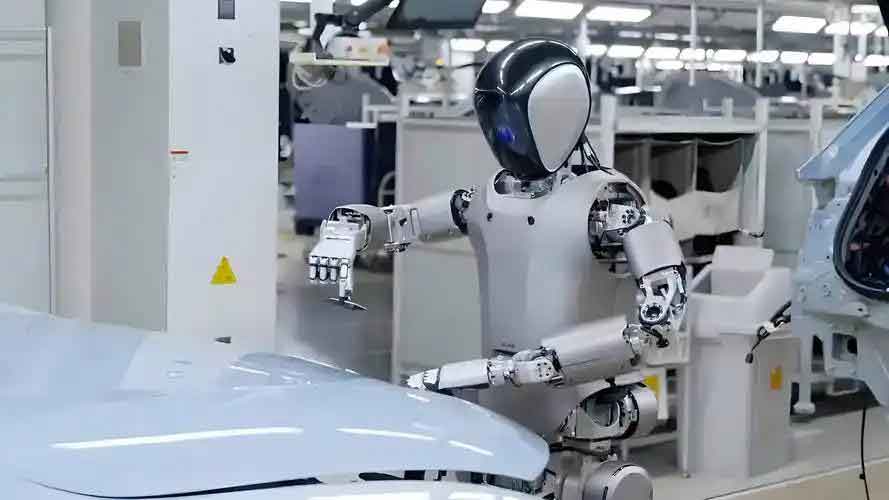
4. Application Frontiers: The Humanoid Robot as the Ultimate Testbed
The convergence of material and manufacturing advancements finds one of its most demanding and promising applications in the development of humanoid robots. A humanoid robot, by definition, must replicate the kinematics, dexterity, and endurance of a human, imposing severe constraints and opportunities for composite materials.
4.1 Structural Skeleton: Achieving Dynamic Agility
The primary structure—the bones of the humanoid robot—must be extremely lightweight to minimize the power required for acceleration and deceleration during walking, running, or lifting. At the same time, it must possess high stiffness to prevent undesirable oscillations or deflections that compromise control accuracy and stability. Carbon fiber-reinforced polymer (CFRP) tubes, sandwich panels, and monocoque structures are ideal for the limbs, spine, and ribcage. The design optimization often involves solving for minimum mass under stiffness and strength constraints, which can be formulated as:
$$ \min_{\mathbf{x}} \quad m(\mathbf{x}) = \int_V \rho(\mathbf{x}) \, dV $$
$$ \text{subject to} \quad g_i(\mathbf{x}) \leq 0, \quad i = 1, \ldots, n $$
$$ \quad \mathbf{K}(\mathbf{x})\mathbf{u} = \mathbf{f} $$
where $\mathbf{x}$ are design variables (e.g., ply angles, thicknesses), $m$ is mass, $g_i$ are constraints (stress, displacement, buckling), $\mathbf{K}$ is the stiffness matrix, $\mathbf{u}$ is displacement, and $\mathbf{f}$ is the load vector. The solution yields a highly efficient, biomimetic skeleton for the humanoid robot.
4.2 Joints and Actuation Systems: Integration and Efficiency
Beyond the passive structure, composites enable more efficient actuation. Lightweight composite linkages reduce the inertia that motors must overcome, leading to faster response times and lower energy consumption. Furthermore, the concept of “robot-in-a-limb” or integrated structures, where composite parts embed conduits for wiring, cooling, or even hydraulic lines, simplifies assembly and improves reliability. The housing for the high-torque density motors and harmonic drives essential for a humanoid robot can also benefit from composites’ thermal insulation or conductive properties when tailored with appropriate fillers.
4.3 End-Effectors: The Quest for Dexterity
The hand of a humanoid robot is a pinnacle of complexity. Achieving human-like dexterity requires numerous small, powerful actuators within a very confined and lightweight package. Composite materials are enabling this. For instance, a direct-drive robotic hand utilizing custom actuators benefits from frameworks made from carbon fiber or high-strength polymers to maintain precise alignment while keeping weight minimal. The development of robust, yet lightweight, composite-based end-effectors is critical for the humanoid robot to perform delicate manipulation tasks in logistics, assembly, or service roles.
5. Future Trajectory: Intelligent Composites and Embodied AI
The future of high-performance composites is inextricably linked with digitalization and intelligence. This synergy is perfectly exemplified in the humanoid robot domain. The next generation of composites will not just be structural; they will be sensory and adaptive.
- Structural Health Monitoring (SHM): Integrating fiber Bragg gratings (FBG) or conductive nanocarbon networks into the composite laminate allows the material itself to report on strain, temperature, and damage. A humanoid robot with an SHM-enabled composite frame could predict maintenance needs and prevent catastrophic failure.
- Multifunctional Composites: Research is advancing composites that combine load-bearing with energy storage (structural batteries), actuation (shape-memory composites), or thermal management. Imagine a humanoid robot whose leg structure also stores electrical energy, improving its operational endurance.
- Co-Design with Embodied AI: The ultimate optimization loop involves the close coupling of material design, mechanical design, and control algorithms. An end-to-end neural network controller for a humanoid robot, trained on vast datasets of physical interactions, can be used to inform and optimize the composite layup and geometry for specific dynamic tasks. The material properties become a variable in the AI’s training, leading to truly bio-inspired, purpose-optimized robotic bodies.
The strategic collaboration between entities possessing deep domain expertise in industrial logistics and those pioneering in embodied AI and humanoid robot hardware is a testament to this direction. Such partnerships focus on building standardized libraries of fundamental skills and deploying powerful, sensor-driven controllers. This approach is essential for transitioning the humanoid robot from laboratory prototypes to robust, economically viable partners in complex, real-world environments like warehouses and factories. The goal is to create a humanoid robot capable of perceiving an unstructured space, making decisions, and executing delicate physical tasks—a feat made possible only by the lightweight strength of advanced composites and the intelligence of modern AI.
In conclusion, the development status of high-performance composites is one of robust maturation in foundational areas and aggressive innovation in advanced frontiers. The established industrialization of key fiber grades provides a reliable material base. The ongoing challenges in resin chemistry and the promising rise of thermoplastic and multifunctional composites chart the course for future growth. This entire trajectory gains profound purpose and accelerated momentum from its application to next-generation robotic platforms. The humanoid robot stands as both a driver and a beneficiary of these material science advancements. As composites become stronger, lighter, smarter, and more integrated, they will cease to be merely components of a humanoid robot and will instead become its defining physical essence, enabling a new era of automated, adaptable, and capable machines.