
As a researcher observing the relentless surge of new technological revolutions, I see them profoundly reshaping the very fabric of our socio-economic development. The cultivation of New Quality Productive Forces has emerged as the core engine for high-quality development, with breakthroughs in frontier technologies being the key to driving comprehensive industrial upgrading. In this context, embodied AI robot intelligence, representing a cutting-edge trend in the evolution of artificial intelligence and a critical future industry, marks a significant expansion of AI’s capabilities. It has become a vital direction for the development of advanced productive forces. Unlike disembodied intelligence confined to software, embodied AI robot emphasizes intelligent systems that leverage a physical form to interact with the environment in real-time, acquiring information, understanding problems, making decisions, and generating actions through the tight coupling of perception and action. This shift resonates deeply with the directive to solidify the real economy’s foundation, pointing the way for the deep integration of hardware and software to empower tangible sectors. In the domain of knowledge services, I witness a fundamental shift in user expectations. The coexistence of information overload and the “last-mile” problem in knowledge acquisition has led users to increasingly seek personalized, contextualized, and physically engaging knowledge experiences. The library, as a central hub for knowledge, faces the core challenge of transitioning from “how to better manage resources” to “how to provide users with seamless, intuitive, and efficient knowledge exploration.” This is where the promise of the embodied AI robot becomes compelling, offering a pathway to transcend the limitations of traditional automation and reshape the library into a responsive, intelligent field for knowledge interaction.
Theoretical Foundations: From Disembodied Abstraction to Embodied Interaction
My understanding of this transformation is rooted in a significant theoretical pivot. The journey began with the “Cognitive Revolution” prompted by Alan Turing’s seminal question about machine thinking. However, the dominant paradigm that followed largely embraced a “disembodied” view of cognition, treating intelligence as abstract symbol manipulation confined within the brain or a computer. This approach, while powerful in constrained domains, revealed profound limitations when confronting the messy complexity of the real world. Philosophical critiques of mind-body dualism, from phenomenology to the works of Merleau-Ponty, laid the groundwork for an alternative by insisting that cognition is inseparable from bodily experience and situated action. This convergence of ideas crystallized into the theory of Embodied Cognition, succinctly captured by the “4E” framework: cognition is Embodied, Embedded, Enactive, and Extended. It posits that our intelligence is shaped by our physical morphology, embedded within a specific environment, generated through interactive engagement with that environment, and can extend beyond the biological body into tools and artifacts.
The technological manifestation of this theory in AI can be traced to pioneers like Rodney Brooks, whose “subsumption architecture” for robots demonstrated that intelligent behavior could emerge from layers of simple sensing-acting loops directly engaged with the world, bypassing the need for central, symbolic world models. Therefore, embodied AI robot intelligence is not merely AI placed inside a robot. It is a paradigm for intelligence that takes the physical body as its precondition, emphasizing the emergence of adaptive and learning capabilities through continuous, active sensory-motor interaction within a specific environmental context. This represents a crucial “embodied turn,” shifting the focus from an isolated mind to an “intelligence-in-the-world.”
This theoretical lens offers a powerful new perspective for re-examining library knowledge services. Traditionally, user studies have relied on models analyzing verbalizable needs and explicit search behaviors. Embodied cognition introduces the critical dimensions of the body and space as primary sources of insight. A user’s trajectory through the stacks, their lingering pause at a particular section, or their physical handling of materials are all rich, unspoken expressions of cognitive state and interest. This theory elevates these embodied interactions from background noise to central data points for understanding implicit needs.
Furthermore, while traditional knowledge organization (classification, subject headings) provides a universal, static map, the “enactive” and “situational” nature of embodied cognition highlights that meaning and connections are dynamically generated through action and context. A service that responds to a user’s immediate, situated need by dynamically assembling relevant physical and digital resources across taxonomic boundaries is itself a form of real-time, user-centered knowledge organization. Finally, libraries have long been theorized as sites for knowledge communication. Embodied cognition, with its concept of the extended mind, allows us to view an embodied AI robot not as a mere tool, but as a potential extension of the user’s own cognitive process within the physical space. This transforms library interaction from a two-dimensional human-computer dialogue into a triadic interplay between human, intelligent agent, and environment, where the space itself becomes an active, intelligent field that facilitates and catalyzes knowledge exchange.
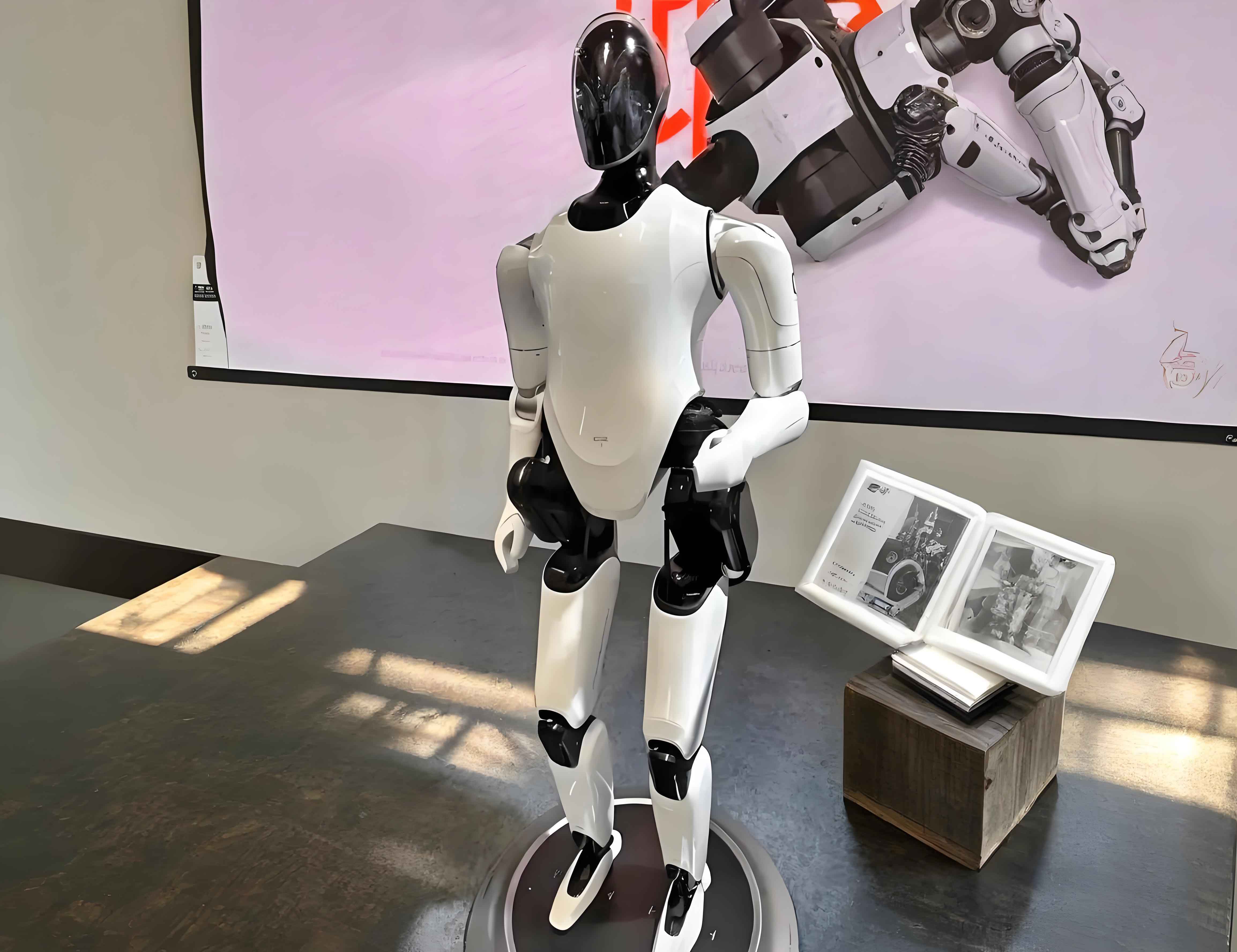
Technical Core: The Building Blocks of an Embodied Library Assistant
From my perspective as a user, the efficacy of any new service hinges on its underlying technological robustness. The deployment of an embodied AI robot in a complex, human-centric environment like a library relies on the seamless integration of capabilities across perception, cognition, action, and interaction.
Embodied Perception: Constructing a Dynamic Digital Twin. For an intelligent agent to serve me effectively, it must first understand the library as I experience it—a dynamic, semantically rich physical space. This requires multi-sensor fusion. Cameras capture visual details like book spines and user posture; LiDAR provides reliable spatial mapping and obstacle detection for safe navigation in crowded aisles; tactile sensors enable delicate manipulation of books. The true technical kernel lies not in collecting these signals, but in fusing them into a coherent, semantically annotated model of the environment—a living digital twin. This twin goes beyond 3D geometry to include service-relevant states: a seat is tagged as “occupied,” a pathway has “high current traffic,” a study zone is “quiet.” This real-time, semantic map is the foundational world model that enables intelligent, context-aware service.
Embodied Cognition: Generating Adaptive Decisions. This is the “brain” that translates perception into action. When I utter a natural language request like “I need foundational texts on architectural theory,” a Large Language Model (LLM) acts as the cognitive core, parsing my intent and decomposing it into a structured task plan. It queries the library’s knowledge graph, generates an optimal navigation path to the correct section, identifies relevant titles via visual recognition integrated with the catalog API, and finally formulates the commands for physical retrieval. This process can be abstracted as a function where the agent’s decision (D) is generated based on its perception of the environment (E), the user’s query (Q), its internal knowledge (K), and its task history (H):
$$ D = f(E, Q, K, H) $$
Crucially, this cognition must be adaptive. The embodied AI robot must remember my preferences, adjust to changes in library layout, and continuously learn from new interactions without forgetting previous skills—a challenge addressed through techniques for continual and lifelong learning. The ultimate goal is generalization: the ability to transfer learned knowledge to novel layouts or unforeseen user requests, a capability profoundly dependent on continuous interaction with the physical world.
Embodied Action: Autonomous Navigation and Dexterous Manipulation. This is where cognition meets the physical world, often the most challenging aspect. Safe and efficient movement requires robust Simultaneous Localization and Mapping (SLAM) and path-planning algorithms that can dynamically replan around moving obstacles (people, book carts) while adhering to social norms—slowing down, giving right of way, maintaining a polite distance. The manipulation of books presents a unique dexterity challenge. A robotic arm must perform precise, force-controlled actions like grasping a slim volume from a tight shelf without damaging it, requiring a closed-loop system integrating vision, touch, and force feedback. The sequence of approach, verification, grip, lift, and placement must be executed smoothly and safely, ensuring the embodied AI robot is a reliable, not disruptive, presence.
Embodied Interaction: Enabling Natural Human-Robot Collaboration. The final piece is how the agent communicates with me. Interaction must be multi-modal, intuitive, and transparent. The embodied AI robot should understand my speech and gestures, and respond through natural language, expressive sounds, or even simple non-verbal cues like orienting its “head” or using a screen to display information. Beyond reactive responses, it should proactively infer my needs from my behavior—like offering help if I seem lost in the stacks. Trust and safety are paramount; its movements must be predictable, its intentions explainable, and its physical design non-threatening to foster a sense of collaborative partnership rather than mechanistic transaction.
The integration of these four pillars can be summarized in the following table, illustrating how they work together to serve user needs:
| Technical Pillar | Core Function | Key Technologies | User-Centric Value |
|---|---|---|---|
| Embodied Perception | World Understanding | Multi-sensor Fusion, Semantic SLAM, Digital Twin | Provides the agent with a real-time, contextual understanding of the library space and the user within it. |
| Embodied Cognition | Decision & Planning | LLMs, Task Planning, Continual Learning | Translates user needs into actionable, step-by-step plans and adapts to new situations and user preferences. |
| Embodied Action | Physical Execution | Motion Planning, Dexterous Manipulation, Force Control | Safely and reliably executes tasks in the physical world, from navigating to fetching a specific book. |
| Embodied Interaction | Communication & Collaboration | Multi-modal HCI, Intent Recognition, Explainable AI | Enables natural, transparent, and trustworthy communication between the user and the intelligent agent. |
Transformed Service Scenarios: The Library Reimagined
Driven by these integrated technologies, the embodied AI robot enables a fundamental reimagining of library services from my perspective as a user. It transforms passive resource access into active, immersive, and collaborative knowledge experiences.
“Immersive” Discovery for Knowledge Acquisition. The classic problem of finding a physical book after an online search is elegantly solved. When I request resources on a topic, the embodied AI robot doesn’t just give me a call number. It guides me to the shelf, and upon arrival, can project augmented reality overlays that visualize the scholarly network around those texts—showing citation links, author relationships, and summaries. I can use gestures to explore this virtual knowledge graph superimposed on the physical collection. The robot might even retrieve a related volume from a different section, creating a dynamic, cross-disciplinary collection tailored to my query. This turns resource discovery from a chore into an exploratory “walk” through an embodied knowledge landscape, significantly lowering the cognitive barrier to accessing deep collections.
“Hands-On” Guidance for Knowledge Internalization. Reference consultation evolves from a transactional Q&A into a collaborative cognitive process. Imagine working on a complex historical analysis. An embodied AI robot, equipped with access to vast digital archives and analytical models, can act as a research partner. It can not only retrieve documents but also, through a connected screen or spatial projection, help visualize timelines, cross-reference events, and simulate historical scenarios. For skill-based learning, like understanding a scientific apparatus, the robot could guide me through a physical or simulated hands-on procedure, correcting my actions in real-time. This multi-sensory, “learning-by-doing” approach, mediated by the embodied AI robot, fosters deeper comprehension and knowledge internalization by engaging both mind and body.
“Heart-to-Heart” Facilitation for Knowledge Exchange. Libraries are social spaces for idea exchange. Here, the embodied AI robot can act as a catalyst and facilitator. During a group study session, it can dynamically retrieve relevant resources mentioned in the conversation, display shared notes on a surface, or even connect the group to a remote expert via a telepresence interface. By sensing the group’s dynamic—identifying dominant speakers, detecting confusion, or recognizing converging ideas—it can proactively suggest discussion frameworks or pose stimulating questions. It transforms the library space from a passive container for conversation into an active participant that deepens the quality of collaborative knowledge construction and connects isolated thinkers into a coherent intellectual community.
“Collective Intelligence” Support for Knowledge Innovation. For users engaged in creative or innovative work, the library can become an intelligent support platform. An embodied AI robot can assist by mapping research landscapes, identifying emerging trends and gaps, and suggesting unconventional connections across disciplines. It can help prototype ideas by managing data visualizations on large displays or simulating model outcomes. Furthermore, by analyzing the work and interests of various users in the library (with appropriate privacy safeguards), the system could intelligently recommend potential collaborators, effectively matchmaking between researchers, artists, or entrepreneurs who might benefit from interdisciplinary synergy. In this scenario, the embodied AI robot and the library ecosystem it operates within become a hub for serendipitous connection and innovation support, moving far beyond its traditional archival role.
Value Orientation: A User-Centric Paradigm Shift
The ultimate measure of this technological integration is the value it creates for me, the user. The embodied AI robot drives a profound shift in the library service paradigm, reflected in several key transitions.
From Environmental Adaptation to Spatial Empowerment. Traditionally, I had to adapt myself to the library’s fixed layout and rigid procedures. Now, the environment adapts to me. Through natural interaction, I can command the embodied AI robot to reconfigure a discussion space, adjust lighting conditions for my reading comfort, or create a personalized resource trail. Control is returned to the user, fostering a powerful sense of ownership, autonomy, and belonging within the library space.
From Information Acquisition to Situational Experience. Knowledge engagement moves beyond extracting textual information. It becomes a multi-sensory, contextual experience. Whether I’m “walking” through a historical period via augmented reality or manipulating a 3D model of a protein structure guided by the robot, learning is embodied and situated. This rich, experiential engagement leads to stronger emotional connection with the material, deeper cognitive processing, and improved long-term retention. The embodied AI robot enables the library to craft powerful narrative and exploratory experiences around its collections.
From One-Way Indoctrination to Two-Way Interaction. The service model shifts from a broadcast of pre-packaged information to a dynamic, participatory dialogue. My actions, queries, and even my non-verbal cues directly shape the service I receive. The embodied AI robot responds, adapts, and learns from our interaction. Furthermore, it facilitates richer interactions between users, turning the library into a platform for knowledge co-creation. My role evolves from a passive consumer to an active participant and contributor in a vibrant knowledge ecosystem.
From Functional Satisfaction to Self-Actualization. While efficiency and accuracy remain important, the value proposition expands. The supportive, personalized, and intellectually stimulating environment co-created with the embodied AI robot addresses higher-level psychological needs. It supports my journey of mastery, satisfies my curiosity, and provides the tools and connections for creative expression and problem-solving. The library transforms from a utility fulfilling a functional need (finding a book) into a nurturing space that supports my intellectual growth and personal development, leading to a deeper, more holistic form of user satisfaction.
In conclusion, the integration of embodied AI robot intelligence is not merely an upgrade to library automation; it is a foundational shift that realigns the library with its core mission in the digital age. By leveraging a physically intelligent presence, libraries can transcend the boundaries between physical and digital, between individual inquiry and social collaboration, and between information provision and human-centered empowerment. This embodied revolution promises to restore the library’s place as an indispensable, dynamic, and deeply human-centric pillar of the knowledge society.