
As a researcher at the intersection of artificial intelligence and robotics, I have witnessed the rapid emergence of embodied AI as a transformative frontier. Embodied AI refers to intelligent systems that perceive and act through physical entities, relying on core elements like embodiment, agents, data, and learning-evolution frameworks. By interacting with the environment, these systems achieve perception, understanding, decision-making, and action, exhibiting adaptive and intelligent behaviors. In this article, I will explore the growth, challenges, and opportunities in this field, emphasizing the role of embodied AI robots in shaping our future.
The advancement of embodied AI is driven by both technological progress and market demand. According to industry reports, the market for embodied AI robots has expanded significantly. For instance, in China, the market size reached billions of yuan recently, with projections indicating accelerated growth as large model technologies break through. This growth underscores the potential of embodied AI robots to revolutionize various sectors. To illustrate, consider the following table summarizing market trends:
| Year | Market Size (in billions of yuan) | Growth Rate |
|---|---|---|
| 2023 | 418.6 | Base |
| 2024 | Estimated 500+ | ~20% |
| 2027 | Projected 632.8 | CAGR ~10% |
This growth is fueled by policy support, such as the inclusion of embodied AI in government work reports, signaling strategic importance. The integration of large AI models with robotics is key, enabling embodied AI robots to process multimodal data, perform dynamic decision-making, and support complex tasks. For example, the learning framework in embodied AI can be modeled using reinforcement learning, where the objective is to maximize cumulative reward: $$J(\theta) = \mathbb{E}\left[\sum_{t=0}^{T} \gamma^t r(s_t, a_t)\right]$$. Here, $s_t$ represents the state from perception, $a_t$ is the action taken by the embodied AI robot, $r$ is the reward, and $\gamma$ is the discount factor. This formula captures how embodied AI robots learn through interaction, adapting to environments over time.
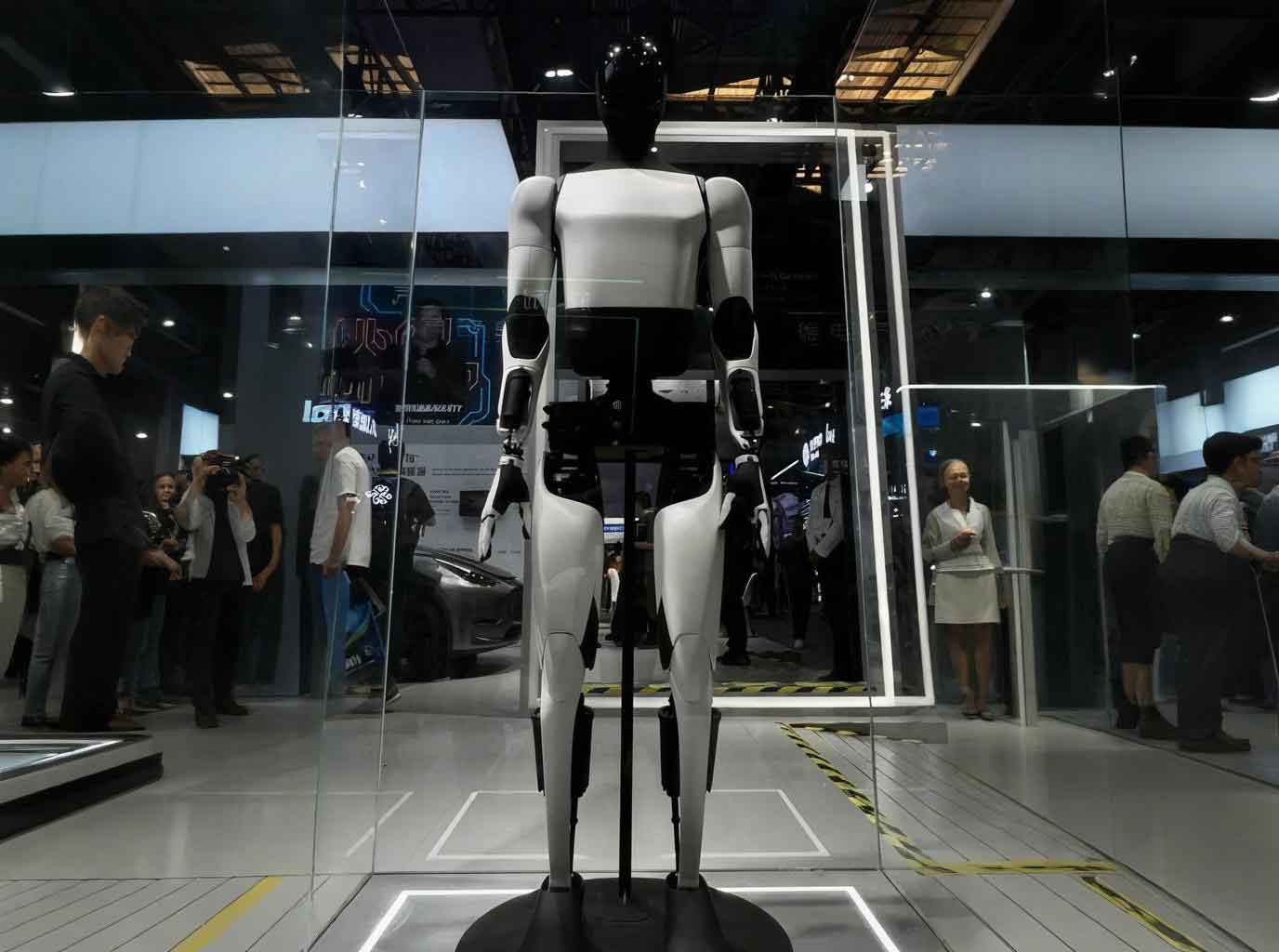
In the realm of embodied AI, robots are the quintessential manifestations, and large AI models serve as the engine for continuous development. On one hand, AI models empower embodied AI robots with environmental perception and dynamic planning via data processing and cross-modal fusion. On the other hand, their self-learning and real-time updating capabilities allow embodied AI robots to handle variable tasks, driving technological iteration. The synergy can be expressed through a system equation: $$y_t = M_\phi(x_t, h_{t-1})$$, where $y_t$ is the output decision, $M_\phi$ is the large model parameterized by $\phi$, $x_t$ is multimodal input (e.g., visual, tactile), and $h_{t-1}$ is the hidden state representing memory. This enables embodied AI robots to perform tasks like navigation or manipulation in unstructured settings.
Globally, tech giants are racing to dominate the embodied AI landscape, investing in innovation and applications. Their efforts span model development, humanoid robots, and autonomous systems. Below is a table summarizing key players and their focuses, highlighting how each contributes to advancing embodied AI robots:
| Domain | Company | Key Initiatives |
|---|---|---|
| Large Model R&D | OpenAI | Developing GPT series for natural language and multimodal perception, enhancing embodied AI robot cognition. |
| Large Model R&D | Gemini models with improved world knowledge, aiding embodied AI robots in reasoning tasks. | |
| Large Model R&D | Huawei | Pangu models integrated with humanoid robots for scenarios like industrial collaboration. |
| Humanoid Robots | Tesla | Optimus robot using autonomous driving stack for factory tasks, exemplifying embodied AI robot applications. |
| Humanoid Robots | Fourier Intelligence | GRx series with dexterous hands for services, showcasing embodied AI robot versatility. |
| Autonomous Driving | Tesla | FSD V12 as end-to-end neural network for perception-decision, relevant to embodied AI robot mobility. |
These initiatives demonstrate the competitive fervor in creating more capable embodied AI robots. Moreover, telecommunications operators are stepping into the fray, leveraging their infrastructure to support embodied AI ecosystems. For instance, some have established innovation centers focused on robots, utilizing 5G-A networks for low-latency control of humanoid robots. This aligns with the trend where embodied AI robots require robust connectivity for real-time operations.
Despite the optimism, embodied AI faces significant technical and data challenges. Technically, most current research applies existing large models to robots, which limits autonomy. True general intelligence for embodied AI robots demands higher-level self-learning, approximated by meta-learning frameworks: $$\min_\theta \mathbb{E}_{\mathcal{T}} [L_{\mathcal{T}}(U_\theta(\mathcal{D}))]$$, where $\theta$ are meta-parameters, $\mathcal{T}$ is a task distribution, $U$ is an update rule, and $\mathcal{D}$ is data. This illustrates the need for embodied AI robots to adapt quickly to new tasks without pre-definition.
Data-wise, embodied AI robots rely on vast amounts of real-world interaction data, which is costly to acquire and annotate. Multimodal data from vision, force, and audio requires specialized labeling, increasing economic burdens. Additionally, data security and privacy are critical, as embodied AI robots often operate in sensitive areas like homes or healthcare. A formula for data efficiency can be: $$\mathcal{L}_{\text{data}} = \alpha \cdot \text{AcquisitionCost} + \beta \cdot \text{PrivacyRisk}$$, where $\alpha$ and $\beta$ are weights. This highlights the trade-offs in training embodied AI robots effectively while safeguarding information.
To address these challenges, I believe operators can play a pivotal role in shaping the embodied AI future. As core providers of communication infrastructure, they are at a turning point to harness embodied AI robots for new business models. My recommendations are threefold, centered on infrastructure, applications, and collaboration.
First, focus on infrastructure and compute support. Embodied AI robots demand high-bandwidth, low-latency networks for real-time data transmission. Operators should accelerate 5G and 6G deployments, ensuring stable connectivity. Edge computing is crucial to reduce latency, enabling millisecond responses for embodied AI robots in critical apps like remote surgery. The computational load can be modeled as: $$C_{\text{edge}} = \lambda \cdot F_{\text{model}}(D) + \mu \cdot N_{\text{robots}}$$, where $C_{\text{edge}}$ is edge compute cost, $F_{\text{model}}$ is model complexity, $D$ is data volume, and $N_{\text{robots}}$ is the number of embodied AI robots. Deploying lightweight AI models at the edge enhances reliability for embodied AI robot operations.
Second, expand application scenarios and services. Embodied AI robots have vast potential in industrial, home, and public sectors. In manufacturing, operators can partner with firms to deploy embodied AI robots for assembly or inspection, using network analytics to boost efficiency. The productivity gain can be expressed as: $$P_{\text{gain}} = \eta \cdot \sum_{i} \tau_i \cdot R_i$$, where $\eta$ is efficiency factor, $\tau_i$ is task time reduction by embodied AI robots, and $R_i$ is resource savings. In homes, embodied AI robots can offer care or security services, integrated with 5G and AI for better user experience. In healthcare, embodied AI robots assist in rehabilitation, requiring precise control loops: $$u(t) = K_p e(t) + K_i \int e(t) dt + K_d \frac{de}{dt}$$, a PID controller for smooth movements of embodied AI robots during tasks.
Third, strengthen strategic partnerships and ecosystem building. Given the diverse players in embodied AI, operators should collaborate with tech firms, robot manufacturers, and startups to develop multimodal solutions. This fosters产业链 synergy, accelerating the adoption of embodied AI robots. Participation in standard-setting is vital to ensure interoperability and safety for embodied AI robots across platforms.
In conclusion, the era of embodied AI is dawning, with embodied AI robots at its heart. Through continuous innovation, market growth, and operator involvement, these systems will deepen integration with society, unlocking new intelligent eras. As I reflect on the journey, the formula for success hinges on balancing technology, data, and collaboration: $$\text{Success}_{\text{embodied AI}} = \int (\text{TechAdvance} + \text{DataQuality} + \text{Ecosystem}) dt$$. This integral over time signifies the cumulative effort needed to realize the full potential of embodied AI robots, transforming industries and everyday life.