
The landscape of humanoid robotics is one of breathtaking ambition and stark contrast. Public perception often remains anchored to images of stiff, single-purpose machines, dependent on explicit commands and confined to the realm of “functional execution.” This gap between technological potential and public expectation highlights a fundamental challenge: our industry has excelled at creating tools that do, but struggles to envision partners that understand and interact. The path forward lies not merely in refining movements or expanding task lists, but in redefining the very essence of intelligence within a physical form. True integration into human environments demands a leap from isolated performance to contextual awareness, from pre-programmed scripts to autonomous decision-making, and crucially, from mechanical action to effective emotional conveyance. The core proposition for the next generation of robots is clear: we must transition from building functional executors to crafting intelligent entities capable of genuine connection.
This journey requires a complete re-evaluation of an embodied AI robot‘s value structure. One can visualize it as a pyramid:
| Value Layer | Description | Primary Challenge |
|---|---|---|
| Emotional Resonance & Platform Extension | The apex. Ability to form social bonds, adapt to nuanced social contexts, and serve as a platform for diverse, evolving applications. | Cross-modal affective computing, long-term relationship modeling, open-ended learning. |
| Generalized Intelligence & Autonomous Decision-Making | The core. Understanding intent, reasoning about dynamic environments, and planning complex action sequences without step-by-step guidance. | World model learning, common-sense reasoning, efficient real-time planning. |
| Functional Realization & Task Execution | The foundation. Reliable physical operation, basic sensorimotor control, and completion of defined, specific tasks. | Hardware robustness, basic locomotion and manipulation, sensor fusion. |
While the industry has solidified the base, the upper layers remain sparsely populated. The evolution of an embodied AI robot from a “tool” to a “companion” hinges on populating these higher-order capabilities. This is not a linear upgrade but a synergistic integration where each layer enables the next. My perspective is that the intelligence of a physical agent is not defined by the peak performance of any single subsystem, but by the emergent properties of their tight integration. We can express this synergy as a foundational principle:
$$ \mathcal{I}_{embodied} = f(\mathcal{P}, \mathcal{M}, \mathcal{C}, \mathcal{R}) \ \text{where} $$
$$ \mathcal{P} = \text{Perceptual Awareness}, \quad \mathcal{M} = \text{Motor Intelligence}, $$
$$ \mathcal{C} = \text{Cognitive Understanding}, \quad \mathcal{R} = \text{Relational Affordance}. $$
The function \( f \) represents the complex, non-linear integration of these modules. An embodied AI robot truly becomes an intelligent entity only when its “hands, feet, eyes, and brain” coordinate not just for balance or grip, but to comprehend a situation and generate an appropriate, autonomous response. This marks the shift from a functional body to a sentient presence.
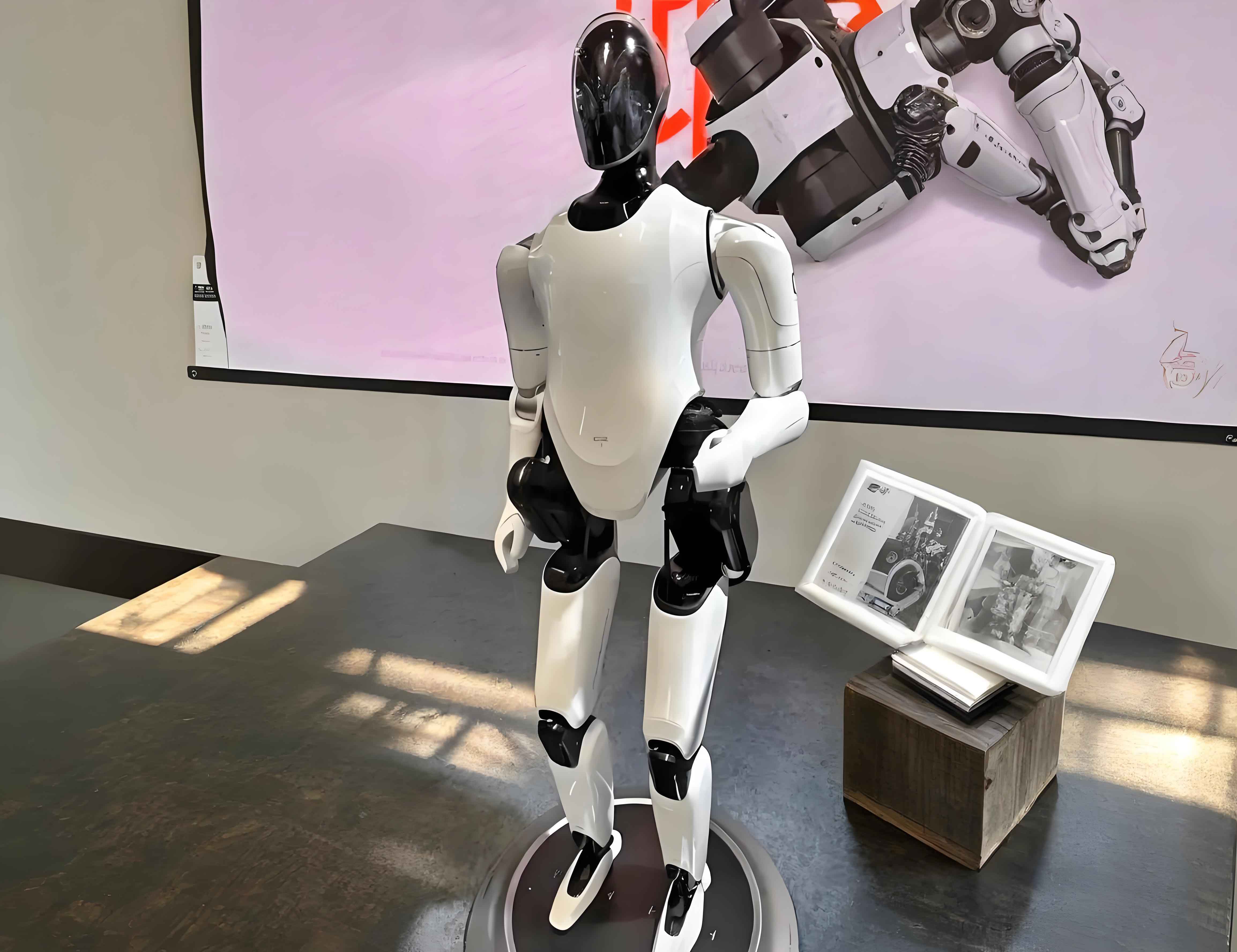
The physical manifestation of this philosophy is a platform designed for continuous environmental interaction. For instance, our own research platform, Orca, is built precisely on this principle of embodied AI, serving as a testbed for perception, learning, and task execution through persistent bodily engagement with the world. Its value is measured not in cycles-per-hour, but in the richness of its interactions and the depth of its understanding.
From Functional Stack to Biomimetic Brain: The Technical Core
Supporting the grand vision of a general-purpose embodied AI robot demands a cohesive and unique technical architecture. The approach cannot be one of isolated point-solutions in locomotion or vision. Instead, it requires parallel advancement across multiple dimensions—movement control, manipulation, affective expression, and multimodal interaction. This integrated strategy is deliberate. I conceptualize our suite of models as a growing “biomimetic brain.”
| Model Family | Biomimetic Analogy | Core Function |
|---|---|---|
| Advanced Motor Control & Manipulation | The Cerebellum & Brainstem | Precise coordination, balance, reflex-level stabilization, and dexterous object handling. |
| Affective Gait & Expression Model | The Limbic System | Infusing motion and form with emotional color, conveying internal state and intent through non-verbal cues. |
| Multimodal Interaction & World Model | The Cerebral Cortex | High-level cognition, situational understanding, intent recognition, and conscious decision-making. |
These models do not operate in silos. They are interlinked through a sophisticated internal communication protocol, enabling the “emergent intelligence” where the whole is greater than the sum of its parts. For example:
$$ \text{Interaction Model} \xrightarrow[\text{detects urgency}]{\text{“User’s voice is strained”}} \text{Emotion Tag: “Anxious”} $$
$$ \downarrow $$
$$ \text{Affective Gait Model} \xrightarrow[\text{parameters}]{\text{Adjusts}} (\text{Step Frequency} \uparrow, \text{Body Sway} \uparrow) $$
$$ \downarrow $$
$$ \text{Robot’s locomotion shifts from “leisurely walk” to “purposeful stride”} $$
This cross-modal feedback loop is the crucible where true behavioral intelligence is forged. Take the fundamental challenge of locomotion. We have committed to a self-developed “straight-leg walking” paradigm. The rationale is deeply rooted in biomechanics. While bent-knee walking offers static stability, it lacks the natural dynamism and energetic efficiency of human gait. A human knee naturally straightens during the mid-stance phase of walking. By replicating this principle, an embodied AI robot achieves a more natural, human-like, and energy-efficient gait. This technical choice directly enables higher-level innovations like our Affective Gait Model. Walking is not merely a displacement function; it is a powerful communication channel. By allowing the gait model to control parameters like cadence, stride length, and torso swing atop the stable “canvas” of straight-leg walking, the robot can express a spectrum of states—confidence, caution, joy—transforming cold mechanics into legible, life-like motion.
The training of such a model is paradigm-shifting. It does not rely solely on massive datasets of physical motion capture. Instead, it employs a reinforcement learning (RL) based simulation training framework. The process can be summarized:
1. Emotion Mapping: Ground emotional states in established psychological frameworks (e.g., PAD – Pleasure, Arousal, Dominance).
2. Expert Choreography: Collaborate with movement artists to deconstruct the kinematic signatures of human gait under different emotional tensions.
3. Simulation-Based RL: Formulate the problem in a physics simulator. The RL agent (the robot) is rewarded for generating gait patterns that maximize the similarity to the target emotional signature while maintaining stability.
4. Domain Randomization & Transfer: Train across varied simulated conditions (floor friction, slopes, disturbances) to ensure robustness before transferring the policy to the physical embodied AI robot.
The training objective for an affective gait policy \( \pi_{\text{gait}} \) can be framed as:
$$ \pi_{\text{gait}}^* = \underset{\pi}{\arg\max} \ \mathbb{E}_{\tau \sim \pi} \left[ \sum_{t} \gamma^t \left( R_{\text{stability}}(s_t, a_t) + \lambda R_{\text{emotion}}(s_t, a_t, e_{\text{target}}) \right) \right] $$
Here, \( R_{\text{stability}} \) ensures physical viability, \( R_{\text{emotion}} \) measures alignment with the target emotion \( e_{\text{target}} \), and \( \lambda \) balances the two objectives.
From Vertical Scenarios to Foundational Competence: The Path to Generality
A practical strategy for a nascent field is to deploy in focused vertical scenarios. Our current applications span research/education, commercial services, entertainment, and specific industrial tasks like logistic picking. These choices are strategic, targeting domains with lower initial manipulation complexity or higher tolerance for interaction-focused development.
The dichotomy between “emotion-driven” entertainment and “efficiency-driven” industry is addressed through a flexible, modular technology stack. We operate on a “capability middleware” architecture:
| Scenario Type | Deployed Module Combination | Primary Value Delivered |
|---|---|---|
| Entertainment & Social Interaction | Affective Gait Model + Facial Expression + Natural Language Dialog + Gesture Recognition | Engagement, Storytelling, Emotional Impact, Memorability. |
| Industrial Logistics | High-Precision Motor Control + Robust Manipulation Policy + Task & Motion Planning (TAMP) + Object Recognition | Throughput, Reliability, Accuracy, ROI. |
| Research & Education | Full Stack Access + API + Simulation Tools + Curriculum | Platform Flexibility, Benchmarking, Algorithm Development, Student Engagement. |
This is not a fragmentation of effort but a coherent capability-evolution process. Each vertical scenario acts as a “competence beacon,” illuminating and hardening a specific set of skills necessary for a general-purpose embodied AI robot.
$$ \text{General Competence} = \bigcup_{i=1}^{n} \text{Refined}( \text{Competence}_i | \text{Scenario}_i ) $$
Entertainment provides a sandbox for affective computing and social AI, where user forgiveness is higher and the demand for “character” is paramount. Industry provides the rigorous proving ground for robustness, precision, and task-level autonomy under clear constraints. Each successful deployment feeds back data, exposes edge cases, and builds trust—not just in a single product, but in the category of advanced embodied AI robots as viable, valuable partners. This iterative, multi-scenario refinement is the responsible path toward a future where a single, adaptable robot can navigate the unpredictable complexities of a human-centric world.
From Instrumental Reason to Emotional Trust: The Irreducible Human Factor
This leads to the pivotal question: In a world that often prizes pure efficiency, is “anthropomorphic interaction” a fundamental requirement or merely an ornamental feature designed to appease humans? I assert it is fundamentally indispensable. The view that a machine need only be maximally efficient is predicated on the classical assumption that a machine is a pure tool—an extension of a human’s will with no agency of its own. However, when we envision embodied AI robots operating in homes, nursing facilities, schools, and public spaces, engaging in frequent, unstructured interaction with non-expert users, anthropomorphic interaction becomes a functional necessity.
Its value is twofold and critical:
1. Cognitive Load Reduction: Interaction modalities that align with human intuition—speech, gesture, expressive movement—drastically lower the barrier to use. They enable natural, efficient collaboration without manuals or specialized training.
2. Trust Fabrication: Trust is the currency of social integration. An entity that perceives your intent, contextualizes it, and responds in a legible, predictable, and sometimes empathetic manner is far more likely to be trusted and accepted. Trust is not a “nice-to-have”; it is the license to operate in intimate human spaces.
We can model the growth of trust \( T \) over time \( t \) in human-robot interaction as a function of competency \( C \), predictability \( P \), and perceived empathy \( E \):
$$ \frac{dT(t)}{dt} = \alpha C(t) + \beta P(t) + \gamma E(t) – \delta T(t) $$
where \( \alpha, \beta, \gamma \) are weighting coefficients for each factor, and \( \delta \) represents a natural decay or erosion rate (e.g., from a single major failure). “Anthropomorphism” here is not about slavishly copying human form, but about deeply understanding and adapting to human cognitive and social models. The ultimate embodied AI robot may come in many forms, but its core must house a “mind” capable of resonance with human experience.
The industry’s metrics must evolve accordingly. We must shift from a “performance-parameter-driven” paradigm (MHz, TOPS, DOF, hours of operation) to a “user-experience-driven” one. Early value is captured by measurable efficiency gains. Long-term, sustainable value will be anchored in relational affordance and platform extensibility. The market will not pay a premium for a slightly faster task-completer; it will invest in a capable, adaptable, and trustworthy entity that integrates into the social and operational fabric of life.
In conclusion, the trajectory for the embodied AI robot is set. It is a path leading away from the confines of a “toy” or a “tool,” towards a more sentient, expressive, and socially intelligent being. It is the evolution from a passive instrument to an active participant; from an object that executes to a subject that understands, expresses, and collaborates. This journey is complex, demanding advances not just in engineering and computer science, but in neuroscience, psychology, and ethics. The destination—an embodied AI robot with a “soul,” capable of genuine emotional linkage—is what guides our every technical and philosophical choice. The road is long, but the direction is unequivocal, and the first steps, grounded in integrated biomimetic intelligence and empathetic design, are being taken today.