
As an observer and researcher in the field of artificial intelligence and robotics, I have witnessed the rapid evolution of embodied AI robots, which integrate AI with physical entities to endow them with human-like perception, interaction, and decision-making capabilities. This technology is widely regarded as a pivotal step toward artificial general intelligence. In this article, I will explore the application of embodied AI robots in the banking sector, focusing on the challenges and recommendations for their large-scale adoption. Banking, as a critical component of the global economy, stands to benefit significantly from embodied AI robots through enhanced service efficiency, expanded financial inclusion, and improved operational resilience. However, the path to widespread implementation is fraught with ethical, data, and technical hurdles that must be addressed. I will structure this discussion around the development trajectory, technical framework, banking applications, key challenges, and strategic suggestions, incorporating tables and formulas to summarize key points and ensure depth.
The concept of embodied intelligence dates back to philosophical musings in the 16th century, such as Descartes’ dualism, which separated mind and body but acknowledged their interaction. In the 1950s, Alan Turing’s embodied Turing test laid the theoretical groundwork for evaluating intelligent agents in physical environments. Over the decades, progress in computer vision, natural language processing, and robotics hardware has gradually advanced embodied AI robots from rudimentary prototypes to sophisticated systems. For instance, early social robots like Kismet in the 1990s demonstrated basic perceptual and interactive abilities. Since 2022, breakthroughs in large language models and intelligent agents have accelerated this evolution, driven by policy support, demographic shifts like aging populations, and technological advancements in both software and hardware. Looking ahead, the market for embodied AI robots, particularly humanoid forms, is projected to expand into a multi-trillion-dollar industry, potentially surpassing the automotive sector in scale and impact. In banking, this promises a transformation toward digitized, human-robot collaborative services that better serve national economies and daily life.
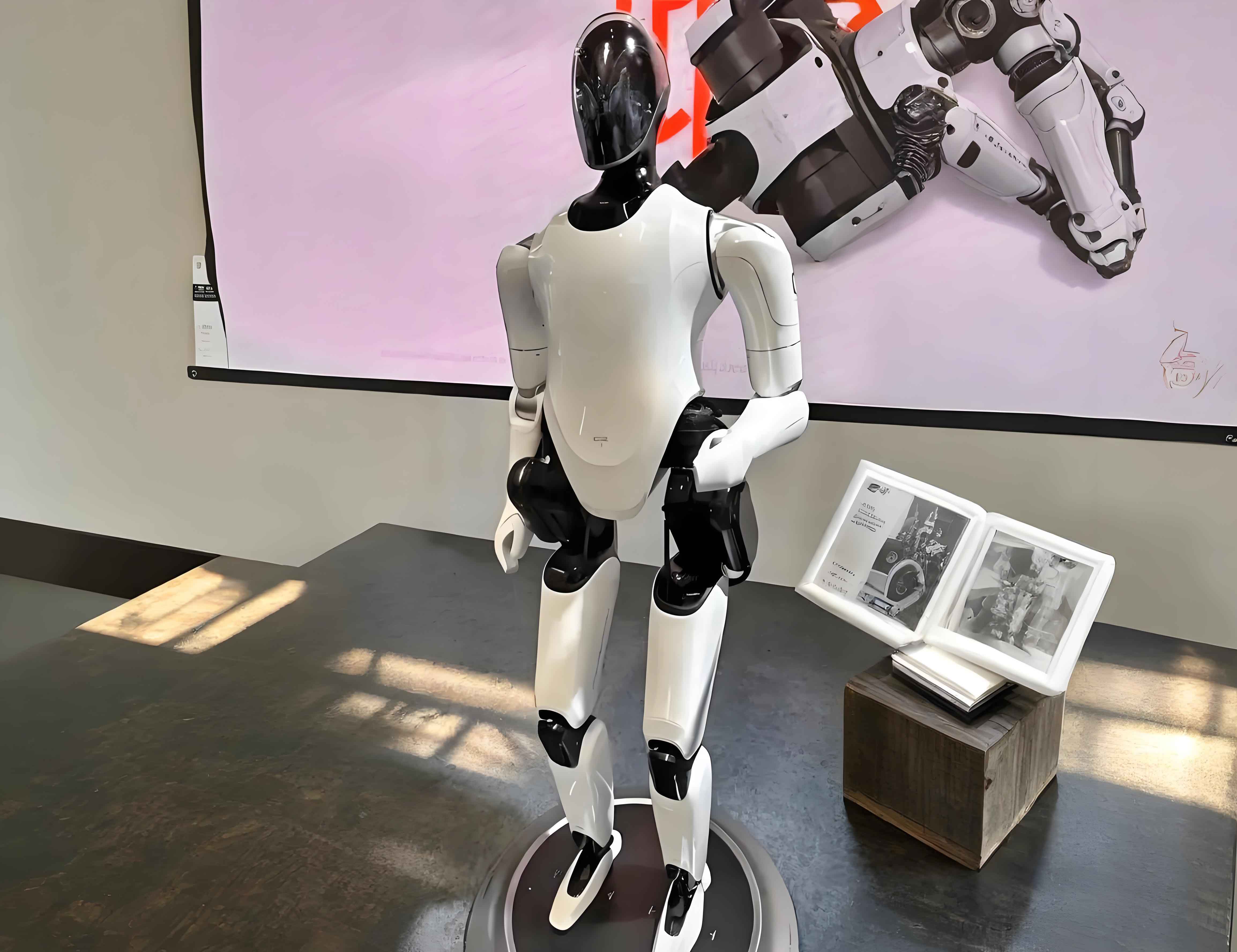
The technical architecture of an embodied AI robot can be analogized to the human body, comprising three core components: the brain, the cerebellum, and the body. Each plays a distinct role in enabling the embodied AI robot to perceive, reason, and act in dynamic environments. Below, I summarize this framework in a table to clarify the functions and technologies involved.
| Component | Function | Key Technologies | Mathematical Representation |
|---|---|---|---|
| Brain | High-level decision-making, perception, reasoning, and long-term memory; akin to cognitive processes. | Large language models (LLMs), vision-language models (VLMs), multimodal AI agents. | For a decision policy: $$ \pi(a|s) = \text{softmax}(f_{\theta}(s, a)) $$ where \( \pi \) is the policy, \( a \) is action, \( s \) is state, and \( f_{\theta} \) is a neural network with parameters \( \theta \). |
| Cerebellum | Motion control and action generation; translates brain commands into precise motor instructions. | Motion planning algorithms, feedback control systems, reinforcement learning. | Dynamics equation: $$ \tau = M(q)\ddot{q} + C(q,\dot{q})\dot{q} + g(q) $$ where \( \tau \) is torque, \( q \) is joint position, \( M \) is inertia matrix, \( C \) is Coriolis matrix, and \( g \) is gravitational force. |
| Body | Physical execution of actions; includes sensors, actuators, and structural parts for real-world interaction. | Motors, sensors (e.g., LiDAR, cameras), batteries, mechanical design. | Sensor model: $$ z = h(x) + \epsilon $$ where \( z \) is measurement, \( x \) is state, \( h \) is observation function, and \( \epsilon \) is noise. |
This integrated system allows the embodied AI robot to perform complex tasks. For instance, the brain might use a multimodal model to interpret a customer’s request, the cerebellum plans the trajectory, and the body executes movements like walking or grasping. The synergy between these components is crucial for the embodied AI robot to operate effectively in unstructured banking environments.
In the banking sector, the embodied AI robot offers promising applications both externally, in customer-facing roles, and internally, in back-office operations. Externally, at bank branches, the embodied AI robot can serve as an intelligent guide, handling tasks such as greeting customers, providing咨询查询, and assisting with transactions. For example, an embodied AI robot equipped with natural language processing can understand a client’s need to transfer funds, guide them to a self-service terminal, and even collaborate with the machine to complete the process—essentially acting as a “walking smart teller.” This enhances service efficiency and personalization. Internally, in vaults or cash management centers, the embodied AI robot can automate repetitive and labor-intensive tasks like cash handling, inventory counting, and item retrieval. Using quadruped or wheeled designs for stability, the embodied AI robot can navigate non-standard spaces, lift cash boxes, and perform fine manipulations as hardware advances. The flexibility of the embodied AI robot makes it suitable for diverse banking scenarios, from crowded lobbies to secure backrooms.
However, scaling the deployment of embodied AI robots in banking faces significant challenges. I categorize these into ethical, data, and technical dimensions, each with specific hurdles that must be overcome to ensure safe and effective integration.
Ethical challenges are particularly complex due to the physical presence of the embodied AI robot. Issues include decision-making accountability—if an embodied AI robot errs in financial advice, who is liable? Workforce displacement concerns arise as the embodied AI robot may replace human jobs, potentially affecting social stability. Additionally, human-robot relationship dynamics, such as trust and collaboration, need ethical guidelines. Data challenges stem from the scarcity of real-world robotic data in banking. Sensitive financial data is hard to access for training, and annotation is costly. Privacy risks are amplified; for instance, if an embodied AI robot’s data is poisoned, it could lead to erroneous transactions. Technical challenges involve both software and hardware limitations. Software-wise, multimodal perception in noisy bank environments remains imperfect; for example, speech recognition accuracy may drop. Hardware-wise, motion control precision and sensor reliability need improvement for the embodied AI robot to perform delicate tasks like handling documents or operating in long shifts.
To illustrate these challenges more concretely, I present a table summarizing the key issues and their implications for banking.
| Challenge Category | Specific Issues | Impact on Banking | Example Involving Embodied AI Robot |
|---|---|---|---|
| Ethical | Accountability, job displacement, human-robot interaction norms. | Legal risks, social backlash, operational conflicts. | An embodied AI robot mistakenly advises a high-risk investment, leading to client losses. |
| Data | Data scarcity, high annotation costs, privacy and security vulnerabilities. | Poor model performance, increased costs, compliance breaches. | Lack of diverse training data causes an embodied AI robot to fail in recognizing elderly clients’ gestures. |
| Technical | Multimodal perception errors, motion control inaccuracies, hardware durability issues. | Service interruptions, safety incidents, maintenance overhead. | An embodied AI robot slips while carrying cash in a vault due to unstable locomotion control. |
These challenges are interconnected; for instance, data limitations exacerbate technical performance issues, while ethical lapses can undermine trust in the embodied AI robot. Addressing them requires a holistic approach, which I outline in the following recommendations.
Based on my analysis, I propose strategic recommendations to foster the adoption of embodied AI robots in banking. These span ethical governance, data management, and technical innovation, aiming to create a conducive ecosystem for scaling embodied AI robot applications.
First, for ethical challenges, I recommend establishing robust regulatory frameworks. Financial authorities should collaborate with ethicists to draft guidelines specific to embodied AI robot use in banking, clarifying behavior standards and liability boundaries. Banks must integrate ethical reviews into development cycles, assessing risks like bias in AI decisions. Public education and feedback mechanisms can build trust; for example, banks can demystify the embodied AI robot through interactive sessions. Second, to tackle data challenges, I advocate for shared data platforms. Banks could pool anonymized interaction data from embodied AI robots via secure infrastructures, enriching datasets while preserving privacy. Techniques like data augmentation can generate synthetic samples; for instance, using generative models to create varied scenarios for training. Blockchain technology can enhance data security by ensuring immutable logs of the embodied AI robot’s actions. Third, on the technical front, I emphasize collaborative R&D. Banks should partner with academia to advance core technologies, such as improving the embodied AI robot’s perception algorithms. Hardware innovations, like better sensors and batteries, can be driven by banking needs. Continuous learning mechanisms should be embedded, allowing the embodied AI robot to adapt to new tasks; this can be modeled as an online learning problem: $$ \min_{\theta} \sum_{t=1}^{T} \ell(y_t, f_{\theta}(x_t)) + \lambda R(\theta) $$ where \( \ell \) is loss, \( \theta \) is model parameters, and \( R \) is regularization for stability.
To synthesize these recommendations, I provide a table mapping actions to expected outcomes for the embodied AI robot in banking.
| Recommendation Area | Proposed Actions | Expected Benefits for Embodied AI Robot |
|---|---|---|
| Ethical Governance | Develop industry guidelines, form ethics committees, conduct public outreach. | Reduced legal risks, enhanced public acceptance, smoother human-robot collaboration. |
| Data Management | Create shared data pools, employ data synthesis, implement blockchain for security. | Improved model accuracy, lower training costs, stronger data integrity for the embodied AI robot. |
| Technical Innovation | Foster bank-academia partnerships, invest in hardware R&D, deploy continuous learning systems. | Higher performance in perception and control, longer operational lifespan, adaptability of the embodied AI robot. |
Implementing these suggestions will require concerted effort from banks, regulators, and technology providers. As the embodied AI robot evolves, it can catalyze a shift toward more integrated, intelligent banking services.
In conclusion, the embodied AI robot holds immense potential to revolutionize banking by bridging digital and physical realms. From customer service to vault management, the embodied AI robot can enhance efficiency, safety, and accessibility. However, ethical dilemmas, data shortages, and technical bottlenecks pose substantial barriers. By adopting proactive governance, collaborative data strategies, and innovative technical solutions, the banking industry can harness the power of the embodied AI robot to drive digital transformation. Looking ahead, I envision embodied AI robots extending beyond branches into homes and public spaces, democratizing financial services and fostering a more connected economy. The journey will be iterative, but with careful planning, the embodied AI robot can become a cornerstone of future banking, embodying the synergy of intelligence and action.