
From my vantage point within the industry, a powerful synergy is propelling the field of embodied AI forward. On one side, strategic policy initiatives are creating fertile ground for innovation and infrastructure. On the other, the relentless, competitive drive of the market is channeling immense capital and talent into the space. This confluence has triggered an unprecedented influx, drawing in established tech giants, ambitious startups, and even curious players from seemingly unrelated sectors, all converging on the vision of creating intelligent machines that can physically interact with our world.
The numbers speak to this frenzy. Industry data indicates that by the third quarter of this year, the number of active robotics-related enterprises has approached the one million mark. In the first nine months alone, nearly 150,000 new companies were registered, representing a staggering year-over-year growth of approximately 65%. This isn’t just a niche interest; it’s a full-scale industrial movement.
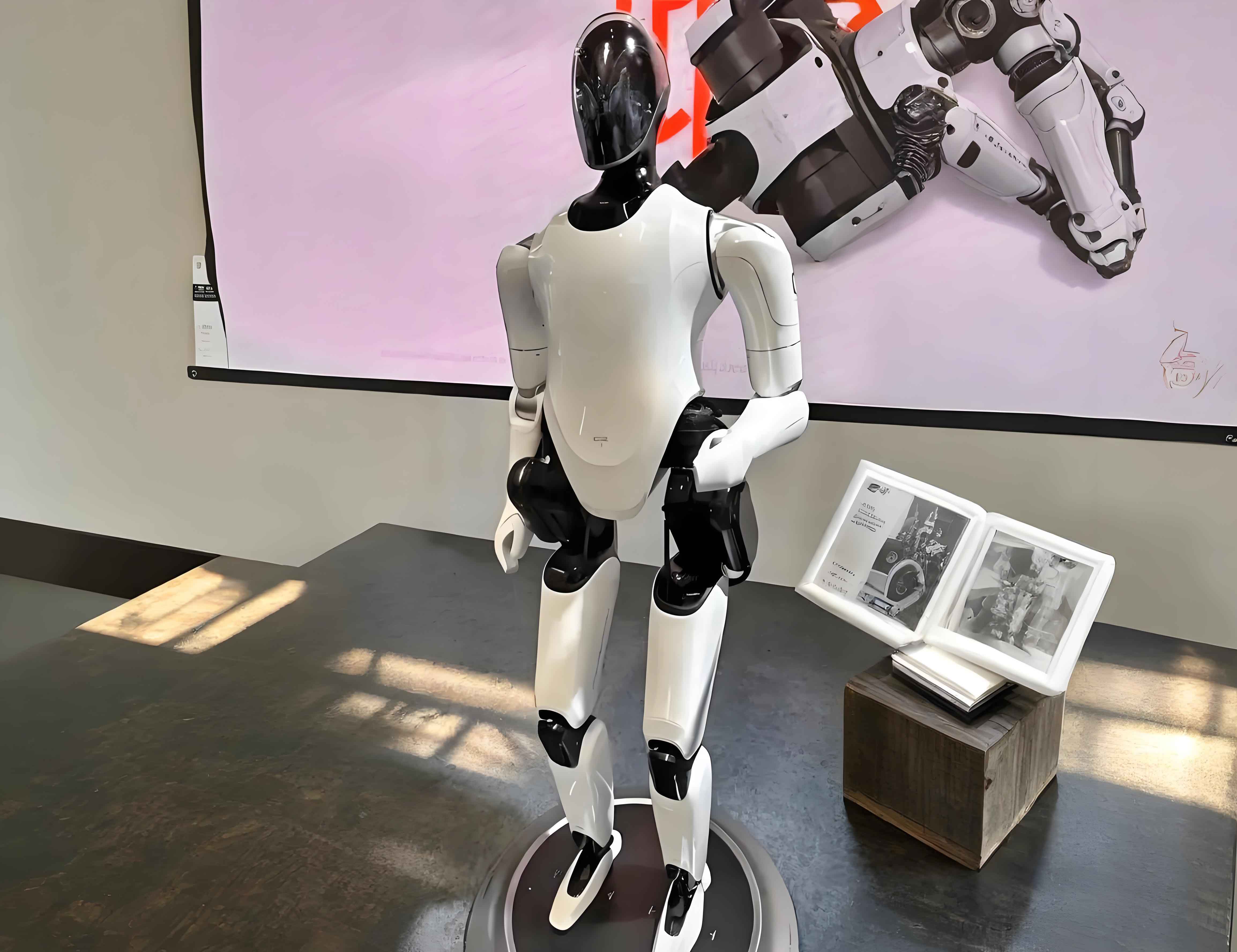
At its core, the development of a sophisticated embodied AI robot relies on four foundational pillars, each representing a complex segment of a vast and intricate supply chain:
- 本体 (Hardware Platform): The physical body—its structure, actuators, sensors, and power systems.
- 智能体 (Agent): The “mind”—the AI algorithms for perception, reasoning, planning, and control.
- 数据 (Data): The fuel for learning—massive datasets of physical interactions.
- 学习进化框架 (Learning & Evolution Framework): The methodology for continuous improvement and adaptation.
The interdependence of these pillars can be summarized by a fundamental relationship:
$$ \text{Competence of Embodied AI Robot} \propto \mathcal{F}( \text{Hardware Capability}, \text{Agent Intelligence}, \text{Data Quality & Quantity}, \text{Learning Efficiency} ) $$
Where $\mathcal{F}$ represents the complex, non-linear function that integrates these elements. This sprawling ecosystem implies that opportunities for innovation and commercialization are ubiquitous, yet so are the profound technical and commercial challenges that stand between the current state and a truly capable embodied AI robot.
The Elusive Mind: The Generalization Abyss
In my analysis, constructing a humanoid shell that can perform basic, pre-programmed movements for demonstration purposes is a manageable engineering task. The true Everest, the grand challenge, lies in crafting the “brain”—encompassing both the high-level cognitive “cerebrum” for reasoning and the low-level, reflexive “cerebellum” for fluid motor control.
While significant hurdles remain in hardware—such as dexterous end-effectors, high-power-density actuators, and advanced proprioceptive sensors—these are viewed as engineering puzzles with clear, albeit difficult, paths to incremental optimization and cost reduction. The trajectory for hardware is relatively charted. The same cannot be said for the intelligence that must animate it.
The most formidable obstacle, in my view, is achieving robust generalization. Just as the ultimate goal of AI is Artificial General Intelligence (AGI), the goal for an embodied AI robot is to possess skills that are general and transferable. Formally, generalization refers to the ability of an intelligent agent to successfully apply knowledge and skills learned in one set of contexts to novel, previously unseen contexts involving different objects, tasks, environments, or even alterations to its own physical form.
A simple illustration: training an embodied AI robot to grasp a specific cup in a lab is trivial. The challenge is for it to reliably grasp any cup, an apple, a raw egg, or a tool it has never encountered before, under varying lighting conditions and surface types. This capability is the defining line between a truly intelligent embodied AI robot and a pre-programmed automaton. We can frame the generalization problem as an optimization over a vast space of possible situations $S$:
$$ \text{Generalization Performance} = \mathbb{E}_{s \sim S_{\text{unseen}}} [P(\text{Success} | s, \theta)] $$
Here, $\theta$ represents the learned parameters of the embodied AI robot‘s model, and $S_{\text{unseen}}$ is the distribution of all possible novel scenarios. Maximizing this expectation is the core challenge.
Why is this so difficult today? The fundamental issue is the lack of a universally accepted, foundational technical architecture (“base model”) for embodied intelligence. The algorithmic landscape is fragmented and non-convergent. Academia and industry are exploring a plethora of competing directions—from end-to-end deep reinforcement learning and imitation learning to hybrid symbolic-sub-symbolic approaches and neuromorphic computing. There is no consensus on which path, if any, will ultimately prove scalable and effective. This divergence of opinion on the fundamental “brain” architecture creates uncertainty and slows collective progress. As one industry observer noted, nations with decades of humanoid research history have faced this same generalization wall, leading to pauses in public development, awaiting a foundational breakthrough.
The table below contrasts the current state with the desired state for key cognitive functions in an embodied AI robot:
| Cognitive Function | Current Typical Capability | Desired Generalized Capability |
|---|---|---|
| Object Manipulation | Precise picking of known objects in structured poses. | Grasping and manipulating novel objects of varied materials, shapes, and fragility in cluttered, dynamic environments. |
| Locomotion | Walking on flat, prepared surfaces. | Traversing complex terrains (stairs, rubble, slopes) and recovering from unexpected slips or pushes. |
| Task Planning | Executing a linear, pre-defined sequence of actions (e.g., “make coffee” as a single macro). | Composing novel action sequences from primitive skills to achieve a high-level goal (e.g., “tidy the room”), dealing with interruptions and failures. |
| Human-Robot Interaction | Responding to specific voice commands. | Understanding intent from natural language, gesture, and context, and engaging in collaborative tasks. |
The Data Famine: Starving Intelligent Bodies
The second colossal mountain to climb is the severe shortage of training data. An embodied AI robot learns from experience, much like a child, but currently, it exists in a state of being both underfed and lacking expert tutors. This paucity of high-quality experiential data is a primary bottleneck slowing the advancement of practical capabilities.
The success of large language models (LLMs) was predicated on the existence of the internet—a vast, pre-existing corpus of human knowledge in textual form. The “intelligence” that emerged was a product of scale. If we subscribe to a similar scaling hypothesis for embodied intelligence, then the requirement is for an astronomically large dataset of physical interactions. This leads me to believe that data service companies—entities that can efficiently collect, curate, label, and generate useful physical-world data—will become critically important nodes in the embodied AI robot value chain.
The data challenge for embodiment is orders of magnitude more complex than for language or even 2D vision. Consider the relatively constrained domain of autonomous driving, often seen as a subset of embodied AI. The data, while enormous, deals with a limited set of semantic actors (cars, pedestrians, signs) operating on a structured 2D plane (the road). Yet, the pipeline of data collection, sensor fusion, cleaning, and annotation remains notoriously expensive, even with advances in auto-labeling.
An embodied AI robot operating in a home or general factory requires data that is higher-dimensional, continuous, and dynamic. It needs to understand the physics of manipulation, the properties of countless materials, and the cause-and-effect of actions in a 3D space. Collecting this data from the real world using physical robots is excruciatingly slow, dangerous for the hardware, and prohibitively costly. The relationship between data volume, diversity, and model performance is often modeled as a power law:
$$ P \approx k \cdot D^{\alpha} $$
where $P$ is a performance metric, $D$ is the dataset size/diversity, $k$ is a constant related to model architecture, and $\alpha$ is a scaling exponent. For embodied tasks, $\alpha$ may be small, implying that massive increases in $D$ are needed for incremental gains in $P$, making the data hunger even more acute.
Simulation offers a tantalizing alternative for generating synthetic data at scale. However, it introduces the formidable “reality gap” or “sim-to-real” transfer problem. A model trained perfectly in a simulated environment often fails catastrophically in the real world due to unmodeled physics, sensor noise, and environmental randomness. While domain randomization and advanced rendering techniques help, bridging this gap completely remains a core research problem. The dilemma is captured in the following comparison:
| Data Source | Advantages | Disadvantages |
|---|---|---|
| Real-World Physical Collection | High fidelity, contains all real-world noise and complexity. | Extremely slow, expensive, risky to hardware, difficult to scale and control. |
| High-Fidelity Simulation | Fast, cheap, perfectly controllable, scalable, allows “supervised” exploration (e.g., of failure states). | Suffers from the reality gap; simulated physics and visuals are imperfect approximations. |
| Hybrid Approaches | Leverages scale of sim and grounding of real data; promising for transfer learning. | Complex pipeline; requires careful calibration and alignment between sim and real domains. |
Compounding the data challenge is the immense computational appetite. Training sophisticated models for an embodied AI robot requires cloud-based compute clusters rivaling those used for the largest LLMs. Furthermore, the “inference” or real-time decision-making must happen on the robot’s onboard computers (“edge” or “end-side”), which have severe constraints on power, size, and heat dissipation. Developing algorithms and hardware that are both powerful and efficient is a critical parallel battle.
The Capital Conundrum: Navigating the Gold Rush
Witnessing multiple technological waves over the years, I observe that the flood of capital into embodied AI is a double-edged sword. It will undoubtedly enable the rise of exceptional companies, but it also guarantees that the vast majority—perhaps ninety-nine percent—will become footnotes, the necessary “accompaniment runners” in a marathon where only a few cross the finish line. This environment demands clarity from both investors and founders: Do they possess the patience and financial stamina for a 5-10 year, or longer, journey? And do they have the acuity and agility to outmaneuver the crowd?
Within the broader sphere, humanoid robots have become the undisputed “star” track, attracting a disproportionate share of attention and investment. This, in my assessment, contains elements of irrationality. Two trends are noticeable: first, policy-driven capital is vigorously flowing into the sector, sometimes from regions lacking the requisite technical or industrial base, creating potential for misallocation. Second, the herd mentality is pushing excessive funds specifically toward bipedal humanoid forms, often at the expense of other, potentially more immediately viable embodied AI robot morphologies.
The current early-adopter market reveals a telling story. A significant portion of humanoid sales is to universities and research institutes for academic exploration. The next largest segments are government entities and state-owned enterprises for demonstration and reception purposes, followed by manufacturing companies. Interestingly, within the latter, a key customer—automotive companies—often deploys these robots not on the assembly line, but in showrooms as high-tech ambassadors to enhance brand image and provide novelty value. This is a rational use given the current limited functional capabilities of general-purpose humanoids.
The fixation on a humanoid form factor is, in many cases, premature. The essence of an embodied AI robot is its ability to perform physical tasks. The optimal morphology is dictated by the task and environment. A robot for warehouse picking might be a mobile arm on a wheeled base. A robot for inspecting narrow pipes might be serpentine. The critical factors are often the number, type, and dexterity of manipulators (arms/hands) and the mobility base. A key unsolved problem is “one-brain-to-many-body” transfer: an AI trained to control one physical platform cannot effortlessly transfer its control policy to a different platform, even for similar tasks. This lack of morphological generalization is a major impediment to flexible deployment.
An overabundance of capital inevitably attracts short-termism and distortion. The phenomenon that requires the greatest vigilance, in my opinion, is the “curated project” or “assembled venture.” These are startups constructed primarily for rapid fundraising, prioritizing investor narratives over substantive technological innovation or practical product-market fit. The playbook can involve assembling a team with impressive but potentially superficial pedigrees to inflate perceived R&D prowess, relying heavily on off-the-shelf supply chain solutions to quickly assemble a demonstrator product lacking core IP, and engaging in “half-sale, half-gift” transactions with prominent partners to artificially boost revenue metrics and market credibility.
Despite these challenges, there is genuine progress. Many believe that Chinese companies in the humanoid space are already operating within the global first tier. A crucial reminder for all stakeholders—policymakers, investors, industrial partners, and the public—is to respect the intrinsic timeline of technological development. We must avoid the temptation to “pull up seedlings to help them grow.” The field, in many respects, is still at a kindergarten level of capability; assuming it has reached university maturity is a recipe for disappointment and wasted resources. The realistic horizon for discussing truly disruptive, widespread impact across industries is likely 10-20 years. The most demanding applications, such as general-purpose humanoids in unstructured home environments, will likely be the last to mature, following a natural path of “water flowing and a channel forming.” The ultimate direction for the embodied AI robot must be genuine industrial empowerment and value creation, not spectacle.
Commercialization: The Strategy of “Laying Eggs Along the Journey”
The pressing question of commercial returns has a historical analogue. The path to profitability does not require a perfect, final-form product from day one. Much like the evolution of the mobile phone—from the bulky “brick phone” to the feature phone to the smartphone—commercialization can happen iteratively. Products can be fielded, generate revenue, provide invaluable real-world data, and fund the next cycle of R&D, in a virtuous feedback loop. This philosophy of “laying eggs along the journey” is why many pioneering embodied AI robot companies are deeply engaged in joint development projects with B2B clients.
Getting robots to “start work” on specific, often simplified, tasks in real environments is the fastest way to break the data deadlock and drive iterative improvement. Each deployment becomes a data collection node and a test of robustness. The commercial logic can be modeled as a reinforcement learning loop where profit ($R$) feeds back into better capabilities (Cap):
$$ \text{Cap}_{t+1} = \text{Cap}_t + \eta \cdot \Delta(\text{Data}_{\text{real}}, R_t) $$
$$ R_{t+1} = \mathcal{G}(\text{Cap}_{t+1}, \text{Market}) $$
Here, $\eta$ is an efficiency factor, $\Delta$ represents the improvement function from real data and reinvested profit, and $\mathcal{G}$ is the market reward function. This iterative cycle is essential for sustainable growth.
The future landscape of embodied intelligence will be richly diverse. The table below hypothesizes potential early commercialization pathways for different embodied AI robot forms, acknowledging that the “brain” may initially be specialized rather than general:
| Robot Morphology | Targeted Scenario | Key Value Proposition | Commercialization Horizon |
|---|---|---|---|
| Mobile Manipulators (Wheeled Base + Arm) | Logistics (sorting, loading), laboratory automation, retail inventory. | Combines mobility and simple manipulation in semi-structured spaces. Lower complexity than bipeds. | Near-term (0-5 years) |
| Specialized Stationary Arms | Precision assembly, high-speed picking, welding, dispensing. | Extreme precision and speed for repetitive tasks. Classical robotics expanding into AI-powered adaptability. | Ongoing, with AI enhancing flexibility |
| Quadruped or Multi-legged Robots | Industrial inspection (energy sites, construction), remote surveying, hazardous environment response. | Superior stability and mobility on rough, unstructured terrain inaccessible to wheeled platforms. | Mid-term (3-8 years) |
| Humanoid Robots (Bipedal) | Complex, multi-step service tasks in environments built for humans (e.g., elderly care assistance, advanced manufacturing line work). | Leverages existing human-centric infrastructure (stairs, tools, workspaces). The ultimate test of generalization. | Long-term (7-15+ years) |
In conclusion, the journey to create a truly intelligent and capable embodied AI robot is a monumental undertaking, fraught with technical deep valleys like generalization and data scarcity, and complicated by the tumultuous weather of capital markets. Success will require not just breakthrough algorithms and elegant hardware, but also strategic patience, a focus on incremental value creation, and a collaborative ecosystem that can generate and share the priceless resource of real-world experience. The mountain is high, but the collective climb is now emphatically underway.