
In the realm of modern industrial automation, the pursuit of fully autonomous “lights-out” factories has been a long-standing goal. However, traditional robotic systems often fall short when faced with tasks requiring dexterity, adaptability, and real-time interaction with unstructured environments. Operations such as cable plugging, optical module installation, or delicate part assembly remain significant “breakpoints” in production lines, reliant on human labor due to their need for force modulation and trajectory adaptation. This is where the paradigm of embodied AI robots comes into play. An embodied AI robot is not merely a machine with a physical form; it is an intelligent agent capable of active perception, autonomous learning, and decision-making through continuous interaction with its environment. In this article, I present a comprehensive framework for developing and deploying embodied AI robots in intelligent manufacturing, drawing from our extensive research and practical implementations. The core of our approach lies in integrating multimodal perception with a reinforcement learning “brain” within a high-frequency control loop, enabling these robots to perform anthropomorphic tasks with remarkable efficiency and reliability.
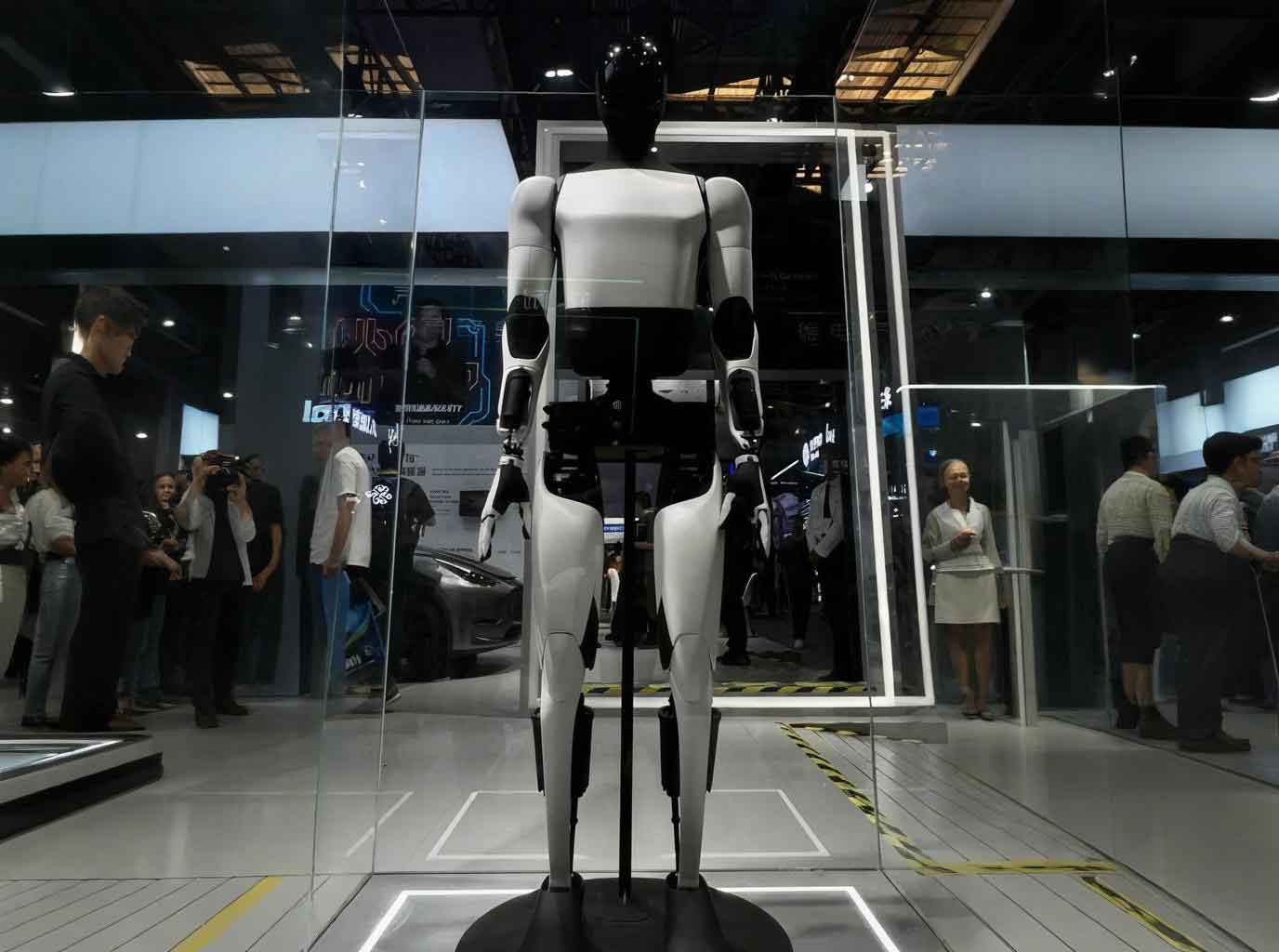
The fundamental challenge in creating an effective embodied AI robot is to establish a seamless “perception-action” feedback cycle. Unlike supervised learning methods that rely on passive datasets, embodied intelligence thrives on active exploration and interaction. This aligns perfectly with reinforcement learning (RL) principles, where an agent learns optimal policies by maximizing cumulative rewards from environmental feedback. Our system models the robot’s operation as a Partially Observable Markov Decision Process (POMDP), which we simplify into a Markov Decision Process (MDP) for practical implementation. The state space $$S$$ is constructed from a history of multimodal observations, including visual data from stereo cameras, spatial six-dimensional force/torque feedback, and proprioceptive robot state information. Formally, at time $$t$$, the state $$s_t$$ is defined as:
$$ s_t = \{o_t, o_{t-1}, o_{t-2}, \ldots\} $$
where $$o_t$$ represents the raw multimodal observation. The MDP is then characterized by the tuple $$(S, A, p, r, \gamma)$$. Here, $$A$$ is the action space of end-effector Cartesian increments, $$p = \Pr(s’_t | s_t, a_t)$$ is the state transition probability, $$r: S \times A \rightarrow \mathbb{R}$$ is the reward function, and $$\gamma \in [0,1]$$ is the discount factor. The objective is to find an optimal policy $$\pi(a_t | s_t)$$ that maximizes the expected discounted cumulative reward:
$$ J(\pi) = \max_{\pi} \mathbb{E} \left[ \sum_{t=1}^{\infty} \gamma^t r_t \mid a_t \sim \pi(\cdot | s_t), s’_t \sim p(\cdot | s_t, a_t), s_1 \sim p(\cdot) \right] $$
To achieve this, we employ model-free, off-policy RL algorithms for sample efficiency. Specifically, the Soft Actor-Critic (SAC) algorithm has proven highly effective in robotic control tasks due to its stability and ability to maximize entropy alongside reward. SAC maintains a policy network $$\pi_{\theta}(a_t | s_t)$$ and a Q-value network $$Q_{\phi}(s_t, a_t)$$, parameterized by $$\theta$$ and $$\phi$$, respectively. The policy outputs a Tanh-Gaussian distribution, with actions sampled as:
$$ a_t = \tanh(\mu_{\theta}(s_t) + \sigma_{\theta}(s_t) \epsilon), \quad \epsilon \sim \mathcal{N}(0,1) $$
where $$\mu_{\theta}$$ and $$\sigma_{\theta}$$ are the mean and standard deviation from the policy network. The temperature parameter $$\alpha$$ balances reward maximization and entropy. During training, we use a replay buffer to store transition tuples $$(s_t, a_t, r_t, s_{t+1})$$ collected by a behavior policy, enabling efficient off-policy learning. To enhance robustness and reduce the exploration space, we combine the RL output with a predefined model-based trajectory plan $$a_p$$. The final action $$a_u$$ is a weighted sum:
$$ a_u = (1 – \beta) a_p + \beta a_t, \quad \beta \in [0,1] $$
where $$\beta$$ is a tunable parameter. This hybrid approach allows the embodied AI robot to leverage prior knowledge while adapting to novel situations through learning.
The perception system of an embodied AI robot is crucial for understanding complex environments. We design a multimodal perception neural network that processes high-dimensional visual data and low-dimensional proprioceptive and force data in parallel. The input consists of three streams: stereo vision images, end-effector six-dimensional force/torque readings, and robot proprioceptive state (joint angles, velocities). These are stacked over a temporal window of 8 frames to capture dynamics. The network architecture is summarized in the table below:
| Modality | Input Shape | Processing Network | Output Feature Dimension |
|---|---|---|---|
| Stereo Vision | 84×84×3 (8 frames) | 4-layer CNN + MLP | 50 |
| Force/Torque | 6×8 (8 frames) | 4-layer Causal ConvNet (pre-trained autoencoder) | 12 |
| Proprioceptive State | 7×8 (8 frames) | 5-layer Causal ConvNet (pre-trained autoencoder) | 12 |
The visual encoder uses convolutional neural networks (CNNs) with data augmentation (e.g., random shifts) to improve generalization, as inspired by DrQ algorithms. For force and proprioceptive data, we employ causal convolutional networks that respect temporal order, pre-trained as autoencoders to extract compact features. All feature vectors are concatenated into a unified multimodal representation, which serves as the input state $$s_t$$ to the SAC policy and Q-networks. This design enables the embodied AI robot to fuse diverse sensory inputs for informed decision-making.
The control system translates the policy’s low-frequency actions (20 Hz) into high-frequency robot commands (1 kHz). We implement an impedance-based PID controller that operates in the task space. Given the current end-effector position $$x_t$$ and the action $$a_t$$ (Cartesian increment), the desired position $$P_d$$ is computed. The controller then generates joint torques $$\tau_u$$ at 1 ms intervals using linear interpolation and impedance law:
$$ \tau_u = J^T(q) \Lambda \left[ P_d – K_p(X – X_d) – K_v(V – V_d) \right] $$
where $$J(q)$$ is the robot Jacobian matrix, $$\Lambda$$ is the inertia matrix, $$X$$ and $$V$$ are the current end-effector position and velocity, $$X_d$$ and $$V_d$$ are the desired trajectories, and $$K_p$$ and $$K_v$$ are adjustable stiffness and damping coefficients. This impedance control allows the embodied AI robot to maintain compliant contact during insertion tasks, mimicking human-like force modulation.
To validate our framework, we conducted extensive simulations and real-world deployments. The task focused on automated plugging of RJ45 connectors and optical modules for 5G small station production—a classic “breakpoint” in assembly lines. In simulation, we used a Franka Emika robot with realistic physics models. The reward function was carefully designed to guide learning:
$$ r(s) = \begin{cases}
\lambda_1 (c_a – l_x), & \text{if } l_x \geq d \\
\lambda_2 (c_b – l_x), & \text{if } l_x < d \text{ and force threshold exceeded} \\
200, & \text{if insertion success detected by YOLO}
\end{cases} $$
Here, $$(l_x, l_y, l_z)$$ is the relative pose of the plug to the target in tool coordinates, $$d$$ is the socket depth, $$c_a, c_b$$ are constants, and $$\lambda_1, \lambda_2$$ are scaling factors. A separate YOLO object detection network was pre-trained to recognize successful insertions from camera images. We trained the SAC agent for 500 epochs (2,500 steps per epoch) with a batch size of 128 and Adam optimizer. The results, averaged over 10 random seeds, showed consistent convergence and high success rates, as illustrated in the training curves below:
| Training Metric | Value at Convergence |
|---|---|
| Average Return per Episode | ~180 |
| Average Q-Value | ~75 |
| Success Rate (Simulation) | 98.5% |
In real production environments, we deployed the embodied AI robot system in a 5G smart manufacturing workshop. The setup included two collaborative robots: one for plugging operations (Franka robot with wrist-mounted stereo camera and force sensor) and another for part handling. The system integrated with PLCs, conveyors, and AGVs for full automation. To ensure real-time performance, we used a Linux RT-patched OS and UDP communication with strict latency requirements (<300 μs RTT). The embodied AI robot learned to perform plugging tasks reliably within two days of online training. By adjusting $$\beta$$, we balanced model-based planning and RL adaptation: $$\beta = 0$$ for free-space motion and $$\beta \approx 0.7$$ during contact-rich phases. This hybrid strategy achieved a production success rate of over 97% in batch operations, effectively eliminating the manual breakpoint.
The advantages of embodied AI robots over traditional automation are multifaceted. Firstly, their ability to learn from interaction reduces the need for extensive programming or precise environmental modeling. Secondly, multimodal perception enables robustness to uncertainties like part tolerances or lighting changes. Thirdly, the reinforcement learning framework allows continuous improvement through data. However, challenges remain, such as sample efficiency in real-world training and safety guarantees. Future work will explore sim-to-real transfer techniques, hierarchical RL for complex tasks, and integration with large language models for intuitive human-robot collaboration. The table below compares our embodied AI robot approach with conventional methods:
| Aspect | Traditional Industrial Robots | Embodied AI Robots |
|---|---|---|
| Programming | Hard-coded trajectories | Autonomous policy learning |
| Perception | Often limited to vision-guided servoing | Multimodal (vision, force, proprioception) |
| Adaptability | Low; requires re-programming for changes | High; adapts via interaction and RL |
| Task Complexity | Structured, repetitive tasks | Unstructured, dexterous tasks (e.g., plugging) |
| Deployment Time | Weeks to months for integration | Days to weeks with learning |
From a theoretical perspective, the success of embodied AI robots hinges on several mathematical principles. The MDP formulation ensures Markovian property for decision-making, while the Bellman optimality equation drives RL convergence:
$$ Q^*(s, a) = \mathbb{E} \left[ r(s, a) + \gamma \max_{a’} Q^*(s’, a’) \right] $$
In SAC, the policy optimization incorporates entropy regularization:
$$ \pi^* = \arg \max_{\pi} \mathbb{E} \left[ \sum_t \gamma^t \big( r(s_t, a_t) + \alpha \mathcal{H}(\pi(\cdot | s_t)) \big) \right] $$
where $$\mathcal{H}$$ is the entropy. For multimodal fusion, we can view the state representation as an embedding function $$f: \mathcal{O} \rightarrow \mathbb{R}^d$$ that minimizes reconstruction loss in autoencoders and task loss in RL. The controller dynamics can be analyzed through impedance models, where the closed-loop behavior is governed by:
$$ M \ddot{x} + B \dot{x} + K x = F_{\text{ext}} $$
with $$M$$, $$B$$, $$K$$ as mass, damping, and stiffness matrices, and $$F_{\text{ext}}$$ as external forces. This allows the embodied AI robot to interact safely with environments.
In conclusion, embodied AI robots represent a transformative technology for intelligent manufacturing. By combining reinforcement learning with multimodal perception and compliant control, they bridge the gap between rigid automation and human-like dexterity. Our practical deployments demonstrate that these robots can reliably automate delicate assembly tasks, paving the way for fully autonomous factories. As research advances, we anticipate embodied AI robots will become more pervasive, not only in manufacturing but also in healthcare, logistics, and domestic services. The key to their evolution lies in scalable learning algorithms, robust sensor integration, and ethical frameworks for human-robot coexistence. Ultimately, the journey of creating truly intelligent machines is intertwined with our understanding of embodiment itself—where perception, action, and cognition converge to create adaptive, resilient systems.