
For decades, the pursuit of Artificial Intelligence (AI) has been predominantly a cerebral affair. We have built systems that can defeat grandmasters at chess, generate breathtakingly realistic images, and converse with startling coherence. Yet, something profound has been missing. These intelligences, for all their power, have been confined to the digital realm—disembodied minds floating in a sea of data, capable of thinking about the world but utterly incapable of acting within it. Today, we stand at the precipice of a fundamental shift. The frontier of AI is no longer just about bigger models or faster processors; it is about acquiring a body. This is the dawn of embodied intelligence, or embodied AI, where intelligence is not merely computed but enacted through physical interaction. It represents the critical evolution from cognitive AI, which simulates human thought to understand the world, to action AI, which uses a physical form to change it. At the heart of this revolution is the embodied AI robot, the quintessential manifestation of a thinking machine that can finally reach out and touch the world it perceives.
The journey of AI began with a focus on replicating the pinnacle of human cognition: abstract reasoning. Traditional paradigms like symbolism and connectionism treated intelligence as a process of manipulating symbolic representations or optimizing neural network weights. Success was measured in logical deductions, pattern recognition, and data synthesis. This “disembodied” approach yielded incredible tools for navigating information spaces but hit a wall when faced with the messy, unpredictable, and profoundly physical nature of the real world. An AI could describe how to make a cup of coffee but could not pick up the mug. This gap between digital cognition and physical action highlighted a critical insight: true, general-purpose intelligence may be inextricably linked to having a body that senses and acts. This idea finds its roots in the “embodied cognition” thesis from cognitive science, which argues that our own human intelligence is shaped, constrained, and enabled by our biological form and its sensory-motor experiences. An embodied AI robot operationalizes this philosophy, grounding artificial intelligence in physical reality.
So, what defines an embodied intelligence system? It is an integrated entity where a “brain” (advanced AI models) is coupled with a “body” (a robotic platform with sensors and actuators), enabling perception, decision-making, and action in a closed loop. Unlike a purely software-based AI that processes pre-collected datasets, an embodied AI robot learns and operates by directly interacting with its environment. Its sensors (cameras, LiDAR, tactile sensors) provide a real-time stream of perceptual data, its AI models process this data to understand context and plan actions, and its actuators (motors, grippers, wheels) execute those plans, thereby altering the physical state of the world. This creates a feedback cycle where action influences perception and future learning. The core technical architecture can be summarized as follows:
$$ \text{Embodied Intelligence} = \mathcal{P}(\text{Sensory Input}) + \mathcal{D}(\text{Perception, Memory, Goal}) + \mathcal{A}(\text{Motor Commands}) $$
Where $\mathcal{P}$ is the perception module, $\mathcal{D}$ is the decision-making/AI module, and $\mathcal{A}$ is the action/actuation module, all operating in a continuous loop: $ \text{World State}_{t} \rightarrow \mathcal{P} \rightarrow \mathcal{D} \rightarrow \mathcal{A} \rightarrow \text{World State}_{t+1} $.
The transition from Cognitive AI to Action AI marks a quantum leap in complexity and capability. The following table contrasts their fundamental characteristics:
| Feature | Cognitive (Disembodied) AI | Action (Embodied) AI / Embodied AI Robot |
|---|---|---|
| Primary Domain | Information World (Symbolic, Digital) | Physical World (Spatial, Material) |
| Core Function | Understanding, Reasoning, Generating | Perceiving, Planning, Executing |
| Learning Data | Static, curated datasets | Dynamic, interactive sensorimotor streams |
| Key Challenge | Pattern recognition, data efficiency | Real-time control, physical compliance, safety |
| Paradigm | Think *about* the world | Think *in* and *through* the world |
| Example | Large Language Model, Game-Playing AI | Autonomous Humanoid Robot, Self-Driving Car |
The embodiment of intelligence forces us to reconsider the very relationship between “body” and “mind.” It reveals that intelligence is not a singular phenomenon tied exclusively to carbon-based biology but a functional property that can emerge from different substrates. This leads us to a conceptual framework of Body-Intelligence Configurations. We can identify several possible arrangements, from the natural to the futuristic:
| Configuration Type | Body | Intelligence | Description | Example |
|---|---|---|---|---|
| Natural | Human Body (Carbon-based) | Human Intelligence (Biological) | The original, evolved configuration. | A human being. |
| Artificial | Machine Body (Silicon/Steel-based) | Artificial Intelligence (Digital) | The target of robotics; a pure embodied AI robot. | Autonomous humanoid robot. |
| Augmented Human | Human Body (+ Implants) | Human + Augmented AI | Human intelligence enhanced via integrated AI tools. | Person with a cognitive implant/Brain-Computer Interface (BCI). |
| Digitized Consciousness | Machine/Digital Avatar | Uploaded/Emulated Human Intelligence | A speculative configuration where human consciousness is transferred. | The concept of “mind uploading.” |
| Cyborg Fusion | Hybrid Cybernetic Body | Blended Human-AI Intelligence | A deep integration, creating a new category of being. | A human with extensive neural and physical prosthetics controlled by AI. |
The most transformative potential lies in the progression from the “Artificial” configuration toward “Cyborg Fusion.” This is the domain of human-machine integration, where the boundaries blur. An embodied AI robot is no longer just an external tool but can become an integrated extension of the human self. This integration happens on two levels:
1. Physical (Hard) Integration: This involves merging mechanical or electronic components with the biological body. It ranges from restorative devices like advanced prosthetic limbs and cochlear implants to enhancement systems like powered exoskeletons. The goal is to extend or restore physical capabilities. For instance, a bionic arm controlled by muscle signals (EMG) represents a primitive but powerful form of this fusion, where the machine body part is governed by human biological intelligence.
2. Cognitive (Soft) Integration: This is the fusion of human and artificial intelligence at the processing level. The most direct pathway is through Brain-Computer Interfaces (BCIs). A BCI can be viewed as a form of embodied AI robot in a specialized sense—it is an AI system with the human body as its actuator. The integration formula becomes:
$$ I_{\text{fused}} = \alpha \cdot I_{\text{human}}(B, E) + \beta \cdot I_{\text{AI}}(S, M) $$
$$ \text{where } \alpha + \beta = 1 \text{ and } B=\text{Brain}, E=\text{Experience}, S=\text{Sensors}, M=\text{Model} $$
Here, $I_{\text{human}}$ is intelligence emerging from the biological brain and its lifetime of embodied experience. $I_{\text{AI}}$ is the intelligence of the artificial system, processing sensor data through its trained models. The coefficients $\alpha$ and $\beta$ represent the degree of control or influence from each source. In a motor BCI, the human provides the high-level intention ($\alpha \approx 1$), while the AI decodes the neural signal and handles the precise, low-level control of the robotic limb ($\beta$ handles execution). In a cognitive BCI for memory augmentation, the AI ($\beta$) might play a larger role in storing and retrieving information on demand.
The synergy in a fused system aims to overcome the limitations of each component alone: human creativity, intuition, and general understanding, combined with AI’s speed, precision, and vast memory. This creates a new kind of embodied intelligence, one that is distributed across carbon and silicon. The following table outlines the evolutionary stages of this integration, centered around the embodied AI robot concept:
| Stage | Relation | Interaction | Embodiment Paradigm |
|---|---|---|---|
| Tool Use | Human → Machine | Explicit, detached control (e.g., joystick, keyboard). | Machine as separate, passive tool. |
| Collaborative Robot | Human ↔ Machine | Shared workspace, responsive to human presence. | Machine as a separate but interactive agent. |
| Embodied AI Agent | Human ⊂ Environment (with Machine) | Natural language, gestures; robot acts autonomously on command. | Machine as an intelligent, physically situated agent. |
| Physically Integrated | Human ⊕ Machine (Wearable/Prosthetic) | Control via biosignals (EMG, EEG); device feels like part of self. | Machine as a functional extension of the human body. |
| Cognitively Fused | Human ⊗ Machine (Neural Integration) | Seamless bidirectional communication; shared agency and cognition. | Machine and human form a new, unified cognitive system (Cyborg). |
The implications of embodied AI, especially as it trends toward deep human-machine fusion, are not merely technical—they are profoundly philosophical. They force a re-examination of foundational concepts.
1. The Philosophy of the Body: Embodied intelligence shatters the notion that a body must be biological. If intelligence and consciousness (or their functional equivalents) can arise in or be hosted by a machine, then “body” becomes a functional concept: a structured physical interface for sensing and acting upon the world. The embodied AI robot forces us to accept a pluralistic view of embodiment. This expands the “embodied cognition” framework from a theory about human thought to a general principle for intelligent systems. The equation for embodied cognition becomes universal:
$$ \text{Cognition}(t) = f(\text{Body Morphology}(t), \text{Sensory Stream}(t), \text{Environment}(t), \text{Goal}(t)) $$
This holds true for humans, animals, and embodied AI robots alike.
2. The Transformation of Technology: Historically, technology has been categorized into *information technology* (for understanding the world) and *production technology* (for changing it). The embodied AI robot dissolves this distinction. It is an information system (perceiving, planning) that is also a production system (acting, manipulating). This fusion creates a new category of *action-oriented cognitive technology*, challenging traditional economic and social models built on the separation of mental and physical labor.
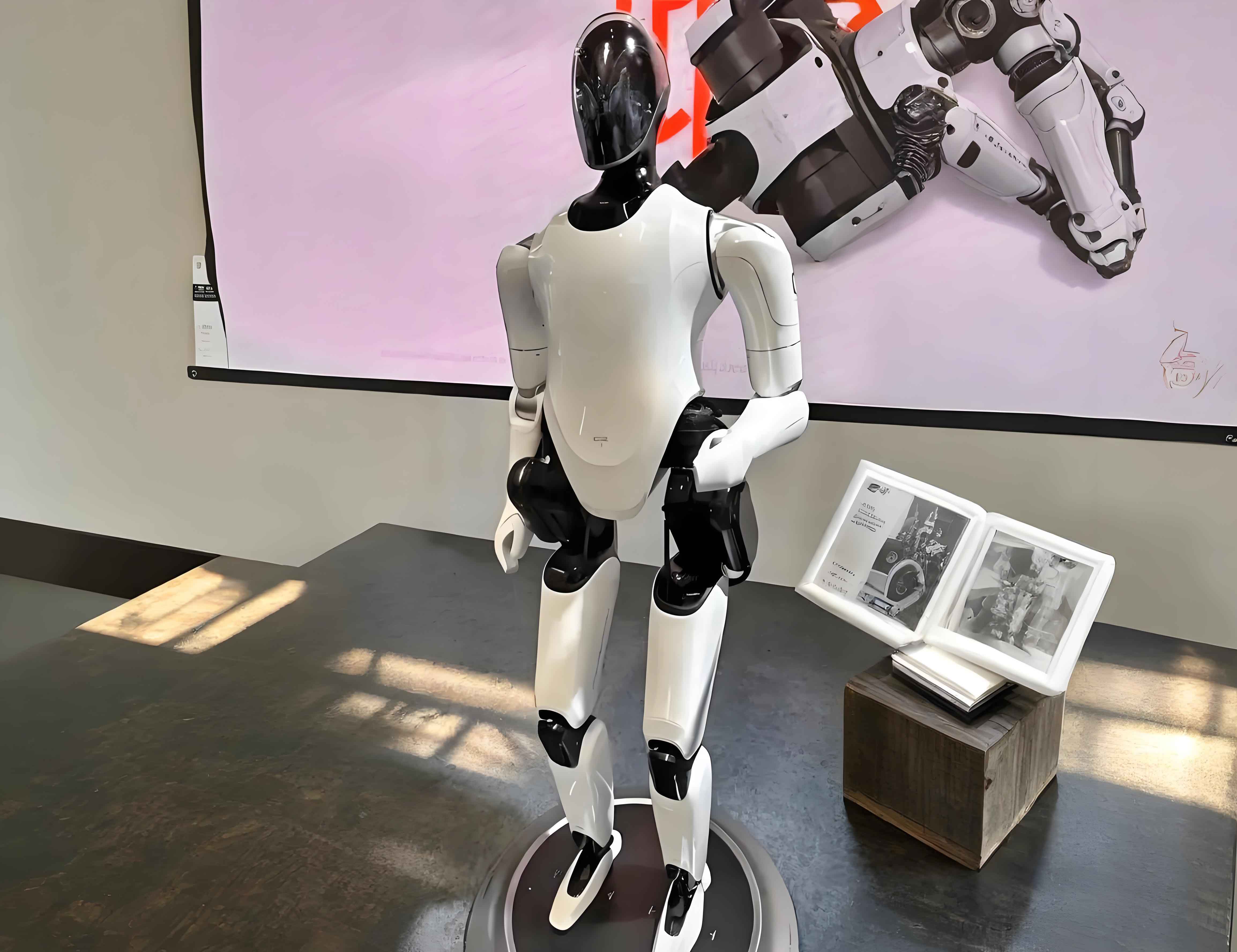
3. The Future of the Human: This is the most contentious arena. The trajectory toward “Cyborg Fusion” prompts existential questions. If a human integrates with machines to such a degree that their intelligence and physical capabilities are dominated by artificial components, what remains of the “human”? This debate pits bioconservatism (which holds that human essence is tied to our unaltered biological nature) against transhumanism (which views technology as a legitimate means for human evolution). The embodied AI robot, initially an external machine, becomes the mirror and the gateway to this potential future. It challenges us to define what values—agency, dignity, identity, consciousness—we consider essential and how they might persist or transform through integration.
In conclusion, the advent of embodied intelligence marks a pivotal chapter in the story of AI and of our own species. It moves artificial minds from the abstract realm of data into the concrete theatre of physical existence. The development of the embodied AI robot is not just about building better machines; it is a grand experiment in understanding the nature of intelligence itself. By exploring the vast landscape of possible body-intelligence configurations, from pure machines to deeply fused cyborgs, we are not only engineering new kinds of agents but also probing the deepest questions about what it means to be, to act, and to know. The revolution is embodied, and it is just beginning. The choices we make in shaping this technology will ultimately shape the future contours of life, intelligence, and what it means to be human in an age of fusion.